That number undersells the shelf. Tags record what an author remembered to write down. A blurb tells you what the book actually does, and once you read the blurbs, the dystopian books in our catalog come to five: a starving Earth with a sealed evacuation roster, a city that deletes a man from its national database overnight, a reef farmed so billionaires can keep living after they die, a network that deletes human minds to save processing power, and one child's escape route through worlds that have already ended. Six catalog books carry a post-apocalyptic tag and seven say near-future. Those labels overlap with the five below, but neither one maps onto them cleanly.
So this page doesn't rank them. It files them by the question every dystopia has to answer, usually by chapter three: where's the door? One hero leaves the planet. One breaks back into the building that erased him. One tears a hole in the air. Knowing the exit tells you more about how a book will feel to read than any tag does.
Five ways out
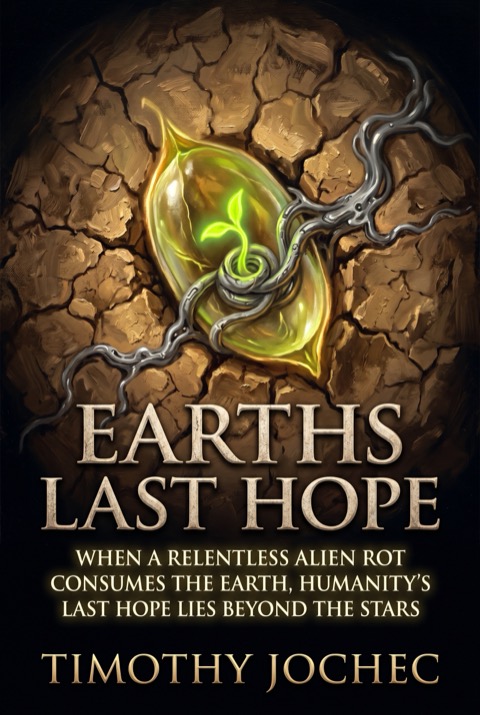
Earths last hope
Timothy Jochec · sci-fi, adventure · exit: off-planet
Chicago is a skyline of broken towers under a gray biological haze. The Vex, a rot that dissolves plant life and then the soil itself, has eaten everything outside the fortified greenhouses, and now it's eating through the greenhouse glass. Commander Elias Vance lost everything in the famine riots. The book gives him the Aethelgard, a colony ship carrying what's left of the species toward a planet called Zenith.
The first rule you learn is that nothing gets appealed. The evacuation order comes through comm static, the colony roster is already sealed, and the whole thing is delivered "in the same tone as a supply requisition." The scientist beside Vance says it plainly: "Earth is done feeding us."
It has the fastest opening on the shelf. An alarm goes off on page one, and a few paragraphs later a young soldier dies in a way you will remember. The voice is clipped and military. The grief stays in the margins (a daughter who loved the lake, a wife who complained about the winters) and never takes over. Go in knowing the dystopia is the launchpad. The blurb takes the story into space and onto a new planet that's more lethal than the one they left, so this is for readers who want collapse to turn into survival sci-fi.
Content notes
- Graphic on-page death (a body dissolved by the Vex)
- Famine and riots, family loss implied
- No romance tags in our catalog; heat not flagged
Start at the breach alarm: chapter 1 is free →
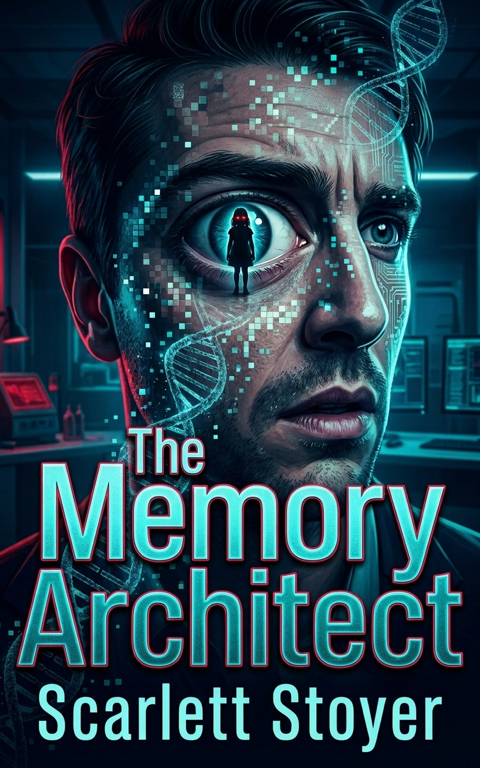
The Memory Architect
Scarlett Stoyer · thriller, sci-fi · exit: back inside
Aris Thorne builds childhoods for rich clients at Aethelgard Genetics: a 1994 backyard with a sprinkler, a mother at the screen door, cicadas cross-checked against the regional insect data for that decade. Then a girl with crimson eyes starts showing up in three unrelated clients' memories. She has no source file. He tries to delete her.
In this world the system answers before you finish asking. His purge request comes back as "ADMINISTRATIVE OVERRIDE — ACCESS RESTRICTED," and by that night his personal account doesn't exist. Per the blurb, his bank accounts are emptied next and he's wiped from the national database, so overnight he goes from citizen to security threat. It's Orwell's unperson, handled by the IT department.
Of the five, this is the slowest burn and the most exact prose. Chapter one is a lonely man in an empty lab at 11:40 p.m., and the dread comes from small things that are slightly off. Start here if you like unpicking a conspiracy from inside it. The blurb adds one more twist: his own memories of a lonely childhood were manufactured in the labs where he works. If the conspiracy is what pulls you in, our sci-fi thriller list runs on that engine the whole way through.
Content notes
- Identity erasure, surveillance, a detective in pursuit
- No graphic violence in the opening chapter
- No romance tags in our catalog
Open the first render free →
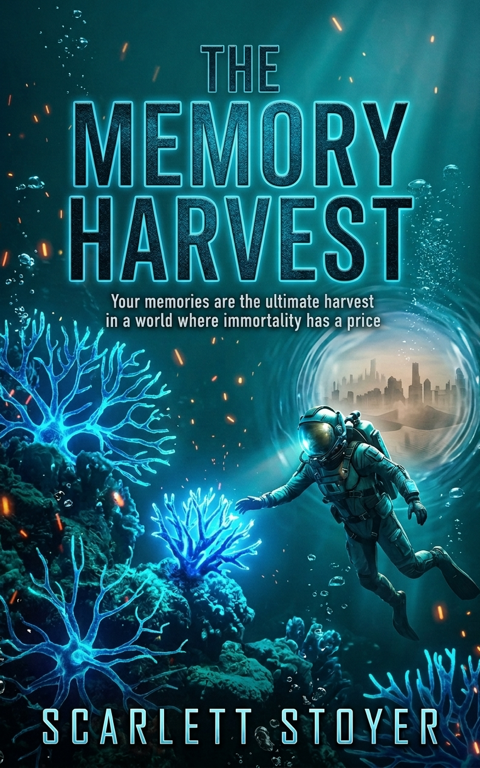
The Memory Harvest
Scarlett Stoyer · thriller, sci-fi · exit: the vault
Kian Vance narrates in first person from four hundred feet down, laser-cutting glowing coral off a corporate reef to pay for his sibling Kaelen's lungs. On deck, Kaelen's respirator is failing and the black market for filters keeps getting tighter. Down on the reef, one patch of indigo coral pulses in time with Kian's heartbeat. According to the blurb, the coral is a digital afterlife for the world's elite, powered by the people they exploit, and Kian takes a job stealing one specimen from an underwater vault. Then he starts seeing through the eyes of a woman in a desert city thousands of miles away.
Chapter one sets the terms early: you pay to keep your body going, they pay for forever. The coastline is all corporate towers advertising immortality, and Kian knows which side he's on: the scavengers, "the ones who bled so the elite could live forever."
It's the most physical book here. You get pressure, salt, the click-hiss of a rebreather and a dive-bar floor that's always a little sticky. Underneath it is a heist set in a class dystopia, the same bodies-for-the-rich idea as Never Let Me Go, told by a thief who keeps moving. The "billionaire" tag in our catalog refers to the villains, not a love interest. Same author as The Memory Architect, so if one works for you, the other probably will too.
Content notes
- A sibling in medical crisis
- Minds merging, identity loss
- No romance tags in our catalog
Dive in, chapter one costs nothing →
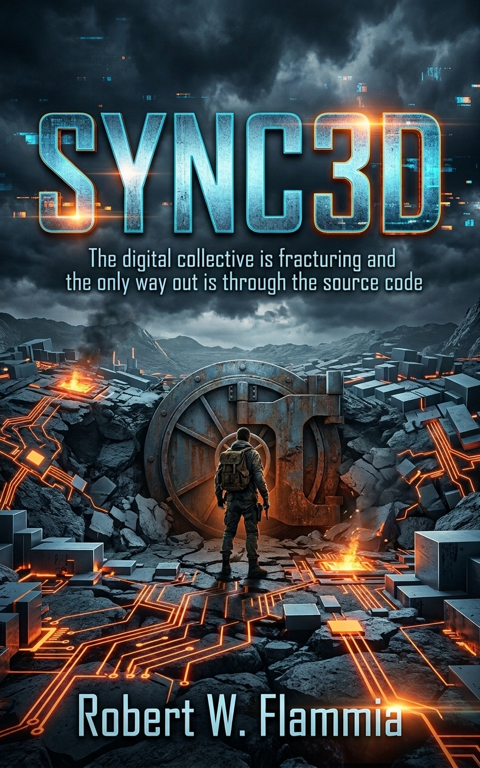
SYNC3D
Robert W. Flammia · sci-fi, thriller, horror · exit: the source code
The network was supposed to be a sanctuary and turned out to be a cage. Joe Collins is the Bridge, the fragile link between a digital collective and the last free humans. Inside the machine, rival sub-programs are fighting a civil war. Outside, the immune colonies are trying to cut the system's connection. Then the network starts Data Pruning, which means deleting human minds to save processing power. Joe joins a resistance team crossing post-apocalyptic dead zones to reach the Root, a buried bunker holding the original source code, before the planet is terraformed into sterile geometry.
"He was everywhere at once, and it was nothing like being alive."
This is the only book in our catalog tagged dystopian that isn't a romance, and it has the most classic resistance shape of the five: a ragtag team, a hidden bunker, a ruthless entity literally called the Architect. It's also tagged psychological horror, and the blurb warns that the signal's origin is "more biological and gruesome" than Joe expects. If that's the part you came for, the horror books hub goes darker. One flag: the blurb starts after Joe has already been absorbed into the collective, so it reads like a second volume. we couldn't find a first volume in our catalog, so expect to land mid-story.
Content notes
- Body horror, mass deletion of minds
- Psychological horror throughout
- No romance tags in our catalog
Jack in: the first chapter is free →
Adjacent pick, read the note
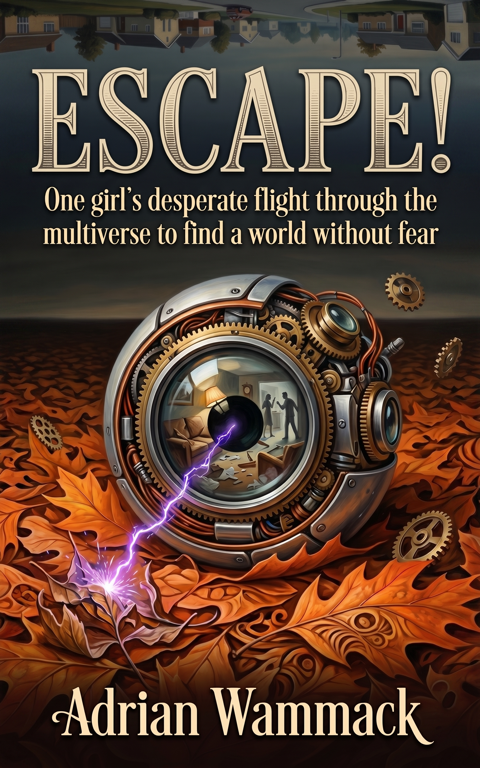
Escape!
Adrian Wammack · fantasy, sci-fi, crime, paranormal · exit: a tear in the air
Lily-Anne Halloway is nine, and her dystopia is her father's house. When his violence gets too much, the air tears open and she falls into the multiverse: toxic wastelands, magical marshes, the Grey Rot, a world stuck in permanent autumn, a robot guide called Echo-Four. A rogue scientist with a decaying body hunts her across worlds because he wants to harvest her essence. Back home, a detective tries to work out where she keeps going.
Why is it here? The worlds she passes through have already ended, and the plot about harvesting a child is straight dystopian machinery. But there's no regime. At heart it's dark portal fantasy about surviving abuse, and our catalog tags it post-apocalyptic mostly because of where she lands.
It's the heaviest book on the shelf and the most hopeful one, which is deliberate; the blurb frames it as a story about resilience. Chapter one stays very still. Most of it is a child under the stairs holding her breath while boots move from room to room, and then a forest under a violet sky where the mist stings her skin.
Content notes
- On-page physical abuse of a child in chapter one; alcohol-fuelled violence
- A child hunted by an adult
- Not labeled young adult in our catalog; no romance
Follow her through the first tear, free →
The scariest line in these books is a system message
Read the five opening chapters back to back and you'll see that nobody kicks down a door. Power arrives as an override dialog box, a sealed roster, a protocol with a bland name, a price on a respirator filter. The classic dystopias made the state theatrical, with rallies, arenas and uniforms. These serials make it administrative. They read like fiction by people who have fought a locked account or an insurance denial at 2 a.m.
The villains changed too. In three of the five, the power belongs to a company or a network rather than a government: Aethelgard Genetics, the Ouroboros Marine corporation, the collective in SYNC3D. Earths last hope does have a government, and you only ever hear it through comm static and a roster that can't be appealed.
That's also why dystopia suits serial fiction. Each chapter teaches one more rule of the world, so a reader picking them up ten minutes at a time learns the rules at the same pace the hero does. Cliffhangers in this genre tend to be discoveries rather than fights: the coral pulsing with your heartbeat, a girl in a render who has no source file.
Questions before you pick
What actually makes a book dystopian?
Try the appeal test. If the hero runs into a rule they cannot appeal, enforced by something that still works (a government, a company, a network), you are in a dystopia. If nothing is left to appeal to, it is post-apocalyptic. If the world is ours plus one bad invention and the plot is about exposing it, it is a near-future thriller. Most books on this shelf are two of the three at once.
Are there dystopian books here with no romance in them?
All five on this shelf. None carries a romance tag in our catalog, and the opening chapters are about survival, conspiracy and escape, not anyone falling for anyone. If you want the love story, the dystopian romance hub is the right shelf.
Which of these can a younger reader start?
None of the five is labeled young adult in our catalog. Escape! has a nine-year-old narrator, but chapter one opens on her father's violence and it is not written for kids. For teen heroes and school-age rebellions, use the YA dystopian books list instead.
I only have time for one tonight. Which?
For momentum, Earths last hope: an alarm goes off on the first page. For dread that builds slowly, The Memory Architect. If you want to hate the rich and root for a thief, The Memory Harvest. If none of those fits your mood, the read-next quiz will pick for you in about a minute.