A classic horror book is one that scared a lot of people when it came out and is still being copied now, whether or not it still scares anyone. That last clause is the part most lists skip. Age makes a book influential, not frightening, and confusing the two is how a newcomer ends up bored by Dracula's middle third and quits the genre.
So this page keeps two ledgers. The first is the canon: the books everything on the horror shelf descends from, grouped by what their era was scared of. The second is the honest one: for each book, whether it still bites or has become a museum piece.
The grouping matters more than any ranking, because horror is a record of anxieties: 1818 feared what science could build, 1897 what might arrive from abroad, and the postwar decades the house, the mind, and the town next door.
Still bites means I reread it recently and something got past my defences that the imitators never managed to copy.
Museum piece means the fear has been mined out by adaptations, or the prose asks more patience than the payoff repays. Know it; do not expect to lose sleep.
A book can be half alive, so a few get a split verdict. Dracula is the obvious case.
Era one · what we might build
Fear of science
Something gets made in a laboratory, and the maker cannot put it back.
1818
Frankenstein
Mary Shelley
Forget the bolts; those belong to the 1931 film. Shelley's creature is articulate, fast, and abandoned on the night of his birth by a maker who runs from the room. The horror is a parent who looks at his child and leaves. The creature teaching himself to read by eavesdropping on a family that would scream if they saw him is the saddest passage in the genre.
Still bites, as a book about abandonment
1886
Strange Case of Dr Jekyll and Mr Hyde
Robert Louis Stevenson
The twist is gone. Everyone knows Jekyll and Hyde are one man, so the mystery Stevenson built plays as an exhibit. What survives is the last chapter, Jekyll's own confession, in which a respectable man admits, at length, how much he enjoyed being the other one. I find that chapter harder to read every year.
Museum piece until the last chapter, which still bites
1954
I Am Legend
Richard Matheson
One man barricaded in a Los Angeles house, staking by day the vampires who besiege him by night, and treating it as a biology problem. Matheson's coldness is the point. The last two pages flip the title's meaning and the reader's sympathy in one move no film version has dared keep.
Still bites, and the ending is the reason
Era two · what might arrive
Fear of the foreign
Victorian horror is about the thing that comes in from outside, usually from the east, usually by invitation. Read these knowing what the anxiety was.
1872
Carmilla
J. Sheridan Le Fanu
Twenty-five years before Dracula, a lonely girl in a Styrian castle is handed a houseguest her own age, and the guest is a vampire plainly in love with her. Short, clear, and the dread comes from Laura's inability to name what happens to her at night. Nobody has written a more tender predator since.
Still bites, quietly
1897
Dracula
Bram Stoker
The most adapted horror novel ever written, and the one most people give up on. Jonathan Harker's four chapters as a guest who slowly realises he is a prisoner still frighten, because the Count is polite and Harker keeps making excuses for him. Then the book moves to England, becomes a stack of diaries and telegrams, and turns into a committee meeting with stakes.
Split: chapters one to four still bite, the rest is the museum
1927
The Colour Out of Space
H. P. Lovecraft
Ahead of Cthulhu on purpose. The tentacles have been merchandised into plush toys; this story, about a meteorite that lands on a Massachusetts farm and slowly poisons the crops, the animals and the family, has never been safely absorbed. Nothing in it has a face. Lovecraft's prejudices are real and worth knowing about. This is still the best thing he wrote.
Still bites
Era three · what we inherit
Fear of the house
Where horror learned the setting can be the villain. Our gothic romance ranking has the same idea with a love story to soften it; these have none.
1959
The Haunting of Hill House
Shirley Jackson
Four people spend a summer in a house that, by the book's own opening judgement, is not sane. No jump scares. The horror is that Eleanor, lonely and thirty-two and finally somewhere she feels wanted, is being courted by the building, and you watch her say yes. The night two women hold hands in the dark and then the lights come up is the scene I would use to explain horror to a stranger.
Still bites, hardest of anything here
1977
The Shining
Stephen King
A recovering alcoholic takes the winter caretaker job at a snowed-in Colorado hotel and brings his wife and psychic son. The film made Jack a monster from the first frame; the novel makes him a man who loves his family and is being worked on, patiently, by a building that wants the boy. The topiary animals, cut from the movie, are the scariest thing King wrote that decade.
Still bites, and it is a different book from the film
Era four · what we are
Fear of the mind
The monster moves indoors. Each of these has a head for a haunted house, which is why the era shades into the psychological thriller shelf.
1843
The Tell-Tale Heart
Edgar Allan Poe
Out of era by a century, and it belongs here, because Poe reached the interior first. A man insists he is not mad while explaining how carefully he murdered the old man with the pale eye, and how the heartbeat under the floorboards would not stop. Two thousand words. Read it aloud and the sentences speed up as he cracks.
Still bites, in one sitting
1892
The Yellow Wallpaper
Charlotte Perkins Gilman
A woman prescribed a rest cure by her physician husband is kept in an upstairs room and forbidden to write. She writes anyway, in secret, about the wallpaper and the woman she starts to see creeping behind its pattern. Six thousand words, a horror story and a medical complaint at once. The final image of her circling the room has never been diluted, because no adaptation is famous.
Still bites
1971
The Exorcist
William Peter Blatty
The set pieces are exhibits now. The spinning head, the stairs, the vomit: you have seen them parodied more often than played straight. What still works is the long middle stretch where Chris, an actress and a single mother, drags her daughter through every doctor and scan in Washington and is told, repeatedly, that nothing is wrong. Blatty was writing about a parent who cannot get anyone to listen, and that has not dated.
Split: the possession is the museum, the mother still bites
Era five · who we live beside
Fear of the town
Postwar America looked out the window and did not like the neighbours. The threat is ordinary people, in numbers, agreeing on something.
1948
The Lottery
Shirley Jackson
A village gathers on a June morning for its annual drawing. The story runs about three and a half thousand words and reads, for most of them, like a county fair. Then it does not. When The New Yorker printed it, readers cancelled subscriptions and wrote in asking where the village was so they could go and watch. Our short story list has more at this length.
Still bites, every single time
1975
'Salem's Lot
Stephen King
King's answer to Dracula: what if the Count bought a house in a small Maine town where everyone already hated everyone? The first hundred pages are the town's grudges and affairs, so when the infection spreads, it spreads along lines already there. People remember the dead boy at the second-floor window. What stayed with me was how little the town noticed.
Still bites, and it is the best first King
Which one tonight
If you have an hour, read The Lottery and then The Tell-Tale Heart and go to bed annoyed at me. If you have a weekend, Hill House. If you want a classic that moves at a modern pace, 'Salem's Lot. If you want the vampire lineage, Carmilla first and Dracula's opening chapters second; the rest of Dracula can wait for a rainy year. And if none of those land, the read-next quiz sorts by mood rather than century.
Questions readers ask
Where should I start with classic horror books?
Start with The Haunting of Hill House if you want dread, Carmilla if you want atmosphere in under a hundred pages, and 'Salem's Lot if you want a plot that moves. Dracula is not the best first classic; its middle third tests patience, and the fame of the ending removes most of the suspense.
Is Dracula still scary?
Parts of it. Jonathan Harker's opening chapters in the castle still work because he does not know what the reader knows. Once the story moves to England and turns into a committee of gentlemen with notebooks, the fear drains out and the book becomes a historical artefact. Read the first four chapters for the horror and the rest for the history.
Are classic horror books free to read?
Most of the pre-1929 titles here are in the public domain in the United States and free on Project Gutenberg or Standard Ebooks: Frankenstein, Jekyll and Hyde, Carmilla, Dracula, The Yellow Wallpaper, Poe, and Lovecraft's 1920s stories. Jackson, Matheson, Blatty and King are still in copyright, so those you buy or borrow. On NanoReads, chapter one of every serial is free.
What is the difference between classic horror and gothic?
Gothic is a set of furniture: old houses, secrets, inheritance, weather. Horror is a goal: the book wants you afraid. Plenty of gothic novels are not horror (Jane Eyre, Rebecca) and plenty of horror is not gothic (I Am Legend, The Lottery). Classic horror often borrows gothic furniture, which is why the two get shelved together.
Does Stephen King count as classic horror?
His 1970s books do. 'Salem's Lot and The Shining are approaching fifty years old, have been imitated constantly, and still read as living books rather than museum pieces. Later King is great but too recent to call classic without stretching the word.
More free-to-read classics, horror and otherwise, are gathered on the free novels hub.
🕯️That dread, in serial form
None of these is a classic and I will not pretend otherwise; the horror end of the NanoReads shelf is small. What they share with the ledger is a fear, not a pedigree, so each is tagged with the era it echoes. Chapter one is free, which is enough to test the match.
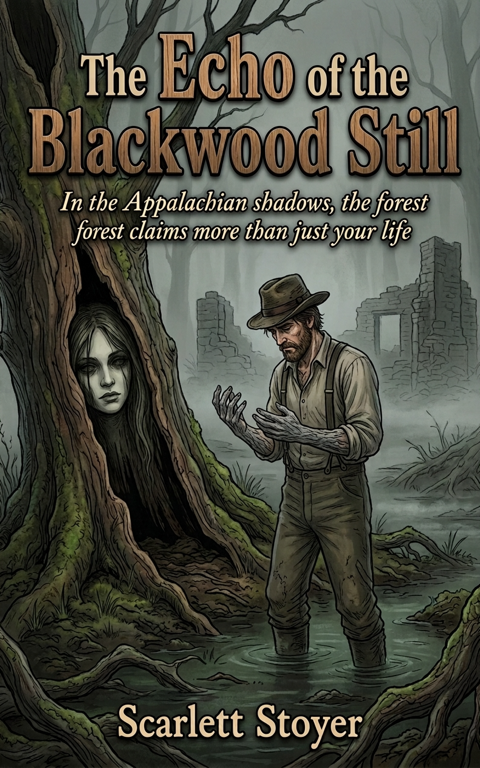
The Echo of the Blackwood Still
Scarlett Stoyer · echoes era three, the house
1892, a remote Appalachian valley, a disgraced taxidermist digging peat for a rich collector. Near an abandoned moonshine still he unearths a hollow trunk with a preserved woman inside, and she starts copying his heartbeat and his speech. Folk horror that accumulates rather than jumps.
Open the valley: chapter one is free →
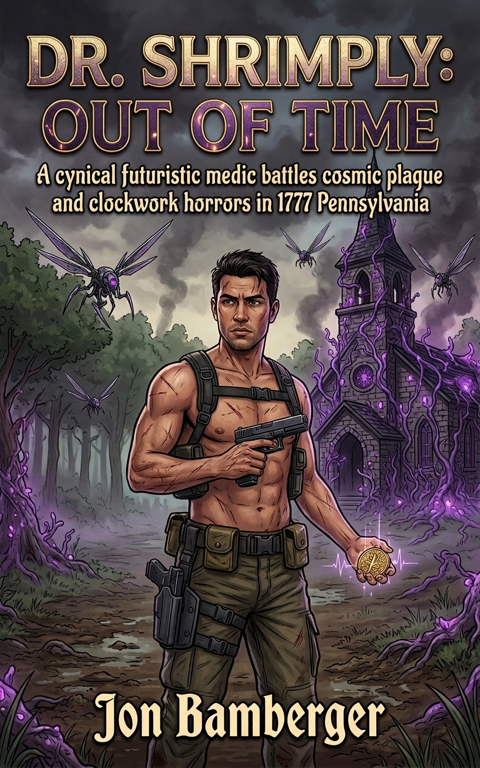
DR. SHRIMPLY: OUT OF TIME
Jon Bamberger · echoes eras one and two
A combat medic from 3026 is pulled through a rift into an alternate 1777 with a pistol, a medallion he does not understand and his father's tactical gear, and has to use future medicine to stop a plague before something cosmic gets involved. Tagged cosmic horror; from the description, pulp with a Lovecraft engine under it.
Try the first chapter free →
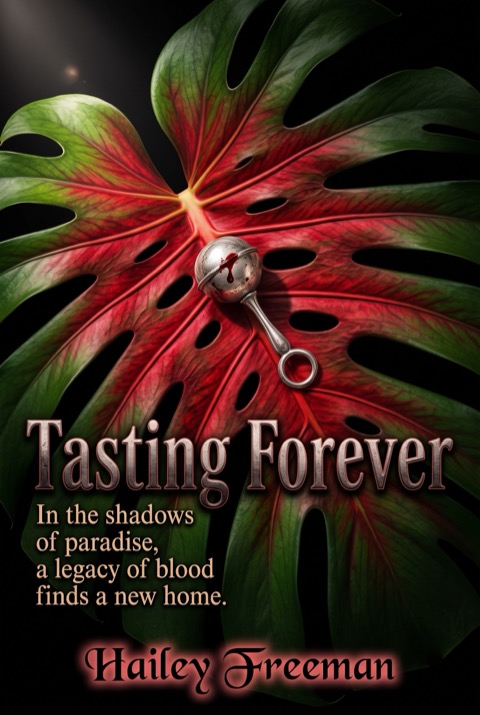
Tasting Forever
Hailey Freeman · echoes era four, the mind
A fugitive couple sets up a new hunting ground in an unfamiliar tropical city while a manhunt closes in, and local police start finding disappearances with the signature of a known cannibalistic killer. A pregnancy is nearing term in the middle of it. Content notes, from the tags: cannibalism, murder, and a pregnancy that is plot rather than backdrop. Whose head you are inside, the description does not say.
Chapter one, free, if you can stomach it →
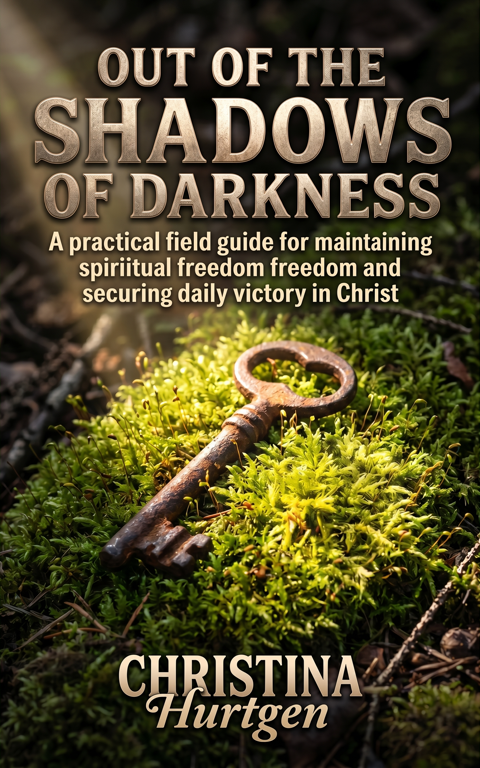
Out of the Shadows of Darkness
Christina Hurtgen · era four's subject, but not fiction
Plain disclosure: this carries a horror tag and is not a novel. It is a nonfiction religious guidebook about keeping up a spiritual defence after deliverance, with biblical strategies for closing what it calls open doors to demonic influence. If The Exorcist's subject interests you as belief rather than story, this is that. Otherwise skip it.
Read the opening free →