

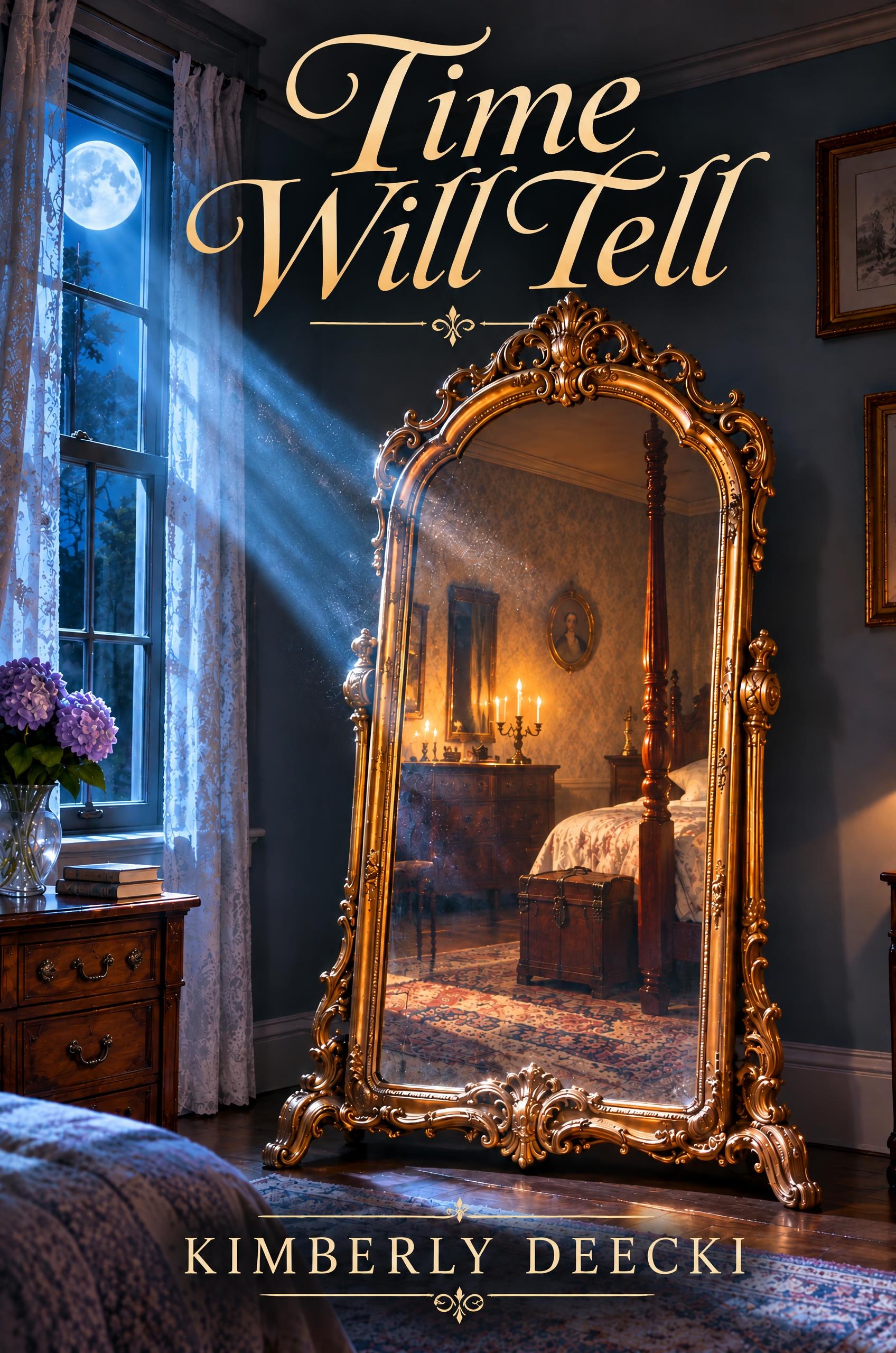
TIME WILL TELL
Two centuries apart, one fateful mirror, and a love that defies time itself
In the spring of 1827, Ohio gentleman Reginald Cornelius Whitcomb steps before an ornate, moonlit mirror in his ancestral manor. When a rare celestial alignment fractures the glass with ethereal light, he is pulled across two centuries, tumbling into the year 2027. He lands directly in the path of Odessa Prescott, a passionate former librarian pouring every ounce of her savings and soul into keeping Whitcomb House alive as a historic museum. Reginald's arrival turns her carefully scheduled world upside down, while the dazzling marvels of the twenty-first century leave the nineteenth-century merchant wholly bewildered. Yet as they work side by side to protect the estate, an undeniable romance blossoms. But Reginald's ingrained code of honor refuses to let him court the woman he loves as an penniless phantom without legal standing or fortune. To save her home and win her hand, Reginald must brave the portal once more, stepping two centuries into the past to build a timeless legacy across generations. Time will tell if honor and devotion can bridge two hundred years. Time Will Tell is an enchanting, slow-burn romantic comedy about destiny, second chances, and the lengths true love will travel.
- Romance
- Science Fiction
- Historical Fiction
- Time Travel
- Historical Romance
- Slow Burn Romance
The Looking Glass
The ledgers for the spring quarter occupied the walnut desk in the east study, arranged according to the system my father had established thirty years prior. The farm leases along the creek required new drainage ditches before the May planting. The sawmill had produced fifty bundles of white oak planks that needed inspection before shipment to Cleveland, and three tenant families had requested extensions on their quarterly grain payments following the unseasonable frost in early March. At five-and-twenty, I had learned that land was an exacting master. It did not care that my father had succumbed to his chest complaint two winters ago, nor that my mother had preceded him by only twelve months. The soil demanded labor, accounts required balance, and a gentleman who neglected either soon found himself with neither land nor title to respect.
A measured knock sounded at the study door. Samuel Fletcher entered, holding a folded slip of paper between two ink-stained fingers. Fletcher had managed the daily labor of Whitcomb House since before I could ride a horse without a leading rein, and his movements possessed the steady predictability of a grandfather clock.
"A wagon from Warren arrived twenty minutes ago, Mr. Whitcomb," Fletcher said, bowing his head slightly. "The teamster brought a crate. He insisted it be unloaded immediately, as his horses were blown from the ridge road."
I dipped my steel pen into the black ink and completed my signature on the lumber manifest. "A crate of what description, Samuel? I ordered hardware from Pittsburgh, but it was not due until the end of the month."
"Glass, sir. Heavy plate, from the weight of it. Four men were required to lift the crate from the bed. The delivery slip bears a single name." He handed me the paper.
The handwriting was sharp and unusually dark, the ink biting deep into the coarse fiber. It read: John Smith, Maker. For Reginald Cornelius Whitcomb, Whitcomb House, Kinsman. There was no bill attached, no invoice for freight, and no town of origin listed beyond the carrier's mark from the Warren turnpike.
"Did the driver say who paid him?" I asked, rising from behind the desk.
"He claimed an elderly gentleman engaged his wagon two days ago near the tavern in Mecca, paying three silver dollars in advance with instructions that the glass must stand upright during transport," Fletcher replied. "We have uncrated it in the entrance hall. I thought it best you examine it before we dispose of the pine boards."
I followed him out of the study and down the central corridor toward the main hall. The morning sun poured through the fanlight above the heavy front door, cutting sharp white rectangles across the oak floorboards. In the center of the hall, resting on two blocks of scrap wood, stood the mirror.
It was enormous, standing well over six feet from base to crest. The frame was carved from dark, heavy walnut, stained to the shade of aged molasses, but the woodwork was unlike any federal or colonial pattern popular in Ohio. Instead of classical fluting or simple rosettes, the border featured tightly coiled vines, stylized leaves, and tiny, sharp crescent shapes that seemed to twist inward toward the glass. The mirror itself possessed an odd, cool clarity. Looking into it, my own reflection appeared remarkably crisp—the dark cut of my tailcoat, the stiff white linen of my cravat, and the neat line of my dark hair were rendered with a precision that surpassed any looking glass imported from Boston.
Yet it was fundamentally wrong for an entrance hall. It dominated the space like an uninvited guest, greeting anyone who stepped through the front entrance with an immediate, startling confrontation of their own visage.
"It cannot stay here," I said, stepping around to inspect the joined backboards. The wood at the rear was planed smooth, marked only with the faint scratch of an auger and another small stamp of the name Smith. "It makes the hall look like a dressmaker's shop. A house of this size requires dignity in its entryway, not an obstacle."
"Shall I have the men carry it out to the carriage house until you decide to sell it, sir?" Fletcher asked.
I considered the piece. The craftsmanship of the frame was extraordinary, despite the peculiar choices of the carver. To leave such glass in an outbuilding where dampness might silver the backing would be wasteful. Waste was a sin my father had preached against with religious fervor.
"No," I decided, running a knuckle along the cool curve of the crest. "Move it to the west bedroom upstairs. The guest quarters are empty, and the wall between the two wardrobes has been bare since the tapestry was taken down for cleaning. It will serve well enough there until I determine which of my acquaintances sent such an extravagant novelty."
"Very good, sir. I will fetch two of the stable hands to assist."
It required four grown men to haul the looking glass up the wide staircase. Their boot heels scuffed against the risers, and the heavy frame groaned under its own density, but by noon they had positioned it firmly against the interior wall of the west bedchamber. The room was quiet, facing the wooded slope behind the house. Its tall sash windows looked out toward the western sky, catching the long afternoon light through the budding sugar maples.
Once the men had cleared away the stray straw and packing cords, I returned to my accounts. The day passed in the orderly fashion I preferred: tenant matters until two, a cold mutton luncheon, two hours reviewing the books for the gristmill, and a brief ride across the southern boundary to ensure the stone walls had survived the winter frost heaves without collapsing. By eight o'clock, the spring dusk had settled completely over Kinsman, bringing with it a sharp, clean chill that smelled of damp soil and melting snow from the higher ridges.
I retired early, reading three chapters of Adam Smith by candlelight in my own chambers before setting the volume aside. Sleep came easily enough, but it did not last.
A strange, cool brightness woke me. The clock in the downstairs hall chimed eleven, its distant brass bell echoing through the floorboards. The house was entirely silent, yet the quality of the light filtering beneath my bedroom door was wrong. It was not the yellow flicker of an untended hearth or the dull amber of a lantern left burning in the passageway. It was cold, blue-white, and steady.
I pulled on my dressing gown, slid my feet into my slippers, and stepped out into the dark hallway. The illumination was coming directly from the west guest chamber at the far end of the corridor. The door stood open two inches, casting a pale, sharp beam across the runner rug.
I walked quietly down the hall and pushed the door open. The night sky outside was clear, entirely free of cloud cover. It was the twenty-eighth of April, and the moon hung high and brilliant, swollen and sharp against a field of stars that seemed unusually dense. Two bright celestial bodies sat in close company near its eastern rim, locked in a rare, tight alignment that cast shadows as sharp as mid-day across the room.
The moonlight struck the ornate mirror at a steep angle. The frame seemed to drink in the pale light, the coiled wooden vines and carved crescents casting strange, sharp silhouettes against the plastered wall. But it was the glass itself that made me halt two paces from the threshold.
The reflection did not show the room around me.
I stared, my pulse ticking heavily against my collar. Behind me, the real room contained a four-poster cherry bed stripped of its winter hangings, a simple pine washstand, and a bare floor of wide pumpkin-pine boards. In the mirror, the room was drastically altered. The walls were painted a pale, chalky gray instead of whitewash. The cherry bed was gone, replaced by a low, unfamiliar cot dressed in plain linen. Near the window stood a collection of bizarre objects: a metal box with a glowing white surface no larger than a book, a tall, spindly rod of curved brass topped with a shade that emitted no smoke, and strange, vibrant printed cards pinned directly to the wall on a board of rough cork.
More unsettling still was the floor. The pine boards were covered by a smooth, dark runner, and near the washstand sat a pair of shoes made of some bright, synthetic-looking fabric unlike any leather I had ever seen.
I took a slow breath, convinced the late hour and the strain of the day's bookkeeping had brought on an ocular delusion. I raised my right hand to adjust the lapel of my robe. In the mirror, my own reflection stood before that foreign room, perfectly clear, perfectly real, mimicking my movement with flawless fidelity. I was there, but the room behind me was entirely alien.
"This is absurd," I murmured aloud. The sound of my own voice was dry and familiar in the quiet air.
I took two deliberate steps forward, closing the distance until I stood a foot from the glass. The cool light from the celestial alignment poured across my shoulders, casting my shadow directly into the strange room beyond. A faint draft brushed against my face. It did not smell of the hearth, nor of the damp Ohio woods outside. It smelled faintly of lemon wax, dried lavender, and something sharp and metallic that I could not name.
I reached out my right hand, intending to touch the cool, hard surface of the glass to break the illusion. My fingers moved forward. My knuckle prepared for the sharp rap of polished plate.
The glass was not solid.
My fingers met no resistance. The surface yielded like the surface of a deep pond on a windless morning, cool and slightly dense, sending faint ripples through the reflection that distorted the gray-painted room beyond. A mild, prickling sensation ran across the skin of my knuckles, like the brush of wool charged with dry winter friction.
I pulled my hand back immediately. The surface smoothed itself out in an instant, returning to that crisp, impossible window. My fingers were dry. My heart pounded against my ribs with an uncharacteristic, rapid cadence.
I looked down at the floorboards beneath my feet. They were solid nineteenth-century timber, cut from the timber stands my father had cleared with his own axe. I looked back at the glass. In the quiet room on the other side, the faint light of that flat, book-sized box pulsed once, casting a pale glow across a stack of papers bound with metal rings.
I squared my shoulders, adjusted the cuffs of my dressing gown, and raised my chin. A gentleman does not flee from an unknown phenomenon within his own house.
I lifted my right foot, leaned forward, and stepped entirely through the glass.
The Upstairs Is Not Part of the Tour
The latch on the parlor door stuck if the humidity went above forty percent, which meant I had to open it with my hip while smiling at a retired couple from Youngstown. My calico bonnet, pinned against two pounds of chestnut hair that refused to stay under linen, slipped half an inch toward my left eyebrow. "If you follow me into the keeping room, …