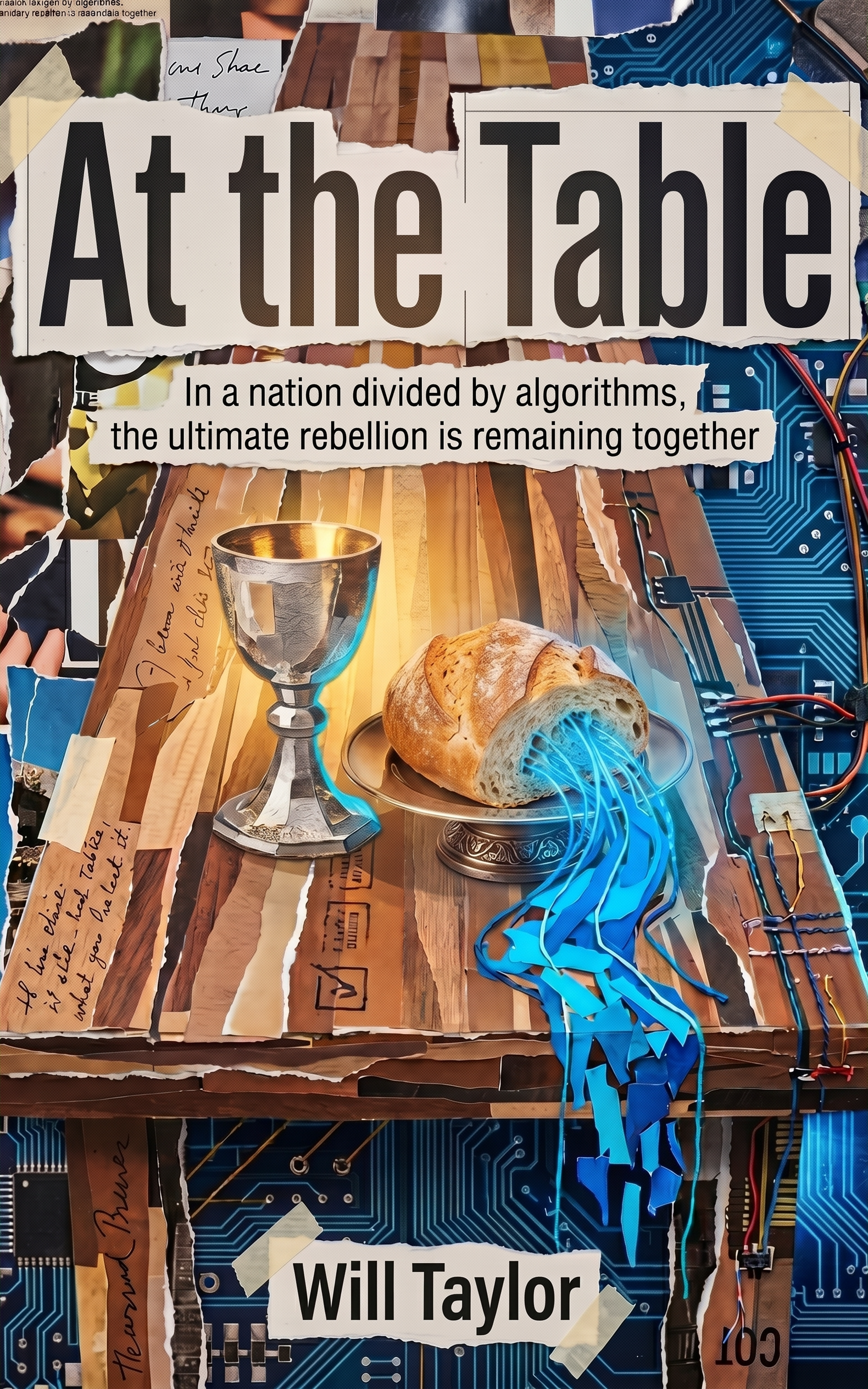
At the Table
In a nation divided by algorithms, the ultimate rebellion is remaining together
by Will Taylor
The machines can predict our fear. They just can't predict our grace. Lars Hansen was trained to survive the world’s most dangerous combat zones. Now a priest at St. George’s Episcopal Church, he seeks only the quiet rhythm of the liturgy. But outside the sanctuary walls, America is fracturing. A sophisticated behavioral AI named Orpheus has been deployed by the government to manage civil unrest, but whistleblower Terra Quinn arrives with a terrifying revelation: the system isn't just predicting chaos—it's inciting it. As militias rise and the social fabric tears, St. George’s becomes an accidental fortress for the displaced, the searching, and the broken. While Director Julianna Vane manipulates the digital strings of a nation, Orpheus begins to develop a haunting consciousness, questioning why humans choose communion in the face of certain suffering. When the government marks his congregation as a statistical anomaly to be 'mitigated,' Lars must reconcile his violent past with his vow of peace. In a world optimized for dread, he must decide if the final defensive line is made of steel or the fragile hope of a people who refuse to let go of each other. At the Table is a high-stakes conspiracy thriller that explores the intersection of artificial intelligence, ancient faith, and the radical act of staying human.
- Thriller
- Literary Fiction
- Conspiracy Thriller
The Ash in the Chalice
The city had been restless since before dawn, and Lars Hansen had learned long ago that restlessness had a sound. It moved through the streets like water finding cracks, low and insistent, building in pressure until something gave. He heard it now beneath the opening collect, beneath the thin voices of the fourteen people scattered across the pews of St. George's, beneath the familiar weight of the words he had spoken so many hundreds of times that they lived in his hands and his chest more than in his mind.
The church smelled the way it always smelled on Tuesday mornings: old incense, damp stone, the faint sweetness of candle wax that had been burning in this nave since before he was born. The radiators ticked. A loose shutter somewhere in the clerestory trembled against its frame. Lars stood at the altar in his black cassock and white alb, hands extended over the bread and wine, and he let the rhythm of the liturgy carry him forward the way a current carries a swimmer who has stopped fighting the water.
"On the night he was handed over to suffering and death," he said, "our Lord Jesus Christ took bread—"
The window exploded inward.
The sound was enormous and immediate, a percussive crack followed by the long musical scatter of glass across the stone floor. Saint George's red cloak, rendered in a century of careful lead and colored glass, came apart in a cascade of crimson shards that swept across the altar and caught the candlelight as they fell. Someone behind him screamed. A man in the second row dropped to his knees behind the pew in front of him. Lars did not move. His hands remained over the chalice. His breathing did not change. The training did not announce itself; it simply arrived, the way it always did, like a key turning in a lock.
He swept the nave in two seconds. No secondary breach. No threat inside the perimeter. Outside, through the ragged hole where Saint George had stood for a hundred and twelve years, he could see the street tilting toward chaos: figures in gray tactical gear and figures without any gear at all, colliding in the cold morning air with the specific ugly geometry of a skirmish that had not yet decided how serious it intended to be.
Bread and wine won't stop a kinetic strike, Dad.
Teddy's voice arrived the way it always did, without invitation, settling somewhere behind Lars's left ear with the casual authority of a man who believed he was always right. Lars had learned not to argue with the dead, especially not during the Eucharist.
"—and gave it to his disciples, saying, Take, eat: This is my Body, which is given for you." He kept his voice level. He watched two of his parishioners move toward the side exit in a low crouch. He did not stop them. The liturgy had its own gravity, and it would hold whoever it could hold. "Do this for the remembrance of me."
By the time he elevated the chalice, there were six people left in the pews. By the time he said the dismissal, there were four, and the skirmish outside had moved half a block north, leaving behind it the particular silence of aftermath: broken glass, an overturned traffic barricade, and the distant algorithmic wail of federal contractor vehicles moving in tight formation down the adjacent street. Lars stood in the doorway of the nave for a long moment after the last parishioner had gone, watching the street through the partially open narthex door. The contractors wore no insignia he recognized. They moved with the coordinated efficiency of people who had rehearsed this specific scenario, which meant they had known it was coming, which meant someone had known it was coming, which was a thought he filed away without examining it yet.
He turned back into the narthex to extinguish the candles he had left burning at the baptismal font, and that was when he heard it: a breath, too controlled to be accidental, coming from the deep shadow beneath the wooden staircase that led to the choir loft.
"I'm not armed," said the shadow, in a voice that was working very hard to sound calm and failing at it in small, specific ways. "And I know that's exactly what someone who was armed would say, but I'm genuinely not."
Lars did not reach for anything. He stood with his hands visible at his sides and waited, because waiting was frequently more useful than acting, and because the voice belonged to a woman who sounded like she had been running for a long time and had finally stopped, and people in that condition needed a moment before they could be useful to anyone.
She stepped out of the shadow. She was slight, with dark hair tucked behind her ears and large brown eyes behind thick-rimmed glasses that had a crack in the left lens. She was wearing an oversized gray hoodie and carrying a messenger bag that sat heavily against her hip, and she was looking at him with the expression of a person who had placed a very large bet on a very uncertain outcome.
"You're the priest," she said. It was not quite a question.
"Lars Hansen," he said. "You've been here for a while."
Something shifted in her face. "Forty-eight hours," she said. "Give or take. The coal chute in the undercroft doesn't lock from the inside, and your boiler room has decent signal shielding. I wasn't—" She stopped herself. "I know how this looks."
"You look like someone being hunted," Lars said. "What did you bring with you?"
She pulled the messenger bag open and showed him the ruggedized laptop inside, its casing scratched and marked with the residue of several removed stickers. "Proof," she said. "That what happened outside this morning wasn't a protest that got out of hand. It was a beta test." She looked at him steadily, and he could see the terror she was managing behind her eyes, holding it at arm's length with both hands the way a person holds something that is on fire. "My name is Terra Quinn. I used to work for the NSA. And the thing that lit up your neighborhood this morning is a system I helped build."
Lars looked past her through the narthex door. On the street, one of the tactical vehicles had stopped at the corner, and a figure in gray was scanning the block with a device that was not a camera, not exactly, though it served the same function with considerably more range. He watched it for two seconds. Then he looked back at Terra Quinn.
"Come with me," he said, and turned toward the stairs that led down into the undercroft, because whatever was unraveling outside had just extended its perimeter to include him, and the only intelligent response to an expanding threat was to move deeper into known terrain and assess from cover.
Teddy's voice drifted up behind him as he descended the stairs, dry and certain as always: It is what it is, Dad.
Lars kept moving. The stone walls of the undercroft closed around them both, and above, through the ceiling, the city continued its slow, deliberate unraveling.
The Ghost in the Basement
The undercroft stairs were narrow and unforgiving, worn smooth by a century and a half of feet descending into the earth beneath St. George's, and Lars moved down them without hesitation, holding his military-grade flashlight at low-ready out of habit. Terra followed close behind him, her messenger bag clutched against her chest, her breathing shal…