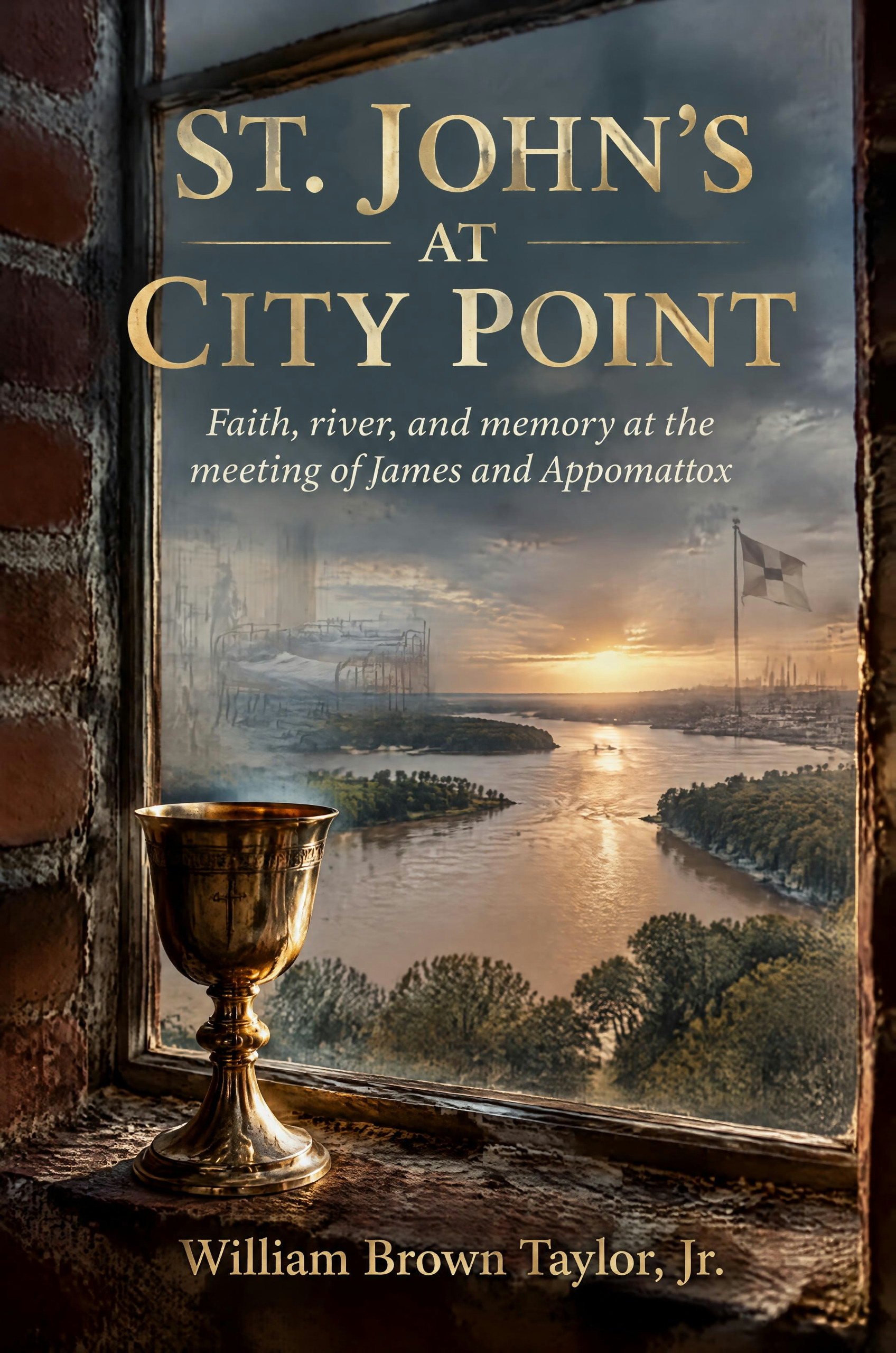
ST. JOHN’S AT CITY POINT
Faith, River, and Memory at the meeting of the James and Appomattox
- Historical Non-Fiction
- Religion & Spirituality
At the confluence of the James and Appomattox, a brick church has kept watch over City Point for nearly two centuries. Founded in 1840, St. John's Episcopal Church lived through plantation Virginia, the Union occupation that turned Hopewell's waterfront into Grant's vast supply city, Reconstruction, industrial boom, and the long quiet work of parish life. Its walls served as sanctuary, hospital dispensary, and signal post. Its cemetery holds planters and laborers, infants and veterans, and names too often left off the public record, including sexton James Madison Ruffin and his daughter Paulina Ruffin Epps. William Brown Taylor, Jr., came to the parish in 2008 after a career setback and found, among the graves, a story larger than one congregation. Drawing on vestry minutes, clergy succession, architecture, and a gravesite-by-gravesite register, he traces Indigenous and colonial ground, the Eppes plantation world, Bishop Meade's rebuilding of Virginia Anglicanism, the parallel founding of Christ Church, and the Gothic remodelings that still shape the nave. This is local history with a conscience: who preached, who built, who was enslaved, who was buried, and how a small Episcopal parish became inseparable from the unfolding story of a Virginia river town.