

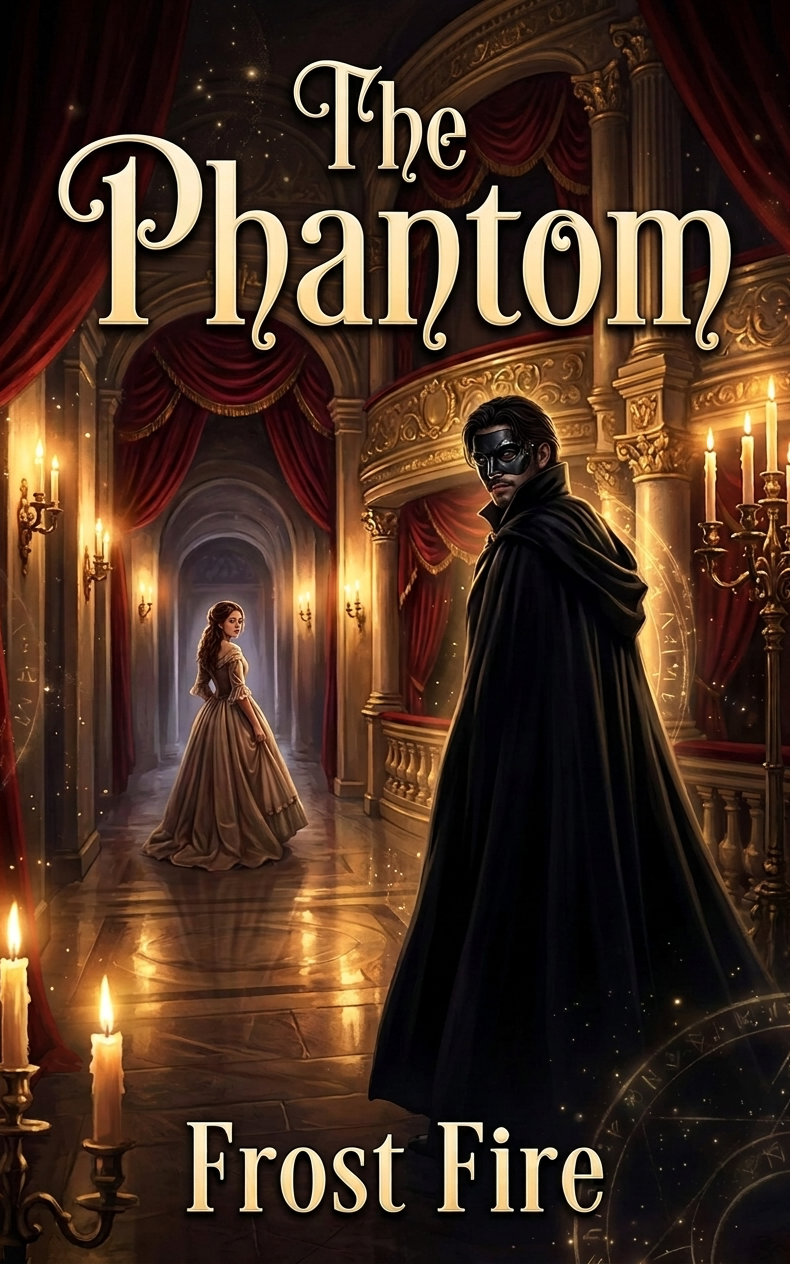
The Phantom
Obsession, power, and desire beneath the Paris Opera
by Frost Fire
Paris, 1890s. The Opéra Garnier glitters with candlelight and secrets. Chorus girl Celeste Moreau dreams of escaping poverty through her voice—until anonymous letters appear in her dressing room, signed only L. Seductive, commanding, and hauntingly perceptive, they promise to make her the greatest soprano Paris has ever known… if she surrenders completely. Behind the velvet curtains lives Lucien Vallière, a disfigured musical genius who rules the opera house from the shadows. To the world, he is a monster. To Celeste, he becomes something far more dangerous. As mysterious accidents claim her rivals and wealthy patron Adrien de Beaumont offers a respectable escape, Celeste is torn between daylight safety and the intoxicating darkness below. Caught in a deadly game of control and desire, she must decide if the man haunting her nights is a villain to escape—or the only one who has ever truly seen her. Dark, sensual, and utterly addictive, The Phantom is a gothic tale of ambition, obsession, and the price of surrender.
- Romance
- Thriller
- Erotica
- Historical Fiction
- Historical Romance
- Dark Romance
The First Note
The dust of the Opéra Garnier never truly settled. It hovered in the air like a pale, shimmering veil, caught in the shafts of gaslight that sliced through the cavernous gloom of the stage. For four hours, the chorus had been pushed to the brink of collapse. The ballet master’s cane had kept a relentless, punishing rhythm against the floorboards, while Monsieur Meyer, the conductor, screamed himself hoarse from the orchestra pit, demanding more volume, more passion, more blood from the girls who stood at the back of the stage. Celeste Moreau stood in the third row of the chorus, her throat raw, her feet burning inside her cheap leather shoes. Her burgundy performance gown, mended at the seams with mismatched thread, felt heavy and damp with sweat.
By the time the rehearsal finally ended, the grand stage emptied with a frantic, exhausted rush. The other girls complained loudly, their voices echoing off the gilded molding of the empty auditorium as they hurried toward the dressing rooms. Celeste lingered behind for a moment, letting the silence of the massive theater wash over her. It was in these quiet moments, when the patrons were absent and the managers were locked in their offices, that the opera house felt less like a gilded cage and more like a living, breathing beast. She touched her throat, feeling the faint vibration of her vocal cords. She had sung every note perfectly, yet she was invisible. To the directors, she was merely a prop, a face in the crowd of peasants and courtesans meant to fill the stage while the prima dona, Madame Carlotta, basked in the spotlight.
With a quiet sigh, Celeste turned and walked down the dimly lit corridor toward the shared dressing room she shared with half a dozen other chorus girls. The scent of greasepaint, cheap powder, and damp wool grew stronger as she approached. She pushed the heavy oak door open, expecting the usual chaotic chatter of her peers, but the room was empty. The others had already gathered their things and fled to the nearby cafes or the drafty garrets they called home. Only the sputtering flame of a single gas jet illuminated the cluttered space.
Celeste walked over to her designated vanity, a scarred wooden table near the back of the room. She reached out to grab her hairpins, but her hand froze in midair. Pressed against the center of her cracked mirror, held in place by a single, brass pin, was an envelope. It was not the cheap, yellowed paper the opera managers used for scheduling. It was a thick, heavy parchment, dyed a deep, midnight black. There was no name written on the front, only a single, elegant letter embossed in wax on the seal: L.
Her heart gave a strange, erratic flutter. She looked around the empty room, her gaze lingering on the shadows in the corners, before she reached out and pulled the pin from the mirror. The paper felt cool and expensive against her fingertips. She broke the wax seal, her hands trembling slightly, and slid the letter out. The handwriting inside was striking, written in an elegant, aggressive script that seemed to cut into the paper itself. The ink was a dark, crimson hue, almost like dried blood.
Your pitch was flat during the third act ensemble, Celeste. You choke your high notes because you fear your own power. You constrain your voice to match the mediocrity of the girls beside you, burying your gift in the dirt. It is a tragedy. You are wasting a voice that could bring Paris to its knees on a chorus that does not deserve to breathe the same air as you. Tonight, when the theater sleeps, you will remain. You will practice the aria from the second act of the forgotten score I have left on the prompter’s box. Do not fail me. Do not fail yourself.
Celeste read the words again, her breath catching in her throat. The critique was surgical in its precision. During the rehearsal, she had indeed held back on the high B-flat, terrified of standing out, of drawing the ire of the stage manager who preferred the chorus to sound like a single, obedient instrument. How could anyone have noticed? She had been buried in the third row, surrounded by twenty other singers. The writer of this letter had been listening to her, and her alone. They had heard the tiny, fractured hesitation in her throat that even the conductor had missed.
A cold prickle of fear washed over her, but beneath it, a dark, intoxicating wave of validation pooled in her chest. For three years, she had lived in near poverty, surviving on stale bread and the meager wages she earned at the opera, believing she was entirely alone in her ambition. Yet here was someone who saw her. Someone who knew her name, who understood the hunger that burned behind her quiet demeanor. It was a stalker’s intrusion, yes, but it was also the first time in her life she felt truly seen.
She folded the letter and tucked it into the pocket of her cloak. She knew she should leave. She should walk out of the stage door, return to her cramped room above the bakery, and lock herself in. But the pull of the empty stage was too strong. The promise of an audience, even an invisible one, was a drug she could not resist.
Leaving her cloak on the chair, Celeste walked back out into the labyrinth of corridors. The opera house had grown cold, the draft from the subterranean cellars whistling through the floorboards. She made her way back to the stage, which was now lit only by a single work light resting on a tall metal stand. The empty auditorium stretched out before her, a vast, yawning abyss of red velvet and gold leaf, swallowed by the darkness.
She approached the prompter’s box at the front of the stage. Resting on the wooden ledge was a faded, hand-bound music score, its edges frayed and yellowed with age. She picked it up, her fingers tracing the elegant, handwritten notes of an aria she had never heard before. It was beautiful, complex, and incredibly difficult, demanding a vocal range that would test the absolute limits of her endurance.
Celeste took a deep breath, the cool, dusty air filling her lungs. She looked out into the cavernous dark of the house. Her gaze was drawn irresistibly upward, toward the grand tier, toward Box Five. The box was draped in heavy, dark velvet curtains, completely shrouded in shadow. She could see nothing, yet a heavy, palpable gaze seemed to press down upon her from the darkness, a physical weight that made the hairs on her arms stand up. She felt as though she were standing before a predator, waiting for the strike.
Instead of running, she opened the score. She began to sing.
At first, her voice was a hesitant whisper, a fragile thread of sound that barely carried past the orchestra pit. But as the melody took hold of her, the music flowed through her veins like liquid fire. The notes were challenging, forcing her throat to open, demanding a raw, emotional vulnerability she had always kept hidden. She forgot the cold, she forgot her aching feet, she forgot her fear. She sang for the shadows. She sang for the invisible presence she knew was watching her from the dark.
Her voice soared into the upper register, clear and resonant, echoing off the high dome of the ceiling. For the first time, she did not hold back. She let the power of her voice fill the empty space, claiming it as her own. She was no longer a nameless chorus girl; she was a queen commanding her court.
As she reached the climax of the aria, she took a step forward, her eyes locked on Box Five. But her foot caught on a warped, loose floorboard near the edge of the stage. She gasped, her balance deserting her. She reached out blindly, her heart leaping into her throat as she began to fall toward the dark pit of the orchestra below.
Before she could hit the ground, the stage lights suddenly flickered and died. The work light went out with a sharp, metallic hiss, plunging the entire theater into absolute, suffocating darkness. Celeste gasped as a pair of strong, gloved hands caught her by the waist, arresting her fall with a sudden, violent jerk. She was pulled back onto the solid wood of the stage, pressed against a broad, solid chest that smelled of rain, old parchment, and a faint, bitter scent like burnt sugar.
She froze, her heart hammering against her ribs like a trapped bird. The grip on her waist was firm, unyielding, possessing a terrifying physical strength. She could feel the heat radiating from the body behind her, the steady, calm rise and fall of his chest. She wanted to scream, to pull away, but a strange, paralyzing weight held her captive.
A low, melodic voice whispered directly against her ear, the breath warm against her cold skin. The voice was deep, rich, and laced with an archaic formality that made her shiver.
"You must watch your step, my sweet Celeste. The stage is a treacherous place for those who do not look where they are going."
The touch of his gloved fingers sent a jolt of electricity down her spine. It was a dominant, controlling touch, yet there was an undercurrent of intense, obsessive tenderness in the way he held her. He did not hurt her, but he made it entirely clear that she could not escape him if he did not wish it.
"Who are you?" she whispered, her voice trembling in the dark.
"I am the one who listens," the voice replied, closer now, the lips almost brushing the shell of her ear. "I am the one who knows the true depth of your hunger. You are a diamond in the rough, Celeste. A precious gem buried beneath the filth of this theater. I can give you the world you deserve. I can make them bow to you. But you must obey me. You must surrender your voice to me completely."
Celeste’s breath came in short, shallow gasps. The sheer intensity of his presence was overwhelming, a dark, suffocating force that seemed to pull her under. She felt a dangerous, shameful urge to lean back into him, to surrender to the absolute control he offered. It was a terrifying realization, a betrayal of her own mind, yet she could not deny the thrill that coursed through her blood.
"Why me?" she managed to ask, her voice barely audible.
"Because you are the only one who has ever sung the music in my head," he whispered. "Do not seek the light, Celeste. The light is a lie. The darkness is where you truly belong."
Suddenly, the grip on her waist vanished. The warmth behind her disappeared so quickly she wondered if she had imagined it. She stood alone in the dark, her hands reaching out into the empty air.
"Wait!" she cried out, but the only response was the distant, hollow echo of her own voice.
A second later, the gas jets along the edge of the stage sputtered back to life, hissing as they illuminated the theater once more. The sudden glare made Celeste shield her eyes. When her vision cleared, she was entirely alone on the stage. The music score was still resting on the prompter’s box, but beside it sat a small, velvet-lined box that had not been there before.
Celeste walked forward, her legs shaking so badly she could barely stand. She picked up the box and opened it. Resting inside, on a bed of faded white silk, was a magnificent necklace. It was a delicate collar of diamonds and sapphires, the stones catching the gaslight and casting brilliant, blue fractures across her face. It was impossibly expensive, a piece of jewelry that belonged to a noblewoman, not a chorus girl.
She gasped, recognizing the necklace instantly. It belonged to Madame Carlotta, the opera’s leading soprano. The diva had been hysterical earlier that week, claiming her dressing room had been ransacked and her favorite necklace stolen. The police had been called, but no trace of the thief had been found. And now, it was sitting in Celeste’s hands.
A wave of panic washed over her. If anyone saw her with this, she would be branded a thief, thrown into the Saint-Lazare prison, and her life would be over. The mystery of her benefactor suddenly took on a sinister, dangerous edge. He was not just a fan; he was a thief, a ghost who moved through the theater’s locked doors with ease, playing a deadly game with her career.
She heard the heavy thud of the stage door closing in the distance, followed by the sound of quick, clicking footsteps approaching. Panic seizing her, Celeste slammed the velvet box shut and shoved it deep into the pocket of her burgundy gown, just as Margot Vasseur walked out from the wings.
Margot was still dressed in her dancing stays and a loose shawl, her chestnut hair falling in messy waves around her face. She stopped when she saw Celeste standing alone on the stage, her dark eyes instantly narrowing with suspicion.
"Celeste? What are you still doing here?" Margot asked, her voice sharp and echoing in the empty space. "The rehearsal ended an hour ago. I thought you would be halfway home by now."
Celeste forced her hands to remain still, though she could feel the hard weight of the stolen necklace pressing against her thigh. She took a slow breath, trying to steady her racing heart.
"I... I wanted to practice," Celeste said, her voice sounding thin and unconvincing to her own ears. "I wanted to work on the phrasing for the ensemble."
Margot walked closer, her gaze sweeping over Celeste’s pale face, her eyes lingering on the closed music score on the prompter’s box. She stepped onto the stage, her dancer’s posture elegant even in her exhaustion. She stopped just a few feet away, crossing her arms over her chest.
"Practice?" Margot scoffed, though her tone was more weary than unkind. "Darling, you are going to kill yourself for a director who doesn't even know your name. You can sing until your lungs bleed, but Meyer will still give the solos to whatever girl has the wealthiest patron to pay for his dinners."
"I have to try, Margot," Celeste said, looking down at the stage floor. "I cannot stay in the back row forever. I cannot live on twenty francs a month."
Margot’s expression softened slightly, a flicker of genuine sympathy crossing her sharp features. She reached out and touched Celeste’s shoulder, her grip firm and grounded.
"I know," Margot said softly. "I know how hard it is. But this place... it is a trap, Celeste. The opera house is a beautiful monster that devours girls like us. If you are not careful, the managers will use you up and discard you the moment you lose your shine. Or worse, one of the wealthy patrons in the boxes will decide you are a pretty toy to be bought and broken."
Celeste felt a cold sweat break out on the back of her neck. She thought of the letter in her pocket, of the dark, heavy gaze from Box Five, and the terrifyingly gentle hands that had saved her from falling. She wondered what Margot would say if she knew the truth. If she knew that Celeste was already playing a dangerous game with a ghost.
"Have you... have you ever heard stories, Margot?" Celeste asked, trying to keep her tone casual. "About the theater being haunted? About someone living in the shadows?"
Margot laughed, a sharp, bitter sound that had no real humor in it. She let her hand fall from Celeste’s shoulder.
"The Opera Ghost? Every theater has its ghost, Celeste. It is a convenient excuse for when the scenery falls or the stage hands get drunk and drop a rope. But the real monsters in this house do not wear masks or hide in the cellars. They wear evening clothes, they sit in the front rows, and they control the purse strings. Those are the ones you need to fear."
Margot stepped closer, her eyes searching Celeste’s face with a sudden, intense seriousness.
"Do not get caught up in the mysteries of this place. If you see something strange, if you find things that do not belong to you... leave them alone. Survival here depends on knowing when to look away. Do you understand me?"
"Yes," Celeste lied, her fingers tightening against the fabric of her skirt, feeling the outline of the velvet box beneath. "I understand."
"Good," Margot said, patting her cheek gently. "Now, come along. The night air is freezing, and the stage door keeper is waiting to lock up. I will walk with you to the boulevard."
"You go ahead," Celeste said, forcing a small, tight smile. "I just need to gather my things from the dressing room. I will be right behind you."
Margot hesitated for a moment, her dark eyes lingering on Celeste as if trying to read the secrets hidden behind her porcelain skin. Finally, she sighed and turned away.
"Do not be long, then. And lock the door behind you. Paris is not safe for a girl alone at this hour."
"I will," Celeste promised.
She watched as Margot walked off the stage, her shadow stretching long and thin across the floorboards before disappearing into the wings. Once she was gone, the silence of the theater returned, heavier and more oppressive than before.
Celeste stood alone on the empty stage, her heart pounding in her ears. She reached into her pocket and pulled out the velvet box. She opened it once more, the brilliant blue diamonds catching the dim gaslight. It was a beautiful, dangerous thing. A token of devotion from a monster who lived in the dark, a man who had claimed her voice as his own.
She knew she should leave it behind. She should drop it on the stage and run as far away from the Opéra Garnier as her legs could carry her. But as she looked up at the empty, dark cavern of Box Five, she felt a strange, intoxicating pull that she could not fight. Her path to the spotlight had finally begun, but she knew, with terrifying certainty, that it was paved with secrets, and there was no turning back.
With a quiet, trembling breath, she closed the box, tucked it back into her pocket, and walked slowly into the shadows.
The Aristocrat's Claim
The Grand Foyer of the Opéra Garnier was a wilderness of light and gold, a monument to the glittering decadence of 1890s Paris. Beneath the soaring ceiling painted with mythological gods, the aristocracy moved in a slow, turgid current of velvet, diamonds, and tailored wool. The air was thick with the scent of expensive ambergris, roasted chestnuts…
Want to read the rest?
Get the full book here: