

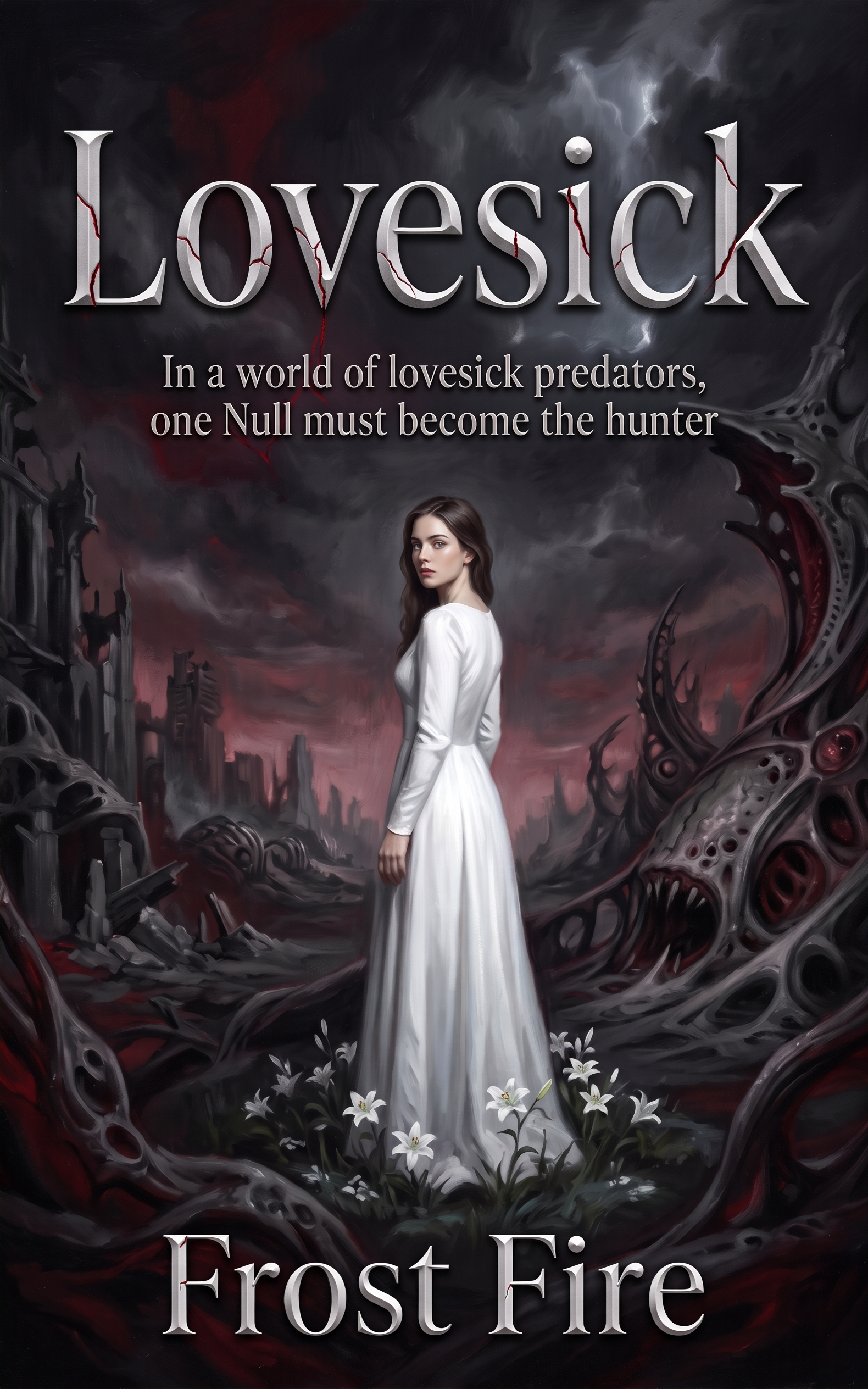
Lovesick
In a world of lovesick predators, one Null must become the hunter
by Frost Fire
Empathy is extinct. Obsession is the law. Lauren Bailey always knew her eighteenth birthday would change everything. In a society reshaped by lovesickness—an infection that twists love into sadism, possession, or ruthless protection—every citizen is tested and claimed by their strain. Lauren expects her fate. What she gets is impossible: she is a Null. No antigens. No strain. The last uninfected girl in a city of hungry hearts. The news spreads like wildfire. Brian wants to break her. Jason wants to cage her. Steven wants to own her. Three powerful infected men, three different hungers, one prize. Kidnapped, traded, and hunted through neon-lit streets, Lauren learns that survival means playing monsters against each other—and that her body hides a secret none of them saw coming. When the government marks her for the lab, her stalkers forge a dangerous alliance. Lauren must decide whether she can love men who see her as property… or become the most dangerous thing in a lovesick world. Dark, addictive, and relentlessly tense—Lovesick is reverse-harem obsession at its most unforgiving.
- Romance
- Thriller
- Erotica
- Dark Romance
- Stalker Thriller
- Enemies to Lovers
The Negative Result
The fluorescent lights of the Third District Testing Facility didn't just illuminate the room; they stripped it bare. They buzzed with a low, relentless hum that vibrated straight through the soles of Lauren’s scuffed sneakers. The room smelled of industrial antiseptic, cold iron, and stale fear—the lingering scent of a hundred eighteen-year-olds who had sat in the same hard plastic chair earlier that morning, waiting to learn which version of broken they were going to be.
Lauren pulled the sleeves of her oversized gray hoodie down over her hands, her thumbs hooked into the frayed seams. She kept her chin tucked, her eyes fixed on the linoleum floor where a long brown scuff mark cut diagonally toward the door. Outside, the sky over the city was the dull, bruised shade of a winter dusk. Inside, time seemed to crawl, stretched taut by the slow dripping of a leaky faucet somewhere down the hall.
Across the stainless steel table, the technician wiped his brow with the back of a gloved hand. His name tag read M. Vance, pinned crookedly to a scrub top that had seen too many bleach cycles. He was a small, thin man with deep violet shadows under his eyes and a nervous twitch in his left jaw—a classic marker of a low-grade possessive strain that had never quite found an anchor. He had been aggressive when she first walked in, snapping at her to state her legal name and date of birth, but now he was strangely quiet.
He was taking too long.
Usually, the reader spat out the results in under thirty seconds. You sat down, they swiped the skin over your inner forearm with an alcohol pad, clicked the multi-needle cartridge against your radial artery, and fed the vial into the desktop analyzer. The screen would flash red for Sadistic, amber for Protective, or blue for Possessive. Then you got your blue paper seal, your digital health profile updated, and a government booklet explaining how to register your strain with the local district board so you wouldn't end up in an enforcement cage by twenty-one.
Lauren’s vial had been in the slot for nearly four minutes.
"Is there a problem with the centrifuge?" Lauren asked. Her voice came out flat, clipped, stripped of any warmth. She had spent eighteen years perfecting that voice. It was the voice she used when men on the subway stood a little too close, or when the neighborhood boys gathered on the stoop after sunset, their pupils blown wide as they tracked the women walking past.
Vance didn't answer. He was staring at the small, high-resolution monitor turned away from her angle of vision. His throat moved as he swallowed hard, his Adam’s apple bobbing against his tight collar.
"Mr. Vance?" she repeated, shifting her weight. The plastic chair creaked softly under her lean frame.
"Hold on," he muttered. His voice was higher than it had been a moment ago, thin and reedy. "The... the calibration might be off. The reader is running a secondary verification."
"It doesn't take four minutes to run a verification," Lauren said. She leaned forward, her hazel eyes narrowing as she watched his hands. They were trembling. Not a slight tremor, but a hard, visible shaking that made the rubber of his nitrile gloves rustle against the metallic arm of his desk chair.
"Sit back," Vance snapped, though there was no real weight behind the order. It sounded like a man trying to bark at a dog while stepping backward off a cliff. "You need to remain seated until the legal assessment is printed."
Lauren didn't sit back. Instead, her eyes tracked his movements as he reached for the thermal printer attached to the side of the machine. The printer didn't hum to life. The motorized feed stayed dead silent. On the screen, reflected faintly in the dark glass of the small window behind Vance’s head, Lauren could see the blocky green text of the system interface.
There were three horizontal bars on the display. Beside each bar was a numerical value.
Strain A (Sadistic): 0.00%
Strain B (Protective): 0.00%
Strain C (Possessive): 0.00%
Below the numbers, a red system diagnostic was flashing in rhythmic, silent pulses: NULL VALUE DETECTED. RE-INSERT CARTRIDGE OR ESCALATE TO REGIONAL CONTROLLER.
The air in the small room suddenly felt much colder, thick and heavy, like trying to breathe under wet wool. Lauren knew the statistics. Everyone knew the statistics. They were taught in civic health class from the age of twelve. Over ninety-nine point nine percent of the population carried active antigen markers by their eighteenth birthday. The infection had entered the gene pool three generations ago, mutating human empathy into sharp, functional obsession. It was the foundation of their laws, their housing districts, their security protocols. Society operated on the predictability of the three strains. You were a violent predator, a compulsive guard, or a territorial owner. You fit into the grid because the grid was designed for men and women who needed to fixate in order to function.
Zeroes didn't exist. Not anymore. A Null was a ghost story the government used to justify mandatory tracking, or a myth whispered by girls in high school bathrooms who hoped their blood tests would somehow come back clean so they wouldn't spend their adult lives looking for a collar to wear or a leash to hold.
"Give me my papers," Lauren said. Her heart was beating a steady, hard rhythm against her ribs, but her face remained smooth, a mask of cold indifference.
"I can't do that," Vance whispered. He wasn't looking at her now. He was looking at his terminal's keypad, his index finger hovering over a yellow function key. "The system... it requires an administrative override for non-standard readouts."
"It's a zero," she said plainly. "You know what it says. Print the failure notification and let me go."
"You don't understand," Vance said, his eyes finally darting to hers. His pupils were expanding, the dark centers swallowing the pale blue of his irises as stress triggered his latent possessive drive. But he wasn't looking at her as a person—he was looking at the screen, then back to her, as if she were a stack of unmarked currency left unattended on a counter. "This isn't a failure notification. A Null readout isn't a medical error, Miss Bailey. It's... it's a priority event."
He didn't hit the yellow button. Instead, with a awkward, jerking motion, he reached into his lab coat pocket and pulled out his personal phone—a cracked, grey-market handheld that wasn't monitored by the facility's internal network logs. He thumbed the screen open, his breath coming in short, shallow hitches.
"What are you doing?" Lauren asked, rising from the chair in one smooth, practiced movement. Her posture wasn't aggressive; it was the coiled, ready stance of someone who spent her life calculating how many steps it took to reach the nearest exit from any corner of a room.
"Just stay there," Vance breathed, his thumb flying across the glass screen. He held the phone to his ear, leaning away from her toward the corner of the desk. "Yeah. It's Vance at the Third District clinic. I've got one. No, I'm serious. Straight zeros across the board. Female, eighteen today. Unclaimed. Unmarked. Yeah... how fast can your team get here?"
Lauren didn't wait to hear the rest of the conversation. She didn't ask questions, and she didn't yell. The moment the word unclaimed hit the air, her instincts—honed by eighteen years of surviving in a city full of territorial monsters—took over.
She grabbed her canvas messenger bag off the floor, spun on her heel, and hit the heavy metal crash bar of the room's secondary exit. The door swung open into the narrow rear alleyway behind the clinic, the cold air hitting her face like a wet towel. Behind her, she heard Vance scream—a high, panicked sound—followed by the heavy clatter of his plastic chair knocking over onto the tile floor.
"Hey! Stop! You can't leave! That result belongs to the district!"
Lauren didn't look back. She shoved her hands deep into her hoodie pockets, ducked her head against the biting wind, and broke into a fast, economical stride down the alley toward the main street.
The city was alive with its usual twilight rumble. High-rise apartment buildings flared with yellow light against the gray sky, their lower levels protected by heavy iron grilles and reinforced security gates. On every corner, digital billboards flashed regional strain notices, public safety reminders about proper suppressant dosages, and advertisements for private security firms specializing in protective containment. People walked fast on the sidewalks, keeping their eyes straight ahead, arms tucked close, their body language sharp and defensive. In this world, eye contact was an invitation; prolonged eye contact was a declaration of intent.
Lauren kept her head down, her heart hammering behind her ribs like a trapped bird. Her mind was racing, replaying the look on Vance’s face. He hadn't called the health ministry. He hadn't called the district medical supervisor. He had called a private number. He had tried to sell her before the ink on the test strip was even dry.
Unclaimed. Unmarked. A Null.
Without an antigen profile, she didn't belong to any strain group. She didn't have the natural aggressive drives that forced people into predictable social hierarchies. To the state, she was a defect—an untracked variable that didn't fit into their neat, compartmentalized control systems. But to the infected... to the men who spent their lives hunting for something pure, something that hadn't been shaped by the same dark, twisted biology that drove them...
She was a prize. The ultimate blank slate.
By the time she reached the corner of Forty-Fifth Street, her breath was ragged, coming in hot, white plumes in the freezing air. She crossed against the light, ignoring the sharp blare of a delivery truck's horn, and turned into the narrow entryway of her apartment complex. The building was an old, four-story brick walk-up with peeling paint and a foyer that perpetually smelled of boiled cabbage and damp concrete. Her aunt, Aunt Clara, worked double shifts as a scrub nurse in the high-containment ward at St. Jude’s—a ward dedicated entirely to sadistics who had gone off their suppressants and snapped. Clara wouldn't be home until tomorrow morning.
Lauren was completely alone.
She took the stairs two at a time, her rubber soles slapping against the worn linoleum steps. On the third-floor landing, Mrs. Gable—an elderly woman whose possessive strain had long since decayed into a hoarded apartment full of stray cats and old newspapers—peered out through a door held open by a heavy iron chain.
"Lauren?" the old woman rasped, her milky eyes squinting through the gap. "Is that you? You're moving fast, girl. What's the hurry?"
"Just cold, Mrs. Gable," Lauren lied without stopping, her hand already digging into her pocket for her keys. "Lock your deadbolts tonight. The wind is picking up."
"It's not the wind," the old woman muttered, her voice dropping to a harsh whisper as she pulled her door shut. "The air feels sharp tonight. Like iron."
Lauren didn't answer. She reached Apartment 3B, slotted her key into the lock, turned it, and slipped inside, shoving the heavy oak door shut behind her. She threw all three bolts—the top latch, the middle deadbolt, and the chain—before letting her back slide down the wooden panels until she was sitting on the cold parquet floor of the entryway.
She closed her eyes, her chest heaving as she tried to force her heart rate down. Inhale for four, hold for four, exhale for four. The standard breathing exercise they taught in self-defense class. It didn't help. Her skin felt hot, prickly with an uncomfortable, prickling awareness that she couldn't shake off.
The apartment was dark, illuminated only by the orange glow of the streetlights filtering through the cheap lace curtains in the living room. It was a small, cluttered space—a worn sofa covered in a knitted throw, a small laminate dining table stacked with Clara's medical journals, and a kitchen that was little more than a alcove with a two-burner stove. It had been her sanctuary for as long as she could remember, a place where the madness of the outside world couldn't reach her once the bolts were shot.
Now, the walls felt thin. Transparent.
Lauren stood up, wiping her sweaty palms on her jeans, and walked into the living room. She didn't turn on the overhead light. Instead, she navigated by the faint orange glare from the window, moving toward the small television set perched on a swivel stand in the corner. She hit the power button. The old cathode-ray tube flickered to life with a quiet static hiss before the image settled into the high-definition feed of District Three News Local.
A female anchor with slicked-back dark hair and the rigid, intensely focused posture typical of an integrated protective strain was speaking into the camera. Behind her, a graphic of the city map was highlighted with red warning zones.
"—repeating our top story tonight," the anchor said, her tone smooth, polished, yet laced with an underlying tension that made her voice buzz slightly through the speaker. "Unconfirmed reports from the Central Testing Registry indicate that a confirmed Null antigen profile was generated less than one hour ago at a local facility in the Third District."
Lauren froze, her hand still resting on the plastic frame of the television.
"While the Department of Health has not released the identity of the individual," the anchor continued, as the screen shifted to display a live shot of the very building Lauren had fled twenty minutes prior, "sources within the district enforcement network confirm that the individual is an eighteen-year-old female. This represents the first verified Null result within the metropolitan area in over seven years. Local authorities are urging the public to remain calm, though multiple high-level strain syndicates have already posted inquiry bounties for verification of the subject's current location..."
"Vance, you bastard," Lauren whispered, her voice barely a breath in the silent room.
He hadn't just called a local buyer. He had leaked it to the news network, or sold it to a broker who made sure the entire city knew within thirty minutes. A Null girl in the Third District. An unclaimed, uninfected eighteen-year-old sitting somewhere in a city of millions, completely unprotected by any strain authority, completely open to being taken.
Her phone, resting on the kitchen counter where she had dropped her bag, began to buzz.
It wasn't a standard ringtone. It was a continuous, frantic vibration that rattled the plastic casing against the Formica surface. Lauren turned slowly, looking at the illuminated screen. Notifications were cascading down the display so fast the text blurred into a solid block of white light.
Unknown Number: We know you're in District 3.
Unknown Number: Name your price for an exclusive protection contract.
Unknown Number: Is it true? Are you really clean?
Unknown Number: Stay where you are. I'm coming to get you.
Unknown Number: $50,000 for your address right now.
Unknown Number: Don't answer anyone else. I can keep you safe. You belong to—
The screen went black for a second as a call tried to break through, then burst back into life with forty new messages. The digital tracking network had matched her phone number to her registry profile. It didn't matter that the news hadn't released her name—anyone with five hundred dollars and a black-market data scraper could pull her registration address from the city's public utility records within minutes.
A hard, knotting sensation formed in the pit of her stomach. The room seemed to shrink around her, the air turning thin again.
She stepped toward the counter, picked up the phone, and turned it completely off. The silence that followed was heavy, almost suffocating.
She moved to the living room window, keeping herself hidden behind the edge of the heavy velvet curtain Clara had hung years ago to keep out the draft. She peeled back a quarter-inch of the fabric and looked down at Forty-Fifth Street.
It was empty. The streetlights flickered, casting long, distorted shadows across the asphalt. A lone plastic bag tumbled across the sidewalk in the wind. But directly across from her building, parked in the red zone in front of a fire hydrant, sat a large, black SUV. Its windows were tinted so dark they looked like polished obsidian. The engine was off, but as she watched, a small, red surveillance light pulsed once from the side-view mirror, scanning the facade of her apartment block.
They were already here.
Not the police. Not the Department of Health. The predators had beat the system to her doorstep.
"Okay," Lauren muttered to herself, her fingers digging into the fabric of the curtain until her knuckles turned white. "Okay. Think."
She couldn't stay here. When Clara got home tomorrow, this apartment would be surrounded—if it wasn't already broken into by midnight. The lock on her front door was a standard five-tumbler brass lock; an integrated sadistic with basic strength enhancement could kick it off the frame in two hits. A possessive type with a set of lock picks would be inside in under thirty seconds.
She was a target. A trophy. Something to be locked in a basement, traded on a regional registry, or carved up until she agreed to take a strain mark to make the hunting stop.
She turned away from the window and rushed into her small bedroom. She pulled a worn leather duffel bag from under her bed and unzipped it with a sharp, metallic scratch. She began tossing items inside with rapid, efficient movements—three pairs of thick socks, jeans, two extra hoodies, her emergency cash envelope from behind the closet baseboard containing three hundred dollars she had saved from her job at the 24-hour pharmacy, a bottle of water, and a heavy brass pocketknife her father had left behind before he disappeared into an enforcement facility.
She didn't grab clothes that were pretty. She grabbed clothes that would make her look small, invisible, like just another blur moving through the cold streets after curfew.
As she zipped the duffel bag shut, a strange sound echoed from the hallway outside her apartment.
It wasn't a casual footstep. It was heavy, deliberate, and slow—the sound of someone who wasn't trying to hide their presence, but who moved with the absolute, unhurried confidence of a hunter who knew the rabbit had run out of burrows.
Lauren froze, the strap of the duffel bag gripped tightly in her hand. Her breath caught in her throat.
The footsteps stopped directly outside Apartment 3B.
Silence filled the space between her room and the front door, stretched so tight it felt like a wire about to snap. Then came the knock.
It wasn't a soft rap, nor was it the aggressive pounding of an officer. It was three slow, heavy thuds against the reinforced wood of the door—a calm, rhythmic measurement of impact that vibrated through the floorboards beneath Lauren’s feet.
Thud. Thud. Thud.
Lauren backed out of her bedroom, her movements silent, her body crouched low. She reached the hallway leading to the entryway, her heart pounding so hard against her sternum she could feel the pulse humming in her teeth. She dropped the duffel bag onto the runner rug and crept toward the front door.
She reached out with a trembling hand, her fingers stopping an inch from the brass cover of the peephole. She forced herself to lean forward, placing her eye against the glass lens.
The fish-eye lens distorted the dimly lit hallway outside, stretching the yellow wallpaper and the narrow runner rug into a curved, sinister tunnel.
Standing on the other side of the door was a man.
He was tall—broad-shouldered enough to nearly fill the narrow frame of the hallway—wearing a dark leather jacket over a black shirt. A faded scar cut through his left eyebrow, giving his face a sharp, dangerous asymmetry. His dark hair was short, cropped close, and his jaw was set like iron.
But it was his eyes that made Lauren’s blood run cold.
In the dim light of the hallway's overhead bulb, his pupils were so fully dilated that the blue of his irises had vanished entirely. They were twin pools of deep, bottomless black—the classic, terrifying manifestation of an active, high-intensity sadistic strain in full territorial lock.
He wasn't looking at the door handle. He wasn't looking at the lock.
He was looking directly through the glass of the peephole, his dark gaze locked onto hers as if he could see the curve of her eye through the brass fitting, as if he could smell the heat of her skin through two inches of solid oak.
A faint, slow smile curved the corner of his mouth—a sharp, cruel expression that offered no warmth, no comfort, and no quarter.
"I know you're standing right there, sweetheart," the man whispered. His voice was low, rough, and completely devoid of fear, passing through the heavy wood as if it weren't even there. "I can hear your heart hitting your ribs. Sounds like a little drum."
Lauren pulled her head back from the peephole, her hand flying to her mouth to stifle a sharp, terrified gasp.
"You can stay behind that door if it makes you feel safe," the voice continued from the hallway, calm and measured, accompanied by the slow, metallic scrape of a heavy boot adjusting its weight against the floorboards. "It won't change anything. You're the Null girl from the Third. And I'm the one who found you first."
Lauren took a step backward, her hand reaching into her pocket, her fingers closing cold and tight around the heavy brass handle of her pocketknife. The flat, cold reality of her new existence settled over her like a shroud: the world she knew was gone. She was no longer a person. She was a prize—and the hunt had just begun.
Predator in Aisle Four
The fluorescent strips overhead hummed at a frequency that vibrated right in the back of Lauren's molars. It was eleven thirty on a Tuesday night, and the 24-hour pharmacy on the corner of Elm and Eighth felt less like a retail store and more like a brightly lit fishbowl sitting in the middle of a dark, hungry ocean. Outside, a light drizzle coated…
Want to read the rest?
Get the full book here: