

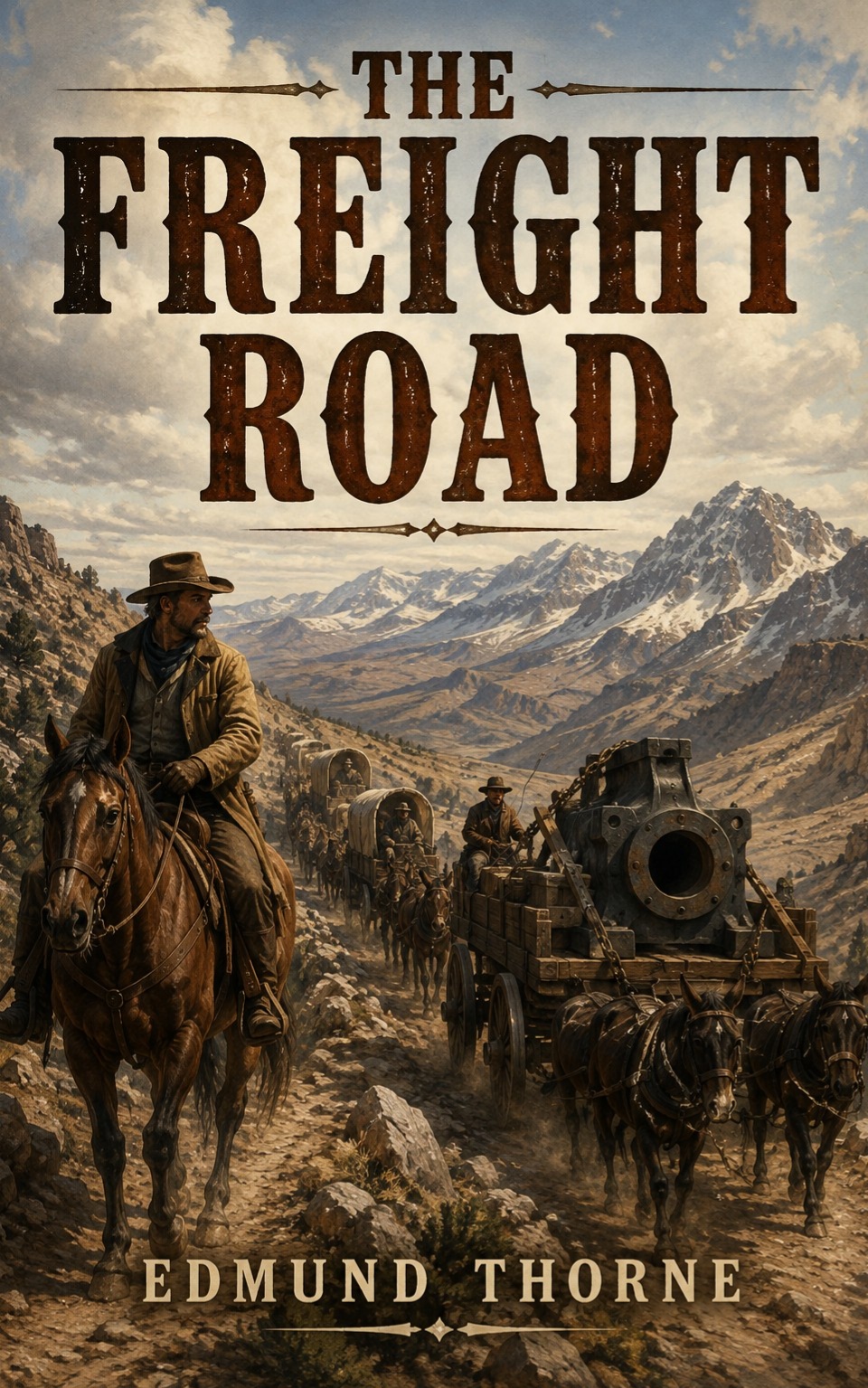
The Freight Road
by Harper Wynnley
New Mexico Territory, 1882. The mine at Silver Basin is losing ground to water, and a replacement pump casting must reach the settlement before winter closes the mountain road. Wagon master Owen Rourke takes six freight wagons north from the railhead with thirty-six mules, mine supplies, blasting powder, and a cast-iron pump casting weighing nearly two tons. The route is long and unforgiving: flooded crossings, washed road, steep grades, failing wagon gear, and weather moving down from the high country. Every delay costs the mine time, but pushing tired animals or damaged wagons too hard can cost the entire outfit. Owen has spent years learning when to press a team and when to stop, what a road will bear, and which men can be trusted when the work turns difficult. He will need all of it to get the freight into Silver Basin—and then get his people home before winter shuts the road behind them. The Freight Road is a traditional historical Western about hard country, practical skill, and the men and women whose work kept frontier towns alive.
- Western
- Historical Fiction
- Adventure
- Frontier
- Wild West
- Survival
Chapter 1
The San Marcos railhead smelled of coal smoke and creosote before the sun had fully cleared the water tank. Owen Rourke was already down among the wagon wheels when the first freight cars began switching on the siding beyond the depot fence. Six wagons stood in a loose line across the yard, their canvas tops still damp with night dew and their iron-tired wheels sunk an inch into mud churned by loading. He worked his way along them with a wrench in one hand and a tallow can in the other, stopping at each hub long enough to feel for play and make certain the spindles had been freshly greased.
At the lead wagon he straightened beside the great gray casting lashed low in the bed, wrapped in burlap and held by three turns of heavy chain. The replacement pump casting for the Silver Basin mine rested squarely on doubled timber blocking. Nathan Kincaid had strengthened the bolsters and bracing before the loading began, but the weight still showed in the running gear, and Owen intended to watch that wagon closely until the iron was delivered.
Jesse Colter came around the tailgate while Owen tested the upper chain. The foundry manifest put the casting at thirty-six hundred pounds, though Jesse doubted the figure after helping load it. Four men and two jacks had been needed to get the iron into the wagon, and he would have put it nearer four thousand by the way it lifted.
"Then we treat it like four thousand," Owen said. "Every halt and every hard grade. Anything heats or works loose, we stop."
Nathan came out from beneath the wagon with grease to his elbows. He had already been under three of the six wagons that morning, testing wheels, hubs, and running gear with wrench and hand. The tires were seated tight, he said, and he had taken a little play out of the near-side hub on the fourth wagon. The pump wagon would get particular attention after hard pulls, and then the three men moved on to the teams.
Thirty-six mules waited down the line, six to a wagon, heads low and tails switching at the early flies. Owen and Jesse checked the fit of collars against shoulders, ran hands down forelegs, and lifted feet to inspect shoes and frogs. On the fourth team they found two animals wearing their shoes thin enough that Nathan was called over. He lifted the first hoof, checked the second animal, and said he could fit new shoes to both before departure. Owen had him do the work there while time was still theirs to spend.
Jesse straightened and said the mornings had begun turning cold sooner than he liked. The higher country would be colder yet, and if the trip carried them too far into October they might finish it in snow. Owen listened without answering and continued down the wagon line while Nathan set up for the shoeing.
Rachel Pendleton was working beside the third wagon with a ledger against one hip and her sleeves pinned back. An open crate rested before her, bottles of carbolic packed in straw among smaller medicine containers and bundles wrapped in paper. She wanted that crate and two beside it raised clear of any water that might get into the wagon during a crossing and covered separately in case rain found its way through the wagon canvas.
"Medicine for the camp doctor?" Owen asked.
"Some of it. Quinine, dressings, other supplies. The rest is letters, account papers, and parcels people trusted me to carry into Silver Basin." She closed the ledger and indicated the three crates. "The bottles will stand some damp. The powders, dressings, and papers won't."
Flour sacks lay along the wagon floor with crated hardware behind them, leaving enough room to improve the arrangement without disturbing half the load. The three crates could go on timber blocking beneath a separate tarpaulin, with Nathan helping to restack them after the mule shoes were finished. Rachel thanked Owen and returned to the freight.
Abel Holloway had been near enough to hear Jesse's estimate of the pump casting. He stood beside the fifth wagon with his arms crossed and most of his weight on his good leg, following the discussion until Owen came within earshot.
"The contract was figured on thirty-six hundred pounds," Holloway said. "Not four thousand, if Jesse's right. A man can get killed moving that much iron over a bad grade."
Jesse would be given room on the descents, Owen explained, with the brake set before the wagon had time to gather speed. Another team could be brought forward for a hard pull when the country required it, and if they reached road that would not safely carry the load, they would stop there and deal with it before going farther.
Holloway shifted his weight. "That lead wagon gets away from him downhill, it won't matter which one I'm driving."
"No. So keep your distance when we start down."
Holloway remained there another moment before limping back toward the fifth team. They would move as soon as Nathan finished the shoes.
The yard was fully awake by then. Railroad men worked along the siding, harness buckles rattled among the wagons, and Nathan's hammer rang against the shoeing iron. Jesse returned to the lead team while Rachel and one of the drivers reset her three crates. Owen had nearly finished the last of his inspection when a rider appeared on the ridge road from the north.
Tobias Garrison came down at an easy trot with dust dried along his horse's legs and his sheepskin jacket open at the throat. He stopped beside the lead wagon, took in the pump casting, and told Owen what he had found above Cottonwood Bend.
A rockslide had taken out nearly a quarter mile of the main road sometime during the previous week. Garrison had followed the scar far enough to know six loaded wagons could not pass it, and loose rock still hung above the cut. The slide might be cleared in time, but there was no telling when, and he had spent the previous day examining another way north.
An old survey route climbed higher around the damaged stretch before joining the road again beyond the slide. Garrison had ridden the full route, getting down where the turns narrowed and where the grade was steepest to examine the footing and roadbed. The ground was firm enough for wagons, and he had found no washout or broken shelf that would stop them. One grade would put Jesse's team to hard work with the pump casting aboard, and two turns were close enough that he wanted men walking beside the wagon to watch the inside wheels.
Owen asked first about water. A spring above the old survey camp had been running well the day before, and Garrison judged it sufficient for thirty-six mules if they watered the teams in shifts and wasted none.
"How much time?" Owen asked.
"A day. Maybe two over the main road." Garrison indicated the northern heights, where cloud had begun gathering above the peaks. "Weather's building too. I'd rather spend the time going around than wait here and hope that slide opens before it turns."
Owen considered the distance, the water, and the weather. "We'll take the survey road. Slow where it's narrow. If Jesse needs another team on the hard pull, we'll give him one."
Garrison nodded and took his horse away to water while the last preparations continued.
The sun was well above the depot roof when Nathan drove the final nail into the second mule's new shoe. Rachel's crates had been raised and covered, the teams stood ready in harness, and Owen made one last pass along the wagons before checking the chains over the pump casting and mounting.
At his signal Jesse gathered the lead team's lines and spoke to the mules. The six animals leaned into their collars, the traces tightened, and the heavy wagon came reluctantly out of the mud. The second wagon followed, then the third, until all six had cleared the freight yard and settled onto the road north.
Coal smoke thinned behind them as the teams began climbing toward the northern hills.
Chapter 2
The alkali flats began an hour past the last stand of piñon on the second morning out from San Marcos, a stretch of country so white and level that distance seemed to disappear into the glare. Owen Rourke rode ahead of the column with his hat brim low, but by midmorning his eyes still ached from the reflected sun. Fine dust followed every wagon and…