

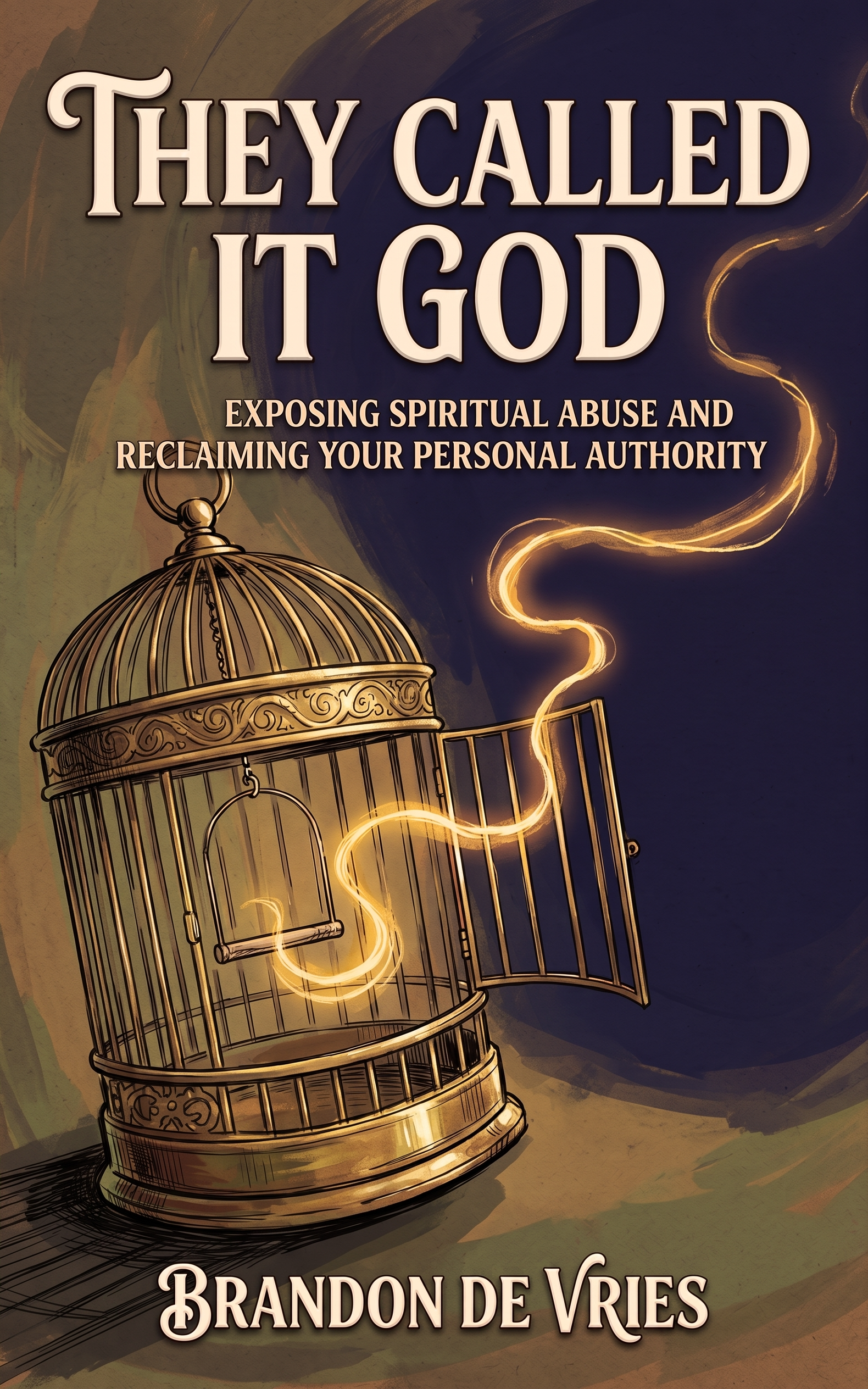
They Called It God
Exposing Spiritual Abuse and Reclaiming Your Personal Authority
by Brandon De Vries
When sacred authority is weaponized, where do you turn to find the truth? For many devoted individuals, high-control spiritual environments begin with promises of community, divine purpose, and unconditional love. But beneath the surface lies a subtle web of coercive control, institutional gaslighting, and the systematic erosion of self-trust. In They Called It God, Brandon De Vries provides a compassionate, evidence-based roadmap for survivors ready to step out from under the shadow of spiritual abuse. Through a structured three-act journey, this groundbreaking guide helps you identify toxic group dynamics, deconstruct weaponized dogma, and navigate the painful fallout of social exile without losing your soul. Packed with actionable somatic grounding protocols, diagnostic grids, and practical boundary frameworks, this book empowers you to dismantle internalized guilt and reclaim your innate intuition. You do not need human gatekeepers to access the sacred. Whether you are actively deconstructing your faith or supporting a loved one in recovery, They Called It God offers the tools to heal your relational health, rebuild unshakeable self-trust, and reclaim your personal sovereignty.
- Self-Help
- Religion & Spirituality
- Healing & Trauma
- Spirituality & Self-Discovery
- Spiritual Growth
- Boundaries & Self-Care
The Sacred Mask: Unmasking Structural Manipulation and Love-Bombing
Predatory systems do not open with control. They open with overwhelming validation dressed up as divine love. That is the trick, and it works precisely because it does not feel like a trick at all. It feels like being found. It feels like relief. It feels, for the first time in a long time, like somebody finally sees you.
Please sit with that for a second before we go any further, because everything else in this chapter builds on it. Nobody joins a high-control group because they are stupid, gullible, or spiritually lazy. People join because a real need was met fast by someone who seemed to understand them better than anyone ever had. That is not weakness. That is being human.
The Weaponized Slogan
Certain phrases get repeated inside high-control environments so often that they stop sounding like sales pitches and start sounding like scripture. Scripture ought to be here for covering." "This community is your absolute sanctuary." "You were led here." Say a phrase like that enough times, in a room full of warm smiles and worship music still ringing in the air, and it stops registering as a claim that needs examining. It just becomes true. Background noise. Air you breathe.
Here is what those slogans are actually doing underneath the emotional language: they are installing a hierarchy before you have had time to notice one exists. "Covering" sounds protective. It sounds like an umbrella held over your head in a storm. But covering, in the mouths of controlling leaders, almost always means one thing — you now answer to me. Your decisions, your relationships, your finances, your calendar, even your doubts now pass through my authority because I have been positioned as your spiritual covering. The word does the heavy lifting so the leader does not have to say the actual sentence out loud.
"Sanctuary" does similar work. A sanctuary is supposed to be a place of safety, and God knows every wounded person walking into a new church is starving for exactly that. But listen to how the word gets used. It rarely describes a place where you are free to disagree, free to leave a service early, free to ask a hard question in a small group without somebody's face going tight. It usually describes a place where you are safe as long as you stay compliant. The moment you stop being compliant, the sanctuary reveals itself as something else entirely — a room with an exit that gets harder and harder to find.
This work exists because this pattern needs a name, and this chapter is where we stabegin to name. Spiritual abuse begins long before anyone notices it, creeping in through the subtle early signs that masquerade as divine love, community, and devotion. To unmask it, we have to expose the inner mechanics of high-control environments and look directly at how toxic leaders weaponize faith. That weaponizing rarely starts with a threat. It starts with a slogan that makes you feel chosen.
How Love-Bombing Actually Works
Love-bombing is not a soft phrase for "being really friendly." It is a documented recruitment mechanism, used by cult leaders, coercive romantic partners, and high-control religious institutions alike, and it follows a fairly predictable arc once you know what to look for.
Stage one is saturation. You get flooded — with attention, with compliments, with invitations, with a leader or key member remembering tiny details about your life and repeating them back to you in ways that feel almost supernatural. It is not supernatural. It is a technique. Intense, sustained attention creates a neurochemical response that mimics falling in love, and falling in love makes people extraordinarily bad at spotting red flags. That is not an accident. That is the point.
Stage two is the manufactured pace. You are told, directly or through group Pressure, that this is happening fast because God is moving fast. Urgency gets spiritualized. "The Lord doesn't want you to wait on this." "We don't usually see this kind of favor this quickly." The urgency is doing a very specific job: it is trying to get you to commit before your discernment has time to catch up with your emotions.
Stage three is the quiet transfer of authority. Somewhere in the middle of all that warmth, a shift happens. The compliments start carrying conditions. The invitations start feeling less like gifts and more like obligations. Missing a gathering, once no big deal, now gets a text asking where you were. Having a different opinion, once welcomed as interesting, now gets a gentle correction about "posture" or "teachability." You do not usually notice the exact moment the transfer happens. You notice, months later, that you have somehow started asking permission for things you used to just decide on.
Historically, this pattern appears across cultic movements regardless of the theology attached to them, because the mechanism is psychological rather than doctrinal. It works in Christian settings, New Age settings, political movements, and multi-level marketing companies—the content changes. The architecture does not. What makes it especially disorienting in religious contexts is that the language of faith gets bolted onto every stage of the process, so that questioning the mechanism feels like questioning God Himself.
This is exactly where the linguistic sleight of hand comes in. Compliance gets unbranded as spiritual maturity. The member who never pushes back, who says yes to every request, who defers instantly to leadership, gets held up as an example of someone who is "growing" or "walking in humility." Meanwhile, the member who asks a pointed question in a leadership meeting, who wants to see the budget, who wonders out loud why the pastor's teaching contradicts something plainly written in the text, gets quietly recategorized. Not as thoughtful. As rebellious. As having "a spirit of offense." As someone who needs prayer covering because something is clearly off in their heart.
I want to be blunt about what that actually is, because soft language keeps people stuck longer than they need to be. Human abuse dressed in divine authority is still human abuse. The vocabulary of faith does not sanctify a leader's tactics. Calling manipulation "discipleship" does not make it discipleship. Calling control "covering" does not make it covering. The label is not the reality.
Scripture itself gives us a much simpler measuring stick for leadership than most high-control environments want you to use. Shepherds are judged by how they treat sheep, not by how many crowds they draw, and if a leader's authority produces fear, shrinking, secrecy, and self-doubt among the people under him, that is not a leadership style that Scripture approves. Read that again slowly. Not attendance numbers. Not charisma. Not how good the sermons feel in the moment. Fruit. Fear versus freedom. Shrinking versus growing. Secrecy versus openness. That is the audit. Everything else is theater.
Rachel Anderson: The Reality Audit
Let me tell you about Rachel Anderson, because her first six months in a high-control fellowship map almost perfectly onto everything we just walked through, and I suspect pieces of her story will feel uncomfortably familiar.
Rachel came out of a rough divorce, isolated, exhausted, and quietly convinced that she had failed at the one thing she thought she was supposed to be good at — being a wife, holding a family together. She was not looking for a cult. She was looking for people who would not look at her with pity or judgment. What she found instead, at least at first, felt like the answer to years of prayer.
Within her first two visits, she was invited to a smaller group led by one of the pastor's closest associates — a woman who, Rachel later said, "remembered things about me that I barely remembered about myself." Small kindnesses arrived constantly. A meal dropped off unannounced. A handwritten card quoting a verse that felt eerily specific to what Rachel had been silently wrestling with that week. An invitation to a leadership training track after only a month, framed as "we don't usually see this kind of anointing this early."
That last phrase should have been a flag. It wasn't, because Rachel had spent years feeling invisible, and suddenly she was being told she was extraordinary. Of course it landed. Of course she leaned in.
By month three, the tone had shifted, though so gradually Rachel could not have pinpointed the exact week it happened. She was now expected to attend three services a week, plus a small group and a serving rotation. Missing any of it got a check-in text that felt caring on the surface — "we missed you, is everything okay?" — but carried an undertone she could not quite name at the time. By month five, a friend outside the church gently asked Rachel why she seemed so anxious about disappointing people she had only known for a few months. Rachel got defensive. She told her friend she did not understand what real community looked like.
That defensiveness is worth pausing on, because it shows up in nearly every account of this kind. The system does not just capture your time. It captures your interpretive framework, so that outside concern starts sounding like outside ignorance. Your friend who has known you for a decade suddenly seems less credible than a small group leader you have known for five months, simply because the small group leader speaks the internal language of the system and your friend does not.
By month six, Rachel described a specific moment that she now identifies as the turning point in her understanding, even though it took another year before she actually left. She had a gut-level, physical sense that something was wrong during a leadership meeting — a tightening in her chest when a financial decision got waved through without any real discussion. She raised a small question about it afterward, privately, to the same leader who had once remembered every detail of her life. The response was warm but unmistakably corrective: she needed to guard her heart against a "spirit of suspicion," because doubt, left unchecked, opens a door the enemy loves to walk through.
Rachel told me later that this was the moment her own instincts started to feel unreliable, and honestly, that is the real damage. Not the missed Tuesday. Not the awkward check-in text. The moment your gut gets recategorized as a spiritual liability. When spiritual manipulation is done in the name of God, it inflicts a very specific fracture — it twists your intuition, teaching you that your gut feeling, that quiet internal voice warning you that something is deeply wrong, is actually "rebellion," "spiritual warfare," or a "deceitful heart."
Run Rachel's timeline against the idealized promises she was given at the start — instant belonging, being seen, being chosen, being safe — and set that next to what actually happened: a widening schedule of required attendance, a narrowing circle of trusted outside voices, a leader who reframed her discomfort as a personal spiritual defect. That gap, between the promise and the pattern, is the entire audit. It is not complicated once you can see it laid out. It is only invisible while you are inside it.
Naming It in Real Time: Scripts You Can Use
Okay. Here is where we get practical, because naming a pattern after the fact is useful, but naming it while it is happening is what actually protects you.
I want to give you what I call the Love-Bombing Diagnostic Matrix — not a complicated tool, just three questions run in sequence whenever a relationship or a community starts moving unusually fast.
- Pace check: Is the intensity of this attention matched by the amount of time we've actually known each other? Real relationships build trust incrementally. Manufactured intimacy skips the increments.
- Reciprocity check: Am I allowed to slow this down without consequence? Ask yourself directly — if I said, "I need more time before I commit to this," would the warmth stay the same, cool, or come with a subtle guilt attached?
- Boundary check: Has anything I've said "no" to been quietly revisited, pressured, or reframed as a spiritual issue? A single "no" that is respected is healthy. A no that keeps getting reopened is a hook.
Alongside the matrix, run what I call the Boundary Audit Protocol. Once a week, especially in the early months of any new community, ask yourself plainly: what did I say yes to this week that I didn't actually want to say yes to? Write it down. Do not edit it for how it sounds. The point is not to judge yourself for saying yes — you said yes because the Pressure was real, and the warmth was, too. The point is to build a written record so the pattern cannot hide behind your memory of individual, isolated moments.
You also need language ready before you need it, because in the moment, manufactured urgency is designed to outrun your ability to think clearly. Here are a few scripts worth practicing out loud, in your own voice, before you ever need them:
- "I need time to process before committing to that."
- "I appreciate the invitation. I'm not going to decide tonight."
- "I hear the urgency, and I'm still going to take the week I need."
- "I'm not comfortable answering that question about my finances/marriage / past right now."
- "I'd like to check with people outside this group before I move forward."
Notice what none of these scripts do. None of them accuse. None of them attack. None of them require you to have the whole system figured out before you're allowed to open your mouth. They reclaim time and reclaim the right to consult your own life before someone else consults it for you. A healthy leader, a healthy community, will not flinch at any of these sentences. A high-control one will.
And here is a quiet internal affirmation worth repeating to yourself in the early weeks of any new relationship or community, religious or otherwise: I am allowed to move at my own pace. Belonging that requires me to abandon my discernment is not belonging. It is capture with better branding.
Do the Work: Reflection Prompts
Get a notebook. Not your phone. Something you can hold, cross out in, come back to. These questions work best written by hand, slowly, without an audience.
- What initial promises drew you into the group — belonging, purpose, healing, certainty, safety? Name them specifically, not generally.
- Where did you first feel Pressure to compromise your personal boundaries "for the sake of community"? Describe the exact moment, the exact request, the exact person.
- Think back to the earliest weeks. What compliment or piece of attention felt the most flattering, the most "finally, someone sees me"? Sit with why that particular thing hit so hard. What need was it feeding?
- Did you ever say no to something in that season and have the no quietly revisited later? Write down what happened the second time you were asked.
- Is there a moment — even a small one — where your gut told you something was wrong, and you were told your gut was the problem? Write down exactly what was said to you in that moment, word for word if you can remember it.
You do not have to finish this list in one sitting. Some of these questions might take a few days to answer honestly, and that is fine. What matters is that you stop letting the fog stay comfortable. Fog is only comfortable because it hides the shape of things. Once you can see the shape — the pace, the Pressure, the reframing, the twisted gut instinct — you can start deciding what you actually want to do about it.
What we have covered here is the doorway, not the whole house. Understanding the mechanics of the door — the slogan, the saturation, the manufactured urgency, the quiet transfer of authority — is what lets you walk back through it with your eyes open, instead of being carried through it. At the same time, someone tells you it's love. The next part of this journey is about what happens once you're standing inside, once the warmth has cooled into something colder, and once the same voices that promised you sanctuary start twisting the very Scripture to draw you in. That distortion — the divine gaslighting — is where we go next, because you cannot dismantle what you have not yet learned to see clearly.
Divine Gaslighting: Exposing the Twist of Scripture and Erosion of Intuition
Here is something nobody tells you on the way into a high-control religious system: the same book that gave you comfort as a child can be turned into a weapon against your own mind, and the person swinging it will call it love the entire time. That is not an accident, and it is not a rare, isolated cruelty practiced by a handful of bad actors. It …
Want to read the rest?
Get the full book here: