

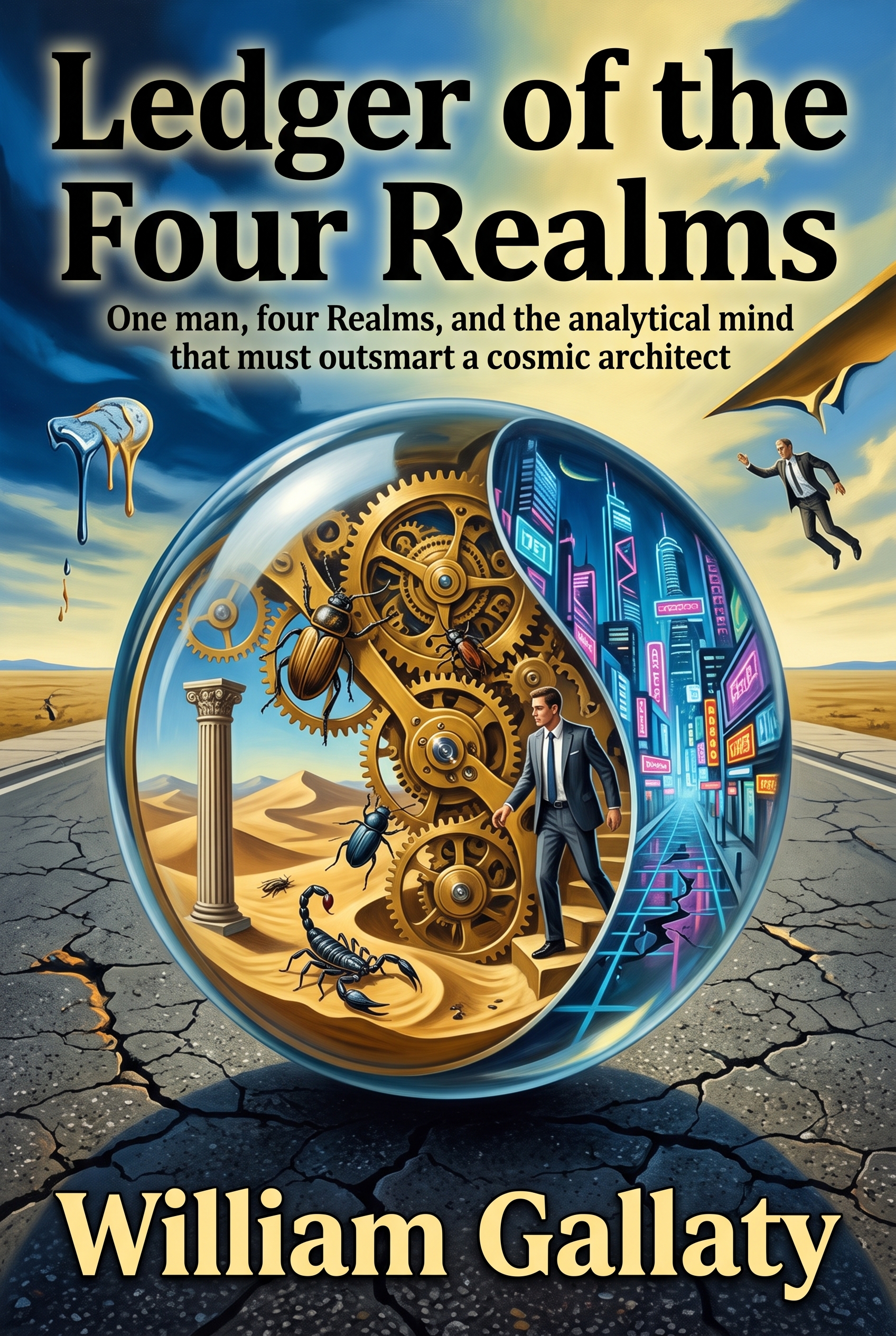
Ledger of the Four Realms
One man, four realms, and the analytical mind that must outsmart a cosmic architect
by William Gallaty
Michael Harlan is a man of spreadsheets and order. As a New York City CPA, balance, logic, and the safety of the status quo define his life. But when he trips into a literal crack in the sidewalk, Michael doesn't hit concrete—he falls into the gears of the universe. Conveyor belts in a subterranean network propelled Michael into a series of fractured realities. Alien overlords crawl through New York; the lawless mud of the 1849 Gold Rush engulfs the scene; an AI-dominated future chills the air; and brutal arenas await in ancient Rome. The rules of reality constantly rewrite themselves through these fractured realities. To survive, Michael must stop being a spectator in his own life. He has no weapons and no superpowers—only his analytical mind and a desperate need to find his way home. But as he navigates these lethal simulations, he realizes he is being watched. A shadowy figure known as the Architect is running an experiment, and Michael is the unwilling subject. To break the cycle, Michael must confront a terrifying reflection of himself and prove that a human soul is more than just a variable in an equation. In this high-stakes game of multiversal chess, the price of losing is eternal deletion.
- Science Fiction
- Thriller
- Adventure
- Parallel Worlds
- Dystopian
- Survival Thriller
The Crack
Just another day in the Big Apple or was it. Mild-mannered CPA Michael Harlan—quiet, unmarried, and living a life of quiet routines and balance sheets, walked slower than the other sidewalk commuters. He was rarely in any hurry to get to his modest accounting office. There was never a rush job except at tax filing times. His world was one of predictable numbers, neat ledger columns, and a deep appreciation for the steady, unchanging rhythm of a Tuesday morning in late September. The city moved around him in a blur of frantic energy, a sea of gray suits and yellow cabs rushing toward some urgent destination, but Michael remained a calm island of order. He adjusted his leather briefcase, feeling the comforting weight of three pending corporate audits tucked neatly inside. He liked the audits. They were logical puzzles with definite solutions, unlike the messy, unpredictable realities of human lives. He took a slow breath of the crisp, autumn air, enjoying the faint scent of roasted coffee beans from a street cart and the distant, familiar hum of subway grates. It was a good day for a walk. It was a day where everything was exactly where it belonged, balanced down to the last penny.
He crossed Thirty-Fourth Street with a measured step, waiting precisely for the pedestrian signal to change from the flashing orange hand to the steady white walking figure. Michael was a man who believed in rules. Rules kept the chaos of eight million people from spilling over the edges of the sidewalk. He looked down at his black leather shoes, polished to a dull shine the night before. They moved in a steady cadence, one-two, one-two, matching the ticking of his vintage wristwatch. The watch was a mechanical piece, requiring a manual wind every morning at exactly seven o'clock. It was an old-fashioned habit, much like his preference for paper ledgers over spreadsheet software when he first started a project. There was a tactile satisfaction in the scratch of a pen on paper, a physical manifestation of order that a glowing computer screen could never quite replicate. He kept his eyes lowered slightly, watching the gray concrete of the sidewalk pass beneath his feet. He knew this path by heart. He knew where the pavement was cracked near the flower shop, and he knew to avoid the puddle that always gathered near the fire hydrant outside the dry cleaners. It was a landscape of minor details, and Michael was a master of details.
The transition from mundane reality to the impossible happened in the space between two heartbeats. It did not begin with a roar or a sudden flash of light, but with a subtle shift in the texture of the ground beneath his right foot. He was stepping over a seam in the concrete, a narrow line where two heavy slabs of granite met near the corner of an old brick building. The gap was normally no wider than a pencil, a standard expansion joint weathered by decades of New York winters. But as his heel came down, the concrete did not resist. It parted. The solid earth, the foundation of his entire structured life, simply ceased to exist beneath him. There was a soft, whispering sound, like a deck of cards being shuffled in an empty room, and then the sidewalk opened up like a pair of dark lips. Michael did not even have time to gasp. His briefcase slipped from his fingers, its metal clasps catching the morning light for one final, brilliant second before it vanished into the gloom. Then, Michael followed it, falling forward into a yawning chasm that had appeared out of nowhere in the middle of a crowded Manhattan street.
The fall was not a violent tumble, but a silent, vertical plunge into an absolute void. The sounds of the city—the screech of brakes, the chatter of pedestrians, the distant wail of a siren—were cut off instantly, as if a heavy vault door had been slammed shut behind him. The air grew cold, smelling of ancient dust, damp iron, and something metallic that reminded him of the third-rail sparks on the subway. He did not scream. The sheer illogic of the situation seemed to paralyze his vocal cords, his analytical mind immediately trying to calculate the physics of a fall that felt entirely unnatural. He was descending through a narrow, vertical shaft, the walls so close he could occasionally feel the brush of cold, rough stone against his sleeves. He tried to reach out, to find a handhold, but his fingers slid off the wet, slick surfaces. The rate of descent was constant, defying the laws of gravity. He was not accelerating at thirty-two feet per second squared; he was moving at a steady, controlled pace, as if he were an item on a dumbwaiter being lowered into a deep basement. He closed his eyes, counting the seconds in his head. One, two, three, four. By his estimate, he had fallen over fifty feet, far below the level of any basement or subway tunnel he knew of. The numbers did not make sense, and that bothered him more than the fall itself.
Then came the impact, though it was less of a crash and more of a sudden, horizontal redirection. Michael hit a surface that was surprisingly pliable, yet incredibly firm. He landed on his side, his ribs taking the brunt of the force, though the material beneath him seemed to absorb most of the shock. It felt like thick, reinforced rubber, moving at a high speed. Before he could orient himself, he was swept forward, his body dragging along the surface until he matched its velocity. He lay flat on his stomach, his hands gripping the edges of what he quickly realized was a massive, moving belt. It was a conveyor, wide enough to support several men lying side by side, and it was rushing through the darkness with a low, rhythmic hum. The air was thick with the scent of machine oil and ozone, the temperature dropping until he could see the faint mist of his own breath when he opened his eyes. But there was nothing to see. The darkness was total, a heavy, suffocating weight that seemed to press down on his chest. There were no lights, no emergency exit signs, and no indication of where the conveyor was heading. He was entirely alone, trapped on a mechanical river in the deep belly of the earth.
Michael lay perfectly still, his cheek pressed against the cold, rough rubber of the belt. His heart was hammering against his ribs, a frantic, irregular rhythm that disrupted his usual internal metronome. He hated irregular rhythms. They represented a discrepancy in the ledger, an error that needed to be found and corrected. He forced himself to take long, steady breaths, counting them to regain control. Inhale for four seconds, hold for four, exhale for four. It was a simple breathing exercise he used during the chaotic rush of tax season, and it worked now, slowly bringing his racing pulse back down to a manageable level. He was a CPA. He dealt with facts, figures, and logical sequences. To survive this, he had to treat it like a complex audit. He had to gather the data, assess the risks, and find the pattern. The first data point was the belt itself. He reached out with his right hand, feeling the edge of the moving track. It was thick, with a heavy steel guide rail running along the side, just inches from his fingers. The belt was moving fast, perhaps fifteen miles per hour, heading in a straight line with no signs of slowing down. The motion was incredibly smooth, suggesting a high-level engineering that didn't align with the city's aging infrastructure.
He carefully shifted his position, turning onto his back so he could look upward. There was nothing but blackness. He raised a hand, waving it inches from his face, but he couldn't see even the outline of his fingers. The darkness was so absolute it felt physical, like a thick velvet cloth draped over his eyes. He reached down to his pockets, his fingers trembling slightly as he searched for his phone. He found it in his right trouser pocket, the familiar rectangular shape offering a small spark of hope. He pulled it out and pressed the power button, expecting the bright, familiar glow of his lock screen to illuminate the tunnel. Nothing happened. The screen remained dead and black. He pressed it again, holding the button down, but there was no response, not even a low-battery icon. He tried the small flashlight key on his keychain next, but the little LED bulb remained dark. It wasn't a dead battery; it was as if the very concept of electrical currents had been suspended, or perhaps some powerful electromagnetic field was dampening his devices. He slipped the phone back into his pocket, his mind registering the information as another variable in the equation. No light. No communication. He was entirely reliant on his own senses and his own mind.
The belt hummed beneath him, a deep, vibrating bass that resonated in his bones. It was a comforting sound in a way, a sign of mechanical consistency in an otherwise terrifying situation. As long as the belt kept moving, he was traveling somewhere, and eventually, every conveyor had to have a terminus. In his line of work, every process had an input and an output. He was the input, a piece of raw material entered into a system he didn't understand. The output was yet to be determined, but he intended to be alive when he reached it. He sat up slowly, keeping his center of gravity low to avoid being thrown off by any sudden shifts in the belt's direction. He sat cross-legged, his hands resting on his knees, his eyes staring into the void. His quiet, peaceful demeanor, a temperament cultivated through decades of solitary routines and quiet office spaces, was his greatest asset now. While another man might have succumbed to screaming panic, Michael found a strange, cold comfort in the analysis of his predicament. He began to inventory his possessions, touching each item through his clothes to confirm its presence. Wallet, keys, pocket watch, a mechanical pencil in his breast pocket, a small notepad. These were his tools, his small anchor points to the world he had left behind just minutes ago.
The air grew colder, and he pulled the lapels of his wool coat tighter around his neck. The scent of ozone was stronger now, indicating a powerful electrical motor nearby, or perhaps a series of generators powering this massive underground network. He could hear other sounds now, faint and distant, echoing through the vast darkness. There was a low clacking noise, like a train passing over distant tracks, and the occasional hiss of pressurized air. It sounded like an automated sorting facility, but on a scale that defied imagination. He wondered if he was beneath Manhattan, or if the fall had transported him somewhere else entirely. The thought of parallel worlds or sci-fi dimensions was illogical, a fantasy reserved for novels and movies, yet his analytical mind couldn't ignore the sheer impossibility of what had occurred. A crack in a solid concrete sidewalk opening up just wide enough to swallow a grown man, then closing instantly behind him. It wasn't a sinkhole; there had been no debris, no dust, and no sound of collapsing earth. It was a clean, precise transition, like a line item being deleted from one spreadsheet and pasted into another.
He reached into his pocket and pulled out his mechanical pocket watch, pressing the release clasp. The lid popped open with a familiar, mechanical click. He couldn't see the face, but he held it close to his ear, listening to the steady, rhythmic ticking of the escapement wheel. Tick-tick, tick-tick, tick-tick. It was a beautiful, comforting sound, a tiny monument to human ingenuity and order in the middle of a chaotic abyss. The watch was still working, which meant mechanical devices were unaffected by whatever force had neutralized his phone. The gears were turning, the mainspring was releasing its energy at a constant, calculated rate, completely indifferent to the darkness surrounding it. Michael felt a sudden surge of respect for the little watch. It was doing its job, keeping time, and he would do his. He closed the lid with a snap and placed it carefully back in his vest pocket. He had to keep moving forward, to prepare for whatever lay at the end of this conveyor. He couldn't afford to be passive. He had to be ready to audit the situation the moment a new data point presented itself.
The belt began to slope downward, the angle gentle but noticeable. Michael shifted his weight, leaning back slightly to maintain his balance. The speed of the belt seemed to increase, the hum rising to a higher pitch, a singing vibration that filled the tunnel. He could feel the air rushing past his face, cold and sharp, bringing tears to his eyes. He blinked them away, staring straight ahead, wishing for even a single photon of light to guide him. Then, he heard a new sound, a deep, metallic clanking that grew louder with every passing second. It was the sound of heavy machinery, of massive gears grinding against each other, and the loud, rhythmic thud of a piston. It sounded like a giant heart beating in the darkness, a mechanical monster waiting to consume him. The risk assessment in his mind immediately spiked, the probability of danger rising to a critical level. He had to be prepared to jump, to throw himself off the belt if it looked like it was heading into a meat grinder or a furnace. He reached out, his fingers finding the steel guide rail again, his muscles tensing as he prepared to make a decision.
The clanking sound was deafening now, reverberating off the invisible walls of the tunnel. Michael could feel the vibrations through the soles of his shoes, a jarring, violent shaking that threatened to throw him off his feet. He crouched low, his knees bent, his hands hovering just above the moving rubber of the belt. He was ready. He had calculated the trajectory of a jump, the angles of impact, the probability of injury. It was a high-risk move, but staying on the belt if it led to destruction was a guaranteed loss. He waited, his senses strained to the absolute limit, searching for any clue, any change in the air current, any shift in the noise that would tell him it was time to leap. And then, just as the noise reached a crescendo, the belt made a sharp, ninety-degree turn to the left. The lateral force was immense, throwing Michael sideways. He slid across the smooth rubber, his shoulder slamming into the steel guide rail with a dull thud. He winced, pain lancing through his arm, but he managed to grab the rail with both hands, holding on for dear life as the belt carried him around the curve and into a new section of the tunnel.
The deafening mechanical noise began to fade, replaced by a low, hollow rushing sound, like wind blowing through an empty cavern. The air pressure changed, growing lighter, and the temperature seemed to rise slightly. Michael let go of the rail and sat up, rubbing his bruised shoulder. He had survived the first major hazard, but he knew the audit was far from over. The system was complex, with multiple inputs, outputs, and processing stages. He was currently in transit, a package being moved from one location to another. But who was the sender? And who was the receiver? The questions multiplied in his mind, each one a red flag on a financial statement that demanded an explanation. He was a man who hated unexplained discrepancies, and he would not rest until he had balanced this ledger. He took a deep breath, the air smelling less of oil now and more of ozone and old, dry paper. It was a strange scent, one that reminded him of the archives in the basement of the public library, a place where history was preserved in quiet, dusty boxes. He sat in the darkness, the conveyor carrying him deeper into the unknown, a mild-mannered accountant turned survivor, guided by nothing but the cold, logical light of his own mind.
He began to analyze the timing of the turns. After the first sharp left, the belt ran straight for what he estimated to be approximately three minutes, based on the ticking of his pocket watch. Then came a gentle slope upward, followed by a long, sweeping curve to the right. He memorized each movement, building a mental map of the conveyor system in his head, a flowchart of his journey through the subterranean dark. It was a way to keep his mind occupied, to prevent the absolute blackness from creeping into his thoughts and turning into panic. He knew that panic was the enemy of logic, a chaotic variable that ruined any calculation. He had to remain calm, to treat this as a structured problem with a logical solution. The belt was a closed system, and every closed system had to have a beginning and an end. He was moving toward the end, and he would be ready when he arrived. He closed his eyes, though it made no difference in the darkness, and let the rhythmic hum of the conveyor carry him forward, a solitary figure in a world of silent, relentless machinery.
The conveyor belt seemed to stretch on indefinitely, a modern Styx carrying him through an underworld of steel and rubber. Michael lost track of the turns after a while, the mental map in his head becoming too complex, too filled with variables to maintain without a pen and paper. He felt a sudden, sharp pang of regret for his lost briefcase. It contained his favorite mechanical pencil, a sleek silver piece with a satisfying weight, and a fresh pad of green ledger paper. With those tools, he could have mapped this entire system, recorded every turn, every slope, every change in speed. He could have turned this terrifying experience into a neat, orderly set of data points. But he had to adapt. He had to use what he had, and right now, all he had was his memory and his analytical mind. He began to run through the numbers of his life, a comforting exercise to keep his thoughts sharp. He calculated the interest on a hypothetical million-dollar loan at four and a half percent over thirty years, compounded monthly. He did the math in his head, the numbers appearing before his closed eyes in neat, orderly columns of blue ink. It was a beautiful, clean calculation, a small island of sanity in a sea of impossible darkness.
The air grew suddenly warmer, a dry, dusty heat that made his skin itch beneath his heavy wool coat. The scent of old paper returned, stronger now, accompanied by a faint, dry smell that reminded him of parched earth and old stone. The hum of the conveyor belt changed, the pitch dropping as if the motor were working harder, pulling the heavy belt up a steep incline. Michael leaned forward, placing his hands on the rubber surface to steady himself. The belt was rising, the angle growing steeper with every foot they traveled. He could feel the strain in his calves, the muscles tensing as he tried to maintain his position. He was climbing, moving toward the surface, or perhaps toward another level of this massive subterranean labyrinth. The thought of what lay ahead filled him with a mixture of apprehension and curiosity. He was a man of routine, a man who disliked surprises, yet there was a small, quiet part of him that found this challenge exhilarating. It was the ultimate audit, a test of his analytical mind against a system of absolute, terrifying complexity. He would not fail. He would find the error in this equation and correct it, no matter how many columns of figures he had to check.
The incline began to level off, the belt flattening out with a soft, mechanical click. Michael sat up, his eyes wide in the darkness, searching for any sign of change. And then, he saw it. A faint, gray light, no more than a pinprick in the distance, appearing ahead of him like a single star in a cloudy sky. It was the first light he had seen since his fall, and it filled him with a sudden, intense relief. He watched it grow, the tiny dot expanding into a narrow, vertical slit of gray, a doorway in the dark. The belt was carrying him directly toward it, the speed remaining constant, a steady fifteen miles per hour. Michael stood up slowly, his feet wide apart for balance, his hands held out to his sides. He was ready. He was approaching the output of the system, the final stage of this mechanical process. He adjusted his coat, smoothed his tie, and took a deep, steady breath. The mild-mannered CPA from New York City was about to face whatever lay beyond the dark, armed with nothing but his logic, his pocket watch, and an unwavering belief in the power of a balanced ledger.
The light grew brighter, a cold, harsh gray that revealed the outline of the tunnel around him. It was a massive pipe of corrugated steel, the walls wet with condensation, the conveyor belt running down the center like a black road. Michael could see his own reflection in the wet metal, a disheveled figure in a gray suit, his hair messy, his face pale and smudged with soot. He looked like a man who had survived a disaster, yet his eyes were calm, his expression composed. He was analytical, logical, and ready. The end of the tunnel was just yards away, a rectangular opening that framed a view of a gray, desolate sky. The belt carried him through the opening, and Michael stepped off the moving rubber onto a solid, concrete platform, his shoes making a sharp, clean sound in the silent air. He was out of the dark, but as he looked around, he realized that the world he had returned to was not the New York City he knew. It was something else entirely, a parallel reality that would test every ounce of his analytical mind to survive. He stood on the platform, his pocket watch ticking steadily in his vest pocket, and prepared to begin his audit of this new, terrifying ledger.
The transition from the conveyor to the platform was a physical shock, the sudden cessation of motion making his head spin. Michael staggered a step, his polished shoes finding purchase on the cold, damp concrete. He stood still for a long moment, waiting for his internal balance to catch up with his surroundings. The air here was different. It didn't smell like Thirty-Fourth Street; there was no scent of exhaust fumes, no hot garbage, no greasy nuts roasting on a corner cart. Instead, it was a flat, sterile cold that carried a faint, metallic tang, like copper pennies held in a wet palm. He looked up, expecting to see the familiar, comforting geometry of the Empire State Building or the sheer glass face of the Chrysler Building, but the sky above was a uniform, heavy gray, like a sheet of unpolished steel. There were no clouds, no sun, just a flat, ambient light that seemed to come from everywhere and nowhere at once. The silence was absolute, a heavy, dead quiet that made the ticking of his pocket watch sound like a hammer striking an anvil.
Michael took a slow, deliberate step toward the edge of the platform. He was a man who appreciated structure, but the structure before him was alien and deeply unsettling. The platform was perched on the side of a massive, circular shaft that plunged down into the depths of the earth, a dark abyss from which the conveyor belt had emerged. Looking down, he could see other belts, dozens of them, snaking through the darkness like black ribbons, moving in silent, synchronized patterns. They crossed each other at different levels, some carrying large, crates of dark metal, others completely empty, all part of a vast, automated sorting system that seemed to have no human operators. It was a machine city, a subterranean metropolis of steel and rubber, and he was a single, tiny biological error that had been accidentally introduced into its complex algorithm. He reached into his pocket and pulled out his mechanical pocket watch, checking the time. It was exactly eight-fifteen. In his normal life, he would be walking into his office right now, greeting his secretary, and pouring his first cup of black coffee. Here, he was standing on a concrete ledge over a bottomless pit, facing an impossible reality.
He turned away from the shaft, his eyes scanning the platform for an exit. There was a single, heavy steel door set into the concrete wall, its surface painted a dull, industrial gray. There were no handles, no keyholes, just a small, rectangular screen near the center that glowed with a faint, blue light. Michael walked over to it, his steps deliberate and measured. He was a CPA; he knew that every system had an entry point, a way to access the data. He stood before the screen, looking at his own pale reflection in the glass. The screen displayed a single line of text in a clean, sans-serif font: Awaiting Input. There was no keyboard, no buttons, just a small, circular glass pad below the screen, about the size of a silver dollar. It looked like a biometric scanner, a device designed to read a fingerprint or a handprint. Michael hesitated, his analytical mind calculating the risks. If he placed his hand on the scanner, he would be identifying himself to a system he didn't understand. It could lock him out, trigger an alarm, or worse. But staying on the platform was a dead end. In financial terms, it was a stagnant asset, producing no return and carrying a high risk of depreciation. He had to make a move.
He raised his right hand, his fingers steady, and pressed his thumb against the cold glass pad. The scanner immediately glowed with a bright, green light, a soft chime echoing through the silent platform. The text on the screen flickered and changed, the words scrolling upward in a rapid blur before settling on a new message: Subject 42: Verified. Access Granted. Michael frowned, his logical mind immediately seizing on the designation. Subject 42. It wasn't his name, nor was it any number he had ever been associated with. It was a label, a data point in a larger ledger. The implication was clear and chilling: he was not a random victim of an accident; he was a registered entity in this subterranean system. The heavy steel door slid open with a soft hiss of pneumatic pressure, revealing a long, narrow corridor lined with white, clinical tiles. The light inside was bright and sterile, casting sharp shadows on the clean floor. Michael took a deep breath, adjusted his tie, and stepped through the doorway, the steel door sliding shut behind him with a solid, final click. He was inside the machine, and the audit had officially begun.
The corridor was long, stretching out ahead of him for what seemed like hundreds of yards, with no doors or windows on either side. The silence was even more intense here, the sound of his footsteps on the tiled floor echoing off the walls like pistol shots. Michael walked at a steady pace, his eyes moving from side to side, noting every detail. The tiles were perfectly square, measuring exactly twelve inches by twelve inches, laid out in a neat grid that would have pleased any surveyor. The grout lines were clean and white, with no signs of dirt or wear. It was a space that was meticulously maintained, yet it felt entirely devoid of life. There were no signs of human occupancy, no discarded papers, no scuff marks on the floor, no scent of cleaning chemicals. It was a sterile, static environment, like a laboratory that had been prepared for an experiment but never used. Michael felt a cold knot of apprehension tighten in his stomach, but he kept his face expressionless, his quiet, peaceful demeanor a shield against the creeping dread.
As he walked, he began to notice a low, rhythmic vibration beneath his feet, a subtle hum that was different from the mechanical roar of the conveyor belts. It was a pulse, a steady, throbbing energy that seemed to flow through the very walls of the corridor. It felt like the heartbeat of a massive organism, a silent power source that kept this entire world running. Michael stopped, placing his hand against the cold white tiles. The vibration was there, a faint, electrical tingle that vibrated in his palm. He closed his eyes, concentrating on the rhythm. It was steady, regular, repeating every three seconds. A three-second cycle. He opened his eyes and looked down the corridor, his mind immediately translating the rhythm into a physical distance. If the corridor was indeed a closed system, then this pulse was a signal, a wave of data or energy moving through the network. He was walking along a data conduit, a physical pathway for information in a world that seemed to be entirely ruled by logic and machinery.
The corridor finally ended at another steel door, identical to the first, but this one was already open, revealing a large, circular chamber. Michael stepped inside, his eyes widening as he took in the scale of the room. The chamber was vast, the ceiling lost in the shadows high above, the walls lined with thousands of small, metallic drawers, like a giant safety deposit vault. In the center of the room stood a circular console of black glass, its surface glowing with a complex array of charts, graphs, and scrolling lines of green code. It looked like a command center, a place where a single operator could monitor and control the entire subterranean network. Michael walked toward the console, his shoes clicking softly on the polished metal floor. He stood before the glowing glass, his analytical eyes immediately scanning the data. It was a ledger, but not one of financial transactions. It was a ledger of human lives, of names, dates, and locations, all organized into neat, digital columns that stretched across the screen. And there, near the top of the main screen, was his own name: Michael Harlan. Status: Active. Phase 1: Initiated.
Michael stared at the screen, his heart skipping a beat. His name was there, spelled correctly, alongside his date of birth, his social security number, and a detailed summary of his financial history down to the last penny. It was a complete audit of his life, a digital record that was more accurate than any file he had ever compiled for himself. The level of detail was staggering, including his high school grades, his medical records, and even his daily walking route through Manhattan. The system knew everything about him, his routines, his preferences, his quiet, solitary habits. It was a level of surveillance that defied any legal or ethical boundary, a clinical, detached collection of data that treated his entire existence as a mere variable in a grand equation. Michael felt a sudden, sharp anger cut through his analytical calm. He was a man who valued his privacy, a man who lived a quiet, unassuming life precisely to avoid this kind of scrutiny. To see his life laid out like a balance sheet for some unknown observer was an intolerable violation. He reached out, his hand hovering over the glass console, wanting to delete the file, to erase his data from this cold, unfeeling system.
Before he could touch the screen, a voice echoed through the circular chamber, a deep, resonant tone that seemed to come from the very walls themselves. It was an authoritative, clinical voice, completely devoid of emotion, yet carrying the weight of an absolute ruler. "Welcome, Michael," the voice said, the sound vibrating in the metal floor beneath his feet. "You have completed the first phase of the experiment. Your transit was within the predicted parameters of efficiency, and your physiological response is well within the acceptable limits of stress. You are a remarkably stable subject." Michael stood still, his hand remaining suspended over the console. He did not look around; he knew there was no physical presence in the room with him. The voice was a disembodied force, a manifestation of the system itself, the hidden architect of this elaborate trap. He lowered his hand and turned his head slightly, his voice calm and steady as he addressed the empty room. "Who are you?" he asked, his tone demanding a clear, logical answer. "And why am I here?"
The voice did not hesitate, responding with the same cold, clinical detachment. "I am the Architect of this system. You are here because you are a unique variable, a subject of exceptional analytical capability and logical structure. Your life, Michael, has been a study in order, a perfect balance of routine and predictability. We are testing the limits of that order when faced with the absolute chaos of the unknown. We are auditing your survival, Michael, to see if a mind built on logic can withstand a world built on madness. Your journey has just begun." The words hung in the silent air, a chilling revelation that confirmed his worst fears. He was a guinea pig, a biological data point in a grand, dystopian laboratory. The crack in the sidewalk, the fall, the conveyor belt—it was all an engineered test, a structured challenge designed to push his analytical mind to its limits. Michael felt a cold resolve settle over him, his anger transforming into a sharp, focused determination. He was a CPA, a master of details and systems, and if this Architect wanted to audit his survival, he would give him an audit he would never forget. He would find the flaws in this system, the errors in the code, and he would use them to tear this digital prison down. He looked back at the screen, his eyes bright with a quiet, dangerous light. "Then let's look at the numbers," he whispered into the silent chamber, and the next phase of his journey began.
The screen before him flickered, the green code dissolving into a complex map of parallel pathways, each one leading to a different destination. The paths were labeled with strange, cryptic terms: Dystopia 2095, Gold Rush 1849, Roman Judea, Alien New York. It was a visual representation of the cosmic game he was being forced to play, a series of hostile realities where his survival would be tested to the absolute limit. Michael looked at the map, his mind immediately beginning to calculate the probabilities, to assess the risks of each path. He knew that the Architect was watching, analyzing his every decision, but he didn't care. He was no longer a passive observer of his own life; he was an active player, a survivor who would use every tool at his disposal to cheat fate and claw his way back to the real world. He reached out his hand, his finger hovering over the first path, and prepared to make his choice. The mild-mannered CPA from New York City was gone, replaced by a man of steel and logic, ready to challenge the creator of his destiny. He pressed his finger against the screen, and the chamber around him dissolved into a blinding flash of white light, carrying him forward into the unknown.
The Junction
The blinding flash of white light receded as quickly as a blown fuse, leaving Michael Harlan flat on his back once more. The sterile, white-tiled chamber and the glowing glass console were gone, deleted from his immediate reality like a misplaced cell entry on a cleared spreadsheet. Underneath him, the familiar, unforgiving texture of high-speed ru…