

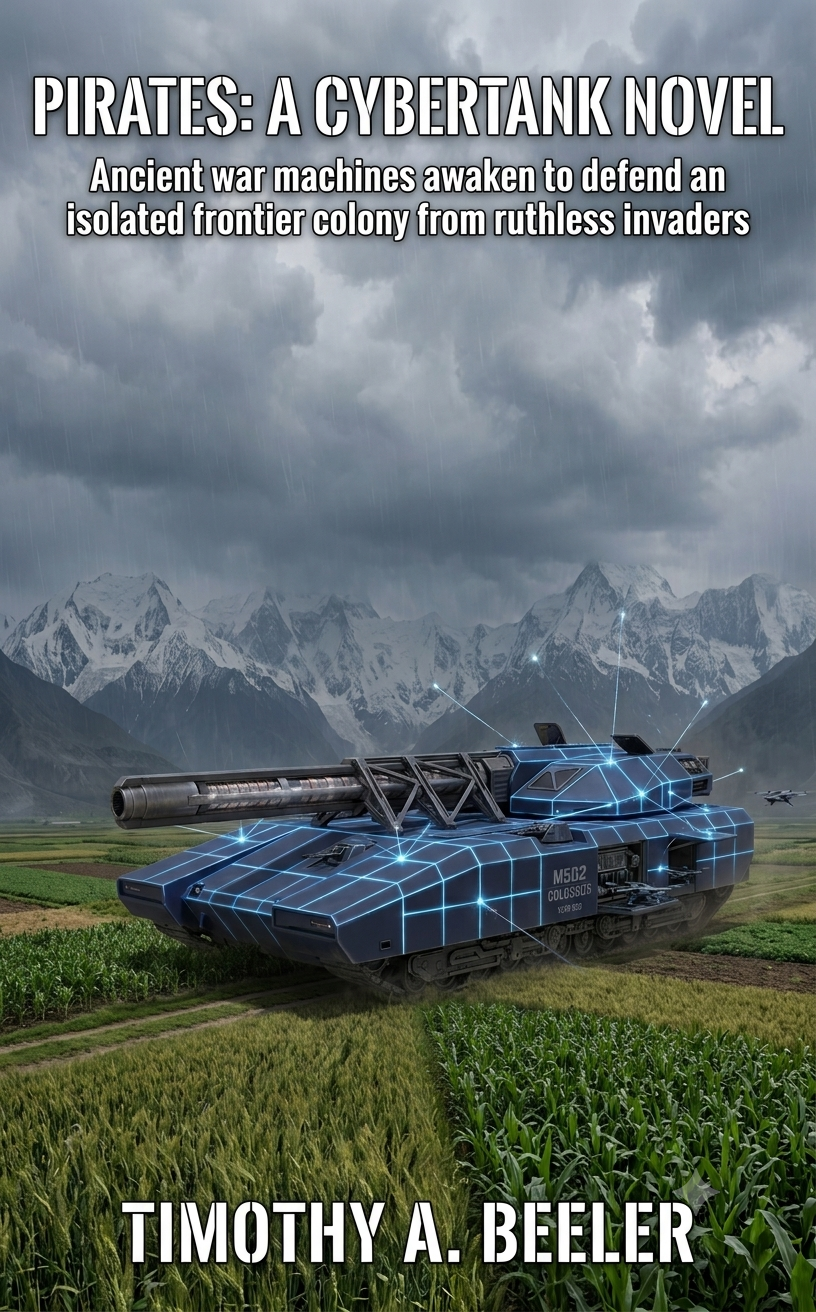
Pirates: A CyberTank Novel
Ancient war machines awaken to defend an isolated frontier colony from ruthless invaders
by Timothy Beeler
An outer-rim paradise on the brink of destruction. On the peaceful agricultural world of New Harvest, recent university graduates Nathan, Elena, and Julian expected a quiet future surveying the wilderness. Instead, they stumble upon a secret buried deep beneath the northern mountains: a forgotten military depot holding two millennia of CyberTank development history, including three dormant M5G2 Colossus units. Their life-changing discovery couldn't come at a worse time. A ruthless pirate fleet commanded by a disgraced former officer descends on the undefended world, intent on stripping its resources and enslaving its people. With no military forces to protect them, the young colonists must execute a desperate gamble. To survive, Elena must crack centuries-old firewalls, Julian must organize an army of civilian farmers, and Nathan must risk his mind to master the deadly neural interface of a behemoth war machine. As the sky fills with enemy drop-ships, these young graduates are all that stand between their home and total annihilation. Timothy A Beeler delivers a thrilling military sci-fi epic combining deep mechanical lore with high-octane armored warfare.
- Science Fiction
- Military Sci-Fi
- Robots & AI
- Colony Worlds
The Northern Wilds
The ground beneath the crawler’s heavy treads was a mixture of slate gravel and wet glacial mud, treacherous enough to slip a lesser machine sideways down the ledge. Nathan Cross kept both hands on the twin steering levers, feeling the vibration of the six-cylinder diesel engine hum up through the soles of his work boots. The smell of hot grease, burnt sulfur, and cold pine needles filled the cab, familiar and grounding. Out here, four hundred kilometers north of the agricultural basin that supported the settlement of New Harvest, the air was thin enough to bite the back of a man’s throat.
A sharp metallic clack echoed from the trailing arm behind them, followed immediately by the harsh whine of an overloaded hydraulic pump.
Nathan pulled the throttle back into low idle and set the brake. "That was the high-pressure line on the soil sampler," he said, flicking a row of toggle switches on the overhead console to cut power to the towed survey rig. "I told the quartermaster back at the campus that those rubber fittings weren't rated for high-altitude frost."
Julian Ortega leaned back in the front passenger seat, pulling off his heavy woolen cap to wipe his forehead. Despite the near-freezing chill outside, the big man looked like he had just finished a turn in the fields. He reached into the footwell, pulling up a battered aluminum canteen and taking a long swig. "He probably gave us the cheap spares on purpose, Nate. The department heads aren't going to waste brand-new parts on three graduates taking a victory lap through the rocks."
"It's not a victory lap," Elena Kowalski said from the rear workstation. She didn't look up from her portable display terminal, her fingers tapping rhythmically across the tactile keys. The blue light of the screen reflected off her grey eyes, making her pale face look almost luminescent in the overcast afternoon light. "We’re completing the northern quadrant mapping initiative. If we don't clear these grid lines, the university loses its research grant for next season, and the central council won't allocate the raw nitrate shipments for the southern valley farms."
Julian grinned, turning around in his seat to look at her. "You take all the fun out of a road trip, El. We finished our finals, we passed our certs, and in three days we get assigned to permanent regional posts. This is the last time we get to see the sky without a greenhouse frame in the way."
"Some of us prefer the greenhouses," Elena muttered, though her tone lacked any real bite. She swept a hand across her sensor pad, zooming in on a grainy topographical sweep. "Besides, the terrain ahead doesn't match the old survey maps from the second wave of colonization. The elevation contours are off by almost twenty meters."
"The ground settles," Nathan said, unlatching the heavy steel cab door. The cold northern wind immediately rushed in, carrying the damp mist from the valley below. He grabbed his tool kit from beneath his seat, the heavy steel spanners clinking together in the canvas bag. "I’m going to fix the high-pressure loop. Julian, grab the torque wrench and keep an eye on the crawler's rear differential. If that seal blows out, we’re walking back to the railhead."
"Walking builds character," Julian said, but he unbuckled his harness and climbed out into the mud anyway, pulling his heavy work coat tight around his broad shoulders. He grabbed a multi-meter and a heavy lever bar from the side rack of the crawler, stepping into the slick gravel with the easy, planted balance of a man raised on uneven earth.
Nathan dropped to his knees behind the towed soil-sampling rig. The machine was a custom piece of agricultural hardware, built to drill two meters into the clay bed and measure nitrogen levels, micro-mineral concentrations, and moisture retention. The flexible high-pressure hose leading to the primary hydraulic ram had burst right near the copper fitting, spraying red fluid over the dark, damp rock.
"The rupture isn't bad," Nathan called out over the whistle of the wind. He reached into his pocket, pulled out a thick roll of reinforced steel-mesh tape, and set his wrenches on the flat top of the drill housing. "The inner sleeve held, but the outer braid gave up. I can bypass the secondary valve and run a direct line from the manifold."
"Make it quick," Julian called back. He had walked past the tail end of the trailer and was standing on the edge of the narrow rock shelf, peering down into an unmapped ravine that cut deep into the side of the mountain. "The fog is rolling up from the lower basin. If it hits us while we’re on this ledge, we’ll be creeping along at two kilometers an hour all the way to nightfall."
Nathan worked quickly, his calloused fingers moving over the brass fittings with trained efficiency. Years spent working on his father’s combined harvesters had taught him that machines were simple creatures; they only did what the metal and fluid allowed them to do. If a line leaked, you sealed it. If a gear stripped, you replaced it. Humans were complicated, full of doubts and second guesses, but an engine was honest. It worked, or it didn't.
He pulled the primary fitting tight with a thirty-millimeter wrench, wiping the excess fluid off the stainless steel casing with a rag. "Julian, hand me that spare quart of hydraulic fluid from the side crate."
There was no answer.
Nathan tightened the line cap and glanced over his shoulder. Julian hadn't moved from the edge of the gorge, but he wasn't looking at the fog. He had pulled his heavy-duty cattle prod from his belt—a modified tool he kept for wild ridge-beasts—and was using the tip to push aside a thick mass of dark green mountain vines clinging to the vertical rock wall across the narrow gap.
"Nate," Julian said, his voice dropping into a low, quiet register that made Nathan immediately set his tool bag down. "Take a look at this."
Nathan stood up, wiping his hands on his coveralls, and walked over to the edge. The ravine was narrow, less than eight meters wide, carved by centuries of snowmelt that rushed down from the granite peaks above. On the far wall, where the rock face curved inward beneath a overhang, the gray stone looked strangely flat.
Julian swung the cattle prod, clearing away a large clump of heavy, broad-leafed vegetation. Behind the green cover, the surface wasn't rock at all. It was smooth, dark gray, and scored with tiny, perfectly uniform lines.
"Reinforced concrete," Nathan said, stepping closer to the edge. He squinted through the dim light. "High-density slag composition. That's not local rock, and it's not civilian construction grade."
From the cab of the crawler, the door slammed open, and Elena jogged over the slick gravel, her boots making a sharp crunching noise. She held a hand-held scanner tightly in her right hand, its green directional array pointing straight at the wall.
"My ambient sensors just spiked," Elena said, her eyes wide as she looked down at the reading. "I was getting localized radio interference on the low frequencies, but I thought it was just solar noise off the iron deposits in the mountain. It isn't. Something over there is radiating an active, structured electromagnetic signature."
"How active?" Nathan asked, turning to look at her.
"Very low power," she replied, adjusting the fine-frequency knob on her interface. "Like a trickle-charge backup battery or a dormant logic loop running on deep standby. It's radiating through fifty centimeters of solid composite wall."
Julian picked up a heavy rock from the ledge and tossed it across the narrow gap. It struck the flat surface with a sharp, heavy thump that echoed down the canyon. The impact knocked away another sheet of dying vines, revealing a massive, square outline set deep into the mountain bedrock. A pair of heavy blast doors, made of dark, rust-pitted armor plate, stood sealed against the stone.
"That's old," Julian said, crossing his arms over his chest. "Five hundred years at least. First Settlement era, before the trade routes collapsed and the old military detachments left."
"The Federation didn't build staging stations in the northern range," Elena said, her voice fast and technical as she cross-referenced the coordinates on her wrist unit. "The colonial archives state this entire region was designated purely for atmospheric research and timber harvesting. There are no records of heavy military infrastructure north of the river."
"Archives lie," Nathan said quietly. He walked along the edge until he found a spot where a fallen rock slide created a natural bridge across the shallow stream running through the bottom of the ravine. "Or somebody didn't want the settlers to know what was up here."
He scrambled down the slope, his boots sliding through the loose shale, and stepped onto the stone rubble. Julian followed without a word, his broad frame moving with surprising quickness, while Elena hovered near the top, her scanner clutched like a shield as she tracked the power grid beneath them.
At the base of the massive doors, the air felt noticeably colder. The ground was clear of moss and debris, protected from the rain by the deep overhang above. A thick layer of grey dust coated everything, undisturbed for centuries. On the right side of the steel frame, buried beneath a heavy clump of mineralized earth and dried lichen, sat a rectangular metal box painted in faded safety yellow.
Nathan took out his utility knife and scraped away the encrusted dirt, exposing an emergency manual override panel. Beneath the layer of grime, a heavy lever rested in the locked position, surrounded by ancient warning labels stamped in high-contrast block lettering.
"The primary power coupling is long dead," Nathan observed, tracing the heavy insulated cables that ran from the panel into the wall. "The contactors are fused together by rust. If we want this to open, we’re going to have to bypass the relay directly."
"Nate, maybe we should report this to the regional directorate first," Elena said, her voice coming down from the ledge above as she slowly picked her way down the rock path. "If this is a classified colonial cache, breaking the seal might trigger an automated salvage alert or violate territorial salvage codes."
"The nearest regional office is three hundred kilometers away, and our radio transponder barely reaches the relay tower at the foot of the mountains," Julian pointed out. He reached down, grabbing the edge of the yellow panel door, and pulled with a grunting breath. The ancient lock snapped with a sharp ping, and the door swung open on dry, screeching hinges. "Besides, look at these hinges. Nobody's been here since the planet was mapped."
Inside the box sat a bank of cold, dark vacuum tubes and a heavy copper knife switch connected to a pair of thick lead-acid battery terminals. The glass on the tubes was grey with corrosion, and the copper was covered in a thick layer of green patina.
Nathan reached into his tool kit and pulled out a jump-starter pack—a heavy lithium unit meant to jump-start the crawler’s main diesel engine. He attached the red clamp to the main bus bar inside the panel and connected the black ground lead to the unpainted steel frame of the door.
"Stand back," Nathan said, flicking the power switch on his jump pack.
A sharp spark cracked in the tight space, accompanied by the pungent smell of ozone and burnt insulation. Inside the wall, a heavy mechanical solenoid clicked—once, twice—and then a deep, resonant hum vibrated through the stone floor under their feet. A row of tiny emergency indicator lights above the door flickered, glowing a dim, dusty amber.
"It worked," Elena whispered, stepping up behind Nathan, her eyes wide as she watched the ancient logic board attempt to boot up. "The local capacitors held a micro-charge for five hundred years."
With a deafening metal-on-metal screech, the heavy steel blast doors shuddered. Clouds of ancient dust poured out from the vertical seam as the internal counterweights dropped. The left door jerked back six inches, stopped with a mechanical clatter, and then slowly began to slide into the mountain wall, dragging rust and dried debris with it.
The gap widened, revealing a pitch-black corridor that plunged straight into the heart of the granite ridge. The air that rushed out of the opening was dry, icy, and smelled strongly of preserved machine oil, ozone, and cold steel.
"That isn't an agricultural storage shed," Julian said, shining his heavy work light into the dark opening. The beam of light cut through the suspended dust, catching the reflective white paint of directional markers painted along the concrete walls.
"Look at the structural reinforcement," Nathan said, taking a step across the threshold. His boots left clean prints in the thick dust. The ceiling was arched, supported by heavy ribbing made of dense carbon-steel alloys that were never produced on New Harvest. "This was built to withstand orbital bombardment."
Elena pointed her handheld terminal down the long hallway. The screen flashed bright green, processing a flood of incoming data as the station's passive sensors linked with her device's short-range wireless receiver.
"I'm picking up a localized network architecture," she said, her voice dropping as she read the scrolling lines of text. "It's running an ancient military operating system. The header identifies this site as Staging Station 09—a forward maintenance and re-arm depot for planetary defense forces."
"Defense forces?" Julian let out a low whistle. "The history books said the planet was settled by a civilian farming cooperative."
"The books left out a few details," Nathan said. He stepped further into the hall, his flashlight beam catching a set of heavy steel tracks embedded in the concrete floor. They were wide—far wider than any train or agricultural transport he had ever seen on the colony.
High above them, miles beyond the cloud cover and the granite peaks of the northern range, the dark sky was quiet. But on the console of the crawler parked out on the ledge, a secondary communications receiver—tuned to the wide-band emergency orbital monitoring frequencies—silently began to register a signal.
A cluster of heavy contacts had just dropped out of sub-light space at the edge of the New Harvest system. There were no friendly broadcast codes, no trade manifests, and no civilian registry pings accompanying the arrivals. A warship, scarred by years of unmaintained combat ops and flying under the darkened transponders of a pirate raiding fleet, adjusted its descent vector, turning its iron prow directly toward the defenseless agricultural world below.
In the quiet gloom of the subterranean corridor, Nathan Cross paused, feeling a faint, rhythmic pulse beneath the floorboards—a vibration that had nothing to do with the wind outside or the diesel engine of their crawler. Deep within the dark belly of the mountain, something massive was slowly, methodically waking up.
Historical Records
The dark air inside the entrance tunnel grew noticeably colder with every step, the overhead clearance expanding until the narrow rock trench gave way to an cavernous subterranean entry vault. High above, thick steel I-beams supported arches of poured carbon-composite, engineered to withstand structural impacts that would collapse an ordinary bunke…