

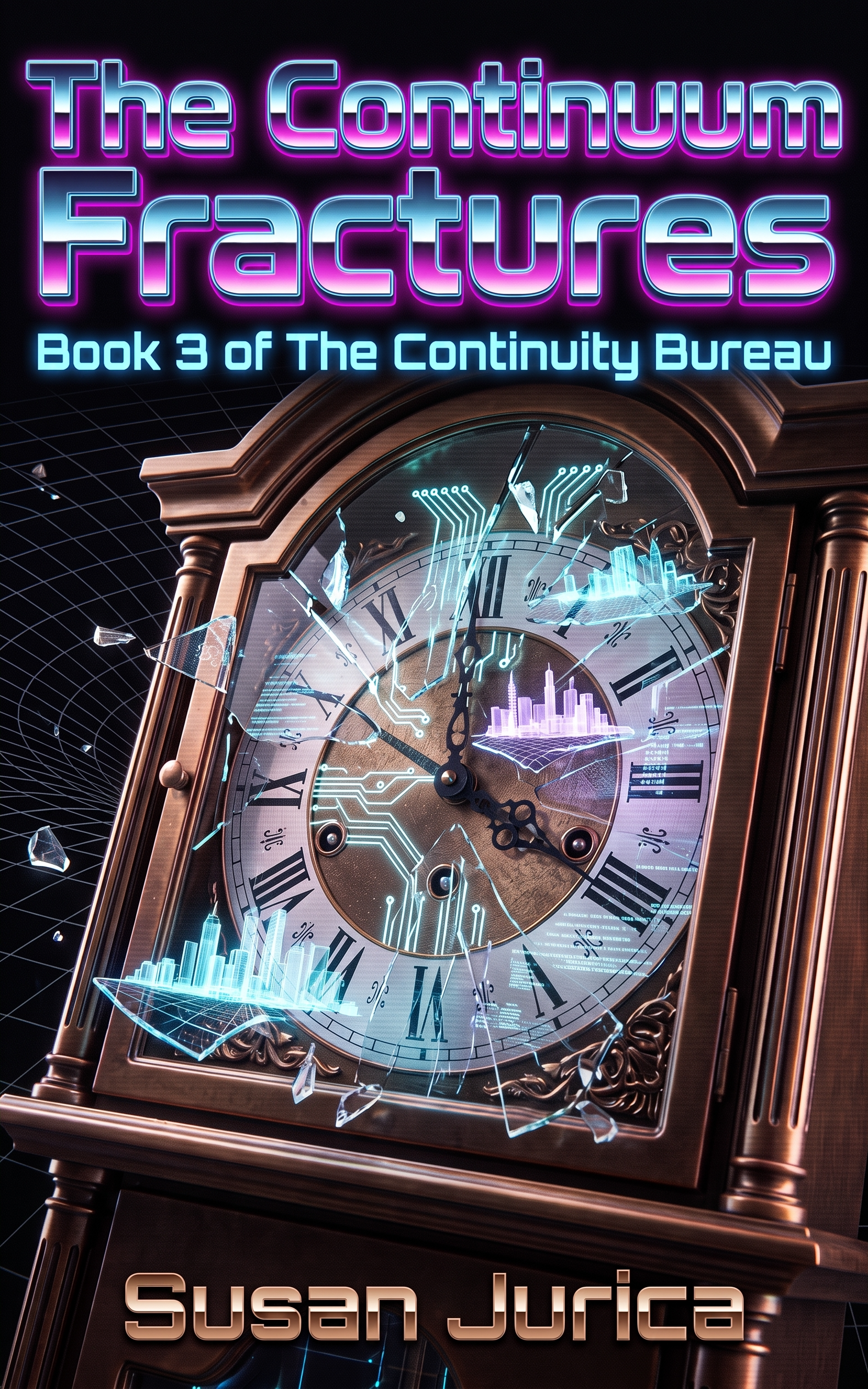
The Continuum Fractures
Book 3 of The Continuity Bureau
by Susan Jurica
The continuum is collapsing. Across unmapped quantum dead zones, retro-causal shifts are erasing entire historical sectors from existence. Continuity Bureau field agents Arthur Vance and Clara Holloway are dispatched to repair damaged timeline anchors before total substrate collapse occurs. But as reality warps around them, they uncover a dangerous secret: previous attempts to stabilize time created thriving rogue pockets populated by millions of temporal survivors. Now, Director Priya Okonkwo-Reyes has ordered aggressive timeline pruning to enforce a standardized reality. Bound by duty but confronted with humanity's remnants, Vance and Holloway face an impossible choice—obey the Bureau to preserve core history, or defy orders to save isolated timeline branches from utter annihilation. Plagued by accelerating temporal nerve degradation and hunted by desperate rogue operatives, Vance must navigate a web of administrative corruption and temporal gravity anomalies. With time running out, the team must execute a dangerous strategy to establish a new universal reference grid before every reality vanishes forever. From Susan Jurica comes an electrifying hard sci-fi thriller that explores the cost of progress and the true price of survival.
- Science Fiction
- Science Fiction
- Time Travel
Echoes in Sector Seven
The perimeter fence at Outpost 9 had rusted through in places that made no sense for rust, streaks of orange bleeding across metal that should have been installed eighteen months ago and looked, in the wrong light, like it had been rotting since the Nixon administration. Arthur Vance stepped past it without breaking stride, the way a man steps past a warning sign he has read too many times to take seriously anymore, and let the dead zone swallow him whole.
Sector Seven did not so much surround him as argue with itself. One breath the street ahead was concrete rubble and blown-out storefronts, awnings collapsed into gray heaps, and the next breath, faster than a blink could account for, the same block wore glass towers forty stories tall, clean and lit and humming with a future that had no business existing here. The flicker came and went like a bad signal on an old television, and Vance had stopped flinching at it sometime around his second year in the field. Clara Holloway had not stopped flinching. He noticed the small, hard set of her jaw each time the skyline changed, the way her hand drifted toward the scanner at her hip as though the device could be reasoned with.
"Pryce," she said into her comm, not looking away from the shifting horizon, "tell me the readings match what I'm seeing, because right now I've got a street that can't decide what decade it wants to be in."
Nathaniel Pryce's voice came back thin and a little too fast, the way it always did when the numbers scared him before his mouth caught up. "It's worse than that. I'm reading substrate fraying across a thirty-year window, ma'am, maybe thirty-two. Whatever's holding this sector together is losing grip on more than architecture. We could be looking at an entire regional history coming loose at the seams."
Vance let the words settle without comment. Thirty years of history did not erase quietly. It erased the way a photograph left too long in the sun erases, the color going first, then the shape, then the fact that anyone had ever stood there at all.
The mobile medical unit sat forty yards back from the perimeter, a squat gray box on treads that Dr. R. Okonkwo had commandeered as her personal fiefdom for the duration of the operation. She caught Vance by the sleeve before he'd gone another ten feet, her grip surprisingly strong for a woman built like a librarian.
"Two minutes," she said. "I'm not asking."
He gave her the two minutes because arguing cost more time than complying, and because the tremor running through his right wrist had gotten bad enough in the last hour that even he had started noticing it without being told to look. The dampener cuff sat clamped over the joint, its readout a dull amber that should have been green. Okonkwo ran her scanner along his forearm, her mouth flattening into a line he'd learned to read as bad news before she said a word.
"The cuff isn't holding," she said. "Degradation's moved past the range I was hoping for. You're at stage three, Arthur. Stage three isn't a number I say lightly."
"Noted." He was already pulling his sleeve back down.
"It is not noted. Stage three means the nerve damage is no longer localized. It means the interference is spreading, and once it spreads past your wrist, past your arm, I don't have a device in this unit that slows it down, let alone stops it."
"Then I'll try not to let it spread past my arm." He said it flat, the joke landing nowhere near a joke, and stepped past her before she could put a hand on him again. Behind him he heard her exhale through her nose, the particular sound of a woman filing a complaint she already knew would go nowhere.
Holloway was waiting at the edge of the staging area, her scanner angled low, sweeping the cracked pavement in slow arcs. "You look worse than you did an hour ago," she said, not glancing up.
"I get that a lot."
"I'm not being polite, Vance. I'm reporting an observation." She straightened and turned the scanner's display toward him. A cluster of readings pulsed against a baseline that should have been flat. "These aren't natural decay signatures. Natural fraying looks like static, incoherent, no pattern. This has a pattern. It's structured. It's got the fingerprint of displacement tech, and not anything the Bureau's got on the registry."
Pryce's voice cut back in over the comm, sharper now, the anxious stammer replaced by something closer to conviction. "That tracks with what I'm seeing on my end. The fraying isn't just happening to Sector Seven. Something's holding it open. Actively. Like a wound somebody keeps picking at instead of letting close."
"Or somebody keeps stitching shut," Holloway said, "against every instinct the continuum has to let it go."
"That's not how substrate decay behaves and you know it. I've run the telemetry three times."
"Then run it a fourth, because your telemetry is telling me a decaying pocket of time is being kept alive on purpose, which means somebody out there is fighting physics itself to protect whatever this place used to be."
Vance let them argue. It was, in its own way, the sound of two competent people doing their jobs, and he had learned to find something almost restful in it, the bickering a kind of white noise against the deeper unease crawling up from his gut. Someone was holding this dead zone open. Someone had decided thirty years of history was worth defying institutional logic for, and institutional logic did not take well to being defied.
The ground answered that thought before he could finish having it.
It did not shake so much as tilt, the whole staging area lurching sideways as though the earth had forgotten which direction gravity was supposed to run. Vance's stomach dropped the way it did on the worst kind of elevator, and above him a support strut that had been standing a moment ago folded inward with a shriek of metal, raining concrete and rebar down across the equipment tables.
"Gravity inversion, localized!" Pryce's shout cracked through the comm. "I'm reading a spike right under the staging grid, get clear!"
"Holloway, equipment first, people second!" Vance was already moving, one hand clamped over a crate of field sensors while debris hammered the tarp beside him. His right wrist screamed where the cuff had slipped a half-inch loose, the tremor turning to something closer to fire, and he ignored it the way he had learned to ignore most things his body tried to tell him lately.
Holloway hauled a scanner rig free from under a collapsing support pole, shoulder braced against the tilt of the ground, shouting instructions at two technicians who had gone white and still. "Cables, then the array, leave the tent, the tent doesn't matter!"
Through it all Pryce stood rooted at his terminal, half-buried in falling dust, both hands locked on his scanner as though letting go would cost more than the debris ever could. "I've got it, I've got the baseline, don't lose the baseline—" He kept recording as chunks of the collapsing perimeter fence crashed down twenty feet from where he stood, his voice thin with fear and stubborn all the same.
The inversion passed as suddenly as it had come, gravity snapping back to something like agreement with itself, and in the ringing quiet that followed, Vance stood among the wreckage of the staging area with his wrist on fire and his eyes on the skyline of Sector Seven, still flickering, still arguing with its own thirty years, and understood with a cold and settling certainty that whoever was holding this place together had just told them, quite clearly, that they did not intend to let go without a fight.
Document Shifts and Phantom Lines
The Bureau's Central Archives occupied four sublevels beneath a records building that had not changed its facade since 1961, and Clara Holloway had come to think of the descent into them as a kind of decompression, each floor stripping away another layer of the world above until only paper and dust and the hum of climate control remained. She stood…