

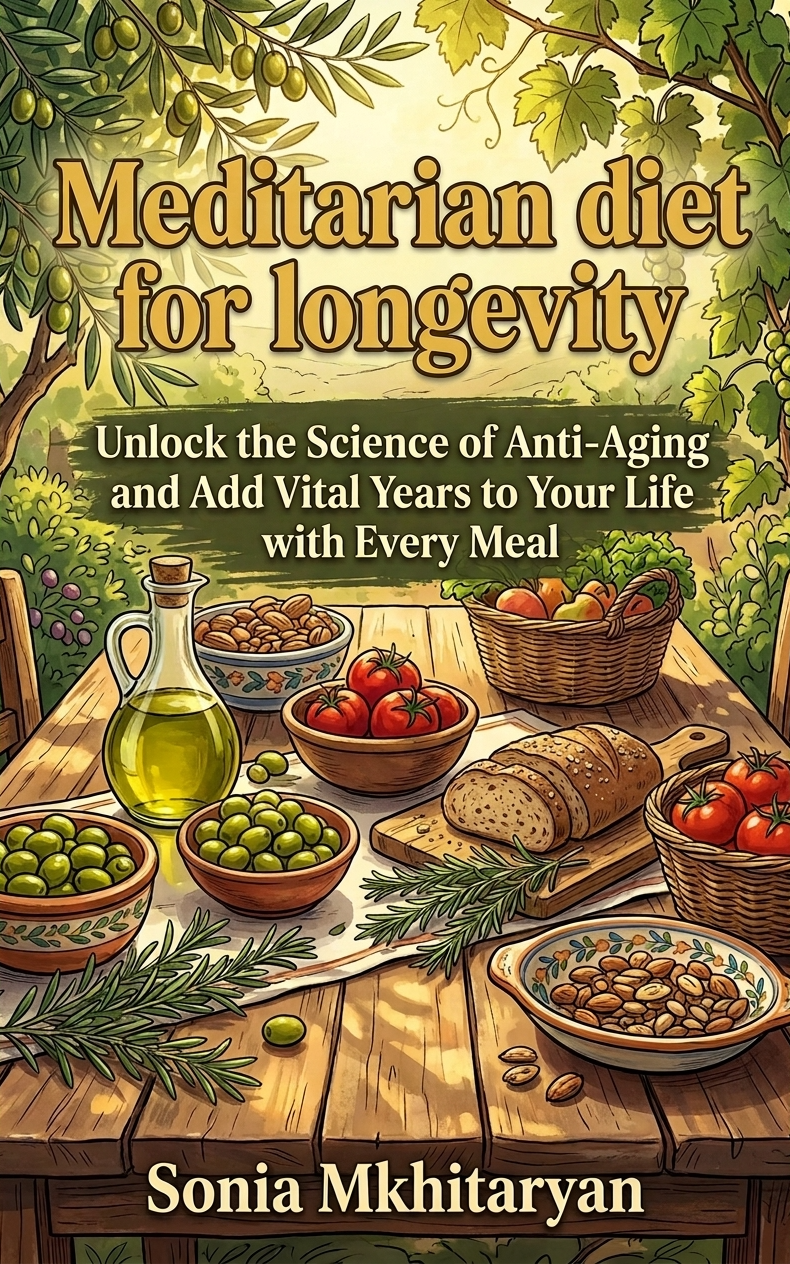
Meditarian diet for longevity
Unlock the Science of Anti-Aging and Add Vital Years to Your Life with Every Meal
by Sonya M.
What if the secret to a longer, more vibrant life wasn't found in a laboratory, but in your kitchen? In 'Mediterranean Diet for Longevity,' Sonia Mkhitaryan reveals the groundbreaking science behind one of the world's healthiest lifestyles. Research shows that adopting these habits can add up to thirteen years to your life, regardless of when you start. This isn't just a diet; it's a biological shield against the diseases of aging. Discover how to protect your DNA through telomere preservation, slash chronic inflammation, and optimize your gut microbiome. From the heart-protective powers of extra virgin olive oil to the cancer-fighting properties of plant-forward eating, Mkhitaryan breaks down the complex biochemistry into actionable steps. You will explore the 'Mediterranean Shield'—a multifaceted defense against heart disease, cognitive decline, and metabolic disorders. More than just recipes, this guide emphasizes the cultural pillars of social connection and mindful movement that complete the longevity puzzle. Featuring a practical 30-day protocol, meal prep strategies, and evidence-based insights, this book empowers you to take control of your biological clock. Start your journey today and discover how delicious the path to a century of health can be.
- Self-Help
- Cookbook
- Wellness & Fitness
- Instructional Guide
- Mindset & Motivation
- Emotional Intelligence
The Fountain of Youth: Understanding Life Expectancy Gains
Somewhere in the hills of Sardinia, a 97-year-old shepherd walks three miles to tend his goats. He has done this nearly every day of his adult life. He eats bread, beans, garden vegetables, a little cheese, and drinks a small glass of red wine with dinner. He is not exceptional in his village. Several of his neighbors are in their nineties, and a handful have crossed a hundred. Nobody finds this remarkable. It is simply how people live there.
That image is not folklore. Researchers have documented it, measured it, and spent decades trying to understand why certain pockets of the world produce so many people who live past 100 without the chronic disease burden that shortens most modern lives. The answer, consistently, points back to something ordinary: what they eat, how they move, and how they eat together.
The Longevity Link
The term "Blue Zones" was coined by researchers who mapped global clusters of exceptional longevity, places where people statistically outlive the rest of the world by significant margins. Five zones have been identified: Sardinia in Italy, Okinawa in Japan, Loma Linda in California, Nicoya in Costa Rica, and Ikaria in Greece. Two of these five, Sardinia and Ikaria, sit squarely within the Mediterranean basin. A third, Nicoya, shares many of the same dietary patterns. That overlap is not coincidence.
What unites these populations is not superior genetics. Researchers confirmed this by studying what happens when people from these regions emigrate and adopt Western eating habits. Their longevity advantage disappears within a generation. The genes did not change. The food and lifestyle did. This finding reframed the entire conversation around aging: the most powerful variable in your lifespan is not something you inherit. It is something you eat, repeatedly, over decades.
Of all the modifiable factors researchers have studied, including exercise, sleep, smoking cessation, and stress management, diet has the largest and most consistent effect on life expectancy across populations. Not because the others do not matter, but because diet is the factor that operates continuously, 24 hours a day, at the cellular level, every single day of your life.
Biological Age vs. Chronological Age
Your chronological age is the number of years since you were born. Your biological age is a different number entirely. It reflects how worn down your cells actually are, how well your DNA is repairing itself, how much inflammation is circulating in your blood, and how efficiently your organs are functioning. Two people born in the same year can have biological ages that differ by 15 years or more, depending entirely on how they have lived.
The Mediterranean diet works by compressing the gap between these two numbers. It does this through several overlapping mechanisms that researchers have been documenting since the landmark Seven Countries Study in the 1960s. That study, led by physiologist Ancel Keys, followed nearly 13,000 men across seven countries over decades and found that populations eating the most saturated fat had the highest rates of coronary heart disease, while those eating in the traditional Mediterranean style had dramatically lower rates, despite similar or even higher total fat consumption.
What Keys observed in the data, later researchers would explain at the cellular level. The Mediterranean diet acts as what scientists now call a multifaceted barrier against the processes that accelerate biological aging. It is not a single compound or a single food doing the work. It is the combined effect of antioxidants, fiber, healthy fats, and phytochemicals working together to slow cellular decay on multiple fronts simultaneously.
The antioxidants from olive oil, fruits, and vegetables neutralize free radicals before they can damage DNA. The fiber feeds beneficial gut bacteria that produce short-chain fatty acids, which regulate inflammation throughout the body. The omega-3 fatty acids from fish reduce the chronic, low-grade inflammatory signaling that erodes tissue over time. Every meal, prepared the Mediterranean way, is an intervention at the cellular level. Over 30 years of eating this way, the cumulative effect on biological age is substantial.
The Evidence: What the Numbers Actually Show
For years, the longevity benefits of the Mediterranean diet were described in relative terms: lower risk of this disease, reduced rate of that condition. Then researchers at the University of Bergen in Norway published a study in PLOS Medicine that translated these risk reductions into something far more concrete: actual years of life.
The findings were striking. A 20-year-old who transitions from a typical Western diet to a Mediterranean-style diet can expect to gain, on average, 13.0 additional years of life if male, and 10.7 additional years if female. These are not years spent bedridden or in cognitive decline. The research accounts for healthspan, not just lifespan.
The gains remain significant even when the dietary change happens later in life:
- Starting at age 20: Potential increase of 13.0 years for males and 10.7 years for females.
- Starting at age 40: Potential increase of 11.7 years for men and 10.0 years for women.
- Starting at age 60: Potential increase of roughly 8 years for both genders.
- Starting at age 80: Even at this late stage, the diet may add approximately 3.4 years of life.
The steepest drop-off in gains occurs between age 20 and age 40, which tells you something important: the earlier the shift, the higher the return. But notice that the gains never reach zero. At 80, switching from a Western diet to a Mediterranean pattern still adds more than three years. The body's capacity to respond to good nutrition does not simply switch off with age. Cells are continuously repairing, renewing, and adapting. Give them better raw materials, at any age, and they will use them.
The Mediterranean Solution: The Golden Ratio and Fiber's Role
What specifically makes this diet so effective? The answer starts with what researchers call the Golden Ratio of plant-to-animal protein. Traditional Mediterranean eating patterns derive roughly 70 to 80 percent of their protein from plant sources, primarily legumes, whole grains, nuts, and seeds, with the remaining 20 to 30 percent coming from fish, eggs, dairy, and occasional lean meat. This ratio matters for reasons that go beyond protein quality.
Animal proteins, particularly red and processed meats, are associated with elevated IGF-1 (insulin-like growth factor 1), a hormone that promotes cell growth. In younger people, IGF-1 supports development. In middle age and beyond, chronically elevated IGF-1 is linked to accelerated cellular aging and increased cancer risk. Plant proteins do not drive the same IGF-1 response. By keeping the ratio tilted toward plant sources, the Mediterranean diet keeps these growth-signaling pathways appropriately modulated across the lifespan.
Fiber is the other engine in this system. Most Americans consume between 10 and 15 grams of fiber per day. The Mediterranean diet, when followed properly, delivers 30 grams or more. That gap is not trivial. Fiber is the primary food source for the gut microbiome, the vast ecosystem of bacteria living in the intestine that regulates everything from immune function to mood to metabolic rate.
When you feed those bacteria adequate fiber, they produce short-chain fatty acids like butyrate, propionate, and acetate. Butyrate in particular has been shown to maintain the integrity of the intestinal lining, reduce systemic inflammation, and even influence gene expression in ways that protect against colorectal cancer. The gut microbiome of people who follow a Mediterranean diet looks measurably different from those eating a Western diet: more diverse, with higher populations of beneficial species and lower levels of pathogenic bacteria.
Aim for at least 30 grams of fiber per day. To put that in practical terms: a cup of cooked lentils delivers about 16 grams, a cup of oats provides 4 grams, and a medium apple adds another 4 grams. By noon, you can already be at 24 grams without any exotic foods or supplements. Pair that with 2 to 4 tablespoons of extra virgin olive oil daily, which provides the oleocanthal and oleacein compounds that function as natural anti-inflammatory agents, and you have the two most powerful daily nutritional levers the Mediterranean diet offers.
Implementation Guide: Setting Your Baseline
Before changing what you eat, it is worth understanding where you currently stand. Four numbers give you a useful starting baseline for tracking longevity-related health markers:
- Fasting blood glucose: A level below 100 mg/dL is normal. Between 100 and 125 indicates prediabetes, a condition the Mediterranean diet reverses in many cases within months.
- C-reactive protein (CRP): This is the primary blood marker for systemic inflammation. A level below 1.0 mg/L is ideal. The Mediterranean diet consistently lowers CRP within 6 to 12 weeks of adoption.
- Triglycerides: Below 150 mg/dL is the target. High triglycerides are strongly associated with cardiovascular disease and are directly driven by refined carbohydrate and sugar intake.
- Waist circumference: For men, below 40 inches; for women, below 35 inches. Abdominal fat is metabolically active in ways that promote inflammation and insulin resistance.
You do not need to be at perfect numbers to start. These measurements are your starting point, not a prerequisite. The value is in establishing where you are today so you can measure change over the next 3, 6, and 12 months. Most people who shift genuinely toward a Mediterranean eating pattern see measurable improvements in all four of these markers within 90 days.
Dr. Valter Longo, who has spent decades studying diet and longevity at the University of Southern California, adds another layer to consider: timing. The content of what you eat matters enormously, but so does when you eat it. Longo's research suggests keeping your eating window within 12 hours per day, meaning if you have breakfast at 7 a.m., you would finish your last meal by 7 p.m. This window allows the body sufficient time in a fasted state to activate cellular repair processes that are suppressed when insulin levels remain elevated around the clock.
A sample starting day might look like this: steel-cut oats with walnuts and blueberries for breakfast; a Mediterranean quinoa salad with chickpeas, cucumber, tomatoes, and olive oil for lunch; baked salmon with roasted asparagus and a drizzle of lemon and olive oil for dinner. That single day provides substantial fiber, omega-3 fatty acids, antioxidants, and plant protein. It is not a rigid prescription. It is a template that can be adjusted for preference, budget, and season.
The Mindset Shift: From Weight Loss to Life Gain
Most people approach dietary change through the lens of weight. They want to lose 20 pounds. They want to fit into old clothes. These are legitimate goals, but they are short-term motivators, and short-term motivators produce short-term behavior. The research on diet adherence is consistent: people who frame dietary change as a cosmetic goal relapse at much higher rates than those who frame it as a health investment.
The Mediterranean diet works best when you think of every meal as a deposit into a longevity account. A handful of almonds instead of a bag of chips is not a sacrifice. It is a transaction that reduces oxidative damage in your arteries today and adds a small increment to your healthspan over time. These individual choices feel modest in the moment. Compounded over 30 years, they are the difference between a 97-year-old shepherd walking three miles and a 70-year-old managing three chronic conditions.
This reframe is not just motivational. It changes the practical decisions you make. When weight loss is the goal, you think in terms of restriction. When longevity is the goal, you think in terms of addition. Add more vegetables. Add more legumes. Add olive oil. Add fiber. Add fish twice a week. The restrictions, to the extent that they exist, follow naturally from having less room for processed foods after you have already filled your plate with things that actively extend your life.
Start where you are. If the full dietary shift feels overwhelming, begin with one replacement: swap one processed snack each day for a handful of walnuts or a piece of fruit. That single change, sustained consistently, will affect your gut microbiome within two weeks. It will begin to modulate your inflammatory markers within a month. The body responds quickly to better inputs. Small changes do not stay small for long when they are consistent.
Key Takeaways
- Diet is the most significant modifiable factor in determining lifespan. Genetics set the outer limits, but food determines where within those limits you land.
- Adopting a Mediterranean-style diet at age 20 can add over 13 years for men and nearly 11 years for women. The gains remain meaningful at every age, including 3.4 additional years when started at 80.
- The diet works at the cellular level by reducing chronic inflammation, protecting DNA from oxidative damage, feeding a healthy gut microbiome, and regulating the hormonal signals that drive cellular aging.
- The Golden Ratio of 70 to 80 percent plant protein to 20 to 30 percent animal protein is a practical framework for structuring meals without complicated calorie counting.
- Aim for at least 30 grams of fiber daily and 2 to 4 tablespoons of extra virgin olive oil. These two targets alone will move your key health markers in the right direction.
- Track four baseline numbers: fasting blood glucose, CRP, triglycerides, and waist circumference. These are your longevity scoreboard.
- The mindset shift from weight loss to life gain is what sustains long-term adherence. Frame every meal as a decision about how many healthy years you are building.
The shepherd in Sardinia does not think about antioxidants. He does not track his fiber intake or measure his CRP. He simply eats the way his community has eaten for generations, moves his body every day, and shares his meals with people he loves. That pattern, examined closely, turns out to be one of the most powerful health interventions ever studied. The chapters that follow will break it down, mechanism by mechanism, food by food, so that you can rebuild it in your own kitchen, in your own life, regardless of where you are starting from today.
Telomeres and the Biological Clock
Every cell in your body is running a clock. Not a metaphorical one. A physical, measurable structure called a telomere sits at the end of each chromosome, and every time a cell divides, that structure gets a little shorter. When telomeres shrink past a critical threshold, the cell can no longer divide safely. It either stops functioning or self-des…