

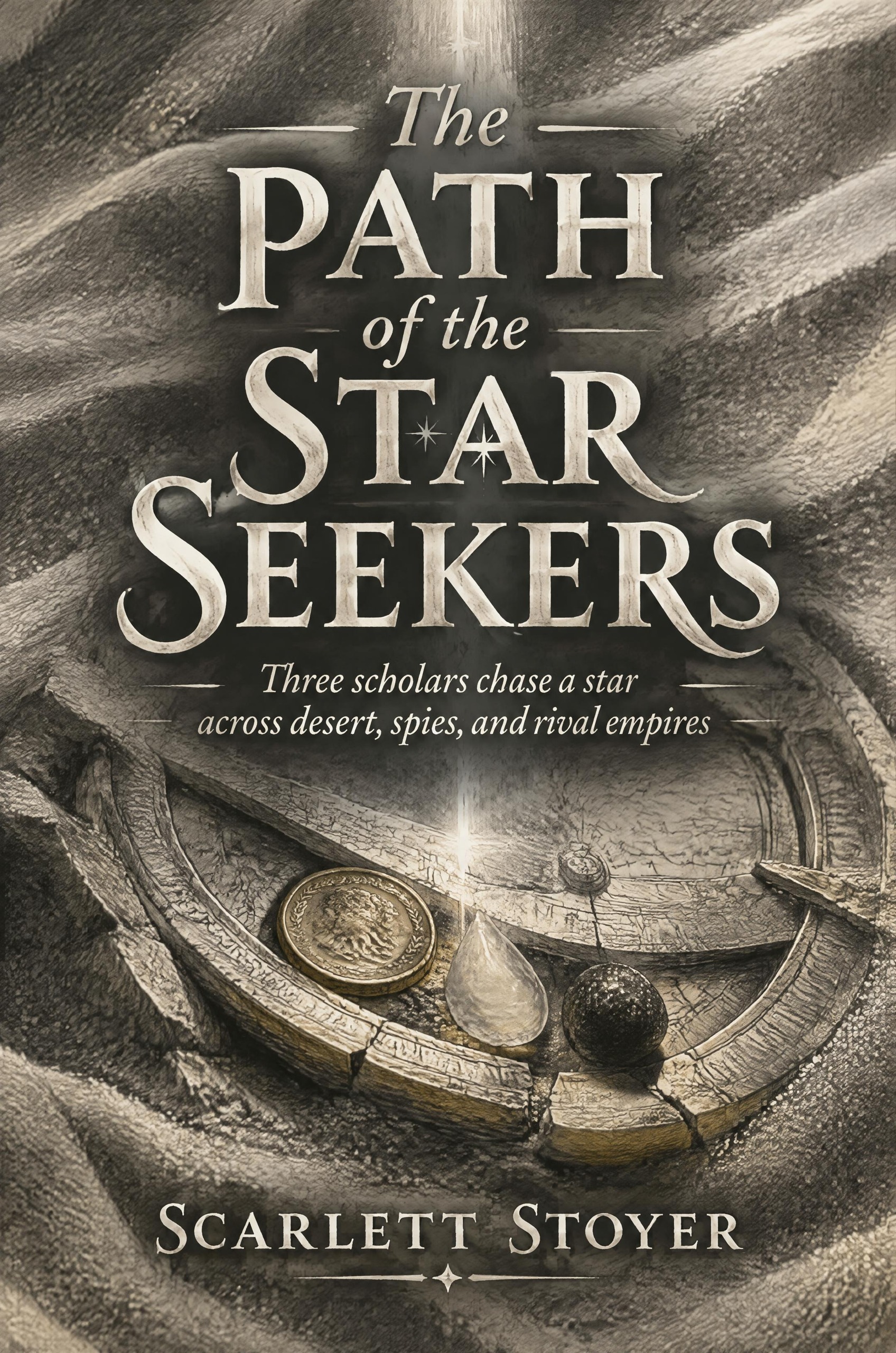
The Path of the Star Seekers
Three scholars chase a star across desert, spies, and rival empires
A new star burns over the East, unlike any chart Melchior Barak has ever drawn. To the old Babylonian astronomer it is not omen enough—until a Parthian noble and a young Persian apothecary arrive with the same conclusion: a King of Kings has been born, and the world will not wait. They set aside court rivalries in Babylon and turn west with gold, frankincense, and myrrh. Hundreds of miles of sand and stone lie between them and a humble destination. Roman spies watch the roads. Bandits hunt treasure. Oasis princes sell travelers to the highest bidder. Melchior reads the sky. Vologases Suren fights with blade and trail-craft. Artaban Karna mends wounds with rare resins. Sandstorms, ambushes, and imperial checkpoints strip them of certainty until only faith and a hard-won brotherhood remain. The Path of the Star Seekers is a historical adventure of intellect, danger, and the quiet discovery that greatness is not a palace—it is a purpose they must survive long enough to serve.
- Historical Fiction
- Adventure
- Mystery
- Literary Fiction
- Ancient Rome
- Expedition
The Strange Sign
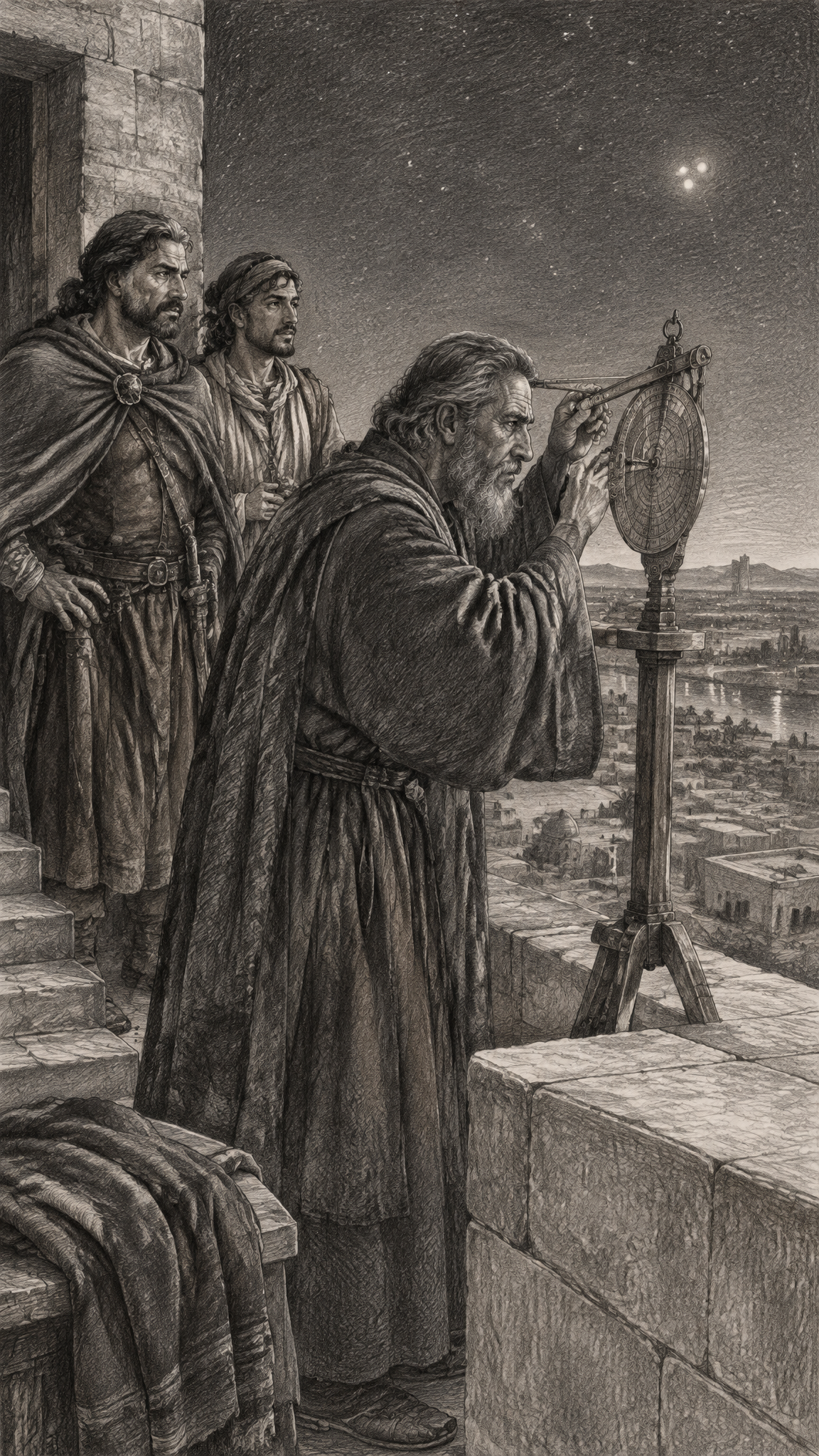
The night was warm enough that Melchior Barak had left his heavier cloak folded on the bench below, and now, three stories above the sleeping rooftops of Seleucia, he climbed the brick stairs of the observatory tower with the slow, even breath of a man who had made this climb a thousand times before. The steps were worn smooth in the center from decades of sandaled feet, his own among the first. He paused at the landing to catch his wind, then stepped out under the waiting sky.
He set the astrolabe on its stand and sighted along the alidade toward the eastern horizon, where Jupiter and Saturn had been drawing nearer to each other for three nights running, a conjunction he had tracked since the planets first entered the same quarter of the sky. It was not an unusual thing in itself. Such meetings came and went, and he had charted dozens over the span of his career, each one duly recorded and forgotten. What stopped his hand on the brass ring tonight was the third light.
It sat just beneath the two planets, where no star belonged, burning gold rather than the cold white of the fixed stars around it. Melchior lowered the astrolabe and looked at it with his bare eyes, the way a man looks twice at a word he has misread. The light did not waver. It did not streak or fall, as a shooting star would, and it did not blur and vanish the way a trick of tired eyes should.
Descending to his study, he returned with a fresh clay tablet and stylus, its bronze tip worn to the exact curve of his thumb. Balancing the clay on his knee as he sat upon the cold stone floor, he measured the stranger light's angle against the horizon and the two royal planets hovering above it. Nearly an hour slipped past in double-checking figures—a habit so ingrained it no longer felt like caution. Against the coordinates logged the previous evening, the shift was unmistakable; he had noted the mark then without much thought, dismissing it as some minor wanderer overlooked across thirty years of watching this same patch of sky.
It had moved less than half a degree. A comet in such a span would have crossed the width of two hands.
Melchior sat very still. Somewhere below him a dog barked twice and went quiet, and the warm wind off the Tigris moved through the tower's open sides and stirred the edge of his robe. He thought of a hundred explanations and set each one aside as a man sets aside a coin that does not ring true. A planet did not appear from nothing. A star did not hold a fixed trajectory toward the west night after night unless something fixed it there.
He went back to his study, lit the oil lamp, and pulled from the cedar chest the scrolls he had not opened in years, the ones copied from older copies, brought east by traders generations before his own, speaking of a star that would rise over the house of a king not born to any throne. He had read them as a young man and set them aside as poetry, the kind of thing priests wrote to give shape to longing. He read them again now with the lamp burning low and his hands, he noticed, not quite steady.
By the time Nabu-shar, the academy's chief overseer, found him in the morning, Melchior had already begun filling his saddlebags.
"You cannot mean to simply walk away," Nabu-shar said, standing in the doorway of the study with his arms crossed over his broad chest, a man accustomed to the comfortable certainties of appointment and rank. "You are an astronomer of the royal academy, Barak—one of the empire's greatest minds, not a wandering zealot. You hold the chief seat of this observatory. There are senior scribes awaiting your word, disciples who depend on your instruction, and celestial tables owed to the imperial court by the new moon."
"The charts can wait a season," Melchior said, not looking up from the leather case he was lining with wool to cushion the astrolabe. "I have never asked this academy for anything in forty years. I am asking now."
"For what? To chase a smudge of light across a thousand miles of desert because an old poem told you to?"
Melchior straightened then and looked at him, and something in his face must have carried more weight than his words usually did, because Nabu-shar's crossed arms loosened slightly.
"I have mapped these heavens since before your beard grew in," Melchior said with quiet, authoritative precision. "I know a transient comet from a wanderer, and I know both from an alignment that defies our standard canons. This star holds its station alongside the royal planets, proceeding west at a fixed, immutable measure each dusk. My calculations are exact. My instruments do not lie, and neither does the math."
"And if you are wrong? If you ride off into the wastes chasing a trick of the air, and some younger man sits in this chair by the time you crawl back?"
"Then I will have been wrong," Melchior said, "and I will have spent my old age finding that out with my own eyes instead of dying in this tower wondering."
Nabu-shar studied him a long moment, the irritation in his face losing ground to something closer to worry, the kind a man might show for a colleague he respected more than he liked. "You have no family to leave behind. No wife to ask you to think twice. Does that make this easier for you, or harder?"
Melchior did not answer that directly. He fastened the last strap on the saddlebag and set it by the door next to the bag already packed with scrolls and tablets. "I am going to Babylon first," he said instead. "There are men there who study the same skies I do, from courts I have corresponded with for years but never met. If this sign is real, it will not have shown itself to me alone."
He lifted down the chased brass cylinder holding pure, refined gold dust from the cedar shelf where it had sat preserved for a decade, an honorarium granted by a Seleucid satrap whose harvest Melchior had preserved with his eclipse calculations. It was not mere trinket money, but the hard-earned tribute of a master scholar. He weighed the cylinder in his palm before securing it within the interior lining of his travelling robe.
"Gold, for a sovereign," he murmured, his voice measured and solemn. "I go not as an emperor bearing an army's ransom, but as a sage offering the purest substance of our earth. It is an offering fit for the order he will inaugurate, and I will bear it with the dignity it demands."
Nabu-shar did not try to stop him again. He stood in the doorway as Melchior shouldered his bags, and when the old astronomer passed him on the stair, he said only, "Send word, if you find anything worth the finding."
"I will send more than word," Melchior said. "I will send proof, written in the sky itself, for any man with eyes willing to look up."
He walked out into the white morning light of Seleucia with his instruments on his back and the gold pouch warm against his ribs, and he did not look behind him at the tower where he had spent the better part of his life, because his eyes, for the first time in forty years, were fixed firmly on the road west.
A Blade in Babylon
Babylon announced itself a mile before Melchior reached its gates, in the smell of river mud and roasting mutton and the braying of a thousand animals none of which seemed pleased with their lot. He came down through the caravan market with his bags cutting into his shoulders, past stalls of dyed wool and copper pots and cages of quail, past a boy …