

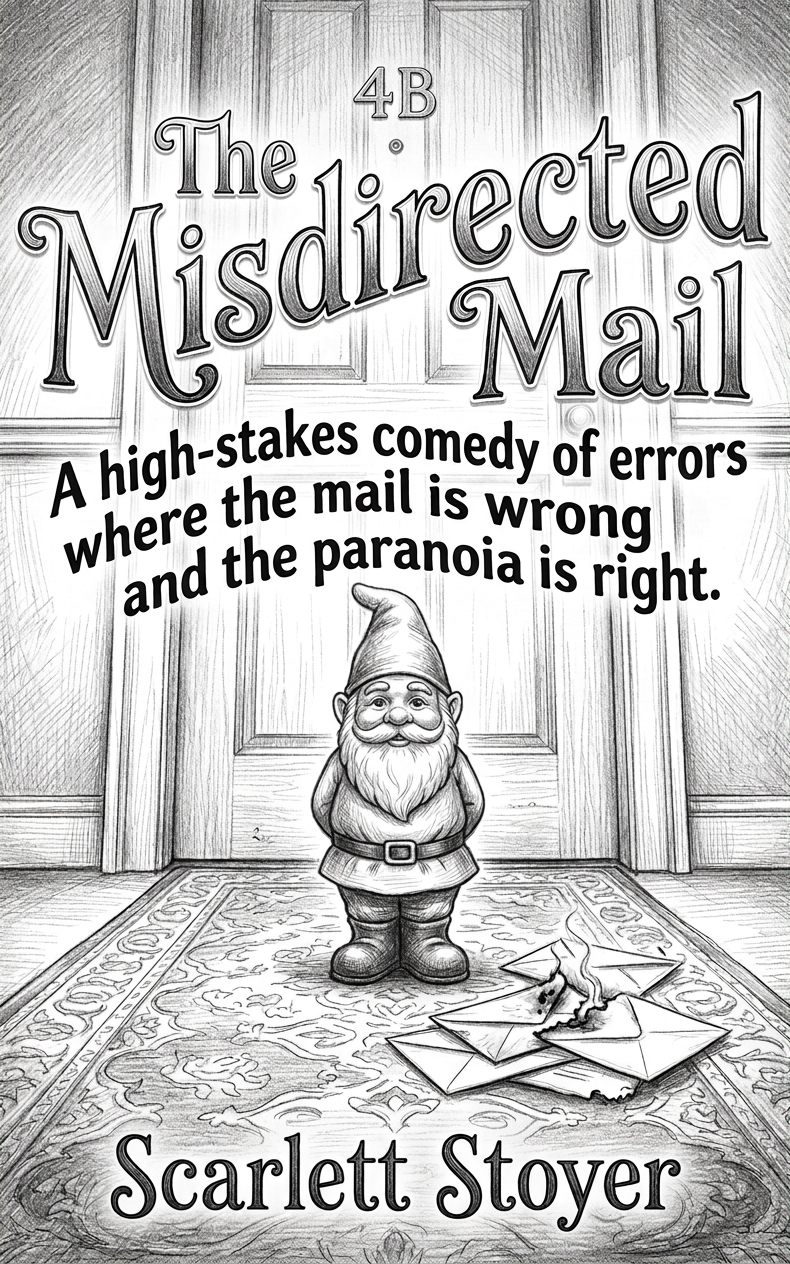
The Misdirected Mail
A high-stakes comedy of errors where the mail is wrong and the paranoia is right
by Scarlett Stoyer
Arthur Pumble is a man of precise habits and even more precise anxieties. As a professional archivist, he believes everything has its place. So when his beloved garden gnome, Bartholomew, vanishes from his post, Arthur’s carefully ordered world descends into a spiral of suburban suspicion. Convinced that his neighbor, the suspiciously dapper Professor Gable, is the mastermind behind a neighborhood conspiracy, Arthur finds a 'clue' in a misdirected letter meant for apartment 4B. What follows is a disastrously incompetent investigation involving a break-in, a malfunctioning espresso machine, and a misplaced laundry basket. When his whirlwind sister Bea arrives, she doesn’t bring sanity—she brings 'sock espionage' and a fake alibi involving experimental performance art. As the rightful tenant and a very confused detective close in, Arthur must navigate a minefield of his own making. In this hilarious farce of neighborly distrust, Arthur Pumble is about to learn that while he might be his own worst enemy, some conspiracies are just crazy enough to be true. Perfect for fans of quirky humor and cozy mysteries, The Misdirected Mail is a reminder that sometimes the biggest mysteries are the ones we create in our own heads.
- Humorous Fiction
- Farce
- Cozy Mystery
- Satire
The Empty Pedestal
Barnaby Pumble did not merely clean his doorknob; he performed a ritual of chemical exorcism. At precisely 7:00 AM, he stood in the dim light of his entryway, armed with a microfiber cloth and a spray bottle containing a proprietary blend of hospital-grade disinfectants. The first stage involved a vigorous circular scrubbing to remove the phantom oils of the physical world. The second stage was a targeted buffing, ensuring the brass glowed with a sterile, suspicious shine. By the third stage—the final, dry polish—Barnaby’s reflection in the knob looked back at him with the distorted, wide-eyed intensity of a man who knew that germs were the least of his problems. In a world of entropy and chaos, the doorknob was a frontline defense. If the threshold was compromised, the sanctuary was forfeit.
Once the brass was sufficiently decontaminated, Barnaby moved to the window. This was the highlight of his morning: the visual inventory of the communal garden. He pulled back the heavy lace curtain by exactly two inches, his eyes darting toward the north-western quadrant of the hydrangeas. It was there that Bartholomew, a hand-painted ceramic gnome with a jauntily tilted red cap and a shovel that suggested a lifetime of honest labor, stood guard. Barnaby had placed him there twelve years ago, and Bartholomew had never deviated from his post by so much as a millimeter.
The garden was empty. Not just empty of people, but empty of the one thing that anchored Barnaby’s sense of geographic stability. Bartholomew was gone. In his place sat a single, vibrant dandelion, its yellow head bobbing in the morning breeze like a tiny, mocking sun. Barnaby’s spectacles fogged over as his breathing accelerated. A dandelion. A weed. A botanical insult left in the wake of a kidnapping.
“Abducted,” Barnaby whispered, his voice a breathy, frantic treble. “Snatched from his post. A calculated extraction.”
He didn't just feel fear; he felt the tectonic plates of his reality shifting. He hurried to his desk and grabbed his pocket organizer, flipping past his meticulously color-coded grocery lists to the section labeled External Threats. His hands shook as he unsheathed his fine-point pen. He needed data. He needed a perimeter check. The disappearance of a twelve-pound ceramic garden ornament was not a random act of neighborhood mischief; it was a declaration of war.
He decided he must retrieve the mail. It was a tactical necessity. The mailroom was the hub of the building, the place where secrets were exchanged under the guise of utility bills and catalog subscriptions. He donned his light-gray cardigan—the color of urban camouflage—and stepped into the hallway, his feet making no sound on the carpeted floor. He moved with the practiced stealth of an archivist who had spent decades navigating the quietest corners of history.
At the bank of brass mailboxes, Barnaby’s fingers hovered over his own slot before drifting, almost of their own volition, toward the neighboring cubby. Through the small slit of apartment 4B, he saw an envelope. It had been shoved into his own box by mistake—a clerical error of monumental proportions. He pulled it out. It was addressed to a Mr. Monty Henderson, the new occupant of 4B. But it wasn't the name that caught Barnaby’s eye. It was the back of the envelope. Written in a hurried, cramped hand was a string of digits: 52-19-88-04.
“A cipher,” Barnaby muttered, his pulse drumming against his sweater vest. “Or coordinates. A ransom demand disguised as a utility statement.”
“A fascinating theory, Barnaby, though I suspect the postal service would be rather surprised to learn they’ve been drafted into your imaginary spy ring.”
Barnaby jumped, the envelope nearly fluttering to the floor. Standing at the end of the hallway was Professor Reginald Gable. The man looked as if he had been born in a three-piece suit. He leaned against a silver-topped walking stick, his white beard trimmed to a point that looked sharp enough to draw blood. Gable was a man who viewed the world as a poorly written play, and Barnaby was his favorite tragic lead.
“Professor Gable,” Barnaby said, smoothing his thinning hair with a trembling hand. “I was merely... correcting a delivery discrepancy. It seems the mail carrier has been compromised by a lack of basic attention to detail.”
“Or perhaps the universe is simply tired of your rigid expectations,” Gable replied, stepping closer with a slow, rhythmic click of his cane. “I noticed the garden looks remarkably improved this morning. Less... cluttered. One might say there has been a clean sweep of the premises. A much-needed aesthetic purge that I don’t recall you approving, yet it happened nonetheless.”
Barnaby’s eyes narrowed behind his thick-rimmed glasses. “A clean sweep? Is that what you call it? I have reason to believe that a certain clandestine ornament relocation has taken place. Bartholomew did not simply walk away. He is a stationary object of historical and personal significance.”
Gable let out a dry, rattling chuckle. “Barnaby, your devotion to that ceramic monstrosity is as baffling as your belief that I would exert the physical effort required to move it. However, I must admit, the garden’s newfound dignity is quite refreshing. One must occasionally shed the baggage of the past to make room for a more sophisticated future. It’s a pity you weren't consulted on the building's new direction.”
“You’re mocking me,” Barnaby accused, clutching the misdirected mail to his chest like a shield. “You’ve always detested his red cap. You find his shovel plebeian.”
“I find his entire existence an affront to the very concept of landscaping,” Gable said, his voice dripping with ironic delight. “But to suggest I would engage in gnome-napping is to suggest I have an interest in your peculiar brand of madness. I have far more important things to attend to than the whereabouts of a hollow-bodied dwarf. Good day, Barnaby. Do try not to hyperventilate in the communal spaces; it leaves such a damp residue on the air.”
Gable turned and strolled away, leaving Barnaby alone in the hallway. The Professor's words lingered like a bad smell. A clean sweep. Shedding the baggage. It was practically a confession. Gable was the mastermind, and the new tenant in 4B, this Monty Henderson, was clearly an accomplice—perhaps a professional handler for Gable’s illicit aesthetic acquisitions.
Barnaby retreated to his apartment, locking the door and engaging the deadbolt with a satisfying clack. He spread the mail out on his dining table, which he had cleared of all non-essential items. He pulled out a map of the building’s floor plan—a document he had painstakingly reconstructed from memory and observation. He began to draw lines, connecting his unit to 4B, then to the garden. The geometry of the crime was becoming clear.
“The mail is the key,” Barnaby told his empty living room. “If I return it, I gain entry. If I gain entry, I find the evidence. I will see the dirt on their carpets. I will hear the ceramic clink of a hidden hostage.”
He looked down at his clothes. His current sweater vest was a soft lavender—too conspicuous. He needed to blend into the shadows of the hallway, to become one with the beige wallpaper and the muted lighting. He hurried to his closet and selected a pair of corduroy trousers that he had tested for silence; they were worn in just enough that the ribs didn't whistle when he walked. He paired them with a neutral-toned, oatmeal-colored sweater vest. It was the ultimate tactical outfit for a man of his specific, nervous talents.
He checked his pocket organizer one last time. The numbers on the envelope—52-19-88-04—burned into his mind. They weren't just numbers. They were the key to the conspiracy. He gripped the misdirected envelope, straightened his spectacles, and took a deep, shaky breath. He was no longer Barnaby Pumble, the anxious archivist. He was an operative. He was a seeker of justice. He was going into the lion’s den of apartment 4B, and he would not leave until Bartholomew was accounted for.
He stepped back out into the hallway, his heart hammering a frantic rhythm against his ribs. The carpet felt like quicksand, but he pushed forward. He was entering a world of thieves and dapper professors, and he was the only one who could stop the decline of order. He reached the door of 4B and raised a hand to knock, his fingers poised between a polite inquiry and a demand for the truth.
The Sister Sabotage
Barnaby Pumble stood in his entryway, adjusting his neutral-toned sweater vest with the frantic precision of a man preparing for a deep-sea dive without a tank. He checked his pocket organizer one last time. The tactical infiltration of apartment 4B was mapped out in his mind with the clarity of a structural blueprint. He reached for the deadbolt, …