

The Kingdom Of God
Discover a hidden kingdom that changes everything about how you see the world
by Scarlett Stoyer
Thirteen-year-old Caleb Montgomery is a boy who believes in facts, logic, and things he can see under a microscope. When a social studies project challenges him to investigate the 'Kingdom of God,' Caleb treats it like a scientific mystery to be solved. Is it a real place? Does it have borders, a capital, or a king you can actually talk to? As Caleb moves from his computer screen to the woodshop of a wise mentor and the kitchen of a radically kind neighbor, his analytical world begins to shift. He meets Sammy, whose simple trust defies logic, and faces Hudson, whose mockery tests his courage. But the investigation becomes dangerously real when the values of this invisible kingdom clash with Caleb’s own family business. Standing up for what is right might mean losing his social standing and risking his family's harmony. In this warm and conversational journey, Caleb discovers that the most powerful kingdom in the universe isn't found on a map—it's a way of living that starts in the heart. Perfect for middle-grade readers, this story explores faith, friendship, and the courage to follow an unseen King.
- Religion
- Christian
The Search for a Secret Map
The hum of the fluorescent lights in room 204 always sounded like a low-grade headache. Caleb Montgomery adjusted his navy blue glasses, leaning forward as Mrs. Clara Gable stood before the whiteboard, her marker poised like a conductor's baton. On the board, written in her characteristically neat cursive, were the words: Empires and Kingdoms: Legacies of Power.
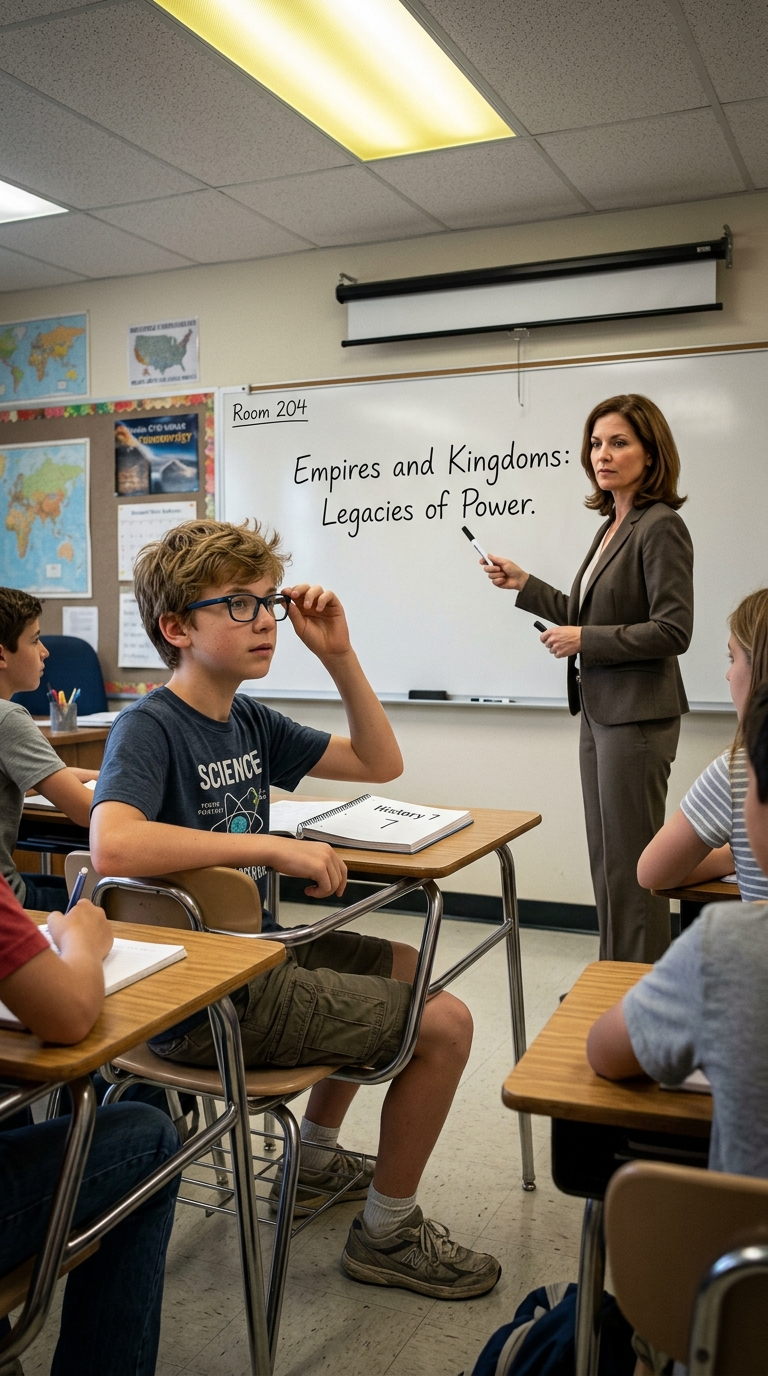
"For your major social studies project this term," Mrs. Gable said, her sharp, intelligent eyes scanning the classroom, "you will choose a historical kingdom or empire. You must analyze its structure, its territory, and its ultimate impact on modern society. I do not want a simple list of dates. I want you to look at how these entities governed their people, how they maintained order, and what they left behind."
Immediately, a flurry of whispers erupted. To Caleb’s left, Marcus was already drawing a crude sketch of a gladius, clearly planning a presentation on the Roman Empire. Across the aisle, Sarah was flipping through her textbook to the chapter on the Ming Dynasty. Caleb, however, sat with his mechanical pencil poised over a blank page in his notebook. His mind, which usually sorted information into neat, logical categories like a computer program, was snagged on a different concept.
He raised his hand. "Mrs. Gable?"
The teacher paused, turning her attention to him. "Yes, Caleb?"
"Actually," Caleb began, his voice precise and thoughtful, "if you look at the historical impact of belief systems, could we research a kingdom that isn't defined by physical borders? Like, what about the Kingdom of God? People talk about it all the time as if it is a real country, but it does not appear on any world map. I want to know why."
A few desks away, Hudson Wright let out a short, mocking laugh. "The Kingdom of God? What are you going to do, Caleb, bring in a map of Narnia? It's a secular history class. Choose a real kingdom, like the British or the Mongols. You know, places that actually had armies and physical territory."
Caleb felt a warm prickle of frustration on the back of his neck, but he kept his eyes on Mrs. Gable. He wasn't trying to be difficult; he genuinely wanted to understand the mechanics of it. If millions of people claimed allegiance to this kingdom, surely there had to be some kind of structural data to analyze.
Mrs. Gable silenced Hudson with a calm, warning look before turning back to Caleb. Her expression was thoughtful. "It is an unconventional choice for a social studies project, Caleb. Historically speaking, religious movements have shaped civilizations more than many military campaigns. But Hudson does raise a valid academic point. How do you plan to analyze a kingdom without physical borders? If you choose this topic, I will challenge you to find concrete evidence of how it functions, its laws, and its impact. You cannot just write a sermon. You must treat it with the same academic rigor as any other empire."
"I can do that," Caleb said, nodding quickly. "I'll find the data."
When the lunch bell rang, Caleb gathered his books and headed toward the cafeteria, his mind already constructing a mental spreadsheet. He was so engrossed in his thoughts that he barely noticed Hudson and his friends blocking the hallway near the water fountains.
"Hey, Montgomery," Hudson called out, stepping into Caleb's path. Hudson was tall, wearing a pristine varsity jacket with thick leather sleeves and a heavy chenille letter 'O' that practically screamed his varsity status, his hands casually tucked into his pockets in a way that claimed the entire hallway. "Seriously, the Kingdom of God? You're going to fail this project. You can't write a paper on a fairy tale. In the real world, the guy with the most points wins. Period. You need real armies, real land, and real power to make history."
"It's not a fairy tale," Caleb said, keeping his voice steady as he adjusted his backpack strap. "It's a historical phenomenon. People have changed the entire course of history because of their loyalty to this kingdom. There has to be a logical framework behind it."
"Good luck finding it," Hudson sneered, turning back to his friends. "Let me know when you find the GPS coordinates."
Caleb ignored the laughter that followed him down the hall. Instead of going to the cafeteria, he bypassed the noisy lunchroom and headed straight for the school library. It was a sanctuary organized by the Dewey Decimal System, where the oak tables were aligned in a perfect four-by-four grid and the smell of old paper was just a byproduct of slow chemical decay. He sat down at one of the computer terminals, opened a new spreadsheet, and labeled the columns: Kingdom Name, Reigning Monarch, Capital City, Population, and Geographic Coordinates.
For the Roman Empire, the columns filled up instantly. But when he typed "Kingdom of God" into the search engine, the results were frustratingly abstract. He walked over to the religion and philosophy section, pulling several heavy volumes from the shelves. He flipped through pages of theology, looking for concrete definitions. One author described it as a "state of spiritual peace." Another called it "the future reign of Christ." A third book claimed it was "within you."
Caleb sighed, tapping his pencil against his forehead. None of this made sense to his analytical mind. How could a kingdom be a physical place, a future event, and inside a person all at the same time? It defied the basic laws of physics and geography. He opened his spreadsheet on his laptop. He typed God under the monarch column, but when he looked at the Location column, his cursor just blinked back at him. It remained stubbornly, mockingly empty.
He spent the rest of his lunch period searching through primary sources, but the definitions only grew more confusing. It was like trying to measure the volume of water with a ruler. His usual scientific tools were failing him.
When the final bell of the day rang, Caleb walked out of the school building, his mind still spinning with unresolved questions. Dry maple leaves scraped and rattled across the concrete sidewalk, chased by a sharp wind that made him zip his jacket to his chin as he walked his usual route home. He kept thinking about what Mrs. Gable had said. If he couldn't find the historical evidence, he would have to change his topic, and he hated giving up on a puzzle.
As he neared the corner of Elm Street, he paused outside the Bright Stars Youth Center. It was a slightly weathered brick building that had once been a neighborhood firehouse. Now, it served as a local community hub. Outside, a large wooden sign stood near the entrance. Painted in bright, welcoming letters, it read: Bright Stars Youth Center - Citizen Workshop This Weekend: Living the Kingdom Life.
Caleb stared at the word Citizen. It was a political term, a word used for people who belonged to a specific country or government. If the youth center was hosting a workshop about being a citizen of this kingdom, then the people inside must believe they actually lived in it.
He adjusted his glasses, looking at the heavy double doors of the center. Perhaps his mistake was trying to find this place in a library book. If he wanted to understand how this invisible kingdom worked, he needed to talk to someone who claimed to be a citizen of it. He decided right then that he would attend the workshop. He needed answers that a spreadsheet simply couldn't provide.
The Carpenter and the Blueprint
The heavy oak doors of the Bright Stars Youth Center groaned slightly as Caleb pushed them open. Inside, the main lobby was quiet, illuminated by the soft afternoon light filtering through high, arched windows. He stepped onto the polished concrete floor, his sneakers squeaking softly. The usual chatter of after-school programs was absent, leaving …