

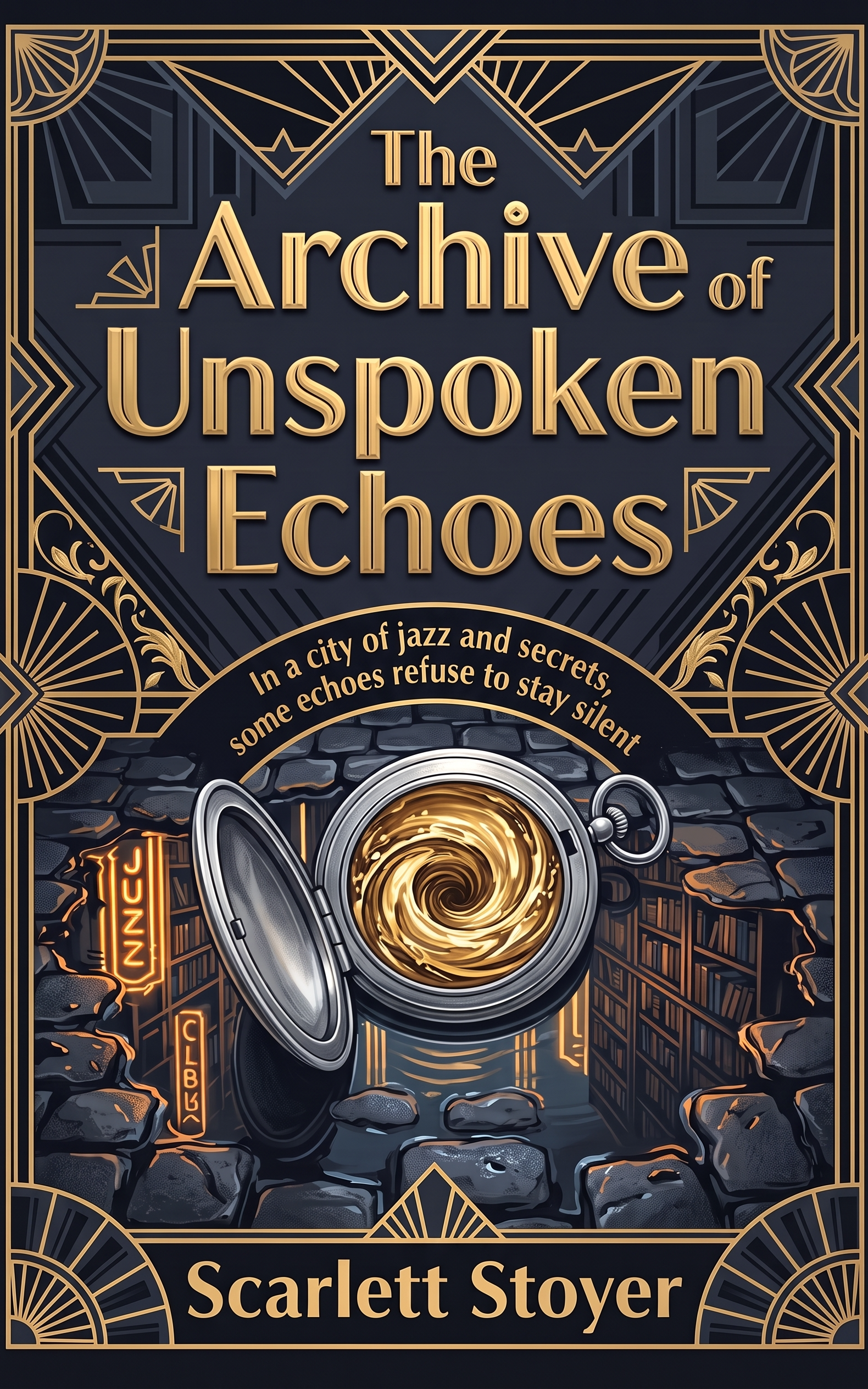
The Archive of Unspoken Echoes
In a city of jazz and secrets, some echoes refuse to stay silent
by Scarlett Stoyer
Chicago, 1926. Behind the heavy brass doors of a hidden library lies the Archive of Unspoken Echoes—a sanctuary for objects that hold the final words of the departed. Librarian Evangeline Marlowe has always preferred the company of glass jars and tarnished jewelry to the roar of the Jazz Age, until a silver locket whispers a confession from a man who is still very much alive. When her mentor vanishes and the locket's shelf is found empty, Eva is thrust into a world of bootleg magic and lethal secrets. Alongside Julian Sterling, a whisper-runner who can bend sound to his will, Eva must navigate a city where the dead are being silenced twice. A shadowy society known as the Echo-Society harvests these memories, weaving them into a new, distorted reality that could erase Chicago's history. From the neon-lit speakeasies to the grime of the stockyards, Eva must find the stolen locket before 'The Weaver' rewrites her own story out of existence. In a race against a man who can edit the past, the truth is the only thing more dangerous than the silence. Scarlett Stoyer delivers a mesmerizing historical fantasy where every sound has a price, and the most powerful magic is found in the words we never got to say.
- Fantasy
- Mystery
- Urban Fantasy
- Cozy Fantasy
- Historical Mystery
- Witches & Wizards
The Wrong Kind of Ghost
The Archive smelled the way it always did at this hour: old paper, melted beeswax, and the faint mineral tang of the limestone walls that kept the whole place a cool fifty-two degrees even when July pressed down on Chicago like a wet wool coat. Eva found the consistency comforting. She had been here six years, and the smell had never changed. She hoped it never would.
She was alone in the cataloging room, her lamp casting a warm circle across the long oak table. The most recent intake delivery sat in a shallow crate to her left: a soldier's watch from the Western Front, a child's porcelain button, a brass key ring with nothing on it. Ordinary objects, quiet and heavy with meaning. She worked through them methodically, pressing two fingers to each one and listening for the echo, that soft harmonic hum that told her the item was real, that someone had loved or feared or lost with it in their hand.
She reached the silver locket near the bottom of the crate.
It was tarnished, oval-shaped, and smaller than she expected. The clasp was worn smooth from years of use. She picked it up, adjusted her glasses with one knuckle, and pressed her thumb against the face of it.
The hum that came back was wrong.
She had cataloged nearly four hundred objects over her years in the Archive, and she knew the particular resonance of a death echo the way a piano tuner knew a flat note. It sat low and gentle, like a chord played in a minor key, trailing off at the edges. What she heard from the locket was nothing like that. It was sharp, erratic, and cold — the kind of sound that made her think of a wire pulled too tight just before it snapped.
She touched the clasp, and the voice came through.
A man's voice, clipped and urgent, spilling out a confession that made the fine hairs on her arms rise. She heard a name. She heard a date. She heard the particular, specific mechanics of a murder described with the flat affect of someone who had rehearsed the telling until all the horror had been stripped out of it. And then she recognized the voice, because she had read the morning paper over her breakfast tea, and Alderman Arthur Sterling had been on the front page of the Tribune shaking hands with the mayor.
Eva set the locket down on the table with great care, as if it were a sleeping thing that might wake badly.
The rules of the Archive were not suggestions. They were the architecture of the entire place. Objects in the collection stored the final echoes of the dead, not the guilty confessions of men who were currently attending civic functions and smiling for photographers. A living person's voice had no business inside these walls. The locket's presence here was either a catastrophic failure of the Archive's intake protocols, or it was deliberate.
She pulled the intake ledger from the shelf above the table and flipped to the most recent pages. Her finger ran down the column of item numbers until it reached the locket's tag. She found the row, and then she found the blank space where the record should have been. Not an accidental smear, not a hurried scribble. The page had been cut out, close to the binding, with something sharp and patient. A single neat incision, the kind that took a steady hand.
Eva stood very still for a moment. She thought about the word deliberate.
Someone had brought a living man's secret into the vault and then erased the evidence of how it arrived. That was not an accident. That was a plan.
She crossed to the fireproof cabinet in the corner and retrieved a lead-lined box, the kind the Archive used for objects that were unstable or too powerful to sit openly on a shelf. She lined it with a square of archival cloth and set the locket inside. The moment the lid closed, the discordant hum faded from her fingertips, though she could still feel the ghost of it crawling along her wrist.
She was reaching for the cabinet key when the sound came from the floor above.
A single heavy thud, like a chair knocked sideways, or a book dropped from a high shelf, or something heavier than either. The ceiling of the cataloging room was low, and sound traveled through the stone with unnerving clarity. Eva looked up at the water-stained plaster as if it might offer an explanation.
"Percy?" Her voice came out quieter than she intended. She cleared her throat and tried again, louder this time, directing it toward the stairwell door. "Mr. Wickes?"
Nothing answered her. The room was completely silent except for the row of clocks along the south wall, which she kept wound out of habit because Percy insisted the Archive should always sound alive. They ticked in their usual staggered rhythm, each one slightly out of phase with the others, a sound she had long since stopped hearing consciously.
Except that it had changed.
She turned and looked at the clocks. All seven of them were still moving, but the ticking was no longer moving forward. The minute hands were rotating in reverse, slow and deliberate, sweeping counter-clockwise through the hour. She watched a grandfather clock's pendulum swing once to the left, then again to the left, never correcting, as if time in this room had simply decided to go back the way it had come.
Eva pressed the lead-lined box firmly shut, tucked it under her arm, and walked to the stairwell door. Her oxfords were quiet on the stone floor. She did not run, because she was not yet sure what she was walking toward, and running without knowing the direction of the danger had always struck her as a poor strategy.
The clocks kept ticking backward behind her as she climbed the stairs, and the hum of something very wrong rose faintly in her ears like a question she already knew she would have to answer.
The Curator's Silence
The stairs felt longer on the way up. Eva climbed them slowly, the lead-lined box tucked under one arm, her other hand trailing along the stone wall. The backward ticking of the clocks faded below her, but the memory of it stayed in her ears like a piece of music played in the wrong key. By the time she reached the upper landing, the Archive's main…