

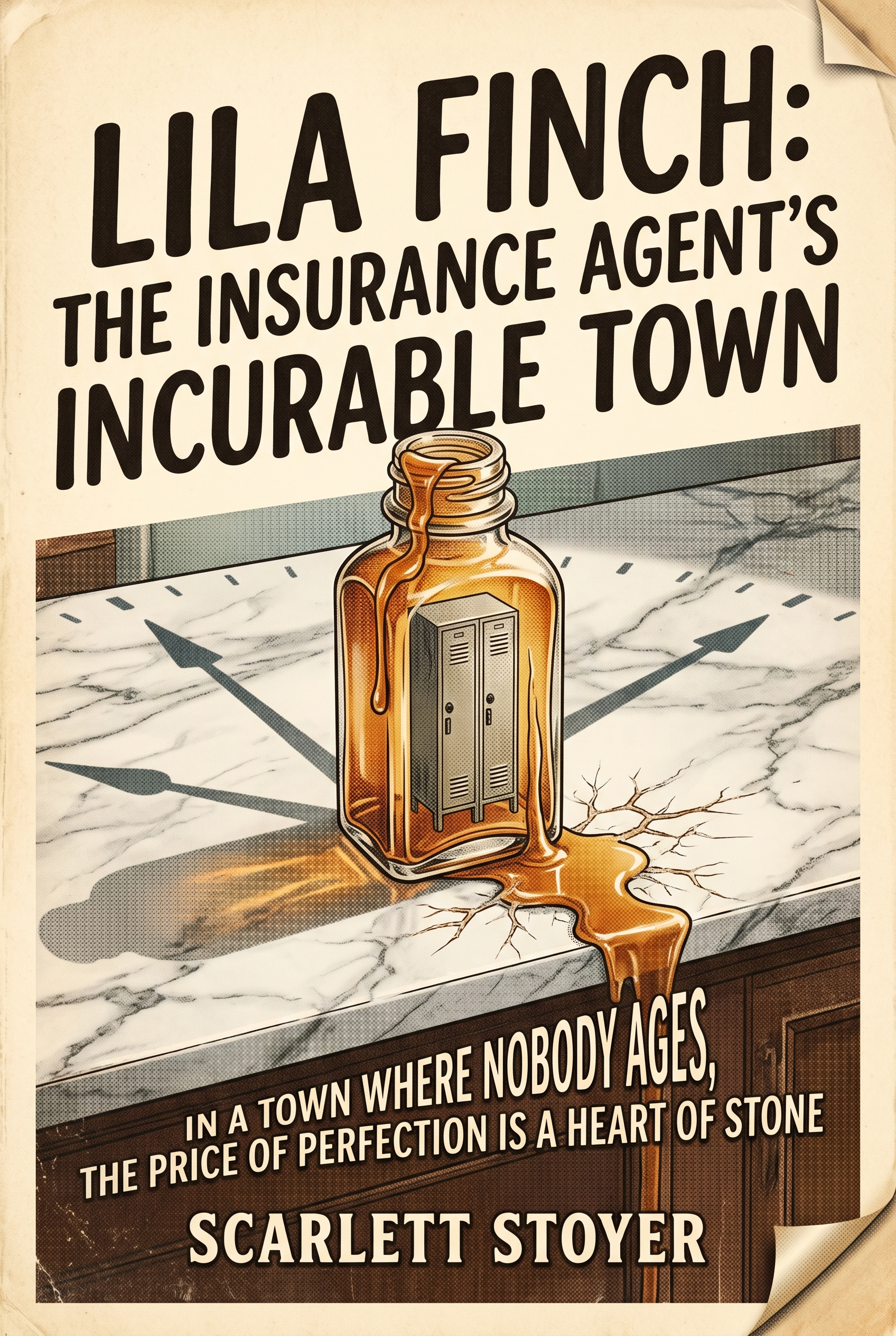
Lila Finch: The Insurance Agent's Incurable Town
In a town where nobody ages, the price of perfection is a heart of stone
Lila Finch thrives on data, spreadsheets, and the absolute certainty of math. But when her new assignment as an insurance adjuster takes her to the secluded valley town of Everlasting, the numbers stop making sense. The mortality rate is zero. The high school roster hasn't changed since 1986. And the local pharmacy sells nothing but empty bottles. Everlasting is a miracle of modern health—or a carefully curated nightmare. As Lila digs into the town's medical records, she discovers a horrifying truth: Dr. Sterling Vance-Kemp isn't curing his patients; he’s preserving them. By replacing their blood with a synthetic chemical, he is freezing the town in time, slowly turning every resident into a living, breathing statue. With 'Wellness Week' approaching, Lila finds herself scheduled for a mandatory physical. Alongside Xavier, a man trapped in a teenager’s body for forty years, Lila must uncover a way to restart the clock. But the cure is as dangerous as the disease. Stopping the treatments could cause four decades of aging to hit the town in a single heartbeat. In a place where 'forever' is a death sentence, Lila must decide if a life of frozen perfection is worth more than the beauty of a natural end.
- Young Adult
- Mystery
- YA Mystery
- Cozy Mystery
- Medical Mystery
- Small Town Mystery
The Zero Percent Mortality Rate
The road into Everlasting, Pennsylvania, was a narrow ribbon of asphalt that seemed to fold in on itself, swallowed by the dense canopy of the valley. I kept my hands steady on the steering wheel, my left index finger rubbing against the leather cover. The persistent blue ink stain on my skin was a familiar comfort, a badge of honor from my morning spent tallying spreadsheet columns back at the firm. I am nineteen years old, and I am the youngest insurance adjuster at my company. Most people my age are worrying about college exams or what to wear to a party, but I prefer things that can be quantified. I like risk profiles, actuarial tables, and clear, undeniable data. When my supervisor handed me the file for a bulk policy renewal covering the entire township of Everlasting, I expected a standard, boring three days of cross-referencing health certificates and municipal property values. I did not expect a statistical anomaly.
I parked my compact car near the town square and stepped out into the crisp autumn air, clutching my heavy leather briefcase like a shield. The first thing that struck me was the silence. There was no hum of distant highway traffic, no drone of lawnmowers, not even the chirp of a cricket. I walked down the clean sidewalk, my leather loafers clicking against the concrete. As I looked around, a cold prickle of unease traced its way down my spine. The residents of Everlasting were walking past me, and they were, without exception, beautiful. A woman sweeping the porch of a local bakery had skin that looked like polished porcelain. A man loading wooden crates into the back of a vintage truck possessed a sharp, chiseled jawline and bright eyes without a single crow's foot. Nobody had a wrinkle. Nobody had a limp. Nobody even seemed to have a blemish or a scar. It was as if the entire population had been plucked from a high-end health magazine. I pulled my notebook from my blazer pocket, my pen hovering over the blank page. The town's physical appearance did not match the typical distribution curve of a standard rural population. It was too perfect.
I turned a corner and found the Gables' Boarding House, a Victorian structure with a wrap-around porch and immaculate white paint. I went up the steps, the wood beneath my feet solid and silent, refusing to creak. I pushed open the heavy oak door. Inside, the air smelled faintly of lavender and old paper. A small, bird-like woman with snowy hair and thick spectacles stood behind the polished reception desk. She wore a floral apron, and as she stepped forward to greet me, I noticed she walked with a slight, distinct limp. She was the only person I had seen in Everlasting who looked over the age of fifty.
"You must be Lila Finch," she said, her voice soft and carrying a rhythmic, storytelling quality. "We don't get many visitors these days, especially not young ladies carrying such heavy briefcases. I am Beatrice Gable, but everyone calls me Bea."
"Yes, ma'am," I replied, keeping my tone professional. "I'm here for the municipal policy audit. I have a reservation for the next three nights."
"Of course, dear," Bea said, sliding a heavy brass key across the desk. "Room four at the top of the stairs. You'll find it very quiet." As I reached for the key, she looked at my ink-stained finger, a faint, sad smile touching her lips. "The most dangerous thing in this town isn't a heart that stops, dear. It's a heart that's been forced to beat forever for no reason at all."
I frowned, my analytical mind instantly trying to categorize the statement. "I'm sure the local health standards are very high, Mrs. Gable."
"Call me Bea," she whispered, her eyes darting toward the front door before she turned back to her ledger. "Go on up, child. Get settled."
My room was neat, featuring a hand-carved wooden bed and a small desk near the window. I immediately set my briefcase on the desk, popped the latches, and pulled out the thick stack of census data and health insurance records I had printed before leaving the office. I sat down, opened my ledger, and began to run the numbers. I checked the birth records against the active policies. Then I checked the death certificates. I stopped, my breath catching in my throat. I ran the calculation again, my pen scratching furiously against the paper. The math did not add up. The local cemetery had not recorded a single new headstone since 1986. For nearly forty years, the mortality rate in Everlasting had been exactly zero percent. It was an actuarial impossibility. Even in the healthiest communities, people died of accidents, heart failure, or simple old age. But here, the ledger was blank. Forty years of absolute biological stasis.
My heart began to beat a little faster. This wasn't just a bad risk profile; this was a total fabrication. I needed to call my supervisor at the regional office to report the anomaly. I pulled my cell phone from my blazer, but the screen showed no service. Not even a single bar. I walked out of my room and down the quiet hallway, searching for a landline. I found a vintage rotary phone mounted on the wall near the staircase. I lifted the heavy black receiver to my ear, but there was no dial tone. The line was completely dead. I traced the cord down to the baseboard and realized it had been cleanly severed, the copper wires exposed and dry.
I walked downstairs to the dining room, my mind spinning with calculations and probabilities. The table was set for dinner, and the rich scent of pot roast filled the air, though underneath the savory aroma, there was a faint, chemical trace of peppermint. A young man in a crisp, tan police uniform was already seated at the table. He stood up as I entered, offering a broad, friendly smile. He looked like a high school football star, with broad shoulders and a neat buzz cut. He looked twenty-five, though there was a strange, guarded stillness in his posture.
"Evening, Ms. Finch," he said, pulling out a chair for me. "I'm Deputy Roland Briggs. Bea told me we had an auditor in town. We don't get many outsiders poking around our files."
"It's just a routine renewal, Deputy," I said, sitting down. I watched him closely as he sat back down and began to click his pen, a rapid, nervous sound that contrasted with his easy smile. "Though I'm having trouble getting a signal on my phone. And the hallway line seems to be broken."
"Oh, the valley is terrible for reception," Roland said, his smile remaining perfectly in place, though his eyes remained blank and empty. "And we don't really have much use for the old lines anyway. Dr. Vance-Kemp keeps everyone healthy and connected. There's no need to worry about the outside world when everything you need is right here. The Doctor says the air in the valley is good for the constitution."
I took a small bite of the pot roast. The meat was tender, but that strange peppermint undertone lingered on my tongue, leaving a cool, unnatural sensation in my mouth. I watched Roland click his pen again, his hospitality feeling entirely practiced, like a script he had memorized and repeated a thousand times. I kept my expression neutral, but beneath the table, my hand clenched into a tight fist. I made a silent mental note to add to my ledger: the town's risk profile was not just non-existent. It was a lie, and the residents were desperate to keep it that way.
Class of 1986 Redux
The morning sun rose over Everlasting, but it did not bring the usual warmth of autumn. It felt flat, like a stage light positioned behind a heavy screen. I left the boarding house early, my leather loafers clicking against the pavement with a rhythmic precision that kept time with my racing thoughts. My destination was Everlasting High School, loc…
Want to read the rest?
Get the full book here: