

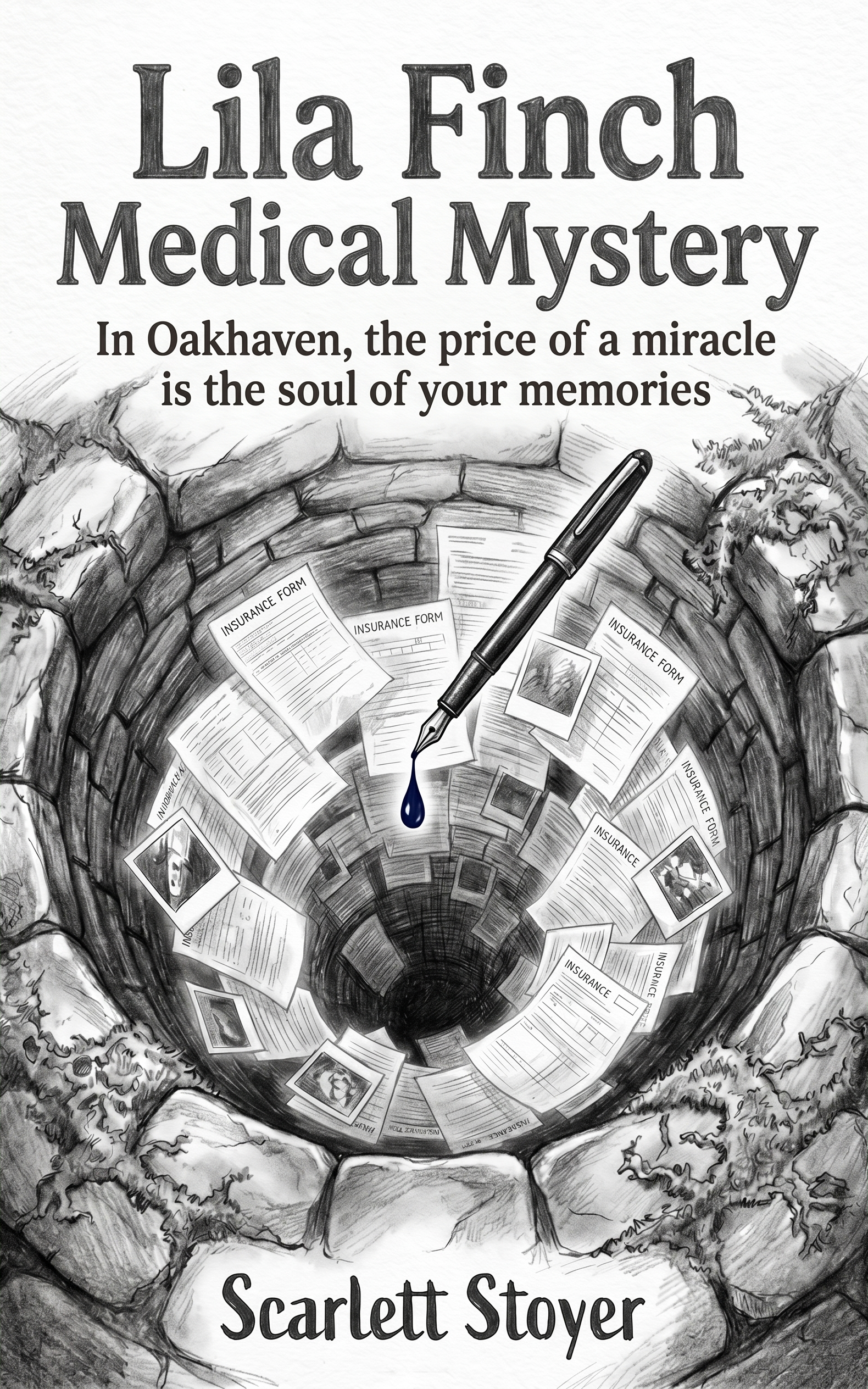
Lila Finch Medical Mystery
In Oakhaven, the price of a miracle is the soul of your memories
by Scarlett Stoyer
Lila Finch knows that numbers never lie, but the medical claims crossing her desk in Oakhaven are doing something much worse: they are telling impossible truths. Patients diagnosed with terminal illnesses are walking out of the clinic with a clean bill of health, while their families report a chilling side effect—the survivors no longer remember who they are. As a meticulous insurance agent, Lila follows the paper trail to the basement of the Oakhaven Clinic. There, beneath the sterile floors, lies an ancient well that breathes life back into the dying, provided a trade is made. The discovery becomes personal when Lila finds her own signature on the 'Memory Rider' policies—contracts she never signed that exchange a patient's physical health for their most precious memories. Teaming up with a local muralist whose mother has become a hollow stranger, Lila must audit a supernatural ledger where the currency is identity itself. With the town’s collective history fading and the charismatic Dr. Thorne tightening his grip on the community, Lila has to find a way to cancel the contracts before the people of Oakhaven forget everything worth living for. In a town where health is bought with the heart, the final premium might be Lila’s own soul.
- Paranormal
- Mystery
- Cozy Mystery
- Amateur Sleuth
- Small Town Mystery
- Murder Mystery
The Statistical Miracle
The quarterly claims report had a problem, and the problem was that it was impossible.
Lila Finch set her coffee mug down on the corner of her desk — the only clear corner, given that the rest was buried under manila folders and color-coded sticky notes — and pressed her index finger against the printed column of numbers as though she could hold them still long enough for them to make sense. Three terminal cases. Three recovery notices. All filed within the same seven-day window in October.
She pulled the first file. Mrs. Eleanor Gable, sixty-seven, hospice-enrolled since August with stage-four lung cancer. Prognosis: four to six weeks. Lila remembered signing the supplemental care rider herself, remembered the particular heaviness of that pen stroke. She had sent Eleanor a card with a small basket of chamomile tea.
Eleanor Gable had been spotted jogging through Oakhaven Town Square at seven this morning.
Lila moved to the second file. Mr. Denny Pruitt, fifty-nine, pancreatic cancer, referred to a hospice facility in September. Recovery notice submitted last Tuesday. The third file belonged to Carol Hess, sixty-three, diagnosed with an aggressive form of leukemia. Her family had already been in contact about funeral pre-arrangements. Her recovery notice was stamped last Wednesday, one day after Denny's.
Lila's photographic memory did not require her to flip between pages. The numbers were already arranged in her head like a perfect ledger, columns neat and unforgiving. She could see the attending physician's name running down all three files like a watermark: Dr. Alistair Thorne, Oakhaven Clinic.
She sat back in her chair and looked out through the agency's front window at the town square beyond. The October light was flat and pale, softening the old brick storefronts into something almost pastoral. Finch Insurance Agency occupied a narrow building wedged between the hardware store and the post office, a location she had chosen deliberately. You learned more about a small town by watching its errands than by reading its newspaper.
Right now, what she was watching was Eleanor Gable.
Lila recognized her the moment she spotted the yellow cardigan, the one Eleanor's daughter had knitted her last Christmas. Eleanor was moving through the square at a pace that no woman recently released from hospice care should have been capable of — brisk, steady, almost purposeful. Her posture was straight. Her color was good. She looked, if Lila was being precise about it, like a woman in her late thirties wearing Eleanor Gable's face.
Lila grabbed her coat and her briefcase and went outside.
The square was quiet for a Tuesday. The farmer's market had packed up, and only a few residents lingered near the gazebo or along the path that circled the old oak at the center of the green. Lila kept a measured distance and watched as Eleanor approached the bench near the fountain where her daughter, Patrice, was sitting with her two young children.
Patrice looked up. Her face broke into that particular expression people wore when they saw someone they had expected never to see walking again — relief and disbelief and something raw underneath both. She stood up from the bench. The children scrambled to their feet. The smaller one, no older than four, reached both arms up instinctively.
Eleanor walked past them.
Not through them, not around them with a distracted apology. She walked past them the way you walk past strangers on a sidewalk in a city where you don't know anyone — with a polite, incurious nod, her eyes already moving ahead to whatever destination she had decided on. The little boy's arms dropped slowly back to his sides.
Lila stopped walking.
Patrice called out, "Mom?" Her voice was careful, the way you speak to someone standing too close to an edge. Eleanor paused, turned, and offered a pleasant and entirely blank smile before continuing on her way. Patrice stood very still for a moment. Then she sat back down on the bench and pulled both her children close to her, and she didn't say anything else.
Lila watched all of this with the focused attention she usually reserved for disputed claim figures. Her mind was already sorting and categorizing. The physical improvement was undeniable and, by any standard she understood, medically impossible. But the woman who had just walked past her own grandchild without a flicker of recognition was not simply distracted or tired or disoriented from medication. That particular blankness had a quality to it. Deliberate, almost. Like a ledger with all the personal entries removed, the columns still neat and functional but stripped of every notation that gave them meaning.
The health is real, Lila thought. Something else isn't.
She turned back toward the agency, her boots clicking a quick rhythm against the brick path. The cold air had sharpened, and she pulled her cardigan tighter with one hand while her mind ran ahead of her feet. There were original policy files in the agency basement, paper copies she maintained out of habit and a deeply ingrained distrust of digital records. If there was a rider she had missed, a clause that tied these recoveries to some arrangement she hadn't approved, it would be there.
She had reviewed these policies a hundred times. She knew every line. But she had also learned, in ten years of forensic accounting, that the most dangerous clause in any contract was the one you were certain couldn't exist.
Patrice and her children were still on the bench when Lila passed. The little boy had his face pressed into his mother's shoulder, and Patrice was staring at nothing, one hand moving slow and automatic through her son's hair.
Lila did not stop. She noted the image the way she noted everything — filed it, cross-referenced it, held it.
Three miracles. Three families watching strangers walk around in their loved ones' bodies. One doctor's name on every file.
She unlocked the agency door, went straight to the basement stairs, and started looking for what she had missed.
The Artist's Eraser
Hollis Vane's studio occupied the ground floor of a narrow building on the south end of Main Street, wedged between a shuttered dry-goods store and a barbershop that still displayed a faded price list from 1987. The sign above the door read Vane Signs & Murals in hand-painted letters, each one a slightly different shade of gold, as if the painter h…