

Jesus Is God
Unveiling the Historical Proof and Theological Truth of Christ's Divinity
by Scarlett Stoyer
Who was Jesus of Nazareth? Beyond a moral teacher or historic prophet, the boldest claim of the Christian faith is simple yet radical: Jesus is God. In this compelling exploration, Scarlett Stoyer bridges the gap between rigorous historical research and deeply personal faith. Beginning with ancient Old Testament prophecies that foretold a divine Savior, this book traces a chronological journey through Christ's miraculous birth, powerful ministry, and explicit claims to divinity. By examining the historical reliability of New Testament eyewitness accounts, Stoyer demonstrates how early believers defended these core truths against ancient challenges and heresies. Blending accessible scriptural analysis with personal spiritual reflections, Jesus Is God equips educators, students, and everyday seekers with an unshakeable foundation for what they believe. Discover why the divinity of Jesus remains the ultimate pivot of human history and how that truth can transform your life today.
- Christian Education
- Historical Non-Fiction
- Biography
- World History
- Cultural & Social History
- Biographical History
The Ancient Promise: Seeds of Divinity
Imagine a world where superpowers swallowed small nations whole, where kings traded loyalty like currency, and where survival meant choosing the right side before the wrong empire came knocking. That was the eighth century BC. It was not a peaceful era of quiet villages and simple farming life. It was a century of fear, and that fear set the stage for one of the most stunning promises ever written down.
To understand why a promise about a child called "Mighty God" mattered so much, we need to see what was on the line. The small nation of Judah faced total destruction, their leaders were desperate, and the people were on the brink of losing everything. In the middle of that turmoil, these ancient words offered real hope—a hope that speaks directly to anyone facing uncertainty and fear today.
A Region on the Edge of Collapse
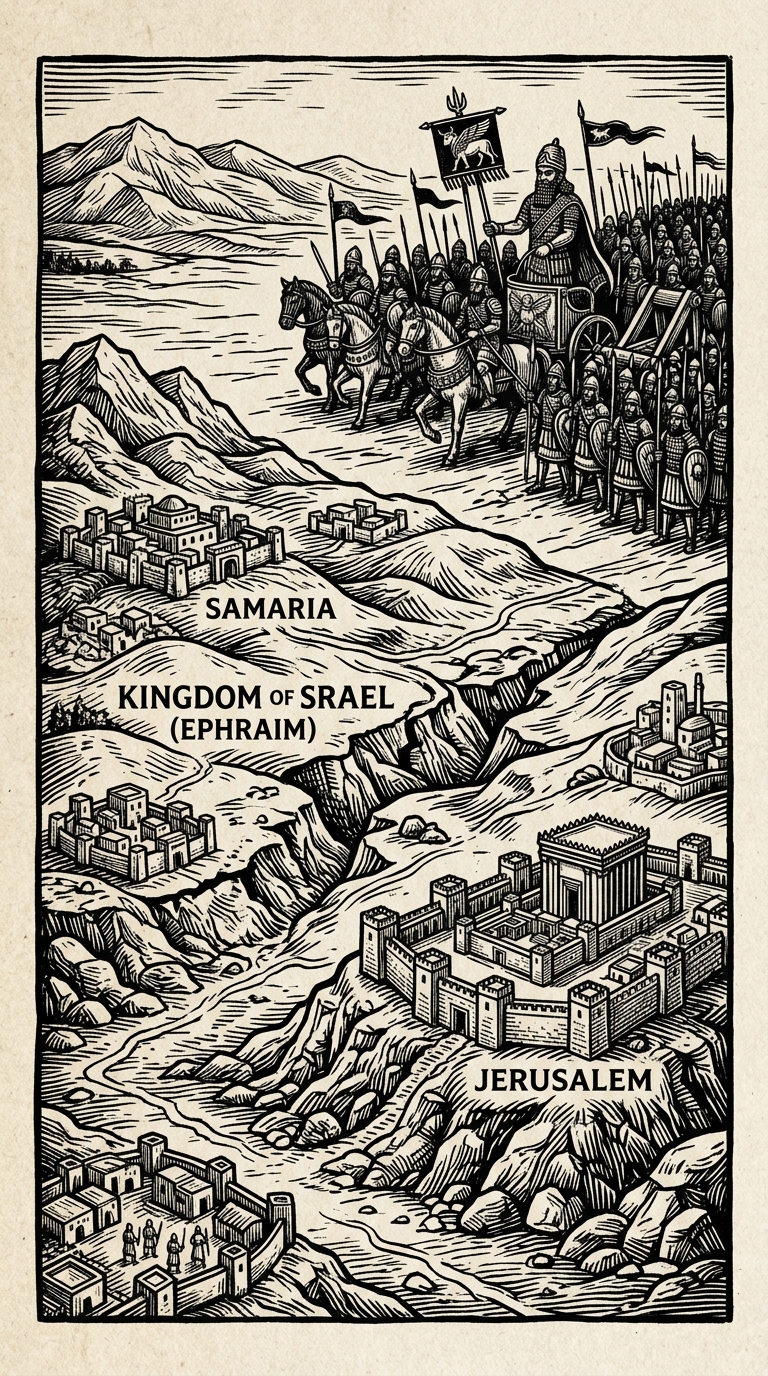
The land of Israel in the 700s BC was not one nation. It was split into two kingdoms: Israel in the north, often called Ephraim, and Judah in the south, with Jerusalem as its capital. Both kingdoms were small. Neither had the military strength of a major power. And both sat right in the path of a growing giant: the Assyrian Empire.
Assyria, centered in what is now northern Iraq, had built one of the most brutal war machines the ancient world had ever seen. Assyrian kings did not simply defeat their enemies. They terrorized them. Records from Assyrian palaces describe skinning captives alive and stacking skulls outside city gates as a warning to anyone who thought about rebelling. This was not exaggeration for effect. Archaeologists have found the carved stone reliefs showing these very scenes, displayed proudly in royal palaces like Nineveh. Fear was a tool of foreign policy.
By 734 BC, this fear had pushed two smaller kingdoms, Israel and Syria (also called Aram), into an alliance. They decided the only way to survive Assyria was to team up and fight back. There was one problem. Judah, the southern kingdom, refused to join them. So Israel and Syria turned on Judah instead, trying to force King Ahaz of Judah into the alliance by threatening to remove him from power. Historians call this conflict the Syro-Ephraimite War, named after Syria and Ephraim, the two kingdoms that ganged up against Judah.
King Ahaz panicked. Instead of trusting God, he looked toward the very empire that should have terrified him most. He sent a message to the king of Assyria, essentially asking for protection, and paid for it with treasures from the Temple in Jerusalem. It worked, in a sense. Assyria crushed Syria and weakened Israel. But it also meant Judah traded one kind of danger for another. Once you invite an empire in as your protector, that empire rarely leaves.
This decision set off a chain of events that would haunt Judah for generations. Assyria did not simply help and go home. It absorbed the region piece by piece. The northern kingdom of Israel fell completely in 722 BC, its people scattered and its identity erased from history, an event so complete that they are often referred to as the ten lost tribes. Judah survived, but barely, and only by becoming a small, obedient subject of a much larger power.
Then, in 701 BC, the danger returned in an even more terrifying form. The Assyrian king Sennacherib marched his army into Judah and laid siege to Jerusalem itself. Assyrian records, discovered on a clay artifact known as the Sennacherib Prism, brag that he trapped King Hezekiah of Judah "like a bird in a cage." Jerusalem should have fallen. By every military logic of the time, it would have fallen. Instead, according to the biblical account in 2 Kings 19, the Assyrian army was struck by a sudden disaster overnight, and Sennacherib withdrew without taking the city. Whatever happened, Assyrian records never claim to have captured Jerusalem, which is itself telling, since Assyrian kings rarely admitted failure in their own inscriptions.
This is the setting we need to hold in our minds: two small kingdoms getting crushed between larger powers, local identities disappearing into a massive foreign empire, kings making desperate political deals, and everyday families watching their world fall apart. This was not a peaceful backdrop for a hopeful prophecy. It was the middle of an actual national crisis, the kind that makes people ask hard questions about whether God is still paying attention.
The Prophet Who Would Not Give Up on Hope
Into this chaos stepped a man named Isaiah. He was not a distant mystic. He was a court advisor, someone with direct access to King Ahaz and later to King Hezekiah. Isaiah 7 records him standing right in front of Ahaz during the Syro-Ephraimite crisis, urging the king to trust God rather than Assyria. Ahaz refused, and Isaiah warned him that his political shortcut would bring exactly the kind of foreign domination Judah feared most.
But Isaiah did not stop at warnings. In the middle of describing military threats, political betrayal, and coming judgment, Isaiah delivers something unexpected: a promise about a child. And this is where the chapter turns from political history into something much bigger.
The Verse That Changes Everything
Isaiah 9:6 reads: "For unto us a child is born, unto us a son is given: and the government shall be upon his shoulder: and his name shall be called Wonderful, Counsellor, The mighty God, The everlasting Father, The Prince of Peace."
Read that again, slowly. This is not a verse about a talented future leader. This is not political flattery aimed at reassuring a nervous kingdom. The words used here go far beyond anything a normal king, however great, could ever claim for himself.
Ancient Near Eastern kings loved grand titles. Egyptian pharaohs called themselves sons of the sun god Ra. Babylonian kings claimed the gods personally chose them to rule. This kind of royal flattery was common across the ancient world. So at first glance, someone might assume Isaiah 9:6 is just another example of exaggerated praise for a new king, maybe Hezekiah, who did turn out to be a good and faithful ruler.
But the specific wording in Isaiah 9:6 does not fit that pattern. And to understand why, we need to look closely at the original Hebrew, because English translations, while helpful, sometimes soften what the ancient words were actually saying.
El Gibbor: A Term That Cannot Be Softened
The phrase translated "The mighty God" in English is, in Hebrew, El Gibbor. Let's break down what these two words mean, because understanding them is the key to this entire chapter.
El is one of the primary Hebrew words for God. It is not a vague term for "a powerful being" or "a hero." Throughout the Old Testament, El is used as a direct name or title for the God of Israel, the same God who spoke to Moses and delivered the Ten Commandments. Gibbor means "mighty" or "warrior," often used to describe strength in battle.
Put together, El Gibbor means "Mighty God" or "God the Warrior." This exact phrase, this exact combination of words, appears again in Isaiah 10:21, and there it unmistakably refers to God Himself, the Lord of Israel. Isaiah uses the same two words to describe the same divine being just one chapter later. That is not a coincidence a careful reader can dismiss. If El Gibbor means God Almighty in Isaiah 10:21, there is no honest reason to claim it suddenly means something weaker, like "godlike hero" or "mighty prince," in Isaiah 9:6.
Some readers try to soften the title by suggesting it means something like "divine warrior" in a loose, symbolic sense, the way an ancient king might be called "godlike" out of flattery. But Hebrew scholars, including Dr. John Oswalt in his well-respected commentary on Isaiah, point out that nowhere else in the Old Testament is a human king given this exact title. Kings are called "son of God" in a symbolic, adopted sense in places like Psalm 2. They are never called El Gibbor. That title is reserved for God alone.
This matters because it means Isaiah 9:6 is not describing a gifted human leader with god-like qualities. It is describing someone who actually carries the title of God Himself, born as a child, in the middle of a political crisis nobody could yet solve.
Comparing the Ancient Neighbors
It helps to compare this to what surrounding cultures were writing at the same time. Egyptian and Mesopotamian texts frequently praised kings using divine language, but usually in a symbolic, almost poetic way. A Pharaoh might be called "the good god" as a title of office, similar to how modern countries might call their leader "commander in chief" without literally meaning he commands every soldier personally. It was a title of position, not an actual theological claim about that person's nature.
Isaiah's writing is different. Isaiah was famously and fiercely against idolatry. Chapters like Isaiah 44 mock other nations for bowing down to statues carved from the same wood used to cook dinner. This is not a man who casually throws around divine titles for effect. Isaiah, more than almost any other Old Testament writer, insists that there is one God, and that calling anything or anyone else "God" is a serious matter. For Isaiah to use the term El Gibbor for this promised child is not a small poetic flourish. It is a deliberate, weighty theological statement from a writer who never used such language lightly.
Proof the Words Have Not Changed
Skeptics sometimes ask a fair question: how do we know this text has not been changed or "cleaned up" over the centuries to fit later Christian beliefs about Jesus? This is where archaeology gives us a remarkable answer.
In 1947, near the Dead Sea in a set of caves at Qumran, shepherds discovered ancient scrolls that had been hidden away for roughly two thousand years. Among them was what is now called the Great Isaiah Scroll, dated to around 125 BC, which is more than a century before Jesus was even born. When scholars compared this ancient scroll to the modern Hebrew Bible used today, the text of Isaiah 9:6, including the phrase El Gibbor, matched almost exactly. There was no tampering, no later Christian editing, no convenient insertion to make an old text fit a new religion.
This means the promise of a divine child called "Mighty God" was sitting in Jewish scrolls, preserved by Jewish scribes, more than a hundred years before any Christian could have possibly influenced the wording. The evidence for this comes directly from the Dead Sea Scrolls collection, now housed and studied at the Israel Museum in Jerusalem, and it is one of the strongest pieces of physical proof we have that this prophecy is exactly as old and unaltered as believers have claimed.
A Cold Library and a Long Night of Doubt
I want to step away from the history for a moment and share something personal, because facts alone rarely settle the deepest questions of the heart.
There was a season in my life when I sat in a university library late at night, surrounded by commentaries and dusty translations, genuinely unsure if any of this was true. I had grown up hearing that Jesus was God, but hearing something and knowing it are different things. I remember thinking that maybe the whole idea had been invented later, patched together by well-meaning but mistaken followers trying to make sense of a good teacher's death.
Then I found myself staring at Isaiah 9:6 next to Isaiah 10:21, tracing the same two Hebrew words, El Gibbor, across both verses with my finger on the page. It struck me that this was not a phrase invented by nervous disciples centuries later trying to elevate their teacher. This was sitting in the Hebrew Scriptures long before Jesus was born, preserved word for word in a scroll buried in a desert cave. The consistency was not something I expected. I remember the room being cold, my coffee gone flat, and a strange quiet settling over me as I realized the Bible was not a patchwork of convenient later additions. It was one long, connected story, written across centuries by different authors, yet somehow lining up on this single, staggering point: a child would be born who would actually be God.
That night did not answer every question I had. But it gave me something steadier than an easy answer. It gave me confidence that the foundation was solid, even if I still had building to do on top of it.
Why This Matters When Your Own World Feels Unsteady
Here is the connection worth sitting with. Isaiah did not deliver this promise during a calm, comfortable season. He delivered it while empires were crushing small nations, while kings were making desperate and foolish political deals, while entire tribes were being wiped from the map. God's plan to send a divine rescuer was not announced in peacetime. It was announced in the middle of the exact kind of chaos that makes people wonder if God has forgotten them.
That pattern is worth remembering. If God had a plan for rescue centuries in advance, spoken clearly enough that we can still read the very same Hebrew words today, then chaos in our own lives is not proof that God has lost control. Ahaz looked at the crisis in front of him and turned to Assyria for an answer. Isaiah looked at the same crisis and pointed instead to a child who would be called Mighty God. One path led to centuries of foreign domination. The other pointed toward the birth of the world's actual rescuer, seven hundred years before it happened.
Takeaways
- God's plan for a divine Savior is not a late invention. It was written down centuries before Jesus was born, in the middle of a real, chaotic political crisis.
- The Hebrew phrase El Gibbor, meaning "Mighty God," is used elsewhere in Isaiah to refer only to God Himself, showing that Isaiah 9:6 is describing more than a human king.
- The Great Isaiah Scroll from the Dead Sea Scrolls proves this exact wording existed more than a century before Jesus was born, ruling out later Christian editing.
- When our own world feels like it is falling apart, we can trust that God's plans are not shaken by political crisis. He has been working toward rescue since long before we were born.
A King from Bethlehem: The Human and the Divine
Somewhere around 700 BC, a farmer from a small village south of Jerusalem picked up his pen and started writing some of the harshest words ever aimed at the ruling class of Judah. His name was Micah, and he came from a town called Moresheth, a place so small and unimportant that most people in Jerusalem had probably never heard of it. That detail m…