
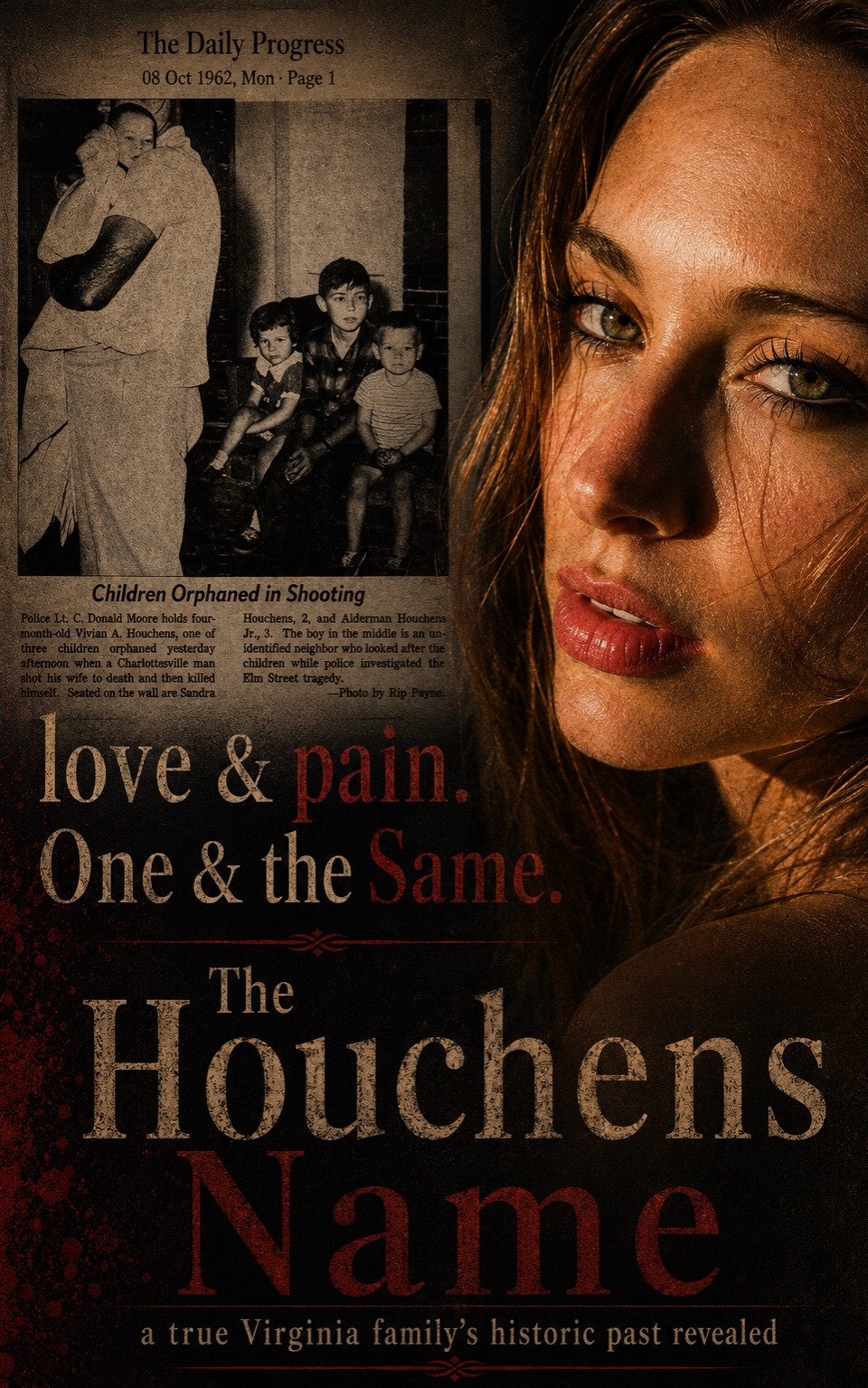
LOVE & PAIN. ONE & THE SAME. THE HOUCHENS NAME
Chaos is a friend of mine, creating a wild soul with the highest vibes & a heart of gold a country mile wide
by Samantha Houchens
What happens when a name is synonymous with both kinship and catastrophe? In 1962, a murder-suicide on Elm Street shattered the Houchens family, leaving a trail of orphaned children and unspoken horrors in the heart of Central Virginia. For decades, the truth remained buried under layers of rural silence and southern propriety. Now, Samantha Houchens peels back the veil, embarking on a forensic journey through courthouse basements and forgotten archival boxes to confront the ghosts of her lineage. From the tragic lives of ancestors like Lucian and Pirley to the recurring patterns of violence and abandonment that haunted their descendants, this narrative is a raw examination of generational trauma. It explores how systemic failures and cultural expectations allowed domestic suffering to fester into a family legacy of fire and blood. LOVE & PAIN. ONE & THE SAME. THE HOUCHENS NAME is more than a true crime memoir; it is a reckoning. It is a guide for anyone seeking to break the cycle of inherited rot by choosing the light of truth over the safety of silence. This is a story of survival, a search for identity, and a testament to the heavy cost of remembrance.
- Biography
- True Crime
- Historical Non-Fiction
- Family Memoir
- Overcoming Adversity
- Historical Crime
The Color of the Devil: Red Metaphors
There is a particular way people lower their voice when they say certain names. Not a whisper exactly. More like the volume drops automatically, the way your body pulls back from something hot before your brain has finished deciding it's dangerous. I noticed that sound long before I understood what it meant. I was just a kid, small enough that adult conversations happened somewhere above my head, and I would catch fragments the way you catch rain in your hands. A word here. A pause there. A name that made the air in a room go tight.
That name was Houchens.
Red was everywhere in my childhood, and I mean that in the most literal sense. The dirt of Orange County, Virginia has a reddish clay to it, the kind that stains the knees of your jeans and packs under your fingernails and stays there no matter how hard you scrub. I grew up with that dirt on me constantly. Red dirt roads that led to places most people on the outside never thought to look. Red mud that clung to truck tires and boot soles and the backs of dogs. And the roses my father kept in the yard, stubborn old climbing roses along the fence line, red as anything you have ever seen. He never talked much about why he planted them. He was not a man who explained his softer choices. But they were there every summer, bloody bright against the green, beautiful and thorny in equal measure.
He warned me about the thorns. That was the thing about my father. He would hand you something beautiful and immediately tell you how it could hurt you. I thought that was just his way of being careful. It took me most of my adult life to understand that was actually the most honest thing he ever taught me. Beauty and danger sharing the same stem. Love and warning wearing the same face. He knew that long before I did.
As I got older and started asking questions about my family, about the name we carried, I began collecting something that did not come from courthouse records or newspaper archives. I started gathering the other kind of testimony. The kind that lives in the mouths of old-timers. The kind that gets passed around at feed stores and church parking lots and over back fences when people think no one important is listening.
Orange County is not a large place. It has the specific quality of small Southern towns where everybody knows something, most people know more than they admit, and the ones who have been there the longest remember everything. When I started asking about the Houchens family, about who they were and what people recalled, the conversations I got back were not simple. They were layered. There was always a moment where the person I was talking to would shift their weight, adjust their expression, and decide how much of the truth they were willing to hand over.
One man, old enough to have known people who knew my grandparents personally, put it this way. He said the Houchens family was like a match. You could use it to light a fire that kept your family warm, or you could use it to burn something down. He paused after he said it, like he was checking to see if I was offended. I was not. I was taking notes.
Another woman, someone who had grown up on the edge of the same community, remembered hearing the name as a child in the way children hear names that are attached to something dark. She said her mother used to say it quietly. Not mean about it, she clarified. Just careful. Like you would say the name of a place where something bad happened. Not because the place itself was evil, but because the memory of what happened there still had weight. The name carried that weight, she said. It just did.
That is the social record of the Houchens name in Orange County. Not a monument. Not a plaque. Just a lowered voice and a careful look and the specific body language of people who remember things they were never quite sure how to talk about.
In Southern Gothic tradition, and Orange County sits comfortably inside that literary and cultural geography, the idea of a family curse is not considered strange. It is practically a genre staple. Families carry darkness the way rivers carry silt. You cannot always see it from the surface, but it is down there, moving, settling, building up over time until one day the riverbed has changed completely and nobody can fully explain when that happened. People in communities like mine have always understood that some families seem to attract tragedy. They may not use clinical language about it. They may not call it generational trauma or untreated mental illness or cycles of domestic violence. But they feel the pattern, and they name it in the language available to them. They call it a curse. They call it bad luck. They call it the devil following a bloodline.
I spent a long time being angry about that. About the casual way people attached supernatural explanations to what was actually human suffering. About how easy it was to say that family was cursed instead of saying that family was failed. Cursed requires no accountability. A curse descends from somewhere outside of human choice. Nobody has to answer for a curse. Nobody has to ask what services were missing, what interventions never came, what silence was kept by the people who saw and did nothing.
But here is the thing I had to reckon with eventually. The people who whispered the Houchens name were not cruel. Most of them were not even wrong about what they observed. They saw a family that kept losing people to violence. They saw children left without parents. They saw a pattern repeat across years and across generations in a way that looked, from the outside, like something more than coincidence. They did not have the vocabulary for what they were actually witnessing. Neither did the people inside it. That is the honest truth of it. The language of trauma cycles, of untreated pain reproducing itself in the next generation, that language was not available to people in rural Virginia in 1962. And if it was available somewhere in an academic building a hundred miles away, it certainly was not making its way down the red clay roads to the people who needed it most.
So they called it a curse, and they whispered the name, and they kept their distance, and the children who were left behind after the worst days of that family's history had to grow up inside both the reality of what happened and the mythology that grew around it. My father grew up inside that. He grew up carrying a name that had been made heavy before he was old enough to understand why, and he carried it quietly, the way you carry something you have no choice about. He planted red roses and warned me about the thorns, and he kept a box in the back of a cabinet, and he answered a seven-year-old's question about grandparents by reaching into a place he had probably not opened in years.
That is what the introduction of this book was really about when it talked about dressing suffering in silk. We do it with love, yes, wrapping it in red and calling it beautiful. But we also do it with pain. We dress pain up in myth and superstition and family legend because the naked version is too hard to look at directly. We call it a curse because calling it what it actually is requires us to sit with something much more uncomfortable. It requires us to say that ordinary people, under ordinary pressures, in ordinary kitchens and on ordinary streets, can break in ways that destroy everyone around them. And that the systems that were supposed to catch those people, the community, the church, the neighbors, the law, sometimes just watched it happen and then went home and lowered their voices whenever the name came up afterward.
That is not a supernatural story. That is a human one. And it is far more frightening than any devil.
The red dirt of Orange County taught me things that no classroom ever could. It taught me that the land absorbs what happens on it and does not give explanations. That places hold memory even when the people in them try to forget. I used to ride through those back roads as a teenager and feel something I could not name, something that was not quite sadness and not quite pride but sat somewhere between them. The Houchens name was attached to this county, to its soil, to specific streets and specific addresses and specific moments in time that had been recorded in courthouse documents and newspaper columns and the long memory of old people who had watched it all happen.
When I started going back through those records as an adult, when I started pulling on the threads of what I only half-knew from childhood, I was not looking for a curse. I was looking for an explanation. I was looking for the human shape of what had happened so I could stop carrying the mythology version of it and start carrying the truth. Those are very different weights. The mythology is shapeless and heavy, the kind of weight that spreads out into everything and makes you feel permanently behind. The truth, even when it is brutal, has edges. You can put it down. You can look at it from different angles. You can decide what to do with it once you have it in your hands.
The devil was never following the Houchens bloodline. There was no supernatural force attaching itself to our name and riding it through the decades. What there was, was pain that never got treated. Grief that never got spoken. Violence that happened behind closed doors and then got buried under a lowered voice and a careful look and a name said quietly in the feed store parking lot. What there was, was a cycle. Cycles are not curses. They are patterns. And patterns, unlike curses, can be broken.
That is the thing about red. You can spend your whole life seeing it as the color of danger, of warning, of the devil and the open wound. Or you can remember that it is also the color of the thing pumping inside your chest right now, keeping you alive, keeping you reading, keeping you here. Both meanings are real. Neither one cancels the other out. The rose is beautiful and it will cut you. The love is genuine and it will cost you. The name carries weight and it carries history and it carries the possibility of something different.
I grew up with red dirt on my knees and a name that made rooms go quiet. I grew up in the shadow of something that happened before I was born, something I did not choose and could not change. But I also grew up with a father who planted roses, who kept a box in the cabinet, who answered hard questions even when it cost him something to do it. That is also the Houchens name. That is also part of what we are.
This book is the reckoning I owe the whole of it. The ugly and the true and the parts that were never supposed to be said out loud. Every name deserves to be looked at directly. Even the ones people have spent decades only willing to say in a whisper.
The Box in the Cabinet
He pulled out a newspaper clipping. Not a photograph. Not a letter. Not anything warm or human or soft. A newspaper clipping, yellowed at the edges, folded in a way that told me it had been opened and closed more times than anyone would ever admit. The paper had the specific fragility of something old, the kind of old that means handled, the kind …