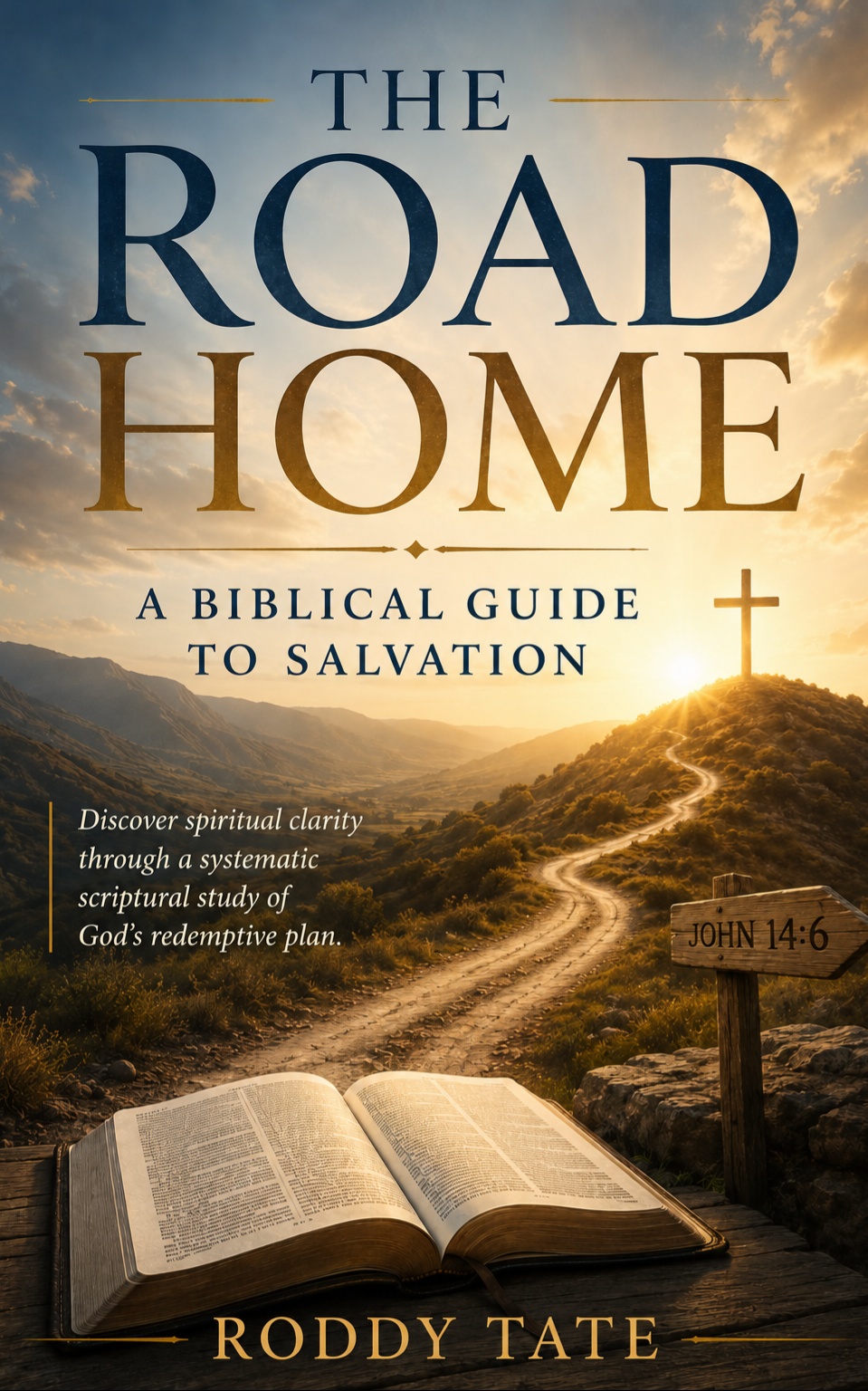
The Road Home: A Biblical Guide to Salvation
Discover spiritual clarity through a systematic scriptural study of God's redemptive plan
by Roddy Tate
Are you certain of your spiritual standing, or are you navigating the journey of faith with a map of human opinion? In 'The Road Home: A Biblical Guide to Salvation,' author Roddy Tate clears the theological fog to reveal the true scriptural path to redemption. Moving beyond modern clichés, this book provides a deep, systematic dive into the heart of the New Covenant. By exploring the original Greek and Hebrew meanings of grace, faith, and repentance, Tate bridges the gap between ancient wisdom and contemporary life. From the loss of Eden to the glorious restoration of the New Creation, you will discover how God has meticulously paved the road back to Him. This guide breaks down complex doctrines into a clear four-part framework, addressing the transition from Law to Grace and the vital role of the Holy Spirit. Whether you are a new believer or a seasoned student of the Word, you will find practical steps for justification and the keys to a lifelong walk of sanctification. It is time to stop wondering and start walking with confidence. Your homecoming is closer than you think. Let the scriptures be your guide on the road back to the Father's house.
- Religion & Spirituality
- Christianity
Eden and the Law
This publication is the culmination of many years of development, designed to assist those who desire a deeper, more structured understanding of God's word. When we study the scriptures, we quickly realize that salvation is not God inventing something new. It is God restoring what was lost. To truly comprehend the beauty of this restoration, we must first travel back to the beginning of the biblical narrative. We must understand the home we lost and the nature of the rescue mission that God set into motion. This chapter examines the transition from the unbroken fellowship of Eden to the introduction of the Mosaic Law, establishing why a Savior was desperately needed to bring us back home.
The Bible begins in a garden and ends in a garden-city. This overarching narrative arc reveals that God's ultimate desire for humanity has always been proximity and peace. Yet, for most of human history, we have lived with a profound sense of spiritual displacement. We feel like travelers who are far from home, searching for a place of belonging that we cannot quite define. By comparing the original state of humanity with the covenant of the Law given at Mount Sinai, we can begin to see how God diagnosed our spiritual disease and pointed the way toward the ultimate remedy.
The Comparison: Unbroken Fellowship vs. The Covenant of Law
To understand why the rescue mission of Jesus Christ was necessary, we must compare two vastly different eras in biblical history: the period of unbroken fellowship in the Garden of Eden and the era of the Mosaic Covenant established at Mount Sinai. These two periods represent different ways of relating to God, and they highlight the devastating impact that sin had on the human condition.
In the beginning, God established a world of perfect harmony. The original state of humanity in Eden was characterized by a complete absence of barriers. There was no sin and no death. Adam and Eve enjoyed a perfect relationship with God, characterized by direct, unhindered communication. They walked with God in the cool of the day, experiencing His presence without fear or hesitation. This was a life of natural belonging, where humanity existed in perfect alignment with their Creator and with one another. Work was meaningful and productive, and the garden provided an abundance of nourishment.
Contrast this with the Covenant of Law delivered to Moses centuries later. At Mount Sinai, the atmosphere was not one of peaceful communion, but of terrifying majesty and distance. The people of Israel were met with thunder, lightning, and the loud blast of a trumpet. Boundaries were set around the mountain, and the people were warned that if even an animal touched the mountain, it would be put to death. Instead of free, unhindered access, the Law introduced a highly structured system of mediation. Only the high priest could enter the Holy of Holies, and that could only happen once a year, accompanied by the blood of sacrificial animals. The relationship was now governed by a written code consisting of hundreds of commandments and decrees. Every violation carried a penalty, and the entire system was designed to remind the people of their moral failures and their separation from a holy God.
The transition from the garden to the mountain represents the shift from a life of natural fellowship to a life defined by a legal code. In Eden, obedience was the natural byproduct of love and trust. Under the Law, obedience became a matter of legal duty and survival. The contrast is stark: one is a home of warmth and life, while the other is a courtroom of justice and condemnation. Understanding this contrast is key to realizing why the Law, while holy and good, could never serve as the final destination for humanity. It was never meant to be our home; it was a temporary station on the road back to the fellowship we lost.
Biblical Distinctions
When we examine the text of Genesis 1 and 2, we see the blueprint of God's original design for human existence. Humanity was created in the image of God, designed to rule over the earth as benevolent stewards. There was no internal conflict and no guilt. The scriptures state that Adam and Eve were both naked, and they were not ashamed. This lack of shame is the defining characteristic of Edenic life. It indicates a total vulnerability and honesty, both before God and with each other. There was nothing to hide. This was the divine design.
The giving of the Law in Exodus, however, served a completely different purpose. The Law was not the original design; it was a diagnostic tool. To understand this distinction, we must look at the biblical definition of sin. In the Hebrew scriptures, the word for sin is chata, which literally means "to miss the mark". In Greek, the corresponding term is hamartia, which carries the same meaning: "to fall short". Humans were created to reflect the glory of God, but sin caused us to miss that mark entirely.
The Law of Moses was introduced to show humanity exactly how far they had fallen from the original standard. It did not create the distance between God and man, but it made that distance visible and measurable. Paul writes in Romans 3:20 that "through the law comes the knowledge of sin." The Law acts like a mirror. When you look into a mirror, it can show you that your face is dirty, but the mirror itself has no power to wash the dirt away. If you try to use the mirror to clean your face, you will only end up frustrated. In the same way, the Law could identify the "missing of the mark," but it possessed no power to transform the human heart or restore the fellowship that had been broken in Eden.
This is where we find the core scriptural anchor for this chapter in Galatians 3:24: "Therefore the law was our tutor to bring us to Christ, that we might be justified by faith". The Greek word used for tutor is paidagogos, which refers to a household servant who was responsible for supervising a child, keeping them safe, and bringing them to the schoolmaster. The tutor did not provide the ultimate education; their job was to ensure the child arrived safely at the place of true learning. The Law was our spiritual tutor. It kept humanity under custody, pointing out our failures, until the Savior arrived to offer true justification and restoration.
Case Study Comparison
To appreciate the emotional and psychological shift that occurred between Eden and the Law, it is helpful to look at two distinct historical moments in the scriptures. Let us compare the experience of Adam in the garden with the experience of the Israelites at the foot of Mount Sinai.
In Genesis, we get a glimpse of Adam's initial relationship with God. The text implies a rhythmic, peaceful association: "And they heard the sound of the Lord God walking in the garden in the cool of the day" (3:8). Imagine the profound peace of that setting. There was no anxiety and no performance pressure. Adam's walk with God was a natural expression of belonging. He did not have to prove his worth or perform rituals to gain access to his Creator. The presence of God was his natural home, a place of safety and warmth. He was known fully, and he was completely at peace.
Now, let us contrast this with the scene at Mount Sinai in Exodus 20:18-19: "Now all the people witnessed the thunderings, the lightning flashes, the sound of the trumpet, and the mountain smoking; and when the people saw it, they trembled and stood afar off. Then they said to Moses, 'You speak with us, and we will hear; but let not God speak with us, lest we die.'"
The contrast could not be more dramatic. In the place of peaceful walking, we find trembling. In the place of proximity, we find a people standing "afar off." The Israelites were overwhelmed by a terrifying awareness of God's absolute holiness and their own spiritual inadequacy. They realized that they could not survive direct contact with a holy God. They begged for a mediator, choosing to have Moses speak on their behalf rather than facing the presence of God themselves. This reaction represents the ultimate consequence of sin: a deep-seated fear of God that drives us away from Him rather than drawing us close. It is the natural reaction of a guilty conscience when confronted with absolute righteousness.
This comparison reveals the tragedy of the human condition. We were designed for the garden, but because of sin, we find ourselves trembling at the mountain. The natural belonging of Eden was replaced by a terrifying awareness of distance. This case study shows us that human nature, when left to its own devices in the presence of God's holiness, is marked by fear and shame. The Law codified this distance, reminding the people that they could not simply walk back into the garden on their own terms.
Correction of Common Errors: The Purpose of the Law
One of the most common mistakes people make when reading the scriptures is believing that the Old Testament Law was intended to be a permanent, universal system of salvation. Many people, even today, operate under the assumption that they can earn their way back to God by keeping the Ten Commandments. They view the Law as a spiritual ladder, believing that if they climb high enough and perform well enough, they can secure their own entry into heaven. This is a fundamental misunderstanding of why the Law was given.
As we have seen, the Law was never designed to be the cure; it was designed to be the diagnosis. It was given to show humanity our complete inability to save ourselves. If we could earn our salvation by keeping a legal code, then Jesus Christ died for no reason. The Apostle Paul addresses this directly in his writings, explaining that no human being will be justified in God's sight by works of the Law. The Law demands absolute perfection. James 2:10 reminds us that "whoever shall keep the whole law, and yet stumble in one point, he is guilty of all." To use the Law as a ladder is to invite failure, because a single slip-up ruins the entire attempt.
Consider the modern example of a student who tries to be perfect in every way to earn their parents' love, versus a patient who realizes they are sick and need a doctor. The student lives in a state of constant anxiety, knowing that any mistake could jeopardize their standing. They are trapped in a performance-driven cycle that produces no real peace. On the other hand, the patient who admits they are sick does not try to heal themselves; they place their trust in the physician. Many people approach God like the anxious student, trying to use "good works" to cover their flaws, much like Adam and Eve tried to use fig leaves to hide their nakedness. But God does not want our performance; He wants our trust. The Law was meant to turn us into patients who recognize our need for a spiritual physician.
By correcting this error, we can see the Law for what it truly is: a gift that prepares us for grace. It was never a ladder to heaven, but a road sign pointing us to Christ. When we realize that we cannot keep the Law, we are finally ready to abandon our self-righteous efforts and accept the rescue that God has provided through His Son.
Comparison Table
To help visualize these concepts, let us look at a simple comparison between the characteristics of Edenic Grace and the characteristics of the Mosaic Law. This structured view highlights the fundamental differences in how relationship and identity operated in these two distinct biblical eras.
| Feature | Edenic Grace (Genesis 1-2) | Mosaic Law |
|---|---|---|
| Relationship Status | Natural Fellowship, direct access to God. | Mediated access, restricted by boundaries. |
| Consciousness | No shame, complete vulnerability. | Consciousness of sin and guilt. |
| Requirements | No written codes, trust. | Written requirements, legal codes. |
| The Human State | Perfect alignment with God's design. | Identified as "missing the mark". |
| Primary Focus | Abundance, life, stewardship. | Diagnosis of spiritual disease, restraint of sin. |
This table makes the distinction clear. The Mosaic Law was a necessary intervention in human history, but it was never intended to be the final state of restoration. It served to preserve a people and define holiness. It showed humanity that the way back to the garden could not be achieved through human effort or legal compliance.
Conclusion: The Tutor Leading Us Home
The journey of faith begins with a realistic assessment of where we stand. If we do not understand the depth of our spiritual displacement, we will never appreciate the value of the rescue. The Garden of Eden represents the home we lost, a place of unbroken fellowship where we were designed to live in perfect harmony with our Creator. When sin entered the world, we missed the mark, falling short of the glory of God and introducing a legacy of fear and separation.
The Law of Moses was not a step backward, but a necessary step forward in God's plan of redemption. It acted as a tutor, exposing our weakness and pointing out our failures. It was designed to lead us to the end of our own self-reliance, forcing us to look beyond our own efforts and search for a Savior who could do for us what the Law could never do: restore the fellowship we lost in the fall.
In the next chapter, we will examine how Jesus Christ, the Second Adam, entered our history to succeed where the first Adam failed, transition us from the Covenant of Law to the Covenant of Grace, and open the road back home.
Reflection Questions
To assist you in your study of these truths, please consider the following questions. You are encouraged to write your answers directly in this booklet, using your own Bible as you seek to understand God's word.
- Do you ever find yourself trying to use "good works" or legalistic rules as a way to hide from God, much like Adam and Eve used fig leaves?
- In what ways have you experienced the "trembling" of Mount Sinai?
The Second Adam: Transitioning to Grace
The transition from the diagnostic condemnation of the Law to the life-giving freedom of grace is the central pivot of the entire biblical narrative. In the previous chapter, we observed how the Mosaic Law functioned as a tutor, exposing our spiritual bankruptcy and demonstrating that human effort can never bridge the gap created by sin. If we were…