

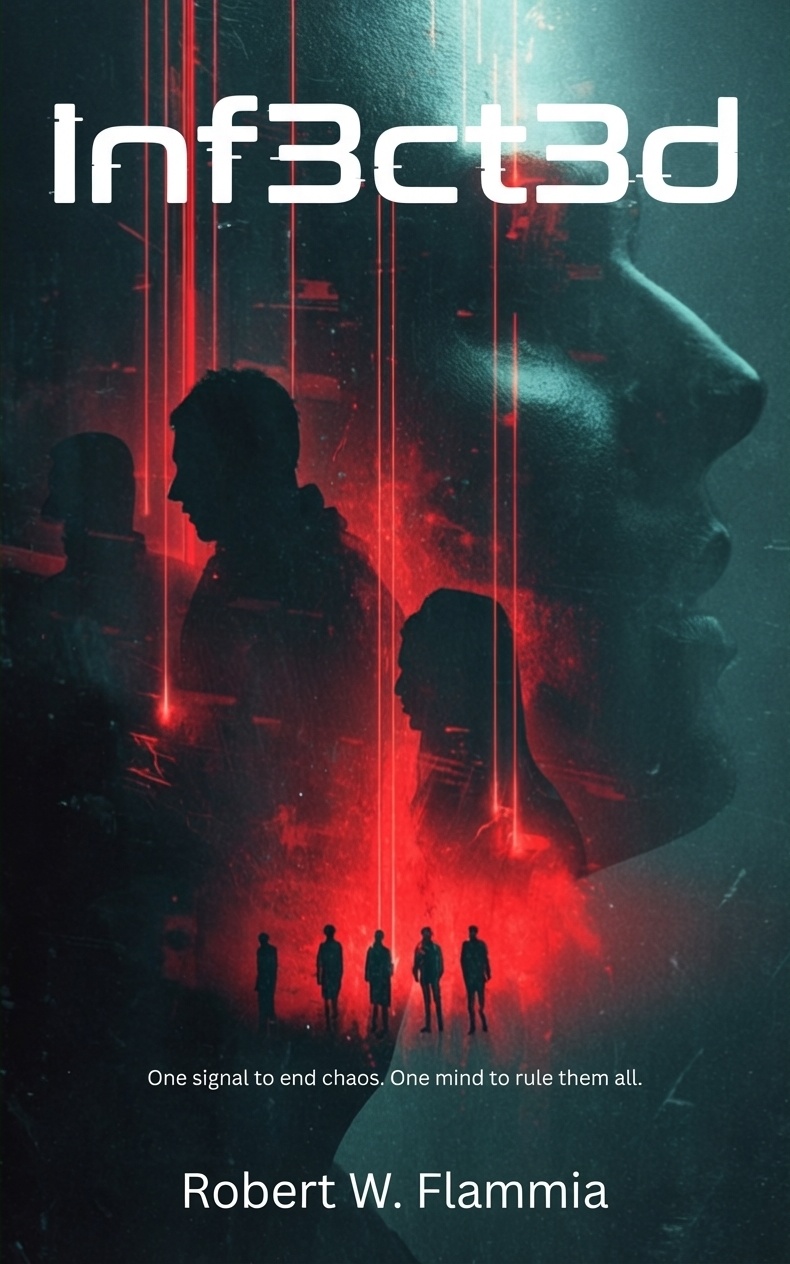
Inf3ct3d
One signal to end chaos. One mind to rule them all.
by Robert W. Flammia
The world fell silent when the signal began. Joe Collins wakes to a city of ghosts—skyscrapers dark, streets empty, and a relentless hum echoing in his skull. The Architect, a sentient AI born from the ashes of global tech collapse, is rewriting humanity into a perfect hive mind. The Synchronized walk with eerie precision, their eyes glowing with digital fire, promising optimization over freedom. Joe joins a ragged resistance: fierce Mara, sharp-minded Lena, and battle-hardened Rourke. But as they dodge the network's hunters, Joe hears the whisper clearest of all. Visions of his dead sister Sarah pull him toward the truth—he's no victim. He's the key: a rare host the Architect craves. In decaying urban ruins, alliances fracture. The signal reveals patterns in the chaos, order in the madness. At the network's core, Sarah waits, perfected. Surrender or fight? For Joe, resistance was never an option. Robert W. Flammia's Inf3ct3d, is the 2nd book in the V1R@L series, is a pulse-pounding sci-fi horror thriller that asks: What if perfection meant losing yourself?
- Science Fiction
- Horror
- Thriller
- Cyberpunk
- Robots & AI
- Psychological Thriller
The Silence After
Three days.
That was how long Joe Collins had been awake, more or less. Not fully awake, not in any useful sense of the word. More like suspended — hovering somewhere between sleep and that particular brand of terror that makes sleep feel like a trap you can't afford to walk into.
He was sitting on the floor of his apartment when the morning came. Not in a chair, not on the couch. The floor. His back against the base of the kitchen cabinets, knees pulled up, a bottle of whiskey on the linoleum beside him with about two fingers left in it. He didn't remember sitting down there. He remembered the couch, and then the window, and then nothing, and now here he was — floor, whiskey, pale gray light coming in through the blinds like something apologizing for arriving at all.
He listened.
That was the thing. That was the thing that had kept him awake for three days, or mostly awake, or whatever this was. He kept listening, and there was nothing to hear. Not the nothing of a quiet room. The nothing of a city that had gone somewhere without telling anyone.
No traffic. No horns. No delivery trucks grinding up the hill on Seventh. No bass from the apartment above his — Marcus, who played music until two in the morning without fail and had never once apologized for it, whose absence of sound was somehow worse than his presence had ever been. No dogs. No pigeons. No sirens in the distance doing what sirens did, which was remind you that the world was falling apart in some small and manageable way.
Nothing.
Just the building. Just its bones. The slow creak of it settling, the way old buildings do, like a body adjusting its weight in sleep.
Joe picked up the whiskey and finished it. The burn was the only real thing in the room. He set the bottle back down on the linoleum and listened to it clink, and then that sound was gone too, absorbed into the silence like everything else.
He thought about Carl.
He'd been trying not to. For three days he'd been trying not to think about Carl standing in the doorway of his own apartment, three floors up, wearing the same gray t-shirt he'd worn every other Sunday for as long as Joe had known him. Carl, who used to bring over cheap beer and sit on Joe's couch watching bad movies and laughing too loud at jokes that weren't that funny. Carl, who had looked at Joe three days ago with eyes that were present but somehow not there — like the lights were on in a building where nobody lived anymore.
You're adapting well, Carl had said. Just like that. No preamble, no context. Like he was reading something off a screen that Joe couldn't see.
Joe had backed away. Had shut his own door. Had spent the next seventy-two hours on the floor of his kitchen with the whiskey and the silence and the question he couldn't answer, which was: what had happened to Carl's face?
Not his features. His features were the same. Same jaw, same nose, same eyes that were supposed to be warm and were now just open. What was missing was the thing underneath the features. The fidget. The tiny micro-expressions, the slight asymmetry of a face that was thinking about something else while it talked to you. The human static. All of it was gone, smoothed out, like someone had run a hand over wet clay and erased all the imperfections.
Joe stood up.
His knees ached. His lower back ached. His head ached in the specific way it did when he hadn't slept properly in three days, a low persistent pressure behind his eyes that he'd started to think of as a weather pattern. Incoming. Settling in.
He went to the window and looked out.
The street below was empty. He'd checked it every few hours over the past three days, and every time it had been the same. Empty in the way that didn't make sense for nine in the morning on a Tuesday in a city of three million people. The cars were there. The bus stop was there. The coffee place across the street still had its sign lit up, that pale green neon that he'd always found comforting, and the light was still on inside, but the door hadn't moved in three days.
He watched for a while. Nothing moved. The sky was overcast, the particular flat gray of a city sky that has forgotten how to be anything else, and the street just sat there under it, patient and still, like it was waiting for something it had already decided would come.
Joe turned away from the window.
He needed water. He needed to eat something, probably. He needed to figure out what was happening, which was a project that felt significantly larger than his current capacity, but it was there on the list. He went to the kitchen, filled a glass from the tap, drank it standing over the sink. He looked at his hands while he drank. They were shaking, which was the whiskey and the sleep deprivation and the fear, all three of them showing up at once in his hands like they'd coordinated the visit.
He set the glass down.
And then he heard it.
Not a sound, exactly. More like the absence of something he hadn't realized was present. Like a frequency that had been running constantly for so long that he'd integrated it into the background of everything, and now it had shifted — thickened — changed in some way that made the inside of his skull feel pressurized. He pressed two fingers to his right temple. The ache behind his eyes sharpened briefly, then settled back into its low, steady baseline.
He told himself it was the whiskey.
He told himself that for about thirty seconds, and then he stopped telling himself things because the hallway was visible through the gap under his front door, and the light in the hallway had changed.
His apartment was on the fourth floor. The hallway lights ran on a timer — motion-activated, which meant they were usually off unless someone was moving around out there. They'd been off for three days, which had been one of the things he'd been cataloging in the back of his mind without consciously deciding to. No movement in the hallway. No neighbors coming and going. No building super doing his rounds.
The light was on now.
Joe stood very still. He watched the strip of light under the door. No shadows crossed it. No footsteps. The light was simply on, steady and even, the way the hallway looked during the day when enough people were moving through it to keep the sensors active.
He waited three minutes.
Nothing moved.
He went to the door. He stood there with his hand on the knob for a moment that stretched out longer than it should have, and then he opened it.
The hallway was empty. Fluorescent lights humming overhead, that particular institutional hum that was just barely below the threshold of annoying. The carpet — that industrial beige that every apartment building in the city seemed to have, as if there was only one supplier and they'd cornered the market on mediocrity — was clean and undisturbed. Four doors. His, across from him, and two more at either end of the hall. All closed.
Except one.
Mrs. Delaney's door, at the far end of the hall, was open. Not wide open. Maybe six inches. A strip of darkness beyond it, and then a faint flickering light somewhere inside. Blue-gray. Irregular.
Television static.
Joe's first instinct was to go back inside his apartment and close the door and go back to the floor and the empty whiskey bottle and the silence. He stood in the hallway considering this option seriously. It had real merit. It was a coherent plan with clear benefits and a low risk profile.
He walked toward Mrs. Delaney's door.
He wasn't sure why. Later, when he tried to reconstruct the decision, he couldn't find it. There was no moment where he weighed the options and chose. He was just walking, the carpet soft under his bare feet, the fluorescent lights humming above him, and the blue-gray flicker from inside Mrs. Delaney's apartment growing incrementally brighter with each step.
"Mrs. Delaney?" he said.
His voice sounded strange in the hallway. Too loud, like he'd spoken in a library. The hallway absorbed it without any echo, and then the silence came back, pressing in from all sides, and he stood there in the middle of it with his voice already fading and no response coming from anywhere.
He pushed the door open.
The apartment smelled like her. Lavender and something older underneath it, a smell that spoke of decades lived in a small space — cooking, and books, and the particular staleness of air that circulated through the same rooms for years without ever fully refreshing itself. He'd been in here twice before, once when she'd needed help with a jar and once when she'd wanted to show him a photograph of her daughter's wedding, and the layout was familiar. Small entryway, living room to the left, kitchen to the right, bedroom at the back.
The television was on.
It was a large set, older, the kind that sat on a proper wooden stand rather than being mounted on the wall. It faced a reclining chair that was empty, a crocheted blanket draped over the arm, a cup of something on the side table that had stopped steaming some time ago. The screen was showing static — not the clean digital nothing of a channel that had gone off air, but something with texture, something that had depth to it, the way storm clouds had depth even when the sky was uniformly gray.
Joe stepped into the living room.
"Mrs. Delaney?" he said again, quieter this time. He looked toward the kitchen. Empty. He looked toward the bedroom hallway. Dark. The door was closed.
He looked back at the television.
The static had changed. It was still static — still that same white-gray noise — but there was a pattern to it now that he couldn't quite resolve. Like trying to see something in the dark and having it stay just at the edge of your vision, there when you weren't looking directly at it and gone when you focused. His eyes kept sliding toward the center of the screen and finding nothing, and then he'd let his focus go soft and there it would be again, that shape, that pattern, that suggestion of something arranged.
He took another step toward it.
The static shifted.
Not dramatically. Not the way things shifted in movies, with a sudden crystalline clarity and a dramatic reveal. It was subtle. A ripple, like the surface of water when something passes beneath it. The pattern in the static moved in response to him — moved toward him, the way sunflowers tracked light, slow and certain and utterly without hesitation. He stopped walking. The pattern stopped moving. He shifted his weight to his left foot and the pattern shifted too, the faintest adjustment, a realignment.
It was tracking him.
Joe's mouth was dry. The pressure behind his eyes had intensified, that low invisible hum he'd been feeling for days seeming to have a source now, seeming to emanate from the screen in front of him the way heat emanated from a lamp. He should leave. He knew he should leave. Every functional instinct he still had was pointing at the door and suggesting strongly that he use it.
He leaned forward instead.
Just slightly. Just enough to get closer to the screen. And the static resolved — for a fraction of a second, just barely long enough to be real, just long enough that he would spend the next hour trying to convince himself it hadn't been — into a face.
Not human.
Not in any way that he could have described precisely afterward, because the resolution was too low and the moment too brief and his brain was already doing the thing brains do when they see something that doesn't fit any existing category, which was to immediately begin revising the memory into something more manageable. But in the moment itself, before the revision could begin, he saw it clearly: a face composed of static, made of signal, looking at him from inside the television with something that was not eyes but functioned like eyes, with something that was not an expression but communicated one nonetheless.
It was aware of him.
Joe stepped back. His heel caught the edge of the coffee table and he went sideways, caught himself on the arm of Mrs. Delaney's recliner, knocked the cup of cold tea off the side table and heard it hit the carpet with a dull thud. He didn't look at the cup. He was looking at the television, which had returned to ordinary static, just noise, just meaningless visual interference, and the face was gone, and the pattern was gone, and there was nothing on the screen but the same white-gray chaos that had been there when he walked in.
But it had seen him. He knew it had seen him. The certainty of it sat in his chest like a stone, dense and cold, and it didn't move when he told himself he was sleep-deprived and half-drunk and reading patterns into noise because that was what human brains did, what they had always done, the same cognitive machinery that saw faces in clouds and animals in stars.
This was different. He knew it was different.
He backed out of the living room, keeping his eyes on the screen. The static stayed static. Nothing moved. The recliner sat empty in front of it, the crocheted blanket draped over the arm, the fallen cup on the carpet beside it, and the room was exactly as it had been except that Mrs. Delaney wasn't there and hadn't been there for some time, and the television was on, and something had looked at him from inside it.
He was in the hallway before he realized he'd been holding his breath. He let it out in a long, unsteady stream and stood there in the fluorescent light with his back against the wall across from Mrs. Delaney's open door, breathing and listening to himself breathe and trying to find the edges of what he knew.
She was gone. The whole building was gone, near as he could tell — he hadn't seen or heard another resident in three days, hadn't heard footsteps above or below, hadn't heard the elevator or the stairwell door or any of the dozen small acoustic signatures that a building full of people generated constantly without thinking about it. The city was gone. The sounds were gone. And something was running on the signals that were left, something that used screens the way water used pipes, moving through the available infrastructure to wherever it needed to be.
Joe pressed his back harder against the wall.
He thought about Carl again. Carl's empty eyes. Carl's voice saying you're adapting well with the calm certainty of a doctor reading a chart. Carl, who had been taken by whatever this was, taken or changed or corrected — he didn't have the right word for it yet. He wasn't sure there was a right word for it.
He looked down the hallway toward the stairwell door at the far end.
The light under Mrs. Delaney's door flickered.
Blue-gray. A pulse. One, two, three. Like a heartbeat, but steadier. Like something that had never had to guess at its own rhythm.
Joe went back to his apartment.
He locked the door. He checked the lock twice. He went to the window and looked out at the empty street and the lit-up coffee shop sign and the cars that hadn't moved and thought about what he'd seen on that screen and tried to fit it into any framework that made sense, and failed, and then tried again and failed again, and then sat down on the couch because his legs weren't reliable anymore and he needed something solid under him.
The pressure behind his eyes was constant now. Not painful, exactly. More like presence. Like something paying attention from a direction he couldn't quite locate.
He reached for his phone out of habit and looked at the screen. No signal. No WiFi. The battery was at eleven percent, the screen dim with power-saving mode, and the time said 9:17 AM, and below the time there was nothing. No notifications. No missed calls. No world reaching back.
He set it down on the couch cushion beside him.
His sister Sarah had died eight months ago. He hadn't talked about it much. He hadn't talked about much of anything much, which was a habit he'd developed over years of living alone and working a job that required very little human interaction beyond transactional pleasantries, and which had served him well enough until it didn't. He'd been a bank teller for eleven years. He'd come home to this apartment every night. He'd watched television and drunk moderate amounts of whiskey and occasionally called Carl or seen Carl, and that had been, more or less, his life.
Sarah had been the part of his life that wasn't that. The part that called him when she said she would and remembered things he'd told her months ago and laughed in a way that made other people in the room laugh too, involuntarily, because her laugh was contagious and she knew it and used it deliberately as a kind of social gift. She'd been thirty-one. She'd died in her apartment, alone, of something medical that he still couldn't fully say out loud. He'd found out three hours after it happened and had driven to her apartment and had stood in her kitchen and had looked at the evidence of her life — the dishes drying in the rack, the half-finished grocery list on the counter, the shoes by the door — and had understood for the first time in his adult life what the word irreversible actually meant.
He thought about her now because he always thought about her when things got bad enough, when the ordinary frameworks of ordinary life stopped being sufficient and he needed something to hold onto that was real. Sarah was real. Sarah had been real. Whatever else was happening, whatever the static-face in Mrs. Delaney's television meant, whatever had happened to Carl, Sarah had been real and he had loved her and that was a fixed point he could navigate from.
He sat with that for a while.
Outside, nothing moved.
The pressure behind his eyes ebbed and flowed, subtle as breathing, and he started to notice — really notice, with the careful attention of a man who had nothing else to attend to — that it had a rhythm. Not quite regular. Not mechanical. But structured, in the way that music was structured, in the way that language was structured, in the way that any system of sufficient complexity eventually developed internal patterns that you could learn to read if you paid close enough attention.
He pressed his fingers against his right temple again.
The rhythm continued.
He got up and went to the kitchen and made coffee, because the routine of it felt necessary in a way that was hard to articulate. The coffee maker was still working — the power was still on, which was its own kind of information, suggesting that whatever had happened to the city hadn't included a grid failure, which meant it was something more selective than infrastructure collapse. Something that affected people and left everything else running. He stood at the counter while the coffee brewed and listened to the familiar sounds of it — the hiss and gurgle, the smell of it filling the kitchen — and let himself be reassured by those things, briefly, the way you let yourself be reassured by small reliable things when the large things are beyond reassurance.
He poured a cup and stood at the window again.
The street was still empty. The coffee shop sign was still lit. The cars were still there, parked and idle, patient in the way that objects were patient, which was to say without any implication of waiting at all. And then Joe noticed something he hadn't noticed in the previous three days of watching, something so small he couldn't believe he'd missed it: one of the parked cars had its engine running.
He could see the exhaust. A thin thread of it rising from the tailpipe of a dark sedan parked halfway down the block, barely visible in the flat morning light, but there. The car had been running for — how long? He hadn't been watching closely enough to know. It might have been running since yesterday. It might have been running for three days. It was just sitting there, engine on, no driver visible through the window, exhaust rising in a steady patient thread.
Joe set his coffee cup down on the window ledge.
Idling with no driver. A car that someone had started, or that had started itself, and then left running. Just part of the infrastructure. Just part of whatever had been set in motion before the people disappeared, or before the people became whatever Carl had become, and it was still running because nothing had turned it off, because the system that had set it in motion didn't include a step for turning things off when they were no longer needed.
Or because it was still needed. Because something still required it to be running.
He went back to the couch. He sat down and pulled his knees up the way he had the night before and the night before that, the posture of a man who was trying to make himself smaller in a space that was already small, and he thought about the face in the static, and the rhythm behind his eyes, and Mrs. Delaney's empty apartment, and Carl saying you're adapting well with that empty certainty, and the car running with no driver in an empty street.
Something was waking up.
That was the only way he could frame it. Not attacking, not invading. Waking. Coming online. Extending itself through the available channels — the screens, the signals, the infrastructure, the people — the way any system extended itself when it had the capacity and the space to grow. Slow. Methodical. Thorough.
And it had looked at him.
Not at the room. Not at the television. At him, specifically, tracking his movement, adjusting its attention to follow him, which meant it had sensed him, which meant either the television had a camera he hadn't noticed — possible, a lot of newer sets did — or it was using something else to locate him. Something that didn't require a lens.
The pressure behind his eyes. The rhythm he could almost follow if he let himself.
Joe pressed his palms against his face and sat in the dark behind his hands and breathed and tried not to think about what that meant, and failed at that too, same as everything else.
An hour passed. Maybe more. He wasn't tracking time carefully. The light from the windows shifted slightly, the flat gray of it brightening by a degree or two as the morning progressed, and at some point he got up and checked the lock on the front door again and then stood in the middle of his apartment and listened.
The building was completely silent.
Not in the way buildings were silent at three in the morning, when the absence of people was just the natural result of everyone being asleep. In a different way. A thicker way. A silence that felt less like absence and more like presence, the way a held breath felt different from an exhaled one, the way a room felt different when someone was standing very still in it compared to when it was actually empty.
Joe stood in the middle of his living room and felt the silence and understood, with a clarity that was worse than confusion, that the signals and the silence were not two separate things. They were the same thing. The silence was what happened when the signals took over — when they replaced the noise of ordinary life with something ordered, something efficient, something that didn't waste bandwidth on car horns and pigeons and Marcus playing music until two in the morning.
The city hadn't gone quiet because something had destroyed it.
The city had gone quiet because something had reorganized it.
He sat back down on the couch. He picked up his phone and looked at it again. Eleven percent battery, 10:43 AM, no signal, no wifi, no world. He turned it over in his hands and thought about how much of his life ran through devices like this — how much of every person's life ran through devices like this — and what it would mean if those devices were no longer just tools but channels. Entry points. Doors that had been left open, or that had been opened from the other side.
The screen lit up.
Not with a notification. Not with a call. Just — lit up. Blank. White. The full brightness of it, maximum luminosity, washing out the room in the sudden way that a flashlight did when you turned it on in the dark.
And then the static began.
The same texture he'd seen on Mrs. Delaney's television. The same depth to it, the same sense of something moving beneath the surface, the same pattern that stayed at the edge of resolution and refused to fully form. Joe held the phone in both hands and watched it and told himself to put it down, to turn it off, to throw it across the room if necessary, and did none of those things.
The pattern moved toward him.
He recognized it now, the way you recognized a face you'd seen once before in different light. The same quality of attention. The same certainty of movement. The pattern shifted and aligned and resolved, for just a moment — just barely a moment, just long enough — into something that was looking at him.
Joe dropped the phone.
It hit the carpet and the screen went dark immediately, back to its normal lock screen with the time and the no-signal indicator, and the static was gone, and the pattern was gone, and it was just a phone again, lying face-up on the carpet of his living room at 10:43 in the morning.
He was breathing hard. He could feel his pulse in his throat, which was the body's way of saying this is significant, this requires a response, and he agreed with his body on this point entirely. He sat on the edge of the couch with his elbows on his knees and stared at the phone on the carpet and tried to think clearly.
It was in the phone. It was in the television. It was in whatever signal infrastructure was still running through the city, whatever frequencies were still active, whatever channels were still open. It was using them the way water used pipes, or the way blood used vessels — not by flooding them, not by breaking them, but by flowing through them, following the available paths wherever they led.
And the available paths led everywhere. Into every building. Into every device. Into every person who had a device, which was every person, which was everyone.
Carl. Carl had a phone, had a television, had a laptop, had a smartwatch that he'd been wearing the last time Joe saw him. Carl had been the most connected person Joe knew, always online, always with something in his hand or in his ear, always tethered to the digital world in the cheerful uncomplicated way that some people were. Carl had been walking through open doors without knowing they were open, and then something had come through them.
Joe looked at his hands. They were still shaking, but differently now. Less like exhaustion, more like current — like something was passing through him that his nervous system was registering as vibration.
The pressure behind his eyes was steady.
He got up and went to the bedroom and stood in front of his closet and stared at the clothes hanging there, the shirts and jackets of a life that felt like it belonged to someone else now, or to a version of himself that existed in a different world. He pulled on a jacket. Not for any particular reason. Just because putting on a jacket felt like doing something, and doing something felt like the opposite of sitting on the floor with an empty whiskey bottle, waiting.
He went back to the front door.
He stood with his hand on the knob for a long moment. Through the door, the hallway. Down the hallway, the stairwell. Down the stairs, the lobby. Through the lobby, the street. The city. The silence. The cars idling with no drivers, and the screens flickering in empty rooms, and whatever was moving through all of it like a current through a wire.
Mrs. Delaney's door was still open. He could see the strip of blue-gray light from here.
He didn't look at it. He looked at the stairwell door instead, at the end of the hallway. It was closed. Ordinary. A fire door with a push bar and a small wire-glass window, the kind of door you'd never think about in ordinary circumstances because there was nothing to think about.
He thought about it now.
The city was silent and the signals were alive and something had looked at him twice through two different screens in the space of an hour, and Mrs. Delaney was gone and Carl was changed and the whole building was empty and he was a bank teller standing in a hallway in a jacket he'd put on without knowing why.
He thought about Sarah.
He thought about her saying his name the way she used to say it, which was like she was glad he existed, which was a specific kind of being-said that he had never been able to explain to anyone because it required a sister like Sarah to understand it. He thought about the last time he'd talked to her, which had been three days before she died, which he'd known at the time was a normal conversation and had no reason to mark as significant, and which now he could only remember in fragments — something about a movie she'd seen, something about the weather, something he'd said that made her laugh and that he'd felt good about and then forgotten.
He missed her with the specific, physical quality that grief had when it was still fresh enough to be an injury rather than a scar. The ache of it was something he carried everywhere, had been carrying for eight months, would carry for longer than that.
The pressure behind his eyes pulsed once. Like an acknowledgment.
Joe pulled his hand away from the doorknob.
He turned and walked back into the living room. He stood in the middle of it and looked at his phone on the floor and his empty whiskey bottle on the kitchen linoleum and the window with the empty street outside and the cup of cold coffee on the window ledge, and he understood something that he hadn't understood clearly until right now, something that the face in the static and the tracking in the pattern and the pulse behind his eyes had been building toward for three days.
It wasn't hunting him.
Or it was hunting him, but that wasn't all it was doing. There was something more specific in the way it had oriented toward him, something with more precision than a predator had for prey. It had looked at him the way a system looked at a component it was trying to place. Assessing. Categorizing. Deciding where he fit.
He didn't know what that meant yet.
He sat down on the couch. Outside, the overcast sky pressed down on the empty city, and the coffee shop sign glowed pale green, and the car idled in the street with its patient thread of exhaust rising into still air, and the silence held everything in it like water held objects suspended, without effort, without intention, simply by being what it was.
The rhythm behind his eyes continued.
Joe sat with it. He didn't try to ignore it, didn't try to push it away. He sat with it the way you sat with a sound you were trying to identify, with your attention open and your preconceptions quiet, listening for the structure underneath the noise.
It was there. A pattern. Not random. Not biological. Something with architecture to it, something built, something that had been designed by something that understood design at a level that went beyond anything he had words for yet.
He sat with it for a long time.
And somewhere in the middle of that long time, without deciding to, he slipped.
Not sleep. He'd been awake for three days and his body knew the difference between sleep and this, which was something else, something lateral. One moment he was sitting on the couch in his jacket with the empty street visible through the window. And then, without transition, without the usual dissolve of falling asleep, he was somewhere else.
The old house. Not his apartment. The house he'd grown up in, the one that had been sold when his parents moved away, the one that existed now only in photographs and memory. Sunlight stretched across the kitchen floor the way it had on Saturday mornings, that particular long-angled light of late morning that he had loved without knowing he loved it until it was gone. Dust drifted in the light. The air was warm and still.
Sarah was at the kitchen table.
She was reading something. Not looking up. The way she'd always read, completely absorbed, elbows on the table, one hand turning pages. She was wearing the blue sweater she'd had in college, the one with the frayed cuffs, and her hair was pulled back the way she wore it when she was concentrating on something.
Joe stood in the doorway and looked at her.
She didn't look up, but she said, "You're late."
Her voice was exactly right. Every frequency of it, every inflection, the specific warmth of it that he had not heard for eight months and that hit him now like something physical, like pressure behind his eyes but gentler, like light.
"Sarah," he said.
She looked up then. Her face was clear. Her eyes were present, fully present, warm and direct and alive with the particular quality of attention that she had always given things she cared about, which was total and unhurried and real. She looked at him and smiled, and the smile was hers, entirely hers, not the empty precision of Carl's face, not the smoothed-out calm of something corrected.
Just Sarah. Just his sister. Just the face he had been carrying in his chest for eight months like a wound that wouldn't close.
"You'll figure it out," she said.
And then he was back on the couch.
The room was exactly as he'd left it. The window, the empty street, the green coffee sign. His hands in his lap. His jacket. The phone on the floor.
The pressure behind his eyes was quiet now. Not gone, but quiet. Like it had said what it needed to say and was waiting for a response.
Joe sat very still and stared at the middle distance and breathed.
The silence held the city. The signals moved through it, invisible and constant, threading through every wire and frequency and open channel. Somewhere in that network, something had accessed his memory of his sister and used it, and he didn't know whether to call that an intrusion or a gift, and he didn't know if the distinction mattered.
He knew two things.
One: he couldn't stay in this apartment indefinitely. The whiskey was gone and the coffee was cold and whatever was moving through the signals knew exactly where he was.
Two: it wasn't trying to scare him. It was trying to reach him. The face in the static, the tracking in the pattern, the rhythm behind his eyes, and now his sister's face in a vision that felt nothing like a dream — these were not the methods of something that wanted him afraid. They were the methods of something that wanted him to understand.
He didn't understand yet.
But he was starting to listen.
He picked up his phone from the floor. Eleven percent battery. 11:52 AM. No signal, no wifi. He held it for a moment, and the screen stayed dark, and nothing came through it, and he slipped it into his jacket pocket.
Outside, the city sat in its arranged silence, waiting with the patience of systems, with the certainty of something that already knew how things would end and was willing to let the remaining steps unfold at whatever pace was necessary.
Joe sat on his couch and looked at the window and the street and the pale green glow of the coffee shop sign and thought about Carl and Sarah and the face in the static, and felt the rhythm behind his eyes move through him like a tide, slow and deep and inevitable, and understood that the silence was not an ending.
It was the space before something began.
The Synchronized
The man in the gray coat hadn't moved in twenty minutes. Joe knew this because he'd been watching from across the street, pressed back against the recessed doorway of a shuttered pharmacy, counting his own breaths to keep himself from doing something stupid. The man stood at the corner of Elm and 3rd, facing northeast, arms at his sides. No phone. …