

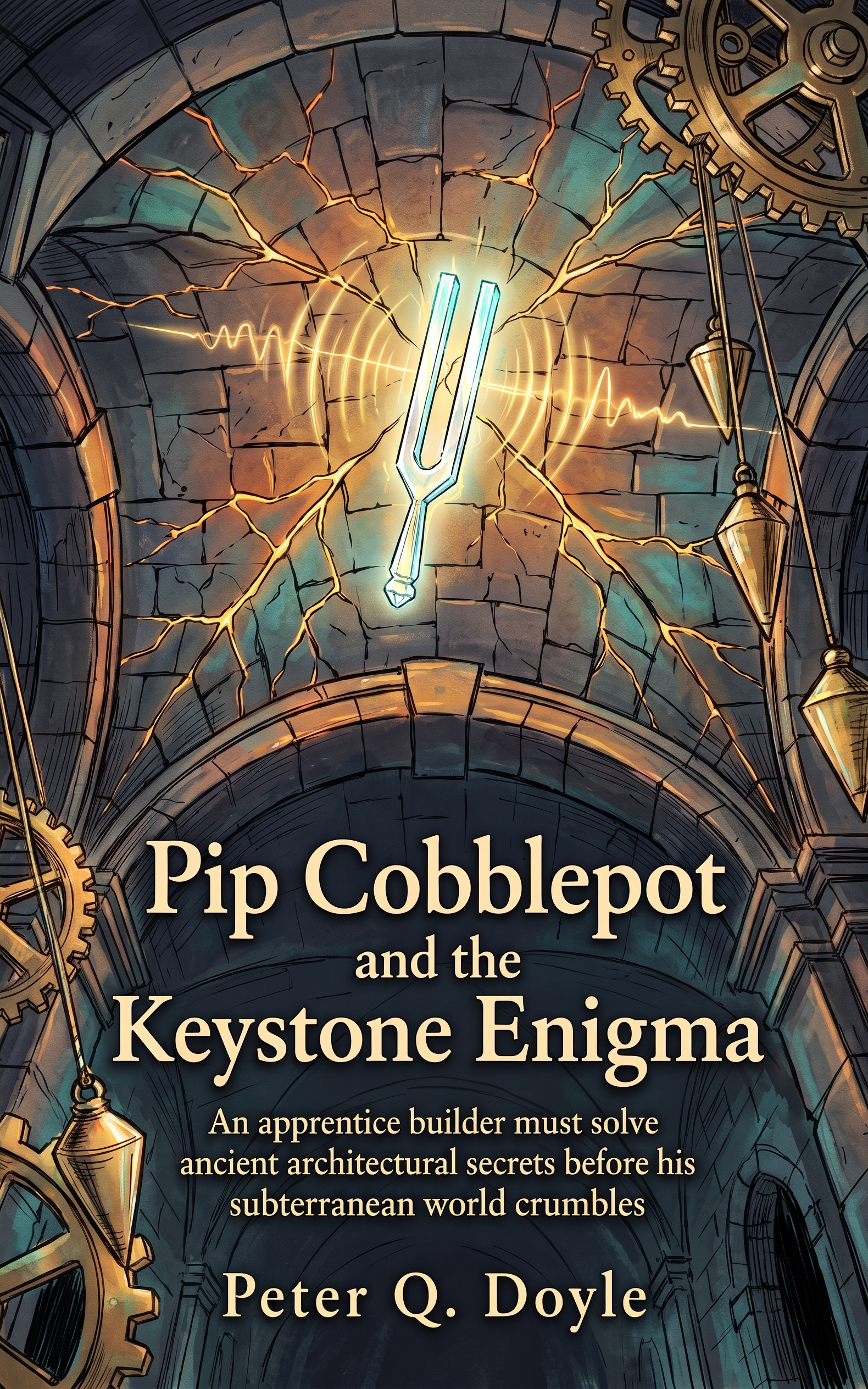
Pip Cobblepot and the Keystone Enigma
An apprentice builder must solve ancient architectural secrets before his subterranean world crumbles
by Peter Q. Doyle
Twelve-year-old Pip Cobblepot can hear the stone speak. Deep beneath the earth in the bustling metropolis of Cobblegate, Pip is just an apprentice builder. But when he detects microscopic fractures and ominous stress harmonics reverberating through the city's ancient vaulted ceilings, he realizes a catastrophic collapse is imminent. The corrupt Grand Guildmaster refuses to listen, eager to protect municipal profits over public safety. Exiled from the builder's guild for speaking out, Pip joins forces with a ragtag crew of outcasts: an eccentric disgraced master architect, a brilliant mortar chemist, a fearless tunnel-runner, and a clever young archivist. Together, they delve into forgotten subterranean test chambers to recover the legendary Codex of the First Architects. Dodging lethal mechanical counterweight traps and navigating flooded vaults, Pip must apply real engineering principles, balance opposing forces, and reset the massive Master Keystone before Cobblegate is crushed under its own weight. A thrilling underground fantasy packed with ingenious puzzles, heart-pounding action, and the power of science.
- Child Books
- Adventure
- Fantasy
- Middle Grade Adventure
- Middle Grade Fantasy
- Educational
The Singing Stone
The mortar groaned before the wood gave way.
Pip Cobblepot balanced on the damp cedar planks high beneath the Lower Siphon Arch, his knuckles white against the handrail. Forty feet below, the Grand Masonry Testing Yard hummed with early-morning activity. Carts rattled across wet cobblestones, and apprentice chisels kept up a jagged, clattering rhythm against fresh blocks of granite. Up on the swaying scaffold, however, the world was narrow, cold, and entirely too loud in a way nobody else seemed to hear.
He drew his brass plumb bob from his leather vest and held the string steady. The pointed lead weight swung in erratic, frantic loops. It refused to settle. Pip leaned closer to the arch curve, pressing his thumb against a dressed granite seam. The stone was cold, but it hummed against his skin, vibrating at a sharp, glassy pitch.
Stone should not sing. When stone sang, it meant the load was shifting.
Pip pulled a pair of fine iron calipers from his pocket and laid the tips lightly against a joint. The metal shivered. It gave off a high, thin whine, like a wet finger dragged across the rim of a crystal goblet. Hairline fractures, no thicker than a cobweb, branched across the face of the ashlar blocks. They were not mere surface flakes. They were tension fissures, spreading outward from the keystone under the pressure of the subterranean canal surging overhead.
The load distribution is three degrees off center, Pip realized, feeling the shudder pulse straight up through his knuckles. He drew a quick stroke on his slate, mapping the tension path. The whole diagonal brace is shearing.
Down on the main testing terrace, a cluster of senior guild inspectors walked the line. At their center strode Grand Guildmaster Gideon Granite, his velvet coat trimmed in polished slate buttons that caught the torchlight. Beside him puffed Felix Mason, the guildmaster’s prized pupil, clutching a gilded bronze drafting kit under one arm.
Pip hurried down the scaffold ladder, his boots scraping cedar rungs until his heels hit the flagstones. Dust powdered his sandy hair as he approached the circle of elders.
“Master Granite, sir!” Pip called, holding out his slate with trembling fingers. “The Siphon Arch is failing. The micro-fractures in the second tier are humming at high tension. If the trade barges enter the upper sluice, the dynamic load will blow the keystone clean out of the wall.”
The inspectors paused. Felix stepped forward, his dark hair slicked back and his lips curled into an effortless smirk. He looked at Pip’s dust-smeared face and let out a light, mocking laugh.
“The orphan boy hears music in the rubble again,” Felix said smoothly, tapping an obsidian stylus against his palm. “Master Granite, the apprentice is confusing ordinary settling cracks with structural failure. His theoretical math belongs on a nursery chalkboard, not in a certified testing yard.”
“The calipers vibrated, Felix!” Pip protested, holding up the tool. “The stone is singing because the compression forces have exceeded the binder’s elasticity! It is not settling!”
Grand Guildmaster Granite cast a cold, heavy gaze upon Pip. His voice was smooth, deep, and utterly unyielding. “The Grand Aqueduct has stood for three centuries, apprentice. It carries forty barges of ore every hour, and it will continue to do so. We do not halt commerce for the nervous hysterics of a boy who cannot tell lime-bloom from a fracture.”
Granite turned his back on Pip and pointed toward the scaffolding with a manicured hand. “Felix, fetch the rapid-curing plaster. Skim over those surface blemishes before the noon cargo convoy arrives. We present a solid face to the city, not unfinished mortar.”
“Right away, Guildmaster,” Felix replied, shooting Pip a triumphant glance.
“No, wait!” Pip stepped forward, but a rough hand grabbed his apron strap and pulled him back.
“Let it be, Pip,” muttered Tilly Masonson, stepping beside him with a heavy wooden bucket of wet lime slurry. Her russet curls were tied back in a stained bandanna, her hazel eyes wide with worry. “You cannot argue with the Grand Guildmaster. You will lose your apprentice badge before breakfast.”
“Tilly, listen to it,” Pip urged, nodding toward the great arch. “Put your ear to the foundation. That is not cosmetic settlement. The whole cavern roof is leaning on that single span.”
Tilly hesitated, setting her mixing paddle into the bucket. Before she could lean down, the ground groaned.
It was not the familiar rumble of a distant freight elevator or the dull thud of quarry blasting. It was an ancient, subterranean snap that traveled straight up through the soles of their boots. The flagstones lurched. High above, the vaulted ceiling shivered, shedding a blinding curtain of gray lime dust.
From the upper gallery wall, forty feet up, an ominous crunch echoed across the yard. A decorative granite cornice, weighing nearly three tons, sheared free from its anchor pins with the deafening roar of a cannon shot.
“Look out!” Pip screamed.
The testing yard erupted into chaos. Guild inspectors scattered in every direction, dropping their parchment scrolls and brass rules. Felix fell backward over a mortar trough, scrambling on hands and knees as rubble rained around him.
Pip didn’t freeze. His eyes locked onto the three-ton block as it tumbled through the air, spinning on its center of mass. His mind mapped the parabolic arc across the yard in an instant—the angle of deflection, the speed of descent, the fatal point of impact on the flagstones.
Tilly was standing directly beneath the projected shadow, frozen in terror with her hands clutched to her chest.
Pip dropped his slate and launched himself across the stones. His boots found traction on the slick paving. He struck Tilly shoulder-first, driving both of them sideways across the floor in a tangle of limbs and leather aprons.
A heartbeat later, the massive cornice slammed into the flagstones where Tilly had stood. The impact cracked the pavement like brittle ice, sending a shockwave through the ground and spraying razor-sharp stone splinters across the yard. A thick cloud of pulverized limestone bloomed outward, choking the air and blotting out the lantern light.
Pip coughed, wiping chalk grit from his eyes. He sat up, checking Tilly’s arms. “Are you hurt?”
Tilly stared at the shattered mass of granite, barely two feet from her boots, then shook her head slowly. “You… you calculated the drop.”
Across the smoky yard, Guildmaster Granite pushed himself to his feet, dusting lime from his velvet coat with frantic, furious slaps. “A faulty anchor pin!” Granite barked through the haze, his voice strained and defensive. “Nothing more than a rusted iron pin! Clear the rubble! The aqueduct remains entirely secure!”
“Secure? Your pride is denser than basalt, Granite!”
The voice scraped through the settling dust like a rusty saw on iron.
From behind the shadow of a massive structural buttress, a squat figure stomped forward. He stood barely three feet tall, his bristling silver-gray beard dusted thick with stone powder. Twin brass-rimmed magnifying lenses sat perched on his wide nose, glinting in the pale torchlight.
The old gnome carried a heavy iron caliper in one calloused hand, clicking its jaws together with sharp, mechanical snaps. He marched straight past the stammering guildmaster and knelt beside the sheared granite face, running his fingers along the jagged crystalline break.
“Master Brickell?” Pip breathed, struggling to his feet.
Barnaby Brickell did not look up. He pressed his ear against the raw fracture line of the fallen block, listening to the deep, lingering vibration trapped within the stone. When he finally turned, his magnifying lenses caught Pip in their wide, distorted glare.
“You,” the old gnome growled, pointing a brass caliper point straight at Pip’s chest. “The boy with the plumb bob. You heard the harmonic before the shear line snapped, didn’t you?”
Pip swallowed the chalk dust in his throat and nodded. “Yes, sir. It sang in a high B-flat right along the mortar seam.”
Barnaby let out a sharp grunt, his eyes narrowing behind the thick glass. “Then pick up your rule, apprentice. The mountain is waking up, and the fools in velvet are about to drop the sky on our heads.”
Chapter 1: The Singing Stone
Twelve-year-old Pip Cobblepot discovers that being the smallest apprentice in the Stonemason's Guild has unexpected advantages when investigating mysterious humming sounds in the Lower Ward. When Master Builder Barnaby tasks him with inspecting three ancient arches showing stress fractures, Pip must apply his knowledge of structural engineering to identify which arch poses the greatest danger.
The singing grows louder as he approaches the westernmost arch, where a hairline crack radiates from a single misaligned stone. Three arches stand before him, each with different structural flaws: Arch A has a large visible crack in a side stone, Arch B has a small crack radiating from the keystone itself, and Arch C shows settlement in the foundation pier. Pip pulls out his field journal, sketches the force arrows, and realizes that the most dangerous flaw isn't always the most obvious one.
Puzzle 1: Which Arch Will Fail First?
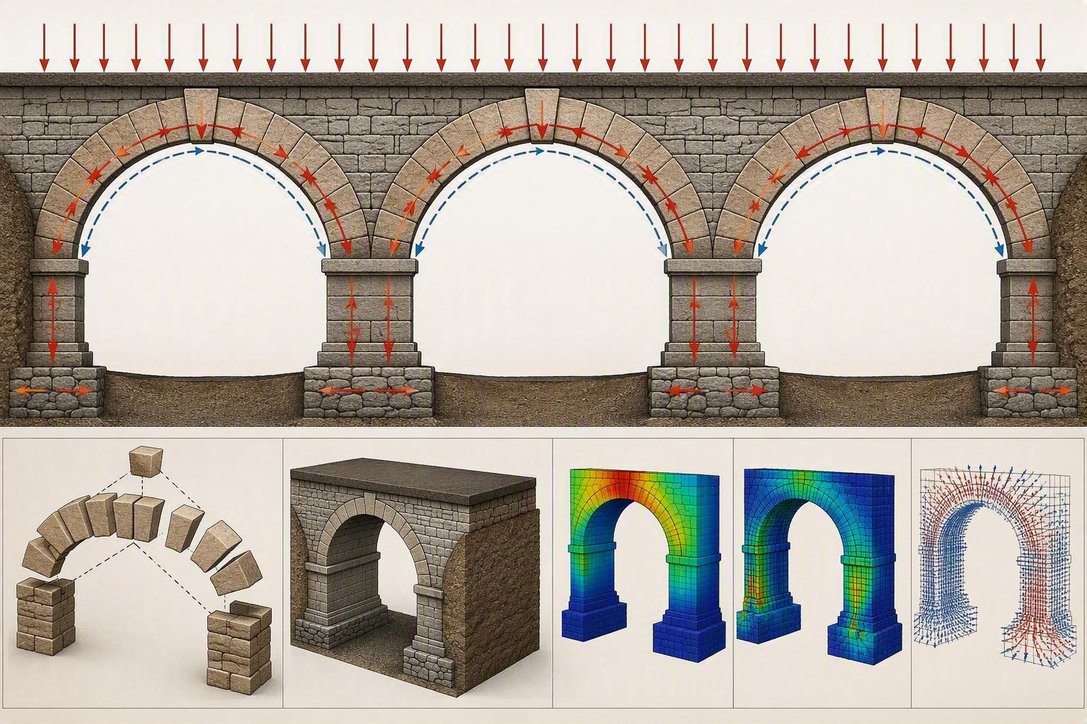
Examine the three arches carefully. Each has a different structural flaw, but only one poses immediate danger of collapse. Arch A shows a large diagonal crack through stone number 7 on the right side, but the crack does not intersect the keystone or primary load path. Arch B has a small hairline crack originating at the keystone (stone number 1) and radiating downward toward stones 3 and 4, directly in the main compression path. Arch C displays visible settlement in the left foundation pier, causing stones 8 and 9 to sit 2 centimeters lower than designed, but the arch has compensated over time with minor stone rotation.
Apply your understanding of load distribution: forces travel from the keystone down through the voussoirs to the foundation piers. A compromised keystone affects every stone below it, while cracks in non-critical stones may be stable for years. Which arch will fail first, and why?
Pip's margin note reads: Most builders stare at the biggest crack. Smart builders ask which stone everybody else is depending on.
The Caliper’s Verdict
Barnaby Brickell’s iron grip clamped onto Pip’s leather vest like a vise, hauling him backward into the shadow of a drainage conduit. Before Pip could protest, the old gnome kicked aside an iron grate hidden behind a stack of weathered ashlar blocks. With a sharp shove, Barnaby urged him down a narrow, damp stairway that corkscrewed directly into t…