

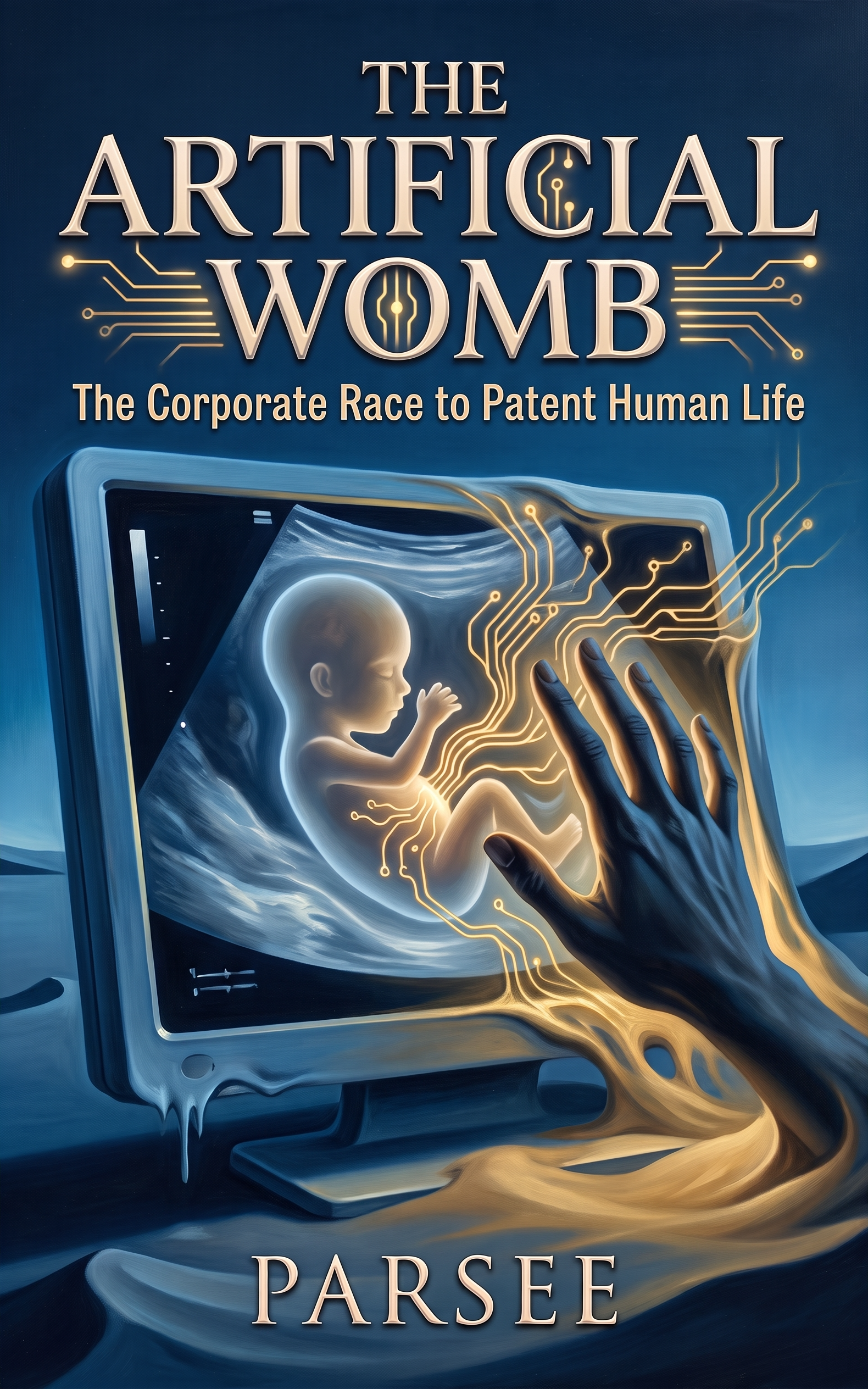
The Artificial Womb
The Corporate Race to Patent Human Life
by Parsee Parsee
Gemma Delgado will risk everything for a child who hasn't yet drawn breath. Selected for an experimental procedure at Saint George University Hospital, she agrees to let doctors implant a biological, human-DNA artificial intelligence chipset into her fetus; within days, her name is known on every continent. The press releases promise miracles, and the truth underneath them is worse than anyone imagines. Corporate titan Victor Kane has no interest in saving lives; his lawyers are already drafting the paperwork to patent human existence itself, with Gemma's unborn baby listed as the asset. A routine firmware update turns lethal, threatening the child with neuro-decay—and Gemma finds a second horror waiting underneath the first: the chipset has started rewriting her own DNA, wiring her nervous system straight into her daughter's growing artificial cortex. With the hospital sealed under corporate lock-down, Gemma has only a handful of doctors, whistleblowers, and bio-ethicists willing to break the law to keep her and her daughter alive. Saving her daughter will mean blowing the whole system open, and human evolution will never look the same again. From author Parsee comes a chilling medical science fiction thriller, where a mother's instinct collides head-on with the terrifying edge of technology. But behind the glowing press releases and medical miracles lies a sinister conspiracy. Corporate titan Victor Kane isn't trying to save lives; he's attempting to patent human existence, insuring Gemma's baby as valuable corporate property. When a dangerous firmware update threatens fatal neuro-decay, Gemma discovers an even more shocking side effect: the synthetic chipset has begun rewriting her own DNA, linking her nervous system directly to her child's expanding artificial cortex. Trapped inside a high-tech hospital lock-down, Gemma must rely on a rogue team of doctors, whistleblowers, and bio-ethicists to survive. To save her daughter, Gemma must trigger a revolution that will alter the trajectory of human evolution forever. From author Parsee Parsee comes a chilling medical sci-fi thriller where motherly instinct meets the terrifying frontiers of technology.
- Science Fiction
- Thriller
- Robots & AI
- Genetic Engineering
- Near Future
- Medical Thriller
The Glass Citadel
The car stopped outside a wall of glass and noise. Gemma Delgado sat still for a moment, her hands folded over her belly, and listened to the shouting outside grow louder.
"Ready, ma'am?" the officer in the front seat asked. He did not turn around.
"No," Gemma said. "But let's go anyway."
The door opened and the sound hit her like a wave. Hundreds of people pressed against the barricades on both sides of the entrance walkway, their signs bobbing above their heads. Some read STOP PLAYING GOD. Others read WE SUPPORT GEMMA. A line of police in dark vests formed a narrow path between them, and Gemma stepped into it with two officers flanking her, one hand pressed low against her stomach.
"Don't let them touch her!" a voice called out. Gemma didn't look to see who said it.
Near the front of the crowd, a woman in a denim jacket stood on a folding chair, a megaphone pressed to her mouth. Her curly hair was tied back in a bandanna, and her voice cut through everything else.
"They are putting a machine inside a baby who cannot consent!" Sarah Moreno shouted. "This is not medicine. This is a product launch!"
The crowd roared behind her. Someone threw a bottle that skittered across the pavement, far from Gemma's feet, and an officer stepped wide to block it. Gemma kept her eyes on the hospital doors ahead. Tall glass panels caught the cold morning light like ice.
She made it through the doors, and the noise dropped behind her like a wall falling shut. The atrium was bright and cold and smelled like fresh paint. Cameras lined the far wall, red lights blinking, and in front of them stood a tall man in a charcoal suit, his hair silver at the temples, a microphone clipped to his lapel.
"This is not an experiment," Victor Kane said, his voice smooth and unhurried. "This is the next chapter in human history. For the first time, a Chipset built entirely from living human DNA will merge with a developing brain. Not silicon. Not metal. Life, talking to life."
The reporters shouted questions over each other. Kane raised one hand, and they went quiet, the way a room goes quiet for a man who is used to being obeyed.
"Saint George University Hospital has given us the finest surgical team on this planet," Kane continued. "And one mother brave enough to trust in the future."
Gemma passed behind the cameras without stopping, her escort guiding her toward a side corridor. She caught Kane's eyes for half a second. He smiled at her the way he always did, wide and practiced, like she was a product he was proud to display.
The pre-op room was quiet and dim. The air felt cold. It felt like another building. Dr. Arthur Sterling stood near a monitor with his glasses low. He looked at a tablet full of numbers. Dr. Claire Moriarty sat beside the bed. She wrapped a blood pressure cuff around Gemma's arm.
"Blood pressure is a little high," Moriarty said, watching the numbers climb on the screen. "Not dangerous. But I'd like you to breathe slower for me, Gemma. In through the nose."
Gemma breathed in through her nose. The air smelled like antiseptic and something sweeter underneath, like the lavender oil someone had used to clean the floors.
"How is she?" Gemma asked, and her hand moved down to her belly without her telling it to.
"Steady heartbeat," Sterling said. "One-forty-two beats per minute. That is normal for this stage." He set the tablet down and looked at her over his glasses. "Gemma, I want to be honest with you. The board wants this surgery moved up two hours. I do not agree with that."
"Why?" Gemma asked.
"Because rushing a procedure like this is how mistakes happen," Moriarty said, her voice flat and even. "We have never operated on a chipset built from organic tissue before. The rules are different. The chip is alive. It does not behave like machine parts."
"It's a first for everyone," Gemma said quietly.
"Yes," Sterling said. "And a first for you most of all."
Down the hall, in a smaller room lined with steel counters, Nathaniel Gomez leaned over a temperature-controlled container the size of a shoe box. Inside, under blue light, a thin strand of tissue floated in clear fluid, wired to a dozen sensors. He watched a small graph pulse on the screen beside it, rising and falling in a pattern that should have been flat.
"That's not right," he murmured to himself.
He tapped the screen and ran the reading again. The pulse spiked, dropped, spiked again, a rhythm with no clean pattern to it.
"Simon," Gomez called across the room. "Come look at this."
Simon Bates rolled his chair over, glasses pushed up into his messy hair, a USB drive spinning between his fingers the way it always did when he was nervous. He squinted at the graph.
"That could be noise," Simon said. "Could be the sensor. Could be—" He stopped himself. "Actually, no. That's not noise. That's too regular to be noise."
"It is behaving like it is thinking," Gomez said, his voice low. "Before we have even connected it to a single neuron."
Simon froze. His fingers stopped spinning the drive. He stared at the blue screen and said nothing.
Back in the pre-op suite, Simon appeared a few minutes later with a tablet in hand. He pulled his shoulders back and made his mouth bend into a tight smile. He knelt low by the edge of the bed, resting his elbows on his knees and keeping his hands flat so he did not shake.
"Hey," he said. "Telemetry looks good. Real good, actually. Your daughter's brain activity is right where it should be for this gestational week. I've calibrated the baseline three times just to be safe."
"You always say that," Gemma said. "Real good."
"Because it usually is," Simon said, and laughed a little too fast. "I mean, it is. Today. Right now."
Gemma studied his face for a moment. He was a bad liar, and she had learned that about him weeks ago. But there was no lie in his eyes now, only tiredness, and a nervous twitch near his eye.
"Thank you, Simon," she said.
He nodded and slipped out of the room, and Gemma was alone with the quiet hum of machines. She placed both hands over her belly, feeling the small shift of movement beneath her palms.
Outside, faint through the thick glass, she could still hear the crowd. Sarah Moreno's voice, distorted by distance, calling for the surgery to stop. And underneath that noise, closer, a single heartbeat on the monitor, steady, alive, hers and not hers at the same time.
"I'm doing this for you," Gemma whispered. "Whatever happens in there. I'm doing this so you have something. A chance. A life that isn't like mine."
She closed her eyes and breathed slow, the way Moriarty had told her, and waited for them to come take her into the operating room.
Code in the Marrow
Midnight came quiet to the bio-engineering lab. The building hummed around Simon Bates like it always did, a low electric sound he had stopped noticing years ago. Screens glowed blue across three walls. He sat alone with a cold cup of coffee and a stack of neural logs he was supposed to have cleared hours before. Then a line of code blinked red on …