

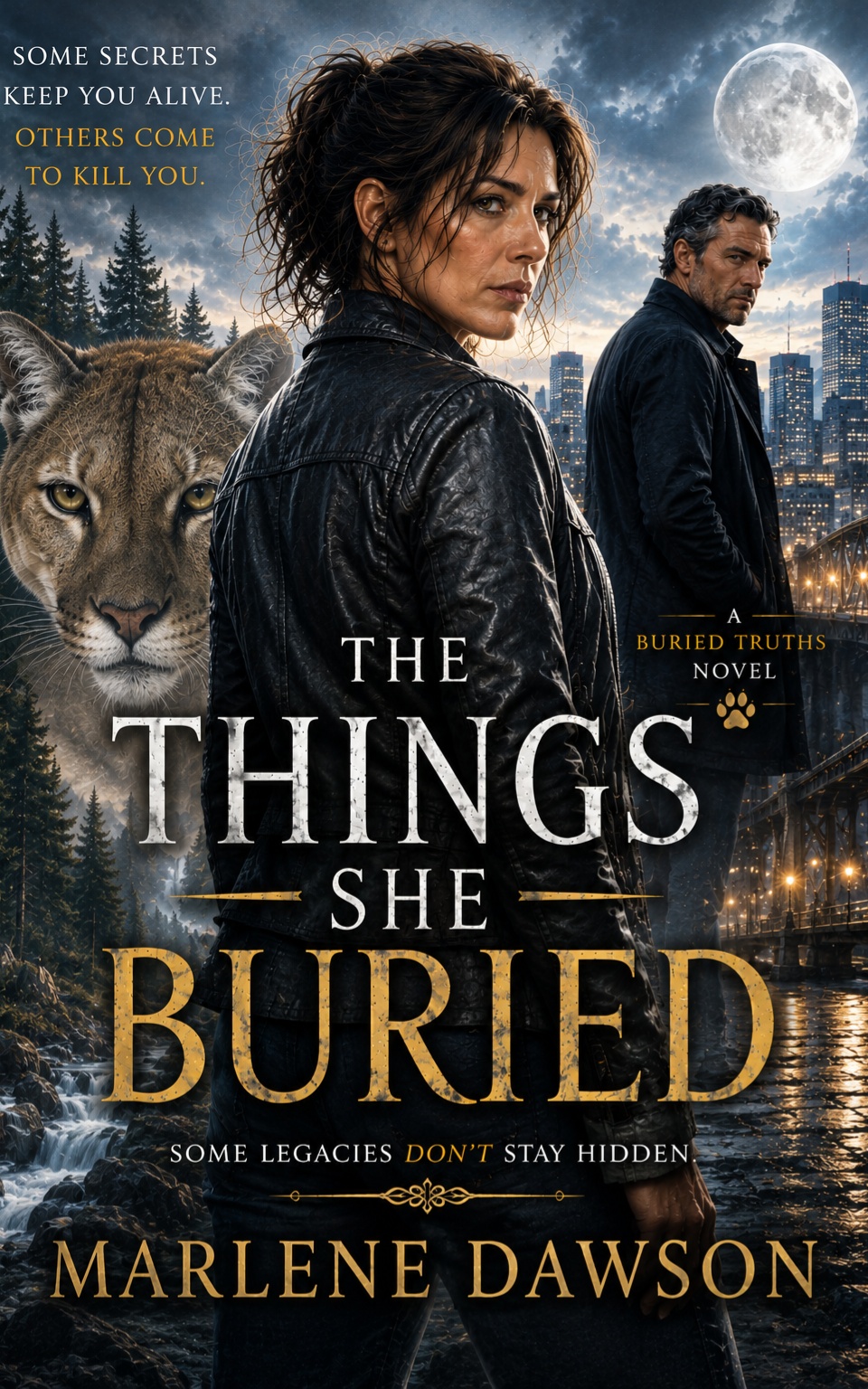
The Things She Buried
Some secrets refuse to stay hidden when the beast inside awakens
by Marlene Dawson "Mystic Ember"
For thirty years, Detective Lena Cross has guarded a dangerous truth: she can transform into a lethal mountain lion, a curse she believed began with a childhood attack in the woods. When a string of grisly murders leaves victims torn apart with wounds mirroring her own predatory claws, Lena's carefully maintained double life begins to unravel. The arrival of enigmatic federal investigator Gabriel Ward raises the stakes. Gabriel knows too much—not just about the impossible nature of the killings, but about Lena herself. As evidence vanishes and the bodies pile up, Lena discovers a shocking reality: shifters are born, not made. She is the heir to an ancient, powerful bloodline currently being hunted down one by one. With the killer turning their sights toward Lena's adult daughter, Lena and Gabriel must forge an uneasy alliance. To save the only family she has left, Lena must unearth the memories of the night that changed everything and embrace the beast within before her lineage is erased forever.
- Fantasy
- Mystery
- Paranormal
- Urban Fantasy
- Police Procedural
- Murder Mystery
The Crime Scene
The call came in at 4:17 a.m., which meant the night had already decided what kind of day it would be. Lena Cross parked behind the last marked unit and killed the engine. The river lot sat empty except for cruisers and a coroner’s van. Floodlights carved a hard white circle out of the dark, and the rest of the world stayed black water and wet concrete.
She sat for a count of five and let the engine tick. Coffee in the cupholder had gone cold. She left it there. Fear was useful if you treated it like a tool and not a story. She treated it like a tool.
Yellow tape snapped in the wind off the water. A young officer lifted it when he saw her badge. His face had that first-year pallor, the kind you got when you still thought homicide was television.
“Detective Cross,” he said. “Patrol thinks animal. Coyotes, maybe a dog pack. We kept the scene tight.”
“Who found him?”
“Jogger. Called it in and threw up in the grass. EMTs confirmed he’s gone. We didn’t move much.”
“Good.” She ducked under the tape. Gravel crunched. The smell hit her before the body did: blood gone thick in the cold, river mud, something metallic that sat under the rest like a second note. Ordinary noses missed that second note. Hers never did.
Two more uniforms stood near a mound of dark cloth and darker wet. Sergeant Hale turned when she approached. Hale had twenty years on the job and a voice that stayed even when the room did not.
“Lena. Ugly one.”
“They usually are.”
Hale tipped his chin at the lights. “Looks like something tore him. Chest, throat, one arm nearly off. No gunshot we can see. No obvious blade. Patrol’s already talking mountain lion. We’ve had sightings up the ridge this fall.”
Lena crouched at the edge of the cone. The victim lay on his back, or what was left of a back. His jacket was shredded into strips. The wounds were not neat. They were not human-neat. They were long tearing tracks, deep enough to show bone in places, the edges ragged where flesh had been pulled instead of cut. The throat was open in a wide, ruined gape. One shoulder sat wrong, the joint worked past its design.
She knew those marks.
She knew them the way she knew the weight of her own hands. Not theory. Not a textbook photo. The exact pattern of a large cat’s killing work: the rake, the clamp, the way muscle parted when something heavy used claws and teeth together. She had left those same tracks in dirt and, once, in a deer she had not meant to finish. She had scrubbed her own nails raw after nights she could not remember all the way through.
Her stomach went cold. She kept her face still.
“ID?” she asked.
“Wallet in the back pocket. James Kellerman, fifty-two. Address on the west side. No obvious robbery. Watch is still on the wrist that’s attached.”
She looked at the wrist. The watch face was cracked. Blood had dried in the cracks. She photographed it in her mind and moved on.
The second officer, Ruiz, hovered with a notepad. “We figured we’d wait for you before we called Fish and Wildlife. If it’s a cat, they take point, right?”
“Not if it’s a homicide,” Lena said. “And we don’t know what it is until the medical examiner says so.”
Hale grunted. “Looks like a homicide committed by something with better teeth than us.”
She stood. The floodlight buzzed. Moths beat themselves against the glass. Across the lot, the river slid past, black and indifferent. She walked a slow circle, staying outside the immediate mess, looking for drag marks, a second set of prints, anything that would make this ordinary.
There were prints. Large, feline, pressed deep in the damp gravel near the body and then lost where the lot turned to packed dirt. A civilian would call them dog. A ranger would call them cougar and start writing press releases. Lena called them what they were and said nothing.
She crouched again, this time farther out, and used her pen light along a smear of blood that led nowhere useful. The smear stopped as if the thing that made it had simply chosen to leave. No struggle trail beyond the first few yards. Kellerman had been hit hard and finished fast.
Ruiz cleared his throat. “You ever seen anything like this, Detective?”
Yes. In a bathroom mirror at fourteen, after she woke up with blood under her nails and no memory of the last hour. In a stand of pines when she was twenty and still stupid enough to test how far she could run. In a locked storage unit she rented under another name, where she kept clothes and a first-aid kit and the kind of silence you paid for in cash.
“I’ve seen animals,” she said. “I’ve seen people who want you to think animal. We treat it like a person until it isn’t.”
Hale nodded like that was the answer he wanted. “CSU is ten minutes out. Coroner’s tech is already here. You want a tent?”
“I want the lot held until we have every print cast. I want the jogger’s statement again, and I want the businesses along the access road checked for cameras. If this is a cat, it didn’t take the wallet. If this is a person, they wanted us looking at teeth.”
She walked the perimeter a second time because movement kept her voice level. The dread sat behind her ribs and did not move. It was a familiar weight. For thirty years she had built a life on the idea that the thing in her was a private disaster, a leftover from a night in the woods when she was a kid. Infection. Accident. Something you locked down and never explained.
This body said the lock might not matter.
A tech in a windbreaker knelt with a camera. The shutter clicked in a dry rhythm. Lena stayed out of the shots and watched the wounds as the light found them from new angles. The spacing of the claw marks was wrong for a dog and right for something heavier in the shoulder. The bite on the throat had the width she knew from her own jaw when the change took her all the way. She could have drawn it with her eyes closed.
She did not draw it. She wrote in her notebook: extensive tearing, neck and torso; possible large predator; hold scene; no public animal statement until ME.
Hale came up beside her with two paper cups. Steam rose. She took one. It was bad coffee and she drank it anyway.
“You look like you swallowed a nail,” he said.
“It’s four in the morning and a man is in pieces.”
“Fair.” He sipped. “Media scanner already pinged. They’ll be on the ridge road in an hour looking for a story about a lion in the city.”
“Let Public Info handle it. We don’t feed them teeth.”
“Copy.” Hale studied the body, then the river. “I’ve seen a dog do damage. Never like this. You think we call the state biologist?”
“After the autopsy. If they want to walk the prints, they can walk them with us, not in front of a camera.”
Ruiz jogged back from the tape. “Jogger’s name is Patel. He runs this loop three days a week. Says the lot was empty when he came down the path. He heard nothing. Saw the shape, thought it was a dumped bag, then he got closer.” Ruiz swallowed. “He said it smelled wrong.”
Lena’s head came up a fraction. “Wrong how?”
“He didn’t have words. Just wrong.”
She wrote that down. Humans used wrong when their brains hit a wall. She had a better word and she would not use it out loud.
The coroner’s tech signaled that they were ready to bag. Lena watched them work. Plastic rustled. Zippers closed. Kellerman became a shape in a bag and then a weight on a gurney. The lot looked emptier without him and somehow worse. Blood still marked the gravel. The prints remained, dark and certain.
She took her own photos on her phone, unofficial, for the file she kept in her head. Close on the shoulder. Close on the throat. A wide shot of the prints with her boot for scale. She deleted nothing. She also sent nothing.
When CSU arrived, she walked them through the cone and the outer ring. She pointed to the prints and the smear and the lack of a second victim. She asked for soil samples and fiber and whatever they could lift from the watch. She sounded like herself: short sentences, no drama, the voice that made rookies stand up straighter.
Inside, the other voice kept talking.
Someone else can do this. Someone else left this on a man in a parking lot where joggers come at dawn.
She shut it down the way she shut down a shift when the bones started to ache. Breath in. Breath out. Hands in her pockets so no one saw them shake.
Hale offered her a ride back to the precinct. She declined. She needed her own car and the ten minutes of dark between here and the highway.
At the tape, the young officer from the start was still there, paler now that the body was gone and the smell remained.
“Detective? Is it true it looks like a cougar?”
She met his eyes. “It looks like a dead man. Write what you saw, not what you heard in the lot.”
“Yes, ma’am.”
She almost smiled. It did not reach anywhere that mattered.
The drive out followed the river until the lights thinned. She cracked the window. Cold air cut the blood-smell that had followed her into the cabin. She kept both hands on the wheel. At a red light with no other cars, she looked at her fingers. Human. Short nails. Clean. The other set lived under the skin, waiting for a night she could not afford.
At fourteen she had woken in the woods with those marks on a tree and a story about a fall. At forty-four she was a detective with a closed file on her own life and a daughter who thought Mom just worked too much. The gap between those facts had been a professional skill. Tonight the gap had a body in it.
She parked in the precinct garage and sat again, same count of five. Then she went upstairs and started the report the way she always did: time of arrival, weather, first officers, victim description, preliminary cause listed as undetermined pending autopsy. She did not write I know these wounds. She did not write they are mine.
Hale dropped a printed photo on her desk an hour later. Kellerman in better days, a company website shot, a man who sold industrial fittings and had no reason to die in a river lot.
“Next of kin?” she asked.
“Ex-wife in Ohio. Adult son in town. Uniforms are on the notification.”
“I’ll take the son after the ME calls.”
Hale lingered. “You sure you’re good? You went quiet out there.”
“I’m always quiet at a scene.”
“Quieter.”
She looked at him until he shrugged and left. Hale was decent. Decent people still did not get this part of her.
The rest of the morning filled with the ordinary machinery of a case: calls, a map of the lot, a request for traffic cams, a note to hold the prints from public release. She drank more coffee. She answered a lieutenant who wanted a line for the noon brief and gave him weather and pending lab work. She did not give him a cat.
At noon the ME’s office called. Preliminary: massive tissue disruption consistent with a large animal or a weapon designed to mimic one. No gunshot. Toxicology pending. Time of death roughly midnight to two. Lena wrote it down and felt the same cold settle lower.
Mimic. That word would live in the file. She knew better than to argue with a preliminary from a phone.
She stood at the window of the bullpen and watched traffic crawl. Somewhere out there, something that tore like she tore had walked away from a kill and left prints for a detective who could not say why they mattered.
She thought about calling in sick for the first time in years. She did not. She thought about driving to the storage unit and checking the locks. Later. After the son. After the second pass at the lot in daylight.
Daylight would not change the wounds. Daylight would only make them easier to photograph and harder to deny.
Ruiz appeared with a sandwich she had not asked for. She ate half because the body needed fuel and the job did not care about appetite.
“Sergeant said you wanted camera canvass by two,” Ruiz said. “I’ve got two stores and a garage. The garage has a unit pointed at the exit, not the river. We’ll see who left after midnight.”
“Good. If you get a vehicle, you call me before you run it.”
“Yes, Detective.”
When he left, she opened a blank document and typed a private note she would never print: Wounds match. Do not say so. Do not shift. Do not explain. She deleted the file and emptied the recycle bin. Superstition. Habit. Both.
The afternoon briefing was short. Animal theory stayed in the room as a theory. Homicide stayed lead. Lena assigned follow-ups and took the notification herself when the son’s name came back from patrol. She drove to a brick duplex and told a young man his father was dead in language that did not include claws. He cried in a way that made her want a wall to put her back against. She left her card and the number for victim services and sat in the car until her hands were steady enough for the ignition.
On the way back to the lot for the daylight pass, she took the long route along the ridge. Trees stood bare and honest. She had run those woods as a girl and later as something else. She did not stop.
The lot in daylight was smaller. Blood looked brown. The prints looked like facts. CSU had cast three of the best. Lena stood where she had stood at dawn and looked at the empty space where Kellerman had been.
Hale joined her with his hands in his coat.
“Still think we wait on Wildlife?”
“We wait on the autopsy and the casts. If a cat did this, it will show in the lab. If a person did this, we don’t hand them a story.”
He accepted that. People usually did when she used that tone.
She stayed until the last tech packed. The river kept moving. A gull argued with nothing. She walked to her car and did not look back at the gravel.
In the garage at the precinct she checked her phone. No new bodies. No media circus yet. A text from her daughter about dinner on Sunday that she answered with a yes and nothing else. Ordinary life, still running on the other track.
She closed the message and sat in the dark of the car a last time. The dread had not left. It had only learned her schedule. She would go upstairs and write the rest of the day into a report that told the truth a person could say out loud. The other truth she would carry the way she had always carried it: silent, exact, and hers alone.
Whatever had torn James Kellerman knew the same work she knew. Until she understood how, she would keep her mouth shut and her hands human, and she would work the case like any other killing that refused to stay simple.
She got out of the car, locked it, and went inside to do exactly that.
Impossible Evidence
The forensics lab sat two floors below the homicide bullpen, a white box that smelled like bleach and warm plastic. Lena Cross signed the log, clipped on a visitor badge she did not need, and waited while the inner door hissed. Fluorescent light made everyone look tired. She was already tired. Priya Shah stood at a bench with a tablet in one hand a…