

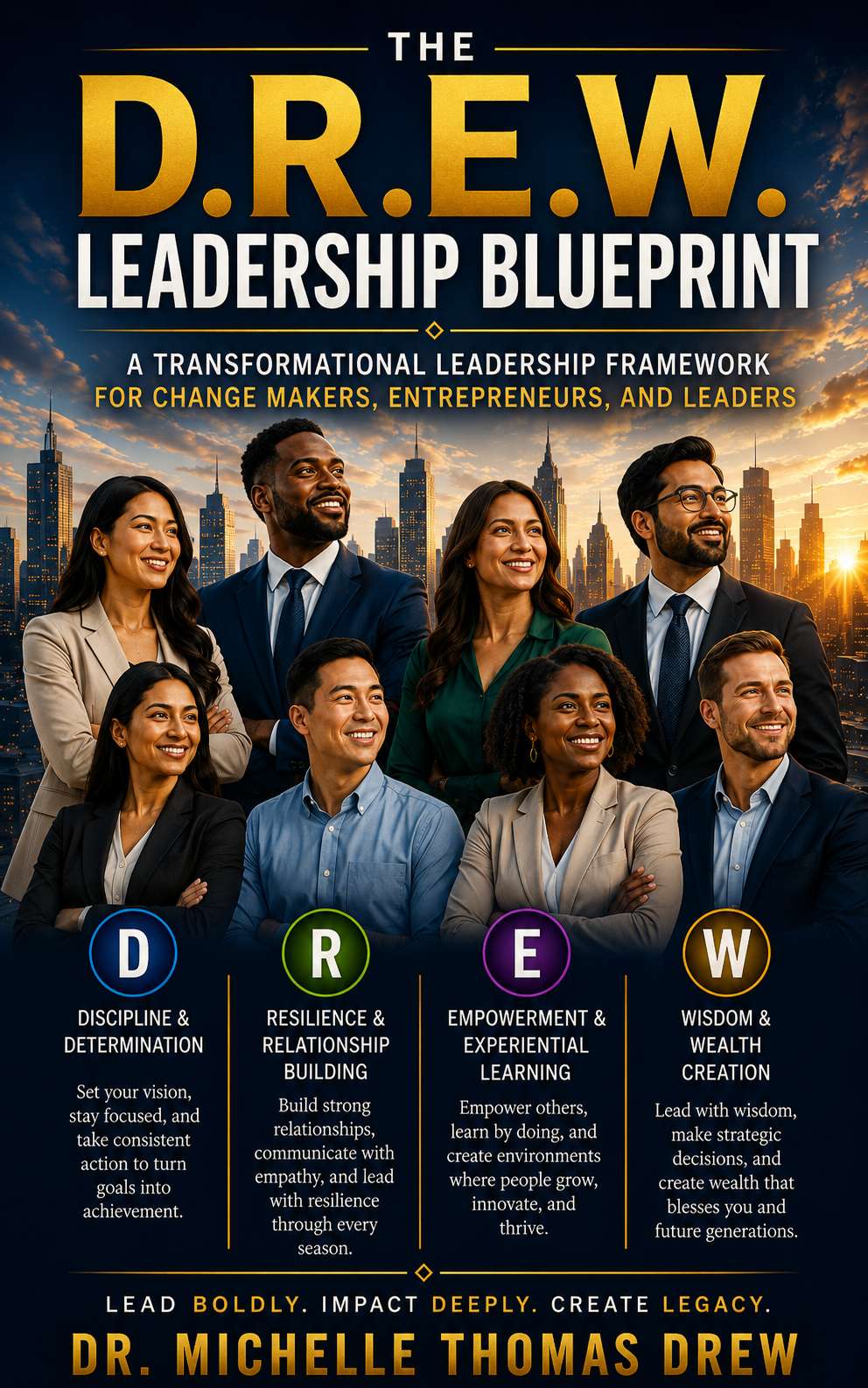
The D.R.E.W Leadership Blueprint
A Transformational Leadership Framework for Change Makers, Entrepreneurs, and Leaders
by Michelle Thomas Drew
The future will not wait for leaders to catch up. It will demand leaders who are prepared to think differently, adapt quickly, empower others, and create what comes next. Artificial intelligence, automation, and global competition are transforming how we teach, work, lead, and succeed. Knowledge alone is no longer enough. Today’s leaders need the discipline to turn vision into action, the resilience to rise through uncertainty, the ability to empower others, and the wisdom to create opportunities that extend beyond themselves. In The D.R.E.W. Leadership Blueprint, Dr. Michelle Thomas Drew introduces a transformational leadership framework that connects established leadership theory with the realities of leading in a rapidly changing world. At its foundation are four powerful principles: D: Discipline & Determination Develop the focus and perseverance to turn purpose into achievement. R: Resilience & Relationship Building Navigate adversity, embrace change, and build relationships rooted in trust and collaboration. E: Empowerment & Experiential Learning Move beyond simply knowing. Learn through experience, develop others, and transform knowledge into meaningful action. W: Wisdom & Wealth Creation Lead with sound judgment and purpose while creating financial, intellectual, social, and generational value. Written for educators, entrepreneurs, professionals, students, emerging leaders, and change makers, this book challenges readers to move beyond simply studying leadership and begin living it in classrooms, businesses, organizations, and communities. The future is not something we simply prepare for. It is something we help create. We shape it through the people we develop, the relationships we build, the opportunities we create, the lives we impact, and the legacy we leave behind. Do not simply become a better leader. Become the kind of leader who inspires others to become better. Lead Boldly. Impact Deeply. Create Legacy.
- Business & Entrepreneurship
- Educational & Academic
- Management & Leadership
- Startup & Entrepreneurship
- Education & Pedagogy
- Career & Professional Development
Chapter 1: Introduction – The Urgency of Entrepreneurial Transformation
A university degree historically functioned as an established mechanism for socioeconomic mobility, providing graduates with reliable access to stable corporate hierarchies and predictable career progression. In the contemporary economy, technological acceleration, artificial intelligence, and widespread automation have dismantled many traditional entry-level employment pathways. Algorithms and automated platforms now execute complex data synthesis, administrative reporting, and technical analysis with exceptional speed and minimal error. Furthermore, global digital connectivity places emerging professionals in direct competition with talented specialists worldwide. Despite these profound transformations in organizational structures and workforce demands, many higher education institutions continue to operate on pedagogical frameworks designed during the industrial era.
For generations, the standard playbook for career success followed a clear and dependable script. Students attended high school, enrolled in four-year degree programs, secured diplomas, and stepped directly into secure corporate pathways with predictable ladders of upward mobility. That industrial era bargain assumed that technological progress would move at a measured, manageable pace, giving workers decades to apply unchanging skills. Today, the rapid ascent of algorithmic automation, machine learning systems, and artificial intelligence has rewritten the rules of employment. Tasks that once formed the training ground for new graduates, such as drafting basic reports, analyzing raw financial data, and organizing logistical schedules, are now executed instantly by digital software tools. This technological reality means that simply showing up with a diploma is no longer enough to guarantee sustainable employment.
The structural evolution of the global marketplace demonstrates that linear career paths are rapidly vanishing across every major sector. Decades ago, students could master a static body of knowledge, earn a baccalaureate credential, and expect decades of continuous professional stability within a single corporate entity. Today, rapid technological shifts regularly render technical skills obsolete within a matter of years, making ongoing adaptability the definitive measure of career sustainability. Modern enterprises increasingly prioritize professionals who understand how to synthesize complex information, build cross-functional partnerships, and navigate unpredictable market shifts with confidence.
The modern workplace resembles a fast-moving ecosystem rather than a steady climb up an unchanging corporate ladder. Entire job classifications disappear within five-year cycles, while brand-new industries emerge almost overnight around artificial intelligence, cloud architectures, digital media, and decentralized commerce. In this high-velocity environment, static knowledge loses practical relevance very quickly. Professionals who thrive in the current marketplace are not necessarily those who memorized the most academic theory, but rather those who possess the intellectual agility to learn, unlearn, and master new capabilities on an ongoing basis. Long-term career sustainability now belongs to adaptive thinkers who can analyze shifting market conditions, connect seemingly unrelated concepts, and collaborate across multidisciplinary teams.
The current labor market no longer guarantees employment based solely upon credential attainment or the completion of standardized coursework. Employers increasingly demand dynamic problem-solving abilities, technological adaptability, and cross-functional competence that extend far beyond textbook memorization. When emerging professionals enter the workforce without practical experience or an adaptive mindset, they frequently experience underemployment and career stagnation. Preparing future leaders for this evolving landscape requires a fundamental shift in educational strategy, emphasizing creative agency, calculated risk management, and the capacity to generate tangible value within unpredictable environments.
Hiring managers today look far beyond paper credentials to evaluate how prospective team members handle unexpected problems and real-world ambiguity. In modern organizations, routine tasks are automated, which means human employees are hired specifically to solve novel challenges that lack standardized instruction manuals. When emerging professionals arrive on the job equipped only with memorized formulas, they quickly find themselves overwhelmed by the demands of complex organizational projects. Educational institutions must therefore pivot away from passive compliance, creating environments where students learn how to make calculated decisions, manage practical risks, and design viable solutions that generate clear, measurable results for businesses and community partners.
When academic institutions focus exclusively on theoretical analysis without providing opportunities for hands-on application, graduates enter competitive industries without the tools necessary to navigate operational ambiguity. Professional success in the digital era requires individuals to translate broad conceptual frameworks into measurable business outcomes, communicative clarity, and innovative solutions. The modern economy rewards those who proactively identify unmet community needs, build sustainable operational models, and lead collaborative teams toward meaningful, measurable objectives.
Theory becomes truly valuable only when it is tested and applied within actual operational contexts. When students spend years studying abstract business principles without ever launching a project, building a budget, or speaking directly to target customers, they miss the opportunity to cultivate practical execution skills. The contemporary marketplace places high value on professionals who can bridge the gap between grand ideas and daily execution. Those who develop the discipline to spot operational inefficiencies, gather resources, communicate persuasive strategic messages, and guide projects across the finish line consistently stand out as valuable leaders in any organization.
Standard postsecondary classrooms frequently demonstrate institutional inertia, characterized by instructional environments where students passively receive lectures and reproduce prescribed content for standardized evaluations. Traditional academic systems historically rewarded strict compliance, uniform performance, and predictability, which effectively prepared graduates for static bureaucratic institutions. However, this pedagogical approach unintentionally discourages independent inquiry, experimental risk-taking, and entrepreneurial curiosity. Consequently, emerging leaders often graduate with theoretical knowledge but lack the practical confidence and operational agility necessary to address complex, ambiguous challenges in modern industries.
The traditional lecture hall model was engineered during the industrial revolution to produce uniform workers who would follow standardized operating procedures without deviation. In that historical context, conformity and silent compliance were valuable organizational traits that helped factories and corporate offices function efficiently. However, in an automated digital economy where repetitive tasks are managed by computers, passive obedience becomes a distinct professional handicap. When academic environments penalize curiosity and demand exact adherence to predictable answers, they inadvertently train students to fear ambiguity rather than embrace it as an opportunity for creative discovery.
Passive classroom dynamics reinforce the dangerous assumption that learning is a transactional process defined solely by test scores and grade point averages. When educational environments penalize constructive failure rather than treating it as a natural step in the innovation cycle, students develop an aversion to creative experimentation. This systemic reliance on rote memorization prevents emerging leaders from cultivating critical decision-making abilities, strategic storytelling competencies, and the emotional fortitude required to guide organizations through periods of profound disruption.
Real innovation is an inherently messy, iterative journey that requires experimentation, unexpected setbacks, and continuous refinement. When educational cultures treat honest mistakes as catastrophic events that ruin grade point averages, students learn to play it safe by avoiding ambitious projects altogether. This fear of failure follows graduates into their professional careers, making them hesitant to propose bold new initiatives or challenge inefficient workplace procedures. Developing impactful leadership requires reframing setbacks as constructive feedback loops that provide essential data for strategic improvement.
To navigate dynamic professional landscapes successfully, students and developing professionals must transition from passive consumers of instruction into active creators of solutions. This evolutionary shift demands an educational framework centered on experiential learning, strategic inquiry, and direct engagement with real-world problems. Developing an entrepreneurial mindset enables individuals to identify operational inefficiencies, organize multidisciplinary initiatives, and create sustainable organizational systems that drive enduring community and economic value.
Becoming a creator of solutions involves learning how to look at community and organizational challenges through an innovative lens. Instead of accepting systemic bottlenecks as permanent realities, creator-minded professionals investigate why those friction points exist and design practical interventions to resolve them. Experiential education accelerates this transformation by placing students into live projects where they must interview community members, test functional prototypes, iterate based on real feedback, and manage genuine operational budgets. This immersive approach builds operational muscle memory that theoretical discussions alone can never produce.
Cultivating a creator mindset requires transforming how emerging professionals perceive their own agency, authority, and professional purpose. Instead of waiting for top-down instructions within rigid organizational structures, proactive leaders learn to analyze market conditions, formulate original value propositions, and execute strategic plans with operational discipline. This transformative perspective allows individuals across diverse disciplines to recognize opportunities where others see obstacles, thereby converting abstract ideas into tangible community assets.
Personal agency is the cornerstone of proactive leadership, empowering individuals to take ownership of their professional journeys rather than waiting for external permission to innovate. When emerging professionals recognize that value creation is an active responsibility, they begin to approach every environment with an entrepreneurial perspective. They identify unserved audience niches, conceptualize compelling marketing strategies, leverage modern digital platforms, and build collaborative alliances that turn theoretical visions into functional, community-centered enterprises.
To bridge the divide between conventional classroom instruction and the complex realities of modern industry, this volume introduces the D.R.E.W. Leadership Blueprint. The D.R.E.W. Model operates not as an abstract academic taxonomy or a collection of superficial corporate slogans, but as an integrated framework for professional and personal identity transformation. Built upon four foundational pillars including Driven, Resilient, Action-Oriented, and Wise, the model cultivates essential competencies through deliberate practice, iterative execution, and structured reflection.
The D.R.E.W. Model provides a clear, structured roadmap designed to help emerging professionals navigate the demands of an automated and highly competitive digital landscape. Rather than offering isolated tips or superficial motivational slogans, this comprehensive framework restructures how individuals conceptualize their professional value and operational responsibilities. By systematically developing internal drive, emotional fortitude, pragmatic execution capabilities, and ethical discernment, the blueprint prepares aspiring leaders to navigate volatile market environments with exceptional clarity and purposeful confidence.
This framework is designed to provide educators, students, organizational leaders, and entrepreneurs with a cohesive methodology for leadership development in an era of rapid technological disruption. By addressing the cognitive, emotional, behavioral, and ethical dimensions of professional excellence, the model establishes a comprehensive pathway from passive compliance to transformational leadership. Each pillar reinforces the others, creating a robust foundation that equips professionals to sustain long-term career momentum while creating positive social and economic impact.
Leadership development becomes truly transformative when it integrates internal mindset alignment with visible, real-world execution. The D.R.E.W. framework addresses the full spectrum of leadership maturity, recognizing that professional excellence requires mental resilience, clear moral standards, strategic planning, and tactical follow-through. By unifying these dimensions into an actionable developmental process, the blueprint allows individuals and organizations to build sustainable pipelines of talent that can lead through economic disruptions while uplifting their communities.
The initial pillar, Driven, centers upon establishing intrinsic motivation rooted in purpose, visionary clarity, and alignment with a defined personal mission. Developing deep internal drive enables professionals to maintain focus and strategic direction when external circumstances fluctuate. The second pillar, Resilient, focuses on psychological adaptability, emotional fortitude, and the capacity to reframe perceived setbacks into vital learning experiences. True resilience equips emerging leaders to navigate ambiguity, overcome organizational obstacles, and sustain high performance under pressure.
Being Driven means having an internal compass that keeps a leader moving forward even when immediate external validation or short-term rewards are absent. Purpose-driven motivation ensures that personal values and strategic goals remain aligned through every phase of a professional journey. Simultaneously, the Resilient pillar provides the psychological endurance required to absorb unexpected operational shocks, navigate industry restructuring, and transform initial failures into strategic competitive advantages.
Purposeful motivation provides the foundational stamina necessary to pursue ambitious, long-term goals despite systemic barriers and competitive headwinds. When professionals ground their work in authentic mission alignment, their commitment remains steadfast even during organizational uncertainty. Combined with emotional resilience, this intrinsic motivation transforms professional challenges into powerful opportunities for continuous skill acquisition and leadership refinement.
When external market pressures or workplace difficulties arise, professionals who rely solely on superficial incentives frequently become disengaged and lose their creative momentum. In contrast, leaders who possess deeply anchored internal drive view professional obstacles as productive friction that refines their capabilities. This powerful combination of vision and emotional durability allows emerging innovators to build sustainable enterprises, inspire their teams, and maintain focus on long-term transformative milestones.
The third pillar, Action-Oriented, bridges the critical gap between conceptual ideation and measurable real-world execution through rapid prototyping, accountability systems, and operational diligence. Emerging leaders must move beyond theoretical deliberation to implement scalable initiatives with precision. Finally, the Wise pillar establishes long-term organizational and personal sustainability through ethical leadership, cultural awareness, stakeholder collaboration, and rigorous governance. Together, these four interrelated pillars provide a holistic roadmap for developing leaders who can innovate with integrity.
An Action-Oriented orientation ensures that great concepts do not get trapped in endless cycles of analysis, planning, and hesitation. Through rapid prototyping, testing, and continuous feedback, action-focused leaders turn theoretical models into functional products and services. At the same time, the Wise pillar ensures that speed and innovation are guided by ethical discernment, cultural competence, and deep stakeholder respect, creating organizations that stand the test of time.
Operational execution distinguishes impactful visionaries from passive observers, ensuring that creative ideas materialize as sustainable products, services, or social initiatives. At the same time, ethical wisdom guarantees that commercial or organizational success does not compromise institutional integrity or community trust. By integrating decisive action with ethical discernment, leaders establish sustainable organizations that generate lasting value for all stakeholders involved.
Without structured operational execution, even the most inspiring vision remains an unrealized daydream that yields no tangible community benefits. Conversely, relentless action without ethical wisdom risks generating short-term profits at the expense of organizational health and public trust. The D.R.E.W. framework harmonizes bold tactical action with grounded moral leadership, ensuring that emerging professionals achieve sustainable career growth while maintaining steadfast dedication to integrity, community uplift, and transparent accountability.
The core imperative of this leadership framework requires educational institutions, corporate organizations, and mentorship ecosystems to look beyond preparing individuals for static employment roles that may be subject to technological displacement. Academic programs and professional development initiatives must intentionally cultivate creator mindsets capable of driving sustainable innovation. By combining strategic literacy, ethical grounding, experiential learning, and operational resilience, the D.R.E.W. Model prepares future change makers to revitalize local economies, launch transformative enterprises, and lead with purpose in an evolving global landscape.
Educational and corporate institutions must recognize that the future workforce needs dynamic ecosystem builders rather than passive job applicants. When training programs emphasize personal branding, strategic marketing literacy, communications law compliance, and real-world project execution, they empower students to build independent career momentum. Equipping emerging leaders with these multifaceted competencies strengthens organizational innovation, expands economic opportunity, and builds resilient local communities capable of thriving in a rapidly shifting digital world.
Ultimately, the advancement of modern leadership development demands institutional courage and strategic collaboration across academic, corporate, and civic domains. When organizations invest in holistic, experiential leadership pipelines, they dismantle historical barriers to opportunity and unlock the full creative potential of emerging professionals. The chapters that follow articulate the concrete principles, practical methodologies, and strategic tools necessary to activate the D.R.E.W. Model and cultivate a new generation of resilient, ethical, and transformational leaders.
Creating lasting systemic change requires a deliberate commitment from educators, executives, policymakers, and community mentors to invest in comprehensive leadership development ecosystems. By combining rigorous academic insight with practical entrepreneurial execution, the D.R.E.W. Leadership Blueprint offers a sustainable path forward for emerging leaders who are ready to build meaningful careers and leave an enduring positive legacy. The subsequent chapters provide step-by-step guidance, actionable templates, and strategic frameworks designed to turn these transformative principles into immediate daily practice.
Chapter 2: The Problem with Passive Learning
The Architecture of Passive LearningPassive learning systematically conditions emerging professionals to operate in states of perpetual hesitation by encouraging them to wait for external instructions, administrative approval, and prearranged opportunities. Traditional pedagogical frameworks have long treated students as passive recipients waiting …