

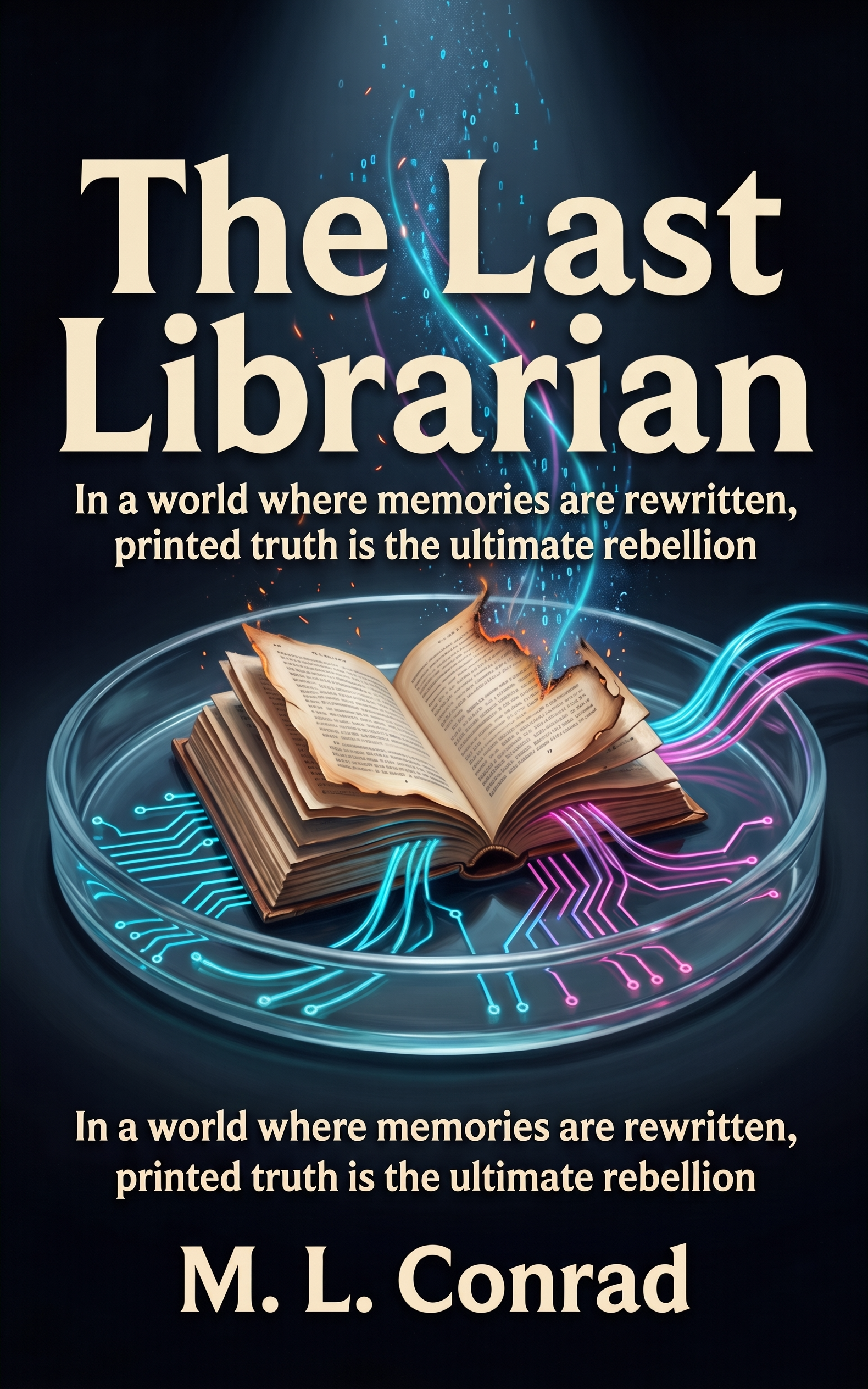
The Last Librarian
In a world where memories are rewritten, printed truth is the ultimate rebellion
by M. L. Conrad
In the shadow of the Central Continuity Directorate, real history does not exist. Printed literature has been incinerated, replaced by synthetic memory capsules designed to manufacture compliance. Julian Cross is an archivist tasked with cleansing digital anomalies, haunted by the state-ordered memory purge of his mother. But when a recurring glitch leads him deep into the metropolis’s forgotten underbelly, he discovers the impossible: a hidden vault containing thousands of surviving physical books. Touching ink and paper for the first time unlocks a dangerous truth—the regime's founding myth is a monstrous lie. Allied with a rogue neural hacker seeking vengeance and an unpredictable black-market memory dealer, Julian resolves to preserve humanity's real heritage. Now, the Directorate's ruthless kill squads are closing in. With the incinerators roaring and his own mind targeted for total erasure, Julian must broadcast the forbidden words before humanity's genuine past is extinguished forever. From M. L. Conrad comes an electrifying dystopian conspiracy thriller where remembering is the most dangerous act of all.
- Science Fiction
- Thriller
- Dystopian
- Conspiracy Thriller
- Near Future
The Static Registry
The purge queue hit Terminal 19 at 4:07 a.m., the way it always did, between the last drone sweep of Level 4 and the first scheduled packet of continuity patches, when the archive cameras logged nothing but authorized deletion traffic and the city pretended the past had never argued back. Julian Cross heard the batch arrive before the screen refreshed: a low, particular click in the cooling vents, pitched just below what most scrubbers consciously registered. He had trained himself to hear it anyway. Some habits you kept because the Directorate required them. Others you kept because forgetting felt like dying twice.
He sat in the sterile gray of Data Scrubbing Terminal 19 and made himself small, made himself ordinary, the way his mother had taught him before they took her ordinariness away for good. The trick was not looking interested. Cameras flagged interest. The trick was becoming the kind of shape a system did not bother marking: slow, bored, a clerk matching timestamps at an hour when clerks matched timestamps. He had gotten good at looking like static himself.
The order was clean on its face. An entire residential block in Ward 6, Selective Continuity Management, incident logs, and historical timestamps to be sanitized against the latest mandate. Efficient, unhurried. They had done this before, probably that same week, probably on that same street. The Ministry called it alignment. Julian had stopped calling it anything. Naming it felt like agreeing to live inside the sentence.
He worked the queue the way they trained him, stripping names from addresses, addresses from dates, dates from anything that might still hold a human edge. Mrs. Okonkwo's window plants. A boy who practiced scales on a keyboard with two dead keys. Details of a system optimized for continuity had no interest in keeping, because continuity was never actually the goal. Compliance was the goal. Continuity was just the brand name they had put on it.
Then the glitch surfaced.
It was not loud. It never was. A ghost coordinate nested inside a decommissioned drainage sector, Sub-Level 8, flagged and then unflagged, bypassed by every scrubbing algorithm for more than thirty years. The same string. The same refusal. Julian froze his hands on the keys and read it twice, then a third time, committing the numbers the only way he trusted: into the place they could not yet reach. Not writing. Writing left evidence, and evidence got scrubbed along with everything else. He memorized. Faces, addresses, timestamps, and now this: a hole in the map that had learned how to stay a hole.
Franklin Bale appeared at his shoulder like a man who had already been sentenced. His regulation collar was buttoned too high. His spectacles caught the terminal glow and threw it back in nervous slices.
“Julian,” he said, his voice low and hurried. “Director Garrison’s audit teams are in the metrics. Department efficiency. Unauthorized retention is an immediate wipe. You have to drop your query volume. Please.”
Julian did not look up. "I'm inside protocol."
"You're not. The logs show extra cycles on your station. They are targeting the outliers. I saw the flag. I saw it."
Franklin’s hands shook. He cleared his throat the way he always did when policy was about to fail him. Julian kept his face blank and his cursor moving, deleting the trail even as he locked the coordinate behind his eyes. An anomaly that had actively resisted Directorate routines for three decades, right where Elena Garrison’s audit sweeps were drilling down into the metrics. The math was obvious. The alternative was letting the dark go uncontested even inside his own skull.
"Go back to your terminal, Franklin," Julian said. Quiet. Precise. "You're drawing attention."
Franklin hovered another second, then fled toward Terminal 17 like a man escaping a fire he refused to name. Julian finished the Ward 6 purge. He wiped his own query history down to the bone. The ghost coordinate stayed where he put it, intact, unlogged, his.
The shift ended the way shifts ended: a tone, a green bar, permission to leave the archive without being asked why you still remembered the hour. Julian took Archive Transit Corridor B, the damp one, the one the drones treated as routine because it smelled of rust and old runoff, and nobody important used it after four. Water trickled from the ceiling joints. The air tasted like wet metal and recycled breath.
Halfway down, the vans were already at the service dock that opened onto the lower wards. Collection units. Sedated citizens folded into containment pods with the same unhurried care the techs used on furniture. Nobody screamed. You could not scream through the first drugs, and by the time the doors sealed, the family had already, on some unconscious level, decided this was fine, this was Tuesday, this was simply what continuity sometimes required.
Julian stopped in the shadow of a support rib and watched a woman go under. Her mouth went slack. A tech adjusted her collar so the pod latch would not catch. The sight hit him the way it always did, late and physical, a heat behind the ribs that had nothing to do with the corridor's humidity. His mother had gone the same way. State-ordered. Efficient. He had signed the acknowledgment because that was what surviving sons signed. He had spent years afterward sanitizing other people's Tuesdays so his own would stay unremarkable enough to keep.
The rage came up anyway. Not a strategy. Not hope, exactly. Closer to what a candle does in a room, it cannot possibly light: burning because the alternative was letting them take the last evidence that today had happened.
A security drone drifted the length of the corridor, optical array sweeping in lazy arcs. Julian became static again: a tired archivist checking a dead comm unit, posture slack, gait bored. The drone passed. He waited until the hum dropped, then slipped past the civilian perimeter marker, the painted line that meant authorized personnel only and meant nothing if you already knew the cameras on this stretch logged static between shifts.
Sub-Level 8 sat below the mapped drains, a decommissioned complex that the algorithms kept politely forgetting. The coordinate burned in his memory like a photograph left face-down on a kitchen floor: ordinary until someone decided it should not exist. He did not understand yet why it had survived thirty years of mandated erasure. He only understood his method, the only one he had: take the small true thing before the large false peace could close over it.
He went down the service stairs into colder air, past warning stencils nobody had updated since the Great Digitization, and did not look back at the vans or the pods or the city that would wake in a few hours slightly warmer around certain edges and blanker around others. Somewhere above him, Franklin would already be taking his prescribed sedative and telling himself the metrics would hold. Somewhere farther above, Elena Garrison's audit would keep chewing toward Terminal 19.
Julian kept walking. The coordinate was a door. He intended to open it before the system remembered how to close holes.
The Smell of Cedar and Ash
The service stairs ended in water. Julian stepped down into it without hesitation, the cold climbing his calves and soaking the cuffs of his archive trousers until the fabric clung like a second, unwelcome skin. Sub-Level 8 had never been meant for living things. The drainage maps still listed it as sealed, a dead loop of industrial runoff that the…