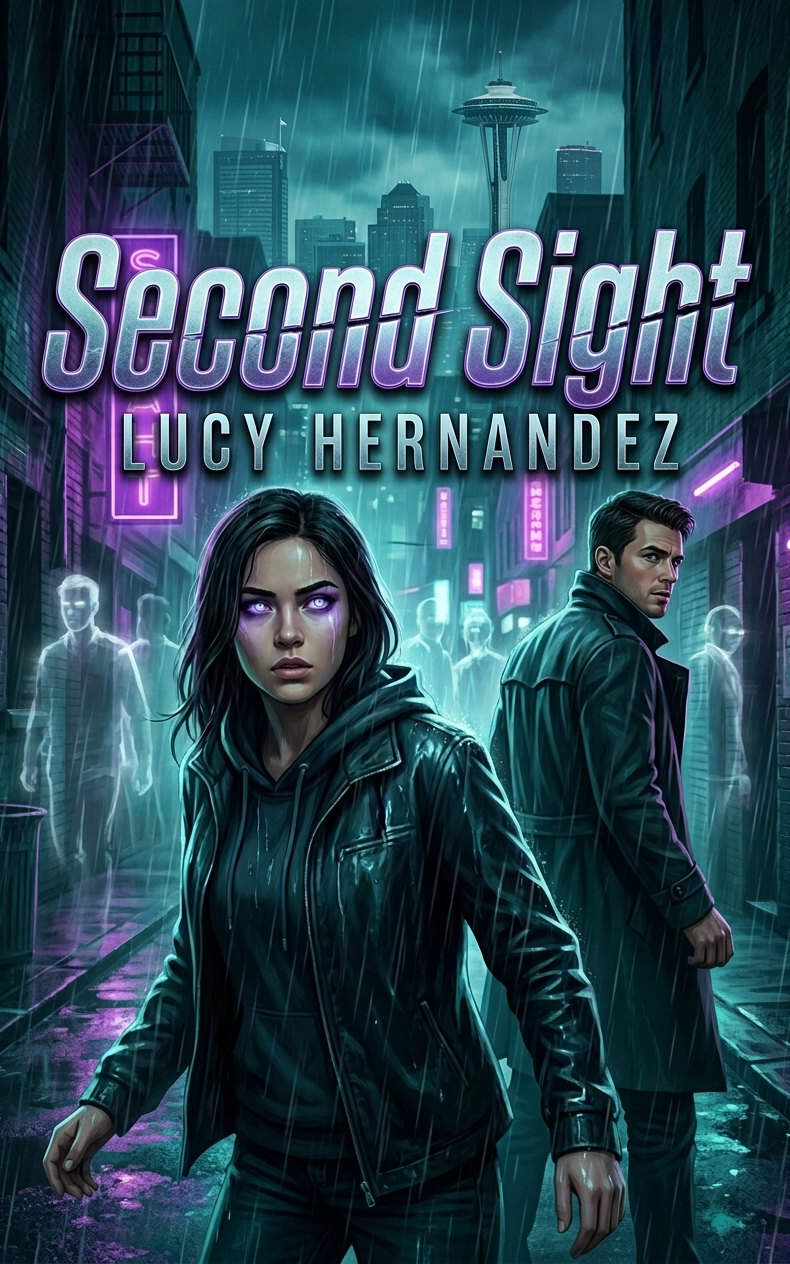
Second Sight
She can see the future, but she never saw this betrayal coming
by Lucy Hernandez
Juniper 'June' Marlowe’s twentieth birthday didn't come with a cake and candles; it came with the voices of the dead and flashes of a future she isn't sure she can change. When she crosses paths with Grant Sterling-Hale, a cynical journalist determined to debunk her 'gift,' June expects a battle of wits, not a bond that defies logic. But the visions take a dark turn when June witnesses a gruesome murder through a psychic premonition. Driven by a desperate need to help, she arrives at the scene only to find herself caught in a lethal trap. With her fingerprints on the weapon and the police at her heels, June is labeled a killer by everyone except Grant. Now a fugitive in the rain-slicked streets of Seattle, June must rely on a man who once doubted her very existence. As they uncover a conspiracy tied to the shadowy Vanguard security firm and the unsolved death of June’s mother, they realize the real killer has been watching June all along. In a race against time and a fate she has already seen, June must embrace her terrifying power to survive a confrontation that could be her last. In this heart-pounding mix of paranormal mystery and high-stakes romance, the only thing more dangerous than seeing the future is living it.
- Romance
- Thriller
- Paranormal
- Contemporary Romance
- Psychic
- Medium
The Birthday Curse
I ran my fingers along the spines of the leather-bound classics, the familiar texture of aged buckram and gold-leaf lettering grounding me as I pulled a worn copy of Wuthering Heights from its resting place. The smell of old paper and vanilla usually acted as a sedative for my frayed nerves, and Marlowe’s Bookstore was a sanctuary of dust and silence, a place where the world felt manageable behind stacks of books and overpriced modern hardcovers. But on the morning of my twentieth birthday, the air inside the shop felt heavy, like the atmosphere right before a summer thunderstorm. It was thick and pressurized, making the back of my neck prickle with an alarm I couldn't explain.
I was shelving a new shipment of contemporary poetry when the first spike of pain hit. It wasn't a normal headache. It felt like a hot needle had been driven through my left temple and twisted. I gasped, dropping a book. The thud echoed through the quiet aisles, sounding like a gunshot in the stagnant air. I gripped the edge of the mahogany shelf, my knuckles turning white as I waited for the world to stop spinning.
“June? You okay?”
Pete, my coworker, looked up from the register. He had spent the last hour meticulously hand-labeling a stack of fragile first editions for me, his thick glasses sliding down his nose and a permanent smudge of ink on his thumb. He looked concerned, his brow furrowed as he started to walk toward me. I tried to wave him off, but the words died in my throat. The temperature in the store plummeted. I could see my own breath hitch in a white puff of frost. The overhead lights began to hum, a low-frequency buzz that vibrated in my teeth, before they flickered with a violent, unnatural intensity. One by one, the bulbs groaned and dimmed until the aisle was cast in a sickly, gray twilight.
Then I saw her.
She was standing at the end of the history section, framed by books on the Great Depression. At first, I thought she was a customer who had slipped in while I was distracted, but the light was passing right through her shoulder. She was pale, a translucent shade of blue that reminded me of milk spilled in water. Her hair was matted, and she wore a dress that looked like it belonged in the nineties. But it was her neck that made my stomach turn. A jagged, angry scar ran across her throat, a deep canyon in her ghostly flesh that looked like it had been carved by something dull and brutal.
She wasn't breathing. Her chest remained perfectly still as she stared at me with wide, hollow eyes. She lifted a hand, her fingers trembling as if she wanted to reach out, but her mouth only opened in a silent, agonizing scream. I could feel her terror. It washed over me like a physical wave, cold and suffocating. I felt the phantom sting of a blade against my own skin, the sensation of life leaking out onto cold pavement.
“Get away!” I screamed, my voice cracking. I backed into the shelving unit, knocking over a display of bestsellers. The books tumbled around my feet like dead birds.
“June! Hey, talk to me!” Pete was suddenly there, grabbing my shoulders. I flinched at his touch, my heart hammering against my ribs so hard I thought it might shatter. I looked past him, but the woman was gone. The lights stopped flickering and returned to their warm, yellow glow. The air was no longer freezing. It was just a normal Tuesday morning in Seattle, except for the fact that I was shaking and tears were streaming down my face.
“I just... I got dizzy,” I whispered, avoiding Pete’s eyes. I couldn't tell him I’d seen a dead woman with her throat cut. He already thought I was a bit eccentric because of how much I talked about my grandmother’s old superstitions. “It’s the migraine. I need to go home, Pete. Please.”
He didn't believe me, I could tell by the way he searched my face, but he nodded anyway. He helped me gather my things, his hand lingering on my arm with a pity that made me want to crawl out of my skin. I hurried out of the store, the chime of the door bell sounding like a funeral knell behind me.
The walk back to my apartment was a blur of gray sidewalks and the smell of rain. Seattle was always damp, but today the mist felt like it was clinging to me, trying to pull me under. My grandmother used to say that when we turn twenty, the blood finally recognizes the spirit. I had always thought she was just being dramatic, a woman lost in the folklore of the old country. Now, I felt like my skin was a size too small. Every person I passed on the street felt like a spark of static electricity against my senses. I could feel their moods, their stresses, and their lingering griefs like a dull roar in the back of my mind.
I locked my door and leaned against it, the silence of my small studio apartment offering no comfort. I didn't turn on the lights. I just crawled into bed, pulling the duvet over my head to shut out the world. I told myself it was a hallucination. I told myself I was coming down with the flu. But as I drifted into a fitful sleep, the darkness behind my eyelids began to bleed into a different reality.
I wasn't in my bed anymore. I was standing in a narrow alleyway, the ground slick with oil and rainwater. The air smelled of garbage and wet brick. A few feet away, a man in a dark, expensive suit stood over a crumpled shape on the ground. I couldn't see his face; it was swallowed by the shadows of the surrounding buildings, but I could feel the coldness radiating from him. It was the same coldness I’d felt in the bookstore. He moved with a clinical, detached precision, looking down at the body of a man whose life was pooling out in a dark shadow on the asphalt.
I tried to scream, but no sound came out. I tried to run, but my feet were rooted to the spot. The man in the suit looked up, and for a second, I felt his gaze pierce right through me, even though I knew I wasn't really there. The intensity of the vision reached a breaking point, a high-pitched ringing filling my ears until I thought my head would explode.
I bolted upright in bed, gasping for air. My pajamas were drenched in sweat, clinging to my skin. I scrambled for the lamp on my bedside table, knocking over a glass of water in the process. When the light flickered on, the silence of the room was gone. It was replaced by a low, rhythmic whispering. It sounded like dozens of people talking at once in the next room, their voices muffled by the walls but insistent. They were calling out, some in anger, some in desperate pleas for help.
“Stop it,” I sobbed, pressing my palms against my ears. “Just stop it.”
And then, through the cacophony, a single voice rose above the rest. It was soft, melodic, and held a hint of a southern lilt that I hadn't heard in years. It was the voice that used to sing me to sleep when I was a child. It was the voice that had vanished on a rainy night three years ago.
“June, honey. Don't be afraid. It’s just the sight opening up.”
“Mom?” I whispered, my breath catching. I looked around the empty room, my eyes searching every corner for a sign of her. She wasn't there, but her presence felt like a warm thumb brushed against my cheek. The whispering of the others dimmed, pushed back by the sheer force of her love.
I stood up and walked toward the bathroom, my legs feeling like they belonged to someone else. My entire body felt like it was vibrating at a different frequency, a hum that resided in my marrow. I reached for the light switch and stared into the mirror. I didn't recognize the girl looking back at me. My face was pale, my hair a tangled mess of honey-blonde waves, but it was my eyes that stopped my heart. Usually, they were a standard, unremarkable hazel. Now, they were a startling, glassy green, the color of a shallow sea before a storm. They looked luminous, as if a fire was burning somewhere deep behind the pupils.
The veil hadn't just torn. It had been shredded. The world of the living and the world of the dead were no longer separate for me. I was twenty years old, and my life as a normal girl was officially over. I was a lighthouse for the lost, and the shadows were already starting to gather at the door.
The Logical Man
The morning light in Seattle was a bruised purple, filtered through a heavy layer of overcast clouds that promised more rain by noon. I sat behind the counter of Marlowe’s Bookstore, my fingers trembling as I tried to organize a stack of invoices. Every time I closed my eyes, I saw that woman with the jagged scar on her neck. Every time the door ch…