

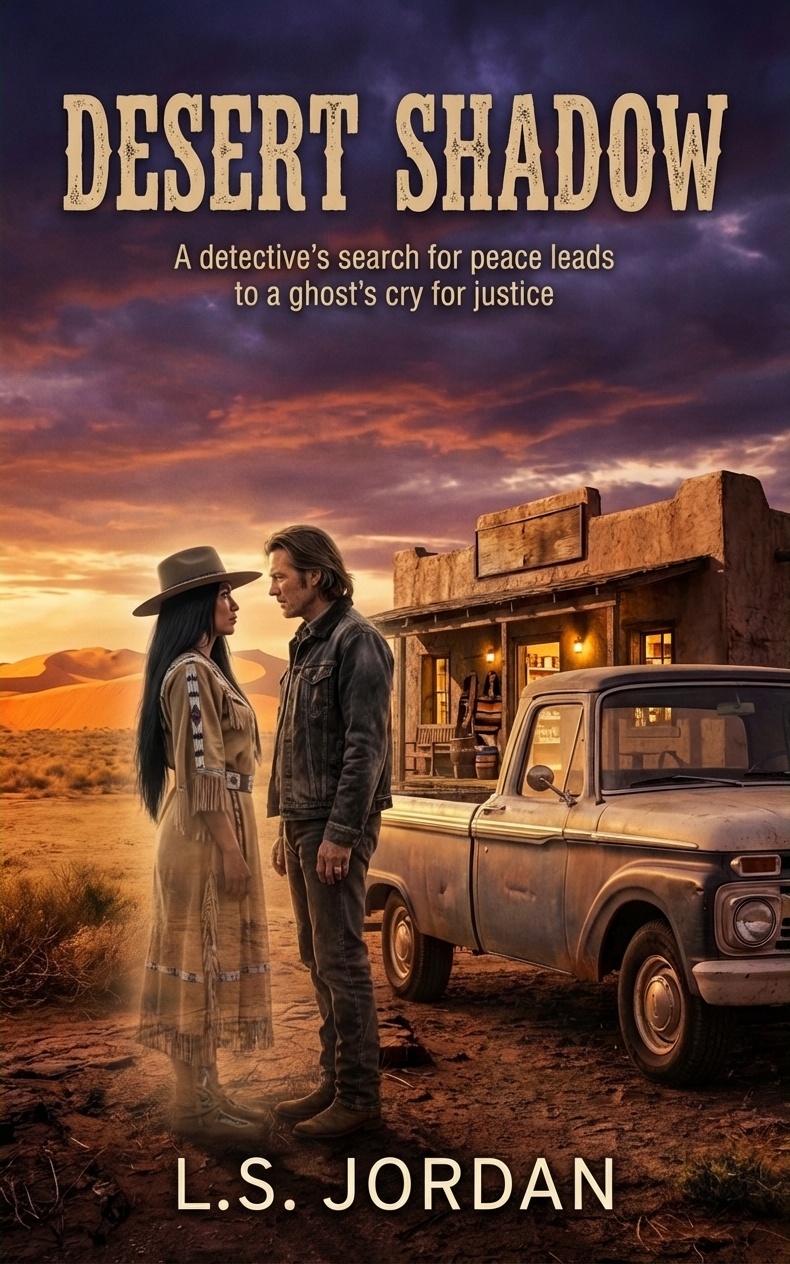
Desert Shadow
A detective's search for peace leads to a ghost's cry for justice
by Lonnie Jordan
Joseph Nightwind was a man who lived for the dead until his own life fell apart. A former Phoenix detective haunted by cold cases and a shattered marriage, he retreats to the Arizona badlands seeking nothing but silence. But the desert has other plans. At a dusty trading post in the middle of nowhere, Joseph meets Anita Blackhorse. She is beautiful, mysterious, and speaks in riddles that cut straight to his soul. After a night of supernatural connection in a crumbling shack, Joseph wakes up alone. There are no footprints in the sand but his own, and a wax heart on the floor carries a final message: You'll be fine. As Joseph digs into the town's history, he discovers the terrifying truth. Anita isn't just a drifter; she is a ghost seeking vengeance for a decades-old crime. Murdered by the powerful Kimble family for uranium rights, her spirit cannot rest until their dark legacy is exposed. Caught between the physical world and the spectral realm, Joseph must navigate a landscape of greed and blood. To find justice for a woman who no longer exists, he will have to risk everything he has left. In the heat of the Mojave, some secrets are buried deep, but a desert shadow never forgets.
- Supernatural Mystery
- Paranormal
- Romance
- Thriller
- Paranormal Romance
- Crime Thriller
Hello Stranger
The sky over the highway was a red wound that would not close. Joseph Nighthawk kept both hands on the wheel of the old truck and let the tires hum their tired song against the cracked asphalt. Dust-devils rose in the rear-view and chased a pale desert moon that had no business being up so early. Phoenix was hours behind him, and so was the apartment with the empty closets and the papers that still smelled like a lawyer’s office. The Glock sat heavy on his hip, five years of service weight he had not been able to leave in a drawer. He had come looking for silence. The desert offered it in long, dry stretches, then took it back with heat and glare.
A diner sign flickered on the edge of Dust Haven, neon almost dead, letters missing like teeth. He pulled off beside a nameless trading post whose porch sagged toward the sand. The building looked like it had been waiting for a storm that never quite arrived. He cut the engine. Heat pressed against the windshield. For a moment he sat and listened to the metal tick as it cooled.
She was sitting by the front door, hat pulled low to hide her eyes. Joseph stepped down and felt the grit under his boots. She looked up as he passed. Her voice was low and musical, a little old-fashioned around the edges.
“Hello, stranger. You look like you lost something.”
He stopped. The words landed in a place he had been trying not to name. “Yeah. Most of my life.”
She did not laugh at him. She only nodded, as if that answer had been sitting on the porch all afternoon waiting for him. He leaned against a porch post. The wood was warm and splintered. She stayed where she was, boots crossed at the ankle, hat brim cutting a shadow across her cheekbones. They talked. Time went soft. Empty roads, towns that forgot their own names, the way a man could drive until the radio turned to static and still not feel gone enough. He told her he was a detective from Phoenix, or had been, and that the job had followed him home until there was no home left. He did not say Susan’s name. He did not have to. The air between them understood unfinished business.
She spoke of the land the way people speak of a relative who will not stay buried. Sage, wind, water that used to run and did not anymore. Her hair was long and dark, ink-black where the sun caught it, and a few dry sprigs of sagebrush had caught in it as if the desert had reached up to claim her. He found himself watching her hands. They were still, then they moved when she talked, tracing nothing in the air.
The afternoon stretched. Shadows grew long across the lot. A truck passed on the highway and did not slow. Joseph’s throat was dry. He said he was going inside for a soda. She said she would wait. He believed her.
The trading post smelled of dust, jerky, and old wood. A man behind the counter took his money without much talk. Joseph paid, popped the can, and walked back into the light. The porch was empty. The chair she had used was still there, but it looked unused, as if no one had sat in it all day. He stood with the cold can sweating in his hand and looked left, then right. No dust of her leaving. No footprint he could swear was hers. He thought, without wanting to, that she had been beautiful. The thought sat in his chest like a stone that had learned to be warm.
He walked around the side of the building to where he had parked. The truck door on the passenger side was shut. He had locked it. He always locked it. She was sitting in the front seat as if she had always ridden there, boots up on the busted dashboard, sagebrush still tangled in her hair. She looked at him through the glass and did not smile like a joke. She smiled like a person who had waited a long time and was done pretending she had not.
He opened the driver’s door. Heat rolled out. “How did you get in?”
“Drive,” she said. “Just drive till the radio crackles, where the road ends.”
He got in. The key turned. The engine complained, then settled. He pulled back onto the highway, then off it onto a dirt track that the map in his head did not bother to name. She reached over and traced something on his shoulder, a story told with a fingertip, riddles he could not catch all the way. When she laughed, it sounded like crying that had learned a better tune. The radio hissed, found a station, lost it, hissed again. The sky bled from red to a deeper copper. Dunes rose on either side like sleeping animals.
He asked her name. She said Anita, then Blackhorse, as if the second word belonged to the ground more than to a person. He told her I'm Joseph. She repeated it once, testing the weight. They spoke of weather that could kill a man who thought he was careful, of towns that lived on rumor, of families that kept ledgers no court ever saw. He did not press her on how she had entered a locked truck. The detective in him wanted a print, a scratch, a reason. The man who had driven out of Phoenix with a divorce ringing in his ears let the question sit unanswered.
The dirt road narrowed. The radio finally gave up and filled the cab with crackle. At the last dune she asked him to stop. He did. Dust hung in the air. She got out and stood with one hand on the open door, looking toward the hills that were already going purple.
“I live over those dunes, stranger. Thanks for the ride.”
She shut the door gently. He watched her walk into the heat shimmer until the shape of her became part of the land. He sat with the engine idling, puzzled in a way that was not quite fear and not quite hope. He wondered if he would ever see her again. The desert did not answer. He put the truck in gear and turned back toward open ground, looking for a place to camp, the soda can still unopened on the seat, her absence already louder than the radio’s static.
The highway into Dust Haven had been a long gray ribbon with heat waves crawling on it. Joseph had counted mile markers without meaning to, the way a man counts breaths after a bad night. His jacket was old leather, cracked at the elbows. His boots were worn down at the heels from city sidewalks and then from this. He had not planned a speech for anyone. He had planned nothing except distance.
Dust Haven itself was barely a town. A few roofs, a water tower that looked tired, the trading post with its dying neon. He had almost driven past. Something in the porch shadow had made him stop. Later he would try to name that something and fail. At the time it was only a woman with a hat pulled low, sitting as if the door belonged to her.
Their talk on the porch had not been an interview. He had not asked for identification. She had not asked why a man with a gun on his hip was buying silence in a place that sold it cheap. He spoke of cold cases the way other men spoke of weather, facts that would not stay buried and would not come clean. Navajo names that had been filed and forgotten. Land that looked empty until someone wanted what was under it. He stopped himself before the words turned into a briefing. She listened with her head slightly tilted, as if she already knew the shape of those stories and was only checking that he did too.
She told him the desert kept disguises. A person could sit in plain sight and still not be there when you looked twice. He thought she was being poetic. He did not yet know she was being exact.
Inside the trading post, the soda cooler hummed. He had chosen a brand without thinking, paid with cash, nodded at the clerk. The whole errand had taken three minutes. Three minutes was enough for a porch to empty itself of a living woman. He had stood in the doorway with the can and felt foolish, then uneasy. Detectives did not like people who left no trace. He walked the length of the porch. No purse. No water bottle. No print in the dust that he could swear was new. The chair might have been sitting empty since morning.
Around the side of the building, the truck waited in a strip of shade that was already failing. He had locked it. He remembered the click. He remembered checking the handle out of habit. She was in the passenger seat anyway, boots on the dash as if the cracked vinyl had been waiting for those boots for years. Sagebrush in her hair. Wildflowers too, small and pale, as if they had grown there while he was inside buying sugar water.
He had stared. He had not meant to stare. She was the most striking person he had seen in a long time, and that thought embarrassed him because he had come here to stop wanting things. High cheekbones, a strong jaw, skin the color of polished wood in late light. Jewelry at her throat that looked older than the trading post. Clothing that did not quite match the year on his watch. He got in anyway. A man who had lost most of his life did not always ask the smart questions first.
“Drive till the radio crackles,” she had said. “Where the road just disappears.”
He drove. The dirt road took them away from the highway’s thin comfort. Fence posts leaned. A windmill turned with no water in sight. She talked in pieces. A family. A claim. Men who smiled when they took what was not theirs. She did not give dates. She did not give a last address. Her fingertip on his shoulder drew lines he could feel through the jacket, a map that was not for paper. When she laughed, her eyes shone as if the laugh had cost her something. He kept his eyes on the track and let her voice fill the cab.
The Glock remained holstered. He was not afraid of her in the way he had been afraid of men in alleys. He was afraid of the gap between what he knew and what he was seeing. Locked doors. Empty porches. A woman who sat like she owned a seat she had never been given. His mind reached for tricks, heat, exhaustion. His body remembered the weight of her finger on his shoulder and did not call it a trick.
At the end of the road the dunes rose, half light, half shadow. She got out and pointed with her chin toward the far hills.
“I live over those dunes.”
He wanted to ask which house, which wash, which name on which mailbox. He did not. She thanked him for the ride as if he had done her a small ordinary favor. Then she walked. The heat blurred her edges. He sat until he could not tell her from the land, then he turned the truck around because sitting there felt like waiting for a ghost, and he was not ready to use that word.
He found a flat of hardpan a few miles back, not quite camp yet, just a place to stop and think. The soda had gone warm. He drank it anyway. The sky went from copper to bruise. He told himself he would ask in town tomorrow about a woman with agate eyes and sage in her hair. He told himself there would be a simple answer. The desert wind came up and moved the sand in small, patient ways, and he sat in the cab with the window down and did not quite believe himself.
Joseph Nighthawk had left Phoenix because the city would not stop talking. Sirens, reports, a marriage that had become a list of absences. Here the talking was different. The land spoke in heat and distance. The woman on the porch had spoken in riddles that felt like facts he had misplaced. He replayed the first line. You look like you lost something. He had answered honestly, which was rare for him with strangers. Honesty had not made her less strange.
He remembered the hours on the porch in pieces. The way the sun slid. The way her hat brim never quite lifted enough for him to read her eyes all the way. She had asked if he believed a road could end and still keep going. He had said he believed in maps and in what a man could prove. She had smiled then, not unkind. “Maps lie too, stranger. They just lie slower.”
He had talked about names that did not stick. People who vanished into paperwork. She had said some names stuck to the ground even when the people were gone. He had not known what to do with that. He was used to files, photographs, dates of death that stayed put. She talked like death was a door you could sit beside.
When he had gone inside for the soda, he had not been running from her. He had been thirsty. That was all. The counter had been scarred. The clerk had had the look of a man who did not ask questions because questions cost extra. Joseph had paid, stepped out, and found the porch returned to emptiness. The shock was quiet. It did not shout. It simply rearranged the afternoon until the talking hours felt like a dream he had had with his eyes open.
Then the truck. Boots on the dash. The locked door that had not stayed locked. He had felt a detective’s irritation, then something closer to awe, which he disliked. Awe was not useful. Awe did not write reports. She had told him to drive, and he had driven because stopping would have meant admitting he was afraid of a woman who had not threatened him once.
On the dirt road she had traced her story on his shoulder. He could still feel the path of it, a slow spiral, then a line that stopped too soon. She spoke of brothers, of a mother who sang, of a piece of land that had a secret the color of old bone and yellow earth. She did not say uranium. She did not say Kimble. Those names were not for this chapter of the day. She said only that some men laughed when they took, and that laughter stayed in the rocks. Joseph listened and felt the old professional hunger, the need to put a date on a crime. He also felt the other hunger, the one that had nothing to do with cases, the one that noticed her mouth when she talked and the sage in her hair and the way she seemed both present and already leaving.
The radio crackled and died. The road disappeared into sand. She got out. The farewell was small. Thanks for the ride. He had heard a hundred thanks in his life. This one stayed. He watched her go over the dunes until watching felt like trespass. Then he drove, puzzled, the question repeating: would he see her again?
Night had not fully come. The west still held a last strip of red. Joseph sat with the truck door open, boots on the running board, and let the desert take the rest of the heat. He thought of the porch, the soda, the empty chair, the occupied seat. He thought of his own name and how, for a stretch of dirt road, it had not mattered. He was a man who dealt in facts. The facts of the afternoon did not add up, and still they sat in his chest as true.
He would sleep when he found a better spot. He would build a fire later, maybe. For now he only sat, a former detective on the edge of a town that barely existed, carrying a gun he hoped not to use and a memory of a woman who had looked at his loss and named it without pity. The dunes held their shape against the darkening sky. Somewhere over them, she had said, she lived. He did not know if that was a house or a story. He only knew the road had ended, the radio had gone to static, and he was not the same man who had pulled off the highway an afternoon ago.
The tires had hummed. The sky had bled. She had sat by the door with her hat low, then vanished, then waited in the truck as if years had been a single afternoon. He started the engine again, not to leave the desert, only to find a patch of ground where a man could stop without feeling he was still being watched by something patient and old. Dust Haven’s weak lights were a rumor behind him. Ahead was sand, wind, and the question she had left in the cab like a second passenger.
Joseph Nighthawk drove slow. He did not turn on the radio. There was nothing left in it but crackle, and he had already followed that sound as far as it would take him. He parked at last on a rise where the wind could move through the cab. He cut the motor. Silence came in, true silence, the kind he had wanted. It did not feel empty. It felt like a held breath.
He thought of her last look, not sad, not playful, something older. Save a night, the desert seemed to say, though she had not used those words. He closed his eyes for a moment and saw red sky on highway, neon about to die, a hat brim, a locked door that opened for her anyway. When he opened his eyes the dunes were still there, dark now, and he wondered again, quietly, without expecting an answer, if he would ever see her again.
The night insects began, sparse and dry. His jacket creaked when he shifted. The Glock was a familiar pressure. Divorce papers were a thousand miles away and still somehow in the truck with him. She had said he looked like he lost something. He had. Most of his life. For a few hours on a porch and a dirt road, the loss had sat beside him and worn sage in its hair and talked in riddles and laughed like tears. Then it had walked over the dunes and left him with a warm soda and a locked mystery.
He would ask around tomorrow. He already knew how that would go. Towns like this protected their silences. Still, he would ask. A detective’s habit died hard, even when the detective was trying to become a man who only drove and camped and forgot his given name for a while.
Joseph sat until the last red left the sky. Then he started the truck once more, found a hollow out of the worst wind, and let the day end the way desert days ended, without applause, with dust settling, with a stranger’s voice still tracing a story on his shoulder that he could feel even after she was gone.
Where the Radio Crackles
Joseph Nighthawk found the hardpan after the last red had left the sky. The ground was flat enough for a tent and hard enough that the pegs would hold if the wind rose. He parked the truck nose-out toward the track, a habit from years of wanting a way off any scene. The dunes sat in a low ring around him, dark now, their edges blurred. He cut the e…