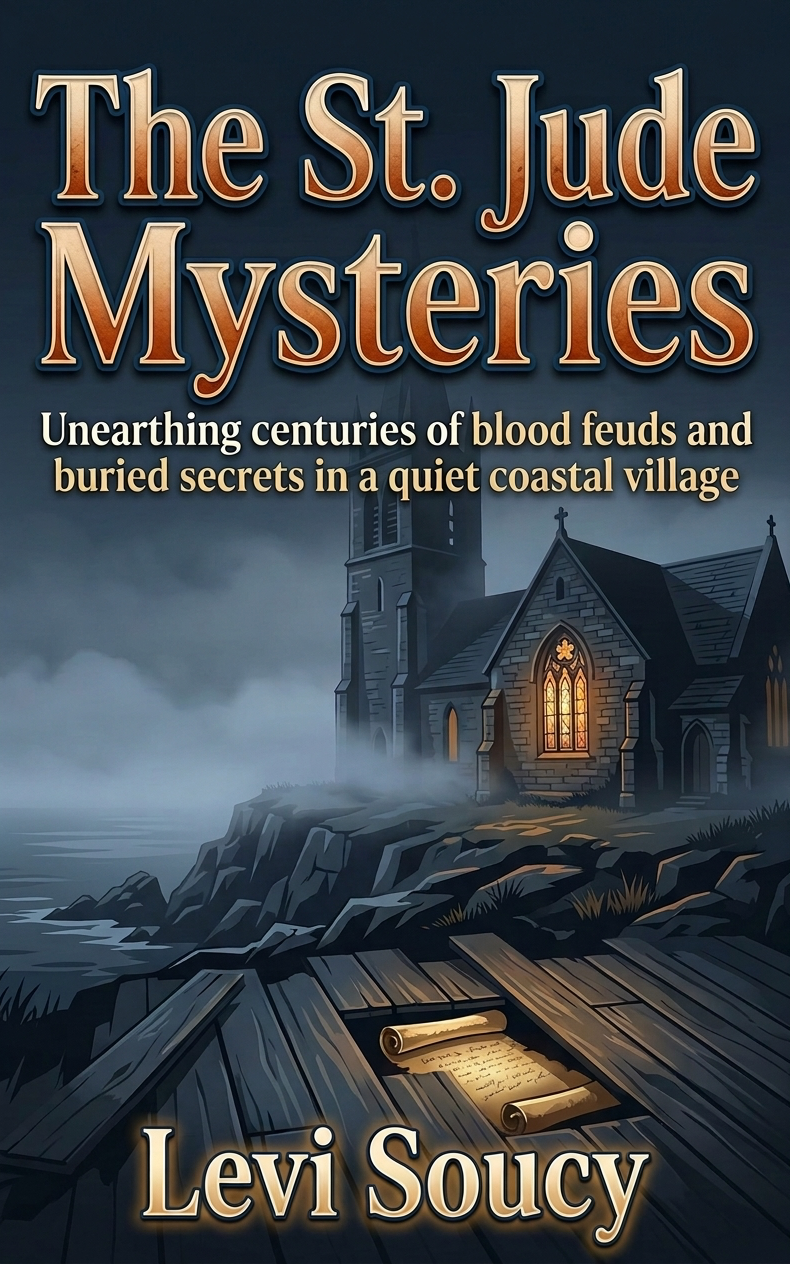
The St. Jude Mysteries
Unearthing centuries of blood feuds and buried secrets in a quiet coastal village
by Levi Soucy
Faith and history collide in the fog-drenched village of St. Jude. When Reverend Caleb Hargrove begins renovating the historic rectory, he expects to find dust and old beams—not a 17th-century land charter that threatens to dismantle the town's foundation. As the artifact’s discovery ignites a dormant war between the town’s founding families, the stakes turn deadly. A visiting scholar is left for dead in the bell tower, and anonymous threats begin appearing on the altar. Someone is desperate to keep the past buried, and they believe the church is the perfect place to hide a secret. Alongside his partner, Lydia Beaumont, Caleb must navigate a labyrinth of ancestral lies and modern greed. From the rocky Maine coast to the hidden compartments of the rectory, they hunt for a truth that the powerful elite will do anything to suppress. But as the shadows of a century-old blood feud lengthen, Caleb realizes that protecting his congregation might mean exposing the rot beneath his own floorboards. In a town where silence is tradition, the truth might be the most dangerous sin of all.
- Mystery
- Crime Fiction
- Cozy Mystery
- Amateur Sleuth
- Small Town Mystery
- Murder Mystery
The Hollow Wall
The morning air inside the St. Jude rectory was thick enough to chew. Dust swirled through the narrow hallway in pale ribbons—pulverized plaster, cedar shavings, and the sour metallic tang of century-old decay. After five years shepherding the coastal parish, Caleb Hargrove had learned the moods of the old building. Today, the house felt restless. The beams creaked like old bones under strain, as though the rectory itself was bracing for impact.
The renovation had long since ceased being cosmetic. It had become an excavation.
Caleb stood in the center of the hall, ghostly footprints trailing behind him in the fine white dust coating the floorboards. From the study came the sharp thwack and scrape of a crowbar. The sound felt less like construction and more like surgery—something buried being forcibly pulled into the light.
He adjusted the stiff collar around his neck. The starch rubbed against his skin, a small irritation that mirrored the larger weight he carried in a town that preferred its sins polished and pressed beneath Sunday clothes. Caleb liked solid things—clear answers, straight walls, foundations that held. Yet lately, every surface in St. Jude seemed to conceal rot beneath it.
“Caleb?” Eliza Pendergast called from the study. “You’re gonna want to see this. And maybe grab a mask unless you feel like coughing up the nineteen-twenties for the next month.”
Her voice cut cleanly through the haze.
Caleb crossed toward the study, squinting against the late-morning light slanting through the tall windows. Eliza stood beside the far wall, her bleached hair tucked beneath a backward baseball cap, tool belt hanging heavy at her hips. She looked wildly out of place in the rectory—like someone from another century entirely, armed with drills and demolition tools instead of incense and hymnals.
She pointed toward the built-in bookshelves.
One entire section of oak cabinetry had been pried away. Behind it wasn’t the expected brick chimney, but a narrow vertical cavity hidden inside the wall itself. The hollow space was barely wider than a man’s shoulders and thick with gray dust and dead spiders. A breath of cold air drifted from the darkness—far colder than the rest of the house—and carried the smell of dry rot and stale shadows.
“I was checking the supports behind the shelves,” Eliza said, lowering her voice instinctively. “The blueprints from the ’58 remodel showed solid masonry here. But the hammer sounded wrong. Hollow. Like knocking on a coffin.”
Caleb stepped closer, following the beam of her work light into the darkness.
“A dead space,” he murmured. “Maybe a hidden storage shaft. The rectory isn’t old enough for a priest hole.”
“It wasn’t empty.”
Eliza reached carefully into the cavity and withdrew a weathered tin box. Rust bloomed across the metal in orange veins, and a thick bead of dark red wax sealed the lid shut. Pressed into the wax was an unfamiliar symbol: a stylized anchor wrapped in a thorned vine.
“I didn’t open it,” she said, handing it to him. “Figured that was above my pay grade.”
The box was heavier than it looked.
“Thanks, Eliza,” Caleb said quietly. “Why don’t you take a breather?”
She nodded once, sensing the shift in the room, then disappeared into the hallway.
Caleb carried the box to the large oak desk at the center of the study. A familiar unease prickled at the base of his neck—the same instinct that had warned him months earlier before the corruption scandal nearly tore the town apart.
He slipped a pocketknife from his jeans. The blade flashed in the muted coastal light.
The study door creaked open.
Lydia Beaumont stepped inside with a stack of sheet music tucked beneath one arm. Wind had loosened strands of auburn hair around her face, and her green eyes sharpened immediately at the sight of the exposed wall and rusted box.
“Mabel said there was a commotion,” Lydia said softly. “She claims she heard the wood screaming from the bakery.”
“Eliza found a false wall,” Caleb replied, never taking his eyes off the wax seal. “Whatever this is, someone wanted it forgotten.”
Lydia stepped closer, fingertips brushing lightly against the cold metal.
“It feels old,” she whispered.
“It is.”
Caleb pressed the knife into the wax. The seal resisted at first, brittle with age, then cracked apart in blood-red flakes. The lid groaned as he pried it open.
Inside, wrapped in oil-stained silk, lay a single rolled parchment.
Caleb carefully unfurled it across the desk. The paper had yellowed to the color of old bone. Lydia leaned over his shoulder, and he heard her breath catch.
It wasn’t a letter.
It was a land charter.
At the bottom of the document sat the same anchor-and-thorn seal, pressed deep into the parchment beside signatures written in archaic, jagged script.
“This can’t be right,” Lydia whispered. “It’s dated sixteen eighty-two.”
Caleb looked up sharply.
“St. Jude wasn’t officially incorporated until the mid-eighteenth century,” she continued. “The historical society’s records don’t go back anywhere near this far.”
“Look at the boundaries,” Caleb said.
His finger traced a line along the jagged Maine coastline.
“The parish land and the old Vesper estate weren’t separate properties,” he said slowly. “According to this, they were one grant. One estate.”
Lydia’s face lost color.
As church organist and the town’s unofficial genealogist, she knew the bloodlines of St. Jude better than anyone. Her finger hovered over a bold signature near the bottom of the parchment.
Vesper.
Beside it, written in smaller, refined script, was another name.
Vance.
“The lost deed,” Lydia breathed. “My grandmother used to talk about it. She said the Vespers didn’t lose their power naturally—that they were erased.”
Silence settled over the study.
Outside, waves crashed against the rocky shoreline while wind hissed through the bare trees beyond the graveyard.
“If this document is authentic,” Lydia continued, “then half the waterfront technically belongs to the Vesper estate. The yacht club. The condominiums. Most of the Vance holdings.”
Caleb stared at the parchment spread across the desk like an open wound.
“This could destroy families,” he said quietly.
“Sterling Vance certainly won’t thank you for finding it.”
Caleb crossed slowly to the window. Beyond the glass, St. Jude looked peaceful—gray stone buildings huddled against the winter coastline beneath a sky the color of bruised steel.
But Caleb knew better.
Rot always hid beneath the floorboards first.
His gaze caught movement near the lychgate at the edge of the church property.
A dark sedan idled beside the road.
Its paint was the color of wet ash, windows blackened with tint. No one emerged. The vehicle simply sat there, exhaust curling white into the freezing air.
Watching.
“Lydia,” Caleb said quietly. “Do you know that car?”
She stepped beside him and frowned.
“No. And it’s too clean to belong here. Most locals carry enough rust to qualify as shipwrecks.”
As though aware of their attention, the sedan’s brake lights flared crimson through the fog.
A low growl rumbled from the engine.
Then the car pulled away, tires crunching over frost-hardened asphalt before disappearing into the mist rolling inland from the sea.
A chill passed through Caleb that had nothing to do with the drafty rectory.
The tin box no longer felt like a discovery.
It felt like a tripwire.
“We need an outside expert,” Caleb said, turning back toward the desk. “Someone with no ties to the Vances or the Vespers.”
“I can contact the university archives tomorrow,” Lydia said, though her eyes remained fixed on the seal. “But Caleb… if someone hid this behind stone and oak for centuries, they never intended for it to be found.”
Caleb rested a hand on the cold tin box.
The sanctuary of St. Jude had always been his responsibility—a refuge for wounded souls, grieving families, and quiet prayers carried through stained glass light.
But standing in that dust-choked study, listening to the wind moan through the eaves, he realized something had changed.
He had not uncovered history.
He had awakened it.
And somewhere beyond the fog-covered shoreline, someone already knew.
The Scholar’s Warning
The fog around the St. Jude train station clung to the earth like damp wool, swallowing sound and softening the edges of the world. The little depot itself looked less constructed than unearthed, as though generations of Atlantic storms had carved it directly from the granite cliffs beyond the harbor. Salt stained the weather-beaten shingles. The p…