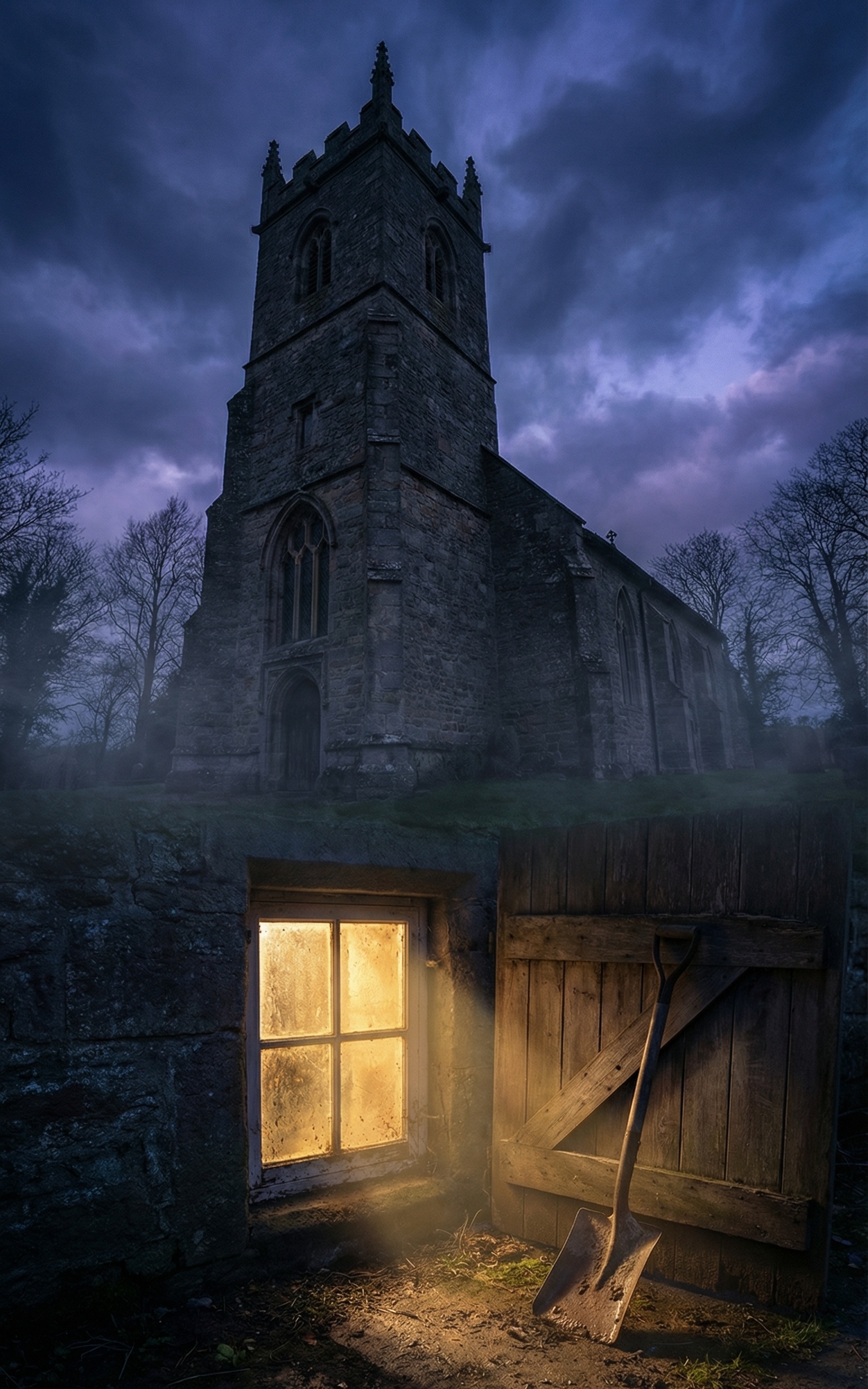
The Pastoral Detective
Faith and justice collide when a decades-old secret is unearthed beneath the sanctuary
by Levi Soucy
Some secrets are better left buried. Others are hidden in the house of God. Pastor Thomas Whitby expected the renovation of his historic church to bring his community closer together. Instead, it unearths a nightmare: a skeleton hidden beneath the basement floorboards for thirty years. The remains belong to Julian Miller, a man whose disappearance once rocked the town and whose presence now threatens to destroy it. Alongside his fiancée, Elara Vance, Thomas trades his sermons for sleuthing. But as they peel back layers of local history, they find a web of corruption that leads directly to the church’s most powerful benefactor, Sterling Montgomery. From suppressed records to a mysterious ledger, every clue suggests that Julian was murdered to protect a fortune built on lies. With his career on the line and an anonymous killer closing in, Thomas must decide how much he is willing to sacrifice for the truth. In a town where silence is a virtue, the Pastor and Elara are about to learn that the most dangerous sins are the ones committed in the dark. Levi Soucy delivers a gripping mystery where the search for justice is a test of faith.
- Mystery
- Amateur Sleuth
The Grave Under the Floorboards
The air in the basement of St. Jude’s was thick with the scent of damp limestone and the lingering, metallic tang of the old furnace. Thomas Whitby adjusted the strap of his headlamp, the beam cutting a sharp, clinical white circle through the subterranean gloom. Beside him, Elara Vance was kneeling on a piece of corrugated cardboard, her measuring tape snapping back into its metal housing with a sharp, echoing crack. They had been down here for two hours, mapping out the dimensions for what Thomas hoped would become a vibrant youth center, a place where the flickering fluorescent lights and gray shadows would be replaced by beanbags, bright paint, and the sounds of life. Currently, however, the only sound was the rhythmic drip of a leaky pipe and the scratch of Thomas’s pencil against his clipboard.
“I think we can fit the study carrels along the north wall,” Thomas said, his voice echoing slightly against the low, timbered ceiling. He rolled up his sleeves, the white of his clerical collar peeking out from the neck of his sweater. “If we can mitigate the moisture, this could actually be a sanctuary for the kids.”
Elara didn’t answer immediately. She was tracing the edge of a heavy paving stone with her gloved hand, her brow furrowed in concentration. “Thomas, look at this. The alignment is off.” She pointed to a section of the floor near the foundation of the original 19th-century vestry. While the rest of the basement floor consisted of packed earth and relatively uniform flagstones, this particular slab sat at a precarious angle, its edges jagged and separated from the surrounding masonry by a gap wide enough to swallow a coin.
Thomas stepped over, crouching beside her. He noticed it then—the way the dust settled differently in the crevice, and the faint, unsettling hollow sound when Elara tapped the stone with the heel of her boot. “It looks like it’s been disturbed,” he murmured. “Perhaps a previous repair to the plumbing?”
“The pipes run three feet to the left,” Elara countered, her voice dropping to a cautious whisper. She reached for a pry bar she’d brought from her restoration kit. “And this stone isn’t just loose; it’s barely sitting in the mortar. It’s as if someone just dropped it back into place in a hurry.”
Thomas felt a prickle of apprehension at the back of his neck. His years as a public defender had taught him to trust his instincts when something felt deliberately concealed. “Maybe we should wait for Gideon,” he suggested, referring to the church sexton. “He knows the layout of these foundations better than anyone.”
“Gideon is halfway to the hardware store in the next county,” Elara reminded him, already wedging the flat end of the pry bar into the gap. “And honestly, if there’s a structural issue, I’d rather know before we start ordering drywall. Give me a hand, Pastor. It’s heavy.”
Thomas hesitated for a heartbeat before nodding. He gripped the edge of the cold, rough stone. Together, they heaved. The slab groaned, the sound of stone grinding against stone shrieking through the quiet basement. With a final, wet thud, they flipped the slab over, letting it rest on the dirt floor. Thomas turned his headlamp toward the dark cavity they had revealed, expecting to see a clogged drain or perhaps a rotted support beam.
Instead, the light hit something pale and porous. Thomas froze. The beam illuminated the unmistakable curvature of a human cranium, partially obscured by the dark, loamy soil. As he shifted the light, the rest of the remains came into focus—a rib cage like a collapsed birdcage, long bones turned the color of parchment, and the tattered remnants of what might have once been a wool coat. The air in the small space suddenly felt much colder.
“Holy moly,” Elara breathed, her hand flying to her mouth. She didn’t look away, her researcher’s eye cataloging the sight even as her face went pale. “Thomas... that’s a person.”
Thomas felt the familiar weight of his old life—the courtroom, the crime scenes, the cold finality of evidence—settle over his shoulders. He knelt lower, his heart hammering a frantic rhythm against his ribs. “Don’t touch anything, Elara. We need to preserve the site.” His eyes locked onto the skeletal hand, where the phalanges were curled as if still clutching at the earth. Resting on what would have been the ring finger was a heavy, tarnished piece of jewelry. It was a signet ring, the gold dulled by decades of oxidation, but the deep engraving of a stylized letter ‘M’ was still clearly visible.
“A signet ring,” Elara whispered, her voice trembling. “Thomas, look at the ‘M.’ It’s so distinctive.”
Before Thomas could respond, the heavy wooden door at the top of the basement stairs creaked open. A shaft of light from the hallway above cut through the gloom, and the rhythmic thump-tap, thump-tap of a cane signaled an arrival. Sterling Montgomery descended the stairs with a slow, deliberate authority that suggested he owned every atom of the air he breathed. He reached the bottom, his sharp eyes immediately locking onto the displaced stone and the gaping hole in the floor.
“Pastor Whitby,” Sterling said, his voice a rich, condescending baritone. He leaned on his silver-topped cane, his gaze sweeping over the skeletal remains with an expression that was disturbingly devoid of shock. “I heard you were down here playing architect. I believe I told the board that any renovations must be cleared through me personally.”
“Sterling,” Thomas said, rising to his full height and stepping between the benefactor and the grave. “We’ve made a grave discovery. There are human remains under the floorboards. I was just about to call the sheriff.”
Sterling’s face hardened, his jaw tightening beneath his neatly trimmed goatee. He took a step forward, his cane clicking sharply against the stone. “You will do no such thing, Thomas. Think about what you are saying. This church is approaching its centennial celebration. We have dignitaries coming from across the state. A scandal of this nature—a ‘body in the basement’—would be catastrophic. It would invite the kind of morbid curiosity that ruins reputations and dries up endowments.”
Thomas stared at him, incredulous. “Sterling, this is a crime scene. A human being was buried here, hidden away. We have a moral obligation—a legal one—to identify them.”
“What you have is a historical curiosity,” Sterling countered, his voice dropping to a low, commanding hiss. “Likely some vagrant from the turn of the century or a forgotten burial from the old cemetery. Put the stone back, Thomas. Cover it up, and I will see to it that the youth center receives a significantly larger budget. We can relocate the carrels. No one needs to know about this.”
“I know about it,” Elara snapped, standing up to face the older man. Her blue eyes were flashing with indignation. “And so does the Pastor. You’re asking us to become accomplices in a cover-up, Mr. Montgomery.”
Sterling looked at her as if she were a particularly loud insect. “Miss Vance, your family has lived in this town a long time. You should understand the value of discretion. Some things are better left in the dark for the sake of the community’s peace.”
“Mercy, Sterling,” Thomas said, his voice calm but infused with the iron of his former profession. “The peace of this community cannot be built on a foundation of secrets and bones. I am calling Sheriff Miller. Now.”
Sterling’s eyes narrowed behind his gold-rimmed spectacles, a flash of genuine venom flickering in his gaze. “You are making a very short-sighted mistake, Pastor. You are a guest in this town, a temporary shepherd. Do not forget who provides the pasture.” He turned on his heel, his cane punctuating his exit with angry, sharp raps against the stairs.
Thomas didn’t wait for the door to click shut. He pulled his cellphone from his pocket, but before he dialed, he looked at Elara. “The ring. I need a record of it before the scene is processed.” He knelt back down, pulled out his phone, and snapped several high-resolution photos of the signet ring. The ‘M’ stood out in the flash, bold and accusing.
As he waited for the sheriff to arrive, Thomas felt a presence in the room. He looked toward the shadows near the old coal-fed boiler, where the darkness was deepest. A figure stood there, partially obscured by the massive iron tank. It was Gideon Pringle. The sexton’s face was a mask of sheer, unadulterated terror, his eyes wide and glassy. He looked as though he had seen a ghost—or perhaps, Thomas realized, he was looking at one he had known all along. Before Thomas could call out to him, Gideon vanished into the back tunnels of the basement, his movements silent and frantic.
Sheriff Miller arrived twenty minutes later, his face grim as he surveyed the site. He was a man of few words, and he spent the next hour bagging evidence and marking the perimeter with yellow tape. He confirmed what Thomas had suspected: the clothing suggested the remains were a few decades old, not a century. When he reached for the ring, Thomas felt a strange jolt of electricity. The sheriff placed it in a small plastic bag, the gold clinking softly against the evidence tag.
Late that evening, Thomas and Elara sat in the rectory kitchen, the lights dimmed and a pot of untouched tea cooling on the table. The silence of the old house felt heavy, as if the walls themselves were listening. Elara had a stack of local history books spread out before her, her fingers flying across the pages of an old town registry.
“The signet ring,” Elara said suddenly, her voice breaking the quiet. “The ‘M.’ Thomas, I’ve been thinking about the Miller family. They were the original owners of the acreage where the church and the Montgomery estate now sit. They were a prominent family until the mid-nineties, when they suddenly lost everything.”
Thomas leaned forward, his interest piqued. “The Millers? I’ve heard the name mentioned in the archives, but they aren't in the current parish registers.”
“That’s because they’re gone,” Elara said, her eyes wide with a realization that sent a chill through the room. “Julian Miller was the son. He was a rising star in the community, an accountant. He disappeared in 1994. The town legend was that he ran off with a bunch of stolen money, but his body was never found. His parents died heart-broken a few years later.”
Thomas looked at the photo he had taken of the ring, the ‘M’ gleaming on his phone screen. “Julian Miller. A man who vanishes, and thirty years later, a skeleton with a Miller signet ring appears under my church.”
“And Sterling Montgomery wanted it buried again,” Elara whispered. “Holy moly, Thomas. If that’s Julian Miller, he didn’t run away. He never left the church.”
Thomas looked out the window toward the dark silhouette of the church spire against the moonlit sky. The mystery was no longer a matter of structural repairs or youth centers. It was a cry for justice from the earth itself. “He’s been waiting thirty years for someone to find him,” Thomas said quietly. “And I don’t think Mr. Montgomery is going to let us find out why he was there.”
A Name for the Nameless
The morning light that filtered through the tall, arched windows of the town library was deceptively peaceful, casting long, dusty motes across the mahogany carrels. Elara Vance sat hunched over a microfilm reader, the mechanical hum of the machine providing a rhythmic backdrop to her frantic search. Her eyes, usually bright with a restorer’s curio…