
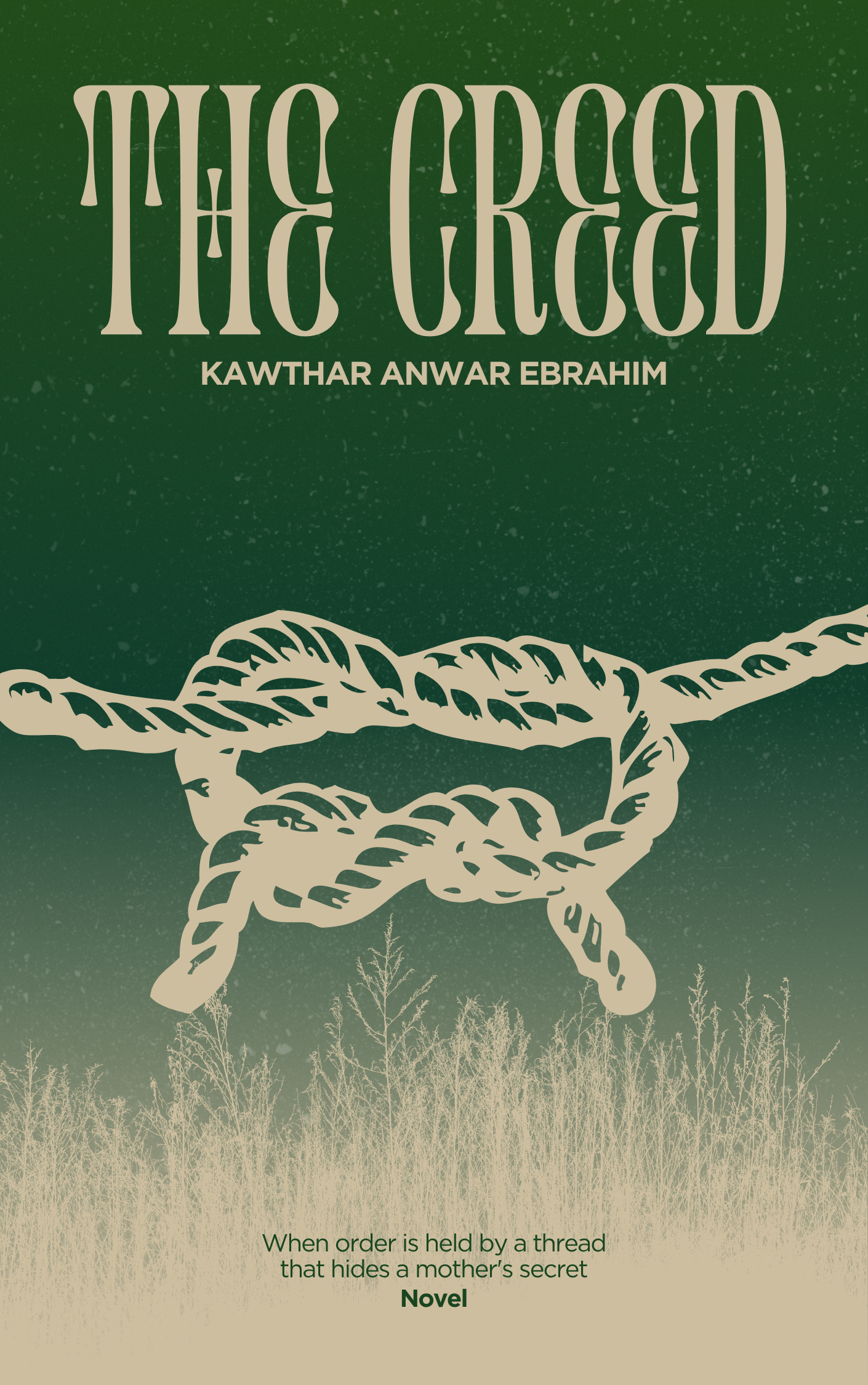
The Creed
When order is held by a thread that hides a mother's secret
by Kawthar Anwar Ebrahim
In the wreckage of the old world, order isn't just a preference, it’s a necessity. Winifred Althoff, a former sociology professor, has achieved the impossible. Deep within the woods, she has woven a group of traumatized survivors into a thriving, ritualistic civilization known as The Creed. Through the sacred laws of 'The Evening Weave' and 'The Law of the Third,' she has banished the chaos of the collapse. To her followers, she is the Architect of their salvation. But the foundation of Winifred’s world is soaked in blood. Ten years ago, during the desperate escape from the city, Winifred made a clinical, academic calculation: her younger daughter, Sol, was a statistical liability. To save herself and her older daughter, Olivia, she locked a door and never looked back. She has spent a decade framing this murder as a tragic necessity of fate. That is, until a stranger arrives with a message that shatters her manufactured peace. Sol is alive. As her carefully constructed society begins to unravel, Winifred must confront the terrifying truth. A private sin cannot be buried under public virtue forever. How far will the Architect go to protect her legacy from the daughter she left to die? A chilling exploration of guilt, gaslighting, and the dark side of sociology, The Creed is a psychological thriller that asks what is the true cost of survival?
- Post-Apocalyptic
- Psychological Thriller
- Dystopian
- Sociological Fiction
- Cult Fiction
The Infinite Knot
Snap. Snap. Snap. Snap. Four times. This is the number of times Winifred typically checks the tension of the thread before she begins her morning hair ritual. Every morning in the Sanctuary follows the same rhythm because deviation is the first step toward the collapse of the self. She stands before a small, polished piece of metal that serves as her mirror, watching her own reflection with a clinical detachment. Her hair is a shock of white, a stark contrast to the dim, gray light of the early morning. She gathers the strands with hands that do not shake. She winds them into a tight, complex knot at the nape of her neck, a physical manifestation of the Infinite Knot that defines their lives. It must be perfect. If the knot is loose, the mind follows. She thinks about the students she used to lecture in university. Structure is the only thing keeping the beast of human nature behind bars. She adjusts her glasses, which are mended with a thin piece of wire, and ensures the bridge sits exactly in the center of her nose. The pressure of the wire is a reminder that she is still here, still the architect of this small, fragile world.
She leaves her private quarters and walks toward the Commons. The floorboards are swept clean of any dust. She watches the way the light hits the grain of the wood, thinking about how much effort it takes to keep the forest from reclaiming the floor. Her daughter, Olivia, is already there, moving chairs into the precise semi-circle required for the morning assembly. Olivia is strong and tan from the sun, her movements efficient but lacking the grace Winifred expects. She watches Olivia for a moment, noting the way her daughter’s jaw is set. It is a look of hollowed-out obedience. Winifred wonders if she is doing enough to keep the girl’s mind anchored to the Creed. She wants to reach out, to touch Olivia’s shoulder, but the distance between them is a deliberate part of the social fabric. A leader cannot be a mother in the way the old world defined it. Emotional proximity is a statistical liability. She greets her daughter with a nod that is more professional than maternal, and Olivia returns it with a silent, sharp dip of her chin. They are two points on a graph that never quite intersect.
Bram Visser is standing by the heavy oak doors, his charcoal wool coat cinched tight. He is the enforcer, the man who ensures the perimeter of their reality remains unbroken. He watches the younger survivors enter the room, his eyes scanning them for signs of lethargy or dissent. He moves toward Winifred, his boots making a dull, rhythmic thud on the wood. He speaks in a low voice, his words as cold as the morning air. He tells her that the tension among the younger gatherers is rising, that they are asking questions about the world beyond the tree line again. Winifred listens, her face a mask of academic calm. She tells him that individualism is the rot that destroyed the old world and that only the collective weave can prevent the anomie of their souls. Bram nods. He understands the necessity of the cage. He does not ask for reasons; he only asks for protocols. Winifred appreciates his lack of spontaneity. It makes him a reliable variable in her calculations.
The community gathers. The room is filled with the scent of pine and the damp wool of hand-woven cloaks. Winifred takes her place at the front, her posture rigid. She looks out at the faces, seeing them not as individuals, but as threads in a single fabric. She begins the sermon, her voice clinical and precise, echoing the lectures she gave a lifetime ago. She speaks about the Law of the Third, the principle of radical equality that ensures no one thread is pulled tighter than the others. She tells them that their survival is not an accident of fate, but a result of their commitment to the rituals. She watches Olivia, who is sitting in the third row, her eyes fixed on a knot in the floorboards. Olivia is faking it. The realization hits Winifred like a snag in the weave, a coarse, jarring friction that disrupts the smooth rhythm of her internal loom. Her daughter is performing the devotion, but her mind is elsewhere, perhaps wandering the ruins of the city they left behind. Winifred pushes the thought away. Doubt is a contagion, and she is the only one who can provide the cure.
A sharp crack echoes from the forest outside, the sound of a heavy branch breaking under the weight of the wind. To everyone else, it is just a noise. To Winifred, it is the sound of a heavy metal door slamming shut in a corridor filled with smoke. The scream of a child, high and terrified, pierces the silence of her memory. Her younger daughter, Sol, is reaching out, her fingers brushing the cold steel as the lock turns. Winifred feels a sudden, violent surge of heat behind her eyes. Her vision blurs, the edges of the room fraying like an old rug. She grips the edges of the wooden lectern until her knuckles are as white as her hair. The panic is a catastrophic calculation error, a decimal point shifted too far that causes the entire equation of her composure to collapse. It is a structural failure in the architecture of her mind, a load-bearing wall giving way to the pressure of a decade of suppressed screams. She is back in the city, calculating the weight of the survivors against the speed of the encroaching chaos. She is choosing the life of the many over the life of the one. She is choosing her own survival. The panic is a physical weight in her chest, making it impossible to breathe. She hides it behind a mask of clinical detachment, her voice never wavering as she continues the sermon. She speaks of the Infinite Knot, even as her own internal world is unraveling into a mess of guilt and ancient terror.
By the time the ritual ends, Winifred’s palms are damp with sweat. She dismisses the collective, watching them file out into the gray morning to begin their labors. She tells Bram to double the patrols at the northern perimeter, citing a need for increased vigilance. He does not question the order. He simply turns and leaves, his mind already focused on the logistics of the task. Olivia lingers for a moment, her eyes searching Winifred’s face for a sign of the mother she used to know. Winifred offers her a brief, performative smile, the kind one might have given a stranger on a train back in the day. She tells Olivia to have a productive day with the gatherers. Olivia nods, her expression unreadable, and walks out the door. The distance between them feels like a physical chasm, one that Winifred has spent a decade widening in the name of social stability.
Winifred retreats to her private Archive. This is the heart of her power, the room where the history of the Creed is written and stored. The walls are lined with shelves of hand-bound ledgers, each one a record of their survival. She sits at her desk and opens the log for the Run, the period of the initial escape. She knows every entry by heart, yet she feels a desperate need to verify the facts once more. She runs her finger down the list of names, the ink faded but legible. As she scans the pages, she notices something that makes her heart stutter. A page has been shifted, the binding slightly loosened in a way that suggests it was pulled too hard. There is a discrepancy in the logs, a small, barely noticeable erasure in the section regarding the final evacuation of the city sector. Someone has been looking at the records. Someone has been digging into the foundation of the lie she built to keep them all sane. The fraying at the edges of her world is no longer a feeling; it is a physical reality. She closes the book, her hands resting on the leather cover. The silence of the Archive is heavy, filled with the ghosts of the choices she made. She is the architect of this world, and she knows better than anyone that when the foundation is built on a corpse, the entire structure is always one crack away from falling.
The Shadow at the Perimeter
The cold air of the northern perimeter always smelled of damp pine needles and wet rocks. Bram Visser stood by the boundary line, his eyes tracking the slight vibration of the wire fence. The morning light had not yet broken through the thick canopy of the woods, leaving the forest floor in a state of heavy, gray shadow. When the guards dragged the…