

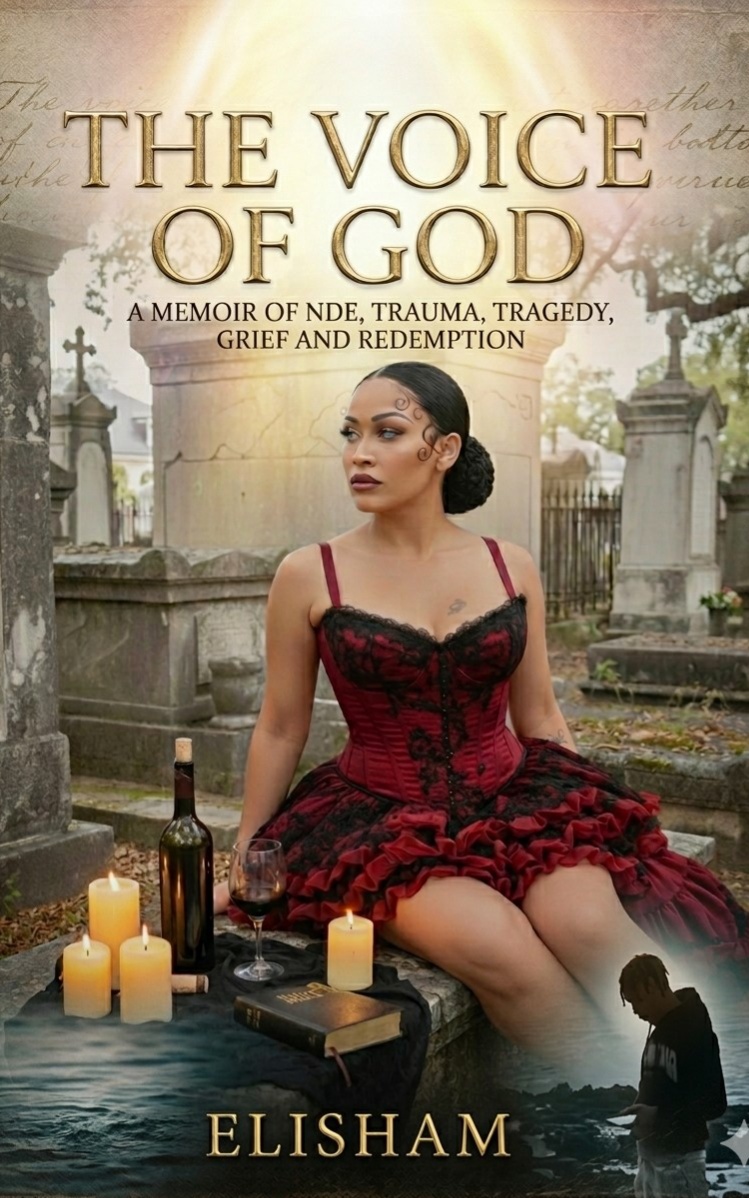
The voice of God
Finding the divine frequency in the depths of trauma, grief, and ultimate survival
by Kabela Elisham
How do you find God when your world has been underwater since you were six years old? Kabela Elisham’s life began in a storm. Born to a mother struggling with schizophrenia and a father lost to addiction, her childhood was defined by survival. At six, she survived a drowning attempt by her own mother; at fifteen, she survived the unthinkable horrors of human trafficking. Each trauma was a scar, each recovery a desperate search for a 'hit' of the divine that no drug or ritual could provide. Just as Kabela found sanctuary in the love of her husband and children, the unthinkable happened. The sudden, tragic loss of her nineteen-year-old son threatened to be the final blow that would break her spirit forever. In the raw, gut-wrenching silence of a hospital room and the crushing weight of a funeral, she felt completely forsaken. But it was in her darkest hour, standing by the rising tides of the ocean, that she finally heard it. Not a whisper, not a scripture, but a vibration—the true Voice of God. This is more than a memoir of tragedy; it is a profound journey through near-death experiences and deep grief to a realization that will change everything you know about spirituality. It is a testament to the resilience of the human soul and the unconditional love that carries us when we can no longer walk.
- Self-Help
- Biography
- Religion & Spirituality
- Parenting & Family
- Healing & Trauma
- Resilience & Grit
The Weight of the Water
I still feel the water sometimes. Not in a dream. In my body. A cold tightening in my chest when a room gets too quiet, when someone stands too close behind me, when the faucet runs too long. I am sitting somewhere warm and safe, and then suddenly I am six years old again, and the world is a blur of soap and silence and my mother's hands.
My mother was many things before she was sick. People who knew her before said she was beautiful, that she could light up a room. But by the time I arrived in this world, the sickness had already moved in like a tenant who never paid rent and refused to leave. Schizophrenia does not announce itself kindly. It dismantles a person from the inside out, quietly at first, then all at once. What was left of my mother by the time I was old enough to remember was someone I loved desperately and was terrified of in equal measure. That is a very particular kind of confusion for a child. To love the thing that hurts you. To reach for the hand that has already decided to let you go.
It was an ordinary morning, the way disasters usually are. Nothing about that day warned me. There was light coming through the window above the kitchen sink. I remember that. The kind of thin, gray light that doesn't commit to anything. I remember the smell, cheap bar soap, something floral and synthetic, the kind that dries out your skin and leaves a waxy residue on everything it touches. My mother was at the sink. She had been talking to something I could not see, which was not unusual. I had learned to move carefully around her moods the way you learn to walk around a sleeping dog, slow and deliberate, hoping not to disturb.
I don't know what shifted in her that morning. I never will. One moment I was standing near her, and the next, her hands were in my hair, and the water was coming up to meet my face. She was strong in the way that fear makes people strong. I did not understand what was happening fast enough to fight it. The cold hit me first, then the pressure against my skull, then the sound of everything above the waterline disappearing into a muffled roar. I opened my mouth and the water came in.
I want to stop here and tell you something important. What happened next is not something I have always known how to talk about. For years, I kept it locked in a place I didn't visit, because every time I got close to it, my body reacted like it was still there. But I am going to tell you now, because this book will not mean anything if I don't give you the truth of it.
The fighting stopped. Not because I gave up. It stopped because something shifted inside me, and I went somewhere else. I did not see a white tunnel or angels with wings the way people describe in movies. It was quieter than that. It was like stepping out of a room where the noise had been deafening and finding yourself in a hallway where everything was still. There was no pain. There was no cold. There was only this soft, enormous quiet, and somewhere inside that quiet, I did not feel alone. I felt, for the first time I could remember, like something was holding me. Not with hands. With presence. With something I had no language for at six years old but would spend the rest of my life chasing.
"When you pass through the waters, I will be with you." Isaiah 43:2. I did not know that scripture then. I would not find it until decades later, dog-eared in a Bible I carried through some of the worst years of my life. But when I read it the first time, I sat down on the floor and cried, because it was the only description that matched what I had felt in that sink. He was there. In the water. In the very thing that was meant to kill me.
I don't know how long I was under. Time does not work the same in those spaces. What I know is that someone intervened. A neighbor, a sound, something that broke through my mother's episode and brought her back to herself long enough for the hands to release. I came up gasping. The world crashed back in with sirens and cold air and the texture of wet cotton against my skin, and I remember crying so hard my whole body shook, but the strange thing, the thing that never made sense to me until I was much older, was that some part of me was grieving leaving that quiet place. Some part of me had felt something there that the living world had never offered me. Safety. Peace. A love without conditions.
They came and took me that day. Social workers with clipboards and careful voices. My mother was hospitalized. I was placed, eventually, in the first of many homes that would never quite be home. And I carried that experience in my chest like a stone, heavy and smooth and secret, for years.
The theologian Howard Thurman wrote, "Don't ask what the world needs. Ask what makes you come alive, and go do it. Because what the world needs is people who have come alive." I think about that now and I understand it differently than most people might. I came alive in a kitchen sink at six years old. Not because life was easy, but because something beyond life reached down into the water and touched me. That touch became the seed of everything that followed, though it would take decades and devastation before I understood that.
Children who experience early trauma carry it in ways that science is only beginning to understand. The body remembers what the mind tries to bury. That cold tightening in my chest I mentioned, that is not a metaphor. That is my nervous system keeping records. For years I thought something was wrong with me. I thought the way I moved through the world, always scanning, always half-expecting the floor to give way, was a defect. It took a long time to understand that it was survival. That my body had simply learned, very early, that the world was not safe, and it was doing its best to protect me.
But here is what I also know. Alongside that fear, there was something else. A knowing. A thread of something that I can only describe as divine awareness, planted in me the morning my mother held me under that water. I knew, even as a small child, that there was more. That what we see is not all there is. That somewhere beyond the cold and the noise and the hands that hurt, there was a love so vast it could hold a six-year-old girl in the moment of her dying and make her feel, briefly, like she had come home.
God does not promise us a life without water. He promises to be in it with us. I did not have the words for that then. I only had the feeling, and I spent the next thirty-something years trying to find my way back to it through every wrong door imaginable before I understood that it had never left me.
I want to speak directly to whoever is reading this and carrying their own earliest wound. Maybe yours did not happen in a kitchen. Maybe it happened in a bedroom, or a car, or in the silence of a house where no one ever hit you but no one ever truly saw you either. Trauma does not require a dramatic event to take root. Sometimes it is the absence of safety. The absence of being held. The absence of a mother who was present in her mind and not just her body.
Whatever your earliest wound is, I need you to hear this: it did not happen because you were unworthy of protection. It happened in a broken world, to a child who deserved better. And if there was even one moment, one breath, one strange and inexplicable sense of peace inside the chaos, I believe that was God. I believe He was there before you had a name for Him. Before you had a theology. Before you had anything except your small body and your will to keep breathing.
Psalm 22:10 says, "From birth I was cast on you; from my mother's womb you have been my God." Not from the moment I found faith. Not from the moment I cleaned up my life or built an altar or learned the right prayers. From birth. From before I knew anything. He was already there.
I spent a long time being angry at God for that morning. If He was there, why didn't He stop her hands faster? Why did any of it have to happen at all? I don't have a clean answer for that, and I am not going to pretend I do. But what I have come to believe, through everything that came after, is that the seed planted in that moment of near-death was the very thing that kept me alive through everything else. The certain knowledge, lodged somewhere below conscious thought, that I had been touched by something real. That I was not invisible. That even in the worst moment, I had not been entirely alone.
That is not a small thing. For a child who would spend the next decade being passed from home to home, who would learn to make herself small and quiet and easy, who would eventually run toward destruction just to feel something, that seed was the difference between surviving and not. I did not know it then. I know it now.
Before You Turn the Page
I want to ask you something, and I want you to sit with it before you answer. What is your earliest memory of feeling unsafe? Not the story you tell people at dinner, cleaned up and survivable. The real one. The one that lives in your body and not just your memory. Where were you? How old were you? And somewhere inside that memory, even if it is hard to find, was there a moment, however small, of something that felt like grace?
You do not have to have an answer right now. But I want you to start looking. Because healing does not begin in the present. It begins where the wound began. And that usually means going back further than we want to go.
There is an exercise I want you to try. Sit somewhere quiet and take out a piece of paper. Write a letter to your six-year-old self. Not a letter full of advice or wisdom. A letter of protection. Tell that child what you wish someone had said to you then. Tell them they were seen. Tell them they were not responsible for what the adults around them could not hold together. Tell them that the love they were searching for in all the wrong places was real, and it was coming, and they were going to make it.
Trauma can begin at the very first chapter of a life. But it is not the final word. The water does not get the last say. I am still here. And so are you.
A House Not a Home
The smell hit you first. Always the smell. Industrial floor cleaner with something artificial underneath it, like someone had tried to cover grief with citrus and failed. I every new placement, until my body adjusted and stopped noticing. That is what children do. We adjust. We stop noticing. We tuck the noticing somewhere deep and quiet and we kee…