

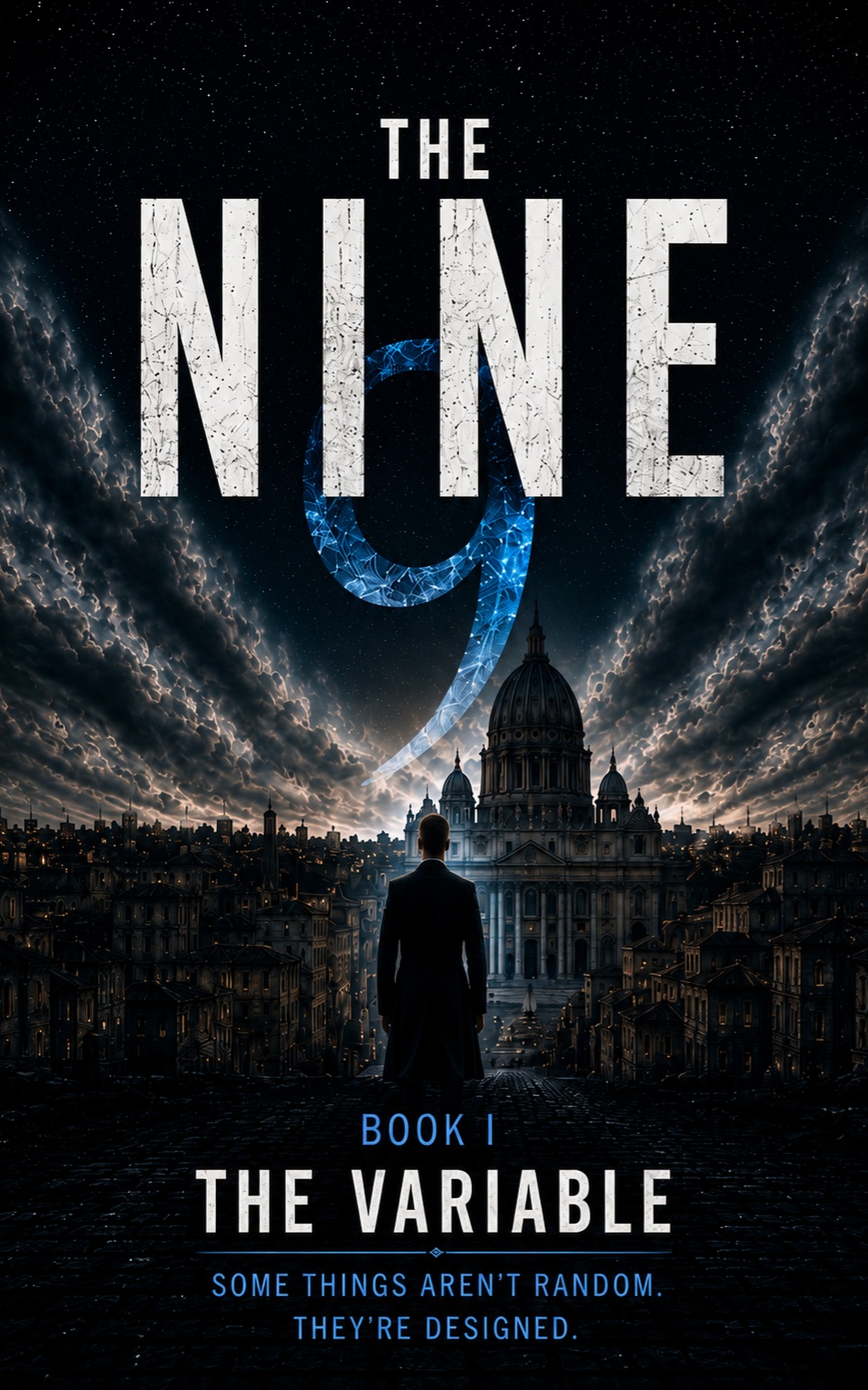
The NINE Book 1: The Variable
The system doesn't predict the future; it has been engineering it since 30 AD.
by John S. Muir
Adrian Voss is the best behavioral analyst at Sentinel Analytics, but he just found a pattern he wasn't supposed to see. Global populations are moving in perfect, eerie synchronization, positioning themselves for crises hours before they happen. As Adrian digs deeper, he uncovers a terrifying truth: a two-thousand-year-old institutional architecture managed by nine regional seats has been pulling the strings of history since the Roman Empire. His discovery comes at a devastating price. Within days, Adrian is stripped of his career, isolated from his sister, and threatened with the loss of his daughter. He finds himself caught in the crossfire of three warring factions—Stabilists, Accelerationists, and System Purists—each fighting for control of the global ledger. When the Nine turn their gaze toward him, Adrian realizes he isn't just investigating the system; he is being used to audit it. Now, he faces an impossible choice: attempt to expose a network that is the very fabric of civilization, or accept a life of high-level complicity to ensure his daughter's survival. In a world where every move is calculated, is freedom just another variable to be optimized? The NINE: The Variable is a cerebral conspiracy thriller that challenges everything you know about power, history, and the price of the status quo.
- Thriller
- Conspiracy Thriller
- Political Thriller
- Psychological Thriller
The Judean Ledger
The masonry exhaled the day’s heat in a dry, mineral radiation that tasted of pulverized lime and exhausted lungs. The air carried a metallic sharpness—copper, salt, and the vinegary, acrid tang of fresh ink—the flavor of a secret already beginning to oxidize on the parchment, a scent that Lucius found more comforting than the smell of the living city. Lucius Flavius pressed his palm against the calcified masonry, feeling the desert’s throat-dry fever vibrating through the grit like a slow, geological heartbeat. To Lucius, the wall was the first page of a ledger that would never be closed—a record of every life currently vibrating through the city’s dust. Through the narrow window, the Judean hills rose like a sun-bleached spine, indifferent to the empire carving its name into the valley below with the slow, grinding persistence of a glacier made of iron and ego.
The room was small, functional, and stripped of provincial inconsistency. A Roman table transported from Caesarea sat centered between two chairs, its wood scarred by the transit across the rocky terrain of the interior. A clay water pitcher stood by the open wall facing the courtyard, the condensation on its surface evaporating almost as quickly as it formed, leaving behind faint, white rings of salt. Outside, Jerusalem’s light was the color of bleached bone, a white-hot glare that turned the horizon into a serrated edge. Below, guards stood in positions they had maintained since morning, still beneath the descending heat. Their armor didn't shine; it glowed with a dull, suppressed fury, the bronze plates soaking up the sun until they became skin-searing brands against their tunics.
Lucius remained standing. He ignored the rhythmic, staccato pulse beneath his left eye, a family curse, his father had called it, the 'blinking of the scales.' It was a sharp, persistent twitch that blurred the edges of the room, a neurological protest against the infinite precision required of his station. To Lucius, it was simply the body’s rebellion against the weight of the work, a glitch in the very lens through which he audited the world. He was a soldier of the sequence, a man who understood that a misplaced decimal could kill more efficiently than a centurion's blade. His weapons were the stylus and the scroll; his battlefields were the margins of tax returns. In the quiet corners of administrative chambers, he knew the fate of millions was decided by a rounding error.
The man they had brought in earlier was being held in an adjacent room under guard. Lucius had seen him briefly during the transfer from temple custody—shorter than expected, with a frayed hem on his coarse tunic, hands bound but posture upright. He lacked the desperate, twitching energy of the zealots Lucius usually processed. There was no sweat on his brow, no frantic scanning of the exits. He was the sort of figure capable of disappearing into ordinary population flow anywhere in the province, a face that would be forgotten ten seconds after passing a merchant’s stall. Except he had not disappeared. That was the issue. He had become a node, a gathering point for the energy of the desperate, a human gravitational well pulling the fragments of a broken society into a new, unrecognizable shape.
Pontius Pilate entered without announcement, sandals scraping lightly against the grit-dusted stone. He crossed to the table, poured water into a cup, drank with a hurried, mechanical desperation, then remained beside the chair without sitting. Pilate’s face was a map of the province—dry, lined, and exhausted by the sheer friction of managing a population that refused to be still. His eyes were rimmed with the red dust of the hills, and his posture suggested a man holding up a roof that was perpetually on the verge of collapse. He did not look at Lucius; he looked through him, his eyes fixed on some invisible ledger of cost and consequence that only a Governor could see.
“The priests want him executed,” Pilate said, his voice flat with the boredom of a man who has heard too many demands for blood. “Publicly. Immediately. They claim he is a threat to the peace, though they are usually the ones making the most noise about the lack of it.”
Lucius felt the dry heat pulse in his temples. “Execution is a blunt instrument, Governor. We are not dealing with a riot; we are dealing with a structural defect. We should be discussing the calibration.” He watched a singular dust mote drift through a beam of white-hot light, suspended in the stagnant air—a tiny, floating speck that refused to settle. It was an irritant to his sense of order, a speck of chaos that required either a location or an erasure. “If we kill him poorly, we feed the fire. If we kill him correctly, we design the cage. The question isn't whether he dies, but what survives him.”
Pilate continued, ignoring the nuance as he always did when the pressure was mounting. “They’re calling it blasphemy. Temple violation. Religious instability. The usual laundry list of grievances they use when someone threatens their collection plates.” He looked toward the window briefly, squinting against the glare, before returning his attention to Lucius. “You reviewed the reports? From the Galilee and the northern districts?”
Lucius had reviewed all of them. The cracked wax of the regional seals served as a reminder of the debt the province couldn't settle. The demand for men and silver was a parasitic weight, an entry in a ledger that was already beginning to bleed red across the empire's balance sheet. He could taste the bankruptcy of his authority in the sharp, vinegary flatness of the sour wine sitting on the table—a thin, metallic fluid that did nothing to cut the desert’s grit in his throat. It was the taste of an administration that had run out of ideas and was down to its last few maneuvers.
Three years of regional surveillance reports and traveler accounts. It wasn't the jagged friction of a riot; it was a rhythmic, quiet pooling of people in the dust—a gathering that left the ledger clean but the authority hollow. It was movement without a center, resistance without a blade. Thousands of people sitting in a field, listening to a man talk about a kingdom that wasn't on any map Lucius had ever drafted. That was the danger. You could find a rebel with a sword. You couldn't find a man who was already living in another world while his body remained in yours.
“He is a structural defect,” Lucius said. He didn't look at the Governor; he looked at the wax tablet on the table, his stylus hovering over a list of names that felt like a casualty report for a war that hadn't officially started. “A hairline fracture in the foundation. If you leave an unrecorded weight in the masonry, the ceiling eventually finds the floor. This isn't about justice, Pilate. It’s about the ledger. We are correcting a clerical error before it destabilizes the sum. The system cannot account for him, therefore the system must remove him.”
Pilate’s expression remained still, a mask of Roman stoicism that was beginning to crack at the edges. “Explain.”
Lucius moved toward the table slowly, his gaze fixed on the floor to steady the muscle that threatened to jump again. “The province maintains stability through layered division. It is a masterpiece of friction. Temple authority against populist resentment. Pharisees against Sadducees. Tax collectors against zealots. Clean against unclean. Roman administration sits above all of it, acting as the grease that prevents the gears from seizing. The distinctions prevent consolidation. They keep the variables manageable. As long as they are fighting each other, they aren't fighting us.”
“And he threatens that.”
“He speaks across categories instead of inside them. He treats the tax collector and the leper as the same unit of value. He eats with the collaborator and the extremist at the same table. That isn't theology, Pilate; it's a systemic breach. He is dissolving the walls we spent a century building. If everyone is a neighbor, there are no more manageable factions. There is only a mass. And a mass is something we cannot govern.”
Pilate picked up the cup again but did not drink. He swirled the water, watching the vortex. “He’s a teacher,” Pilate countered, a flicker of Roman skepticism crossing his tired face. “The province is full of men who think they hear the gods whispering in the caves. Why does this one require the Governor’s signature? Why not let the priests handle their own theological sewage?”
“Teachers follow curricula,” Lucius said, his thumb pressing into the limestone of the wall until the skin went white. “This one creates a convergence. He is a magnet pulling the iron filings of their resentment into a single, sharp point. They see him as an alternative. Not an alternative government, which we could crush, but an alternative reality. If we do nothing, the filings become a blade. And that blade will be aimed at the heart of the administration.”
The room settled into a silence so absolute it felt like a draft of a final report—void of dissent, waiting for the ink to dry on a sentence that had already been decided in the abstract. Outside, one of the guards shifted position beneath the heat, the clank of bronze against bronze echoing up the stone walls like a funeral bell. Pilate placed the cup on the table without making a sound, the finality of the gesture echoing in the small space.
“Convergence points can be removed,” Pilate said softly.
“Yes.”
“Quietly. A midnight transfer to a fortress in the south. A cell with no window and no name. Let him rot until even his mother forgets his face.”
Lucius shook his head, his gaze fixed on the dust mote. “Quiet removal contains the event, but it does not control the aftermath. Disappearance creates a vacuum, and a vacuum is a space for myth. The followers would fragment around rumor—and rumor lacks boundaries. It can be anywhere. It can be everywhere. You would turn a man into a ghost, and you cannot crucify a ghost.”
Pilate waited, his brow furrowing as he grappled with the logic. He was a man of action, and the architecture of belief was a language he barely understood.
“Public execution creates boundaries,” Lucius continued, his voice dropping an octave. “It fixes the variable in time and space. It provides a coordinate for the grief. The heat doesn't just press; it occupies the room like a physical weight, drawing the moisture from my throat. We need to make the end of him so undeniable, so physically absolute, that the movement has nowhere to go but the structure we provide for it. We must show them that their alternative reality ends at the tip of a Roman nail.”
Below the window, a man crossed the courtyard with a bundle of warm flatbread. The scent of yeast drifted upward—thick, sweet, and aggressively human, a reminder of the biological needs that drove the city. The man’s progress across the stone wasn't the movement of a citizen, but a single caloric unit traversing a corridor of supply and demand. Lucius felt a weight press into his chest—not guilt, which was a luxury for those who didn't understand the machinery, but the airless, crushing pressure of the institutional bones. He was a single, load-bearing pillar holding up the ceiling of the world, and the world was getting heavier with every decision.
“You’re recommending crucifixion,” Pilate said, naming the horror with the clinical detachment of a physician.
“I’m recommending visibility. I'm recommending we turn him into an anchor. We need a landmark for the end of this nonsense.”
Pilate leaned back slightly in the chair, his eyes tracking the fly that had just entered. “The priests already want blood. They have been shouting for it since the sun came up.”
“They want enforcement. They want to be the ones who stopped the breach so they can maintain their own tenuous grip on the people. We let them have the blame, and we keep the architecture. We remain the administrators of the inevitable.”
The fly settled against the wall, its wings twitching. Lucius watched it briefly before continuing. “If he disappears quietly, the followers create their own versions afterward. Escape. Ascension. Secret survival. They’ll see him in every shadow. But a body on a hill? Under the midday sun? That is a fixed point. It requires a location. It requires a guard detail. It requires a burial report. We aren't just ending him, Pilate; we're filing him where he can be found. We are making him part of the record.”
“They’ll still mythologize him,” Pilate said, his voice tinged with a sudden, weary insight.
“Yes. But they will mythologize him within the context of Roman authority. The event becomes concrete enough that everything afterward must organize around it. We aren't ending the movement, Pilate. We are designing its cage. We are creating a history that we can curate, a narrative that we can edit when the time comes. We are turning a rebellion into a religion, and religions can be taxed. They can be codified. They can be managed.”
Lucius tasted the leaden, mineral flatness of the water—flat, tepid, and tasting of the lead pipes that fed the city's hierarchy. He considered the phrasing before answering. “It prevents clean consolidation. It keeps them focused on the hill, not the system. They will weep for the man and forget to hate the empire that broke him.”
Pilate looked toward the courtyard again. The guards had rotated now. New men, fresh from the barracks, yet they stepped into the same positions, held the same spears. The machinery of the empire never stopped; it only cycled, replacing its parts as they wore out. “What happens after the execution? What happens when the sun goes down?”
“The body is released. The tomb becomes known. It becomes a monument, a static point in a moving world.”
“And the movement? The thousands in the fields?”
Lucius looked toward the open window. Jerusalem continued moving beyond the administrative compound: vendors shouting, animals braying, water carriers staggering under their loads, prayer calls drifting through heat and stone. It was a cacophony of life, disorganized and dangerous. “The movement survives. But it survives as an institution. And institutions can be managed. They develop hierarchies. They create their own rules. They become predictable. We are trading a volatile variable for a stable one. We are trading a fire for a hearth.”
Pilate studied him carefully after that, a long, searching look that seemed to peel back Lucius’s skin to look at the gears beneath. “You’re speaking as though survival is acceptable. As though you want it to persist. Most men in your position would want total erasure.”
Lucius met his eyes, his vision clearing as the pulse beneath his skin finally stilled. The twitch had retreated, cowed by the clarity of the logic. “Suppression creates martyrs without structure. It creates an explosion that you cannot catch. Public process creates structure around the martyrdom. It creates a vessel for the energy. Rome is not a hammer, Governor. It is a mold. We pour the chaos into the shape we want, and we wait for it to harden. Once it is solid, it is harmless. It is just another part of the architecture.”
The fly lifted from the wall and disappeared back through the window, a tiny escape from the pressurized room. Pilate stood again, his mind made up. “If we proceed, it remains legal. Temple authorities make the accusation; Rome authorizes the sentence under provincial authority. The sequence must be perfect. No procedural gaps. No room for appeal.”
“It will be,” Lucius said, the words feeling like a heavy stone being rolled into place. “The city moves through routines older than anyone inside this chamber. We are simply adding a new entry to the ledger. One more name among millions.”
“The method?” Pilate asked, though he knew the answer.
“Crucifixion outside the walls. On the road where the merchants pass. Visible enough to discourage romanticism, yet central enough to become a coordinate. A man who vanishes is a ghost that haunts the mind. A man on a hill is an anchor that holds the mind in place. We are giving them a fixed point to revolve around while we manage the rotation.”
Pilate almost smiled at that—a grim, mirthless twitch of the lips. “It won’t discourage it. You know that as well as I do. It will only make them hungrier for the next world.”
“No. But it provides the coordinates. It turns their hunger into a ritual. And rituals are the easiest things in the world to govern.”
Pilate said nothing. The silence stretched long enough that the sounds outside the chamber became clearer: sandals against stone, distant livestock, wind moving dust through the lower streets with a dry, hissing sound. Finally, Pilate moved toward the doorway. “I’ll see him publicly. I’ll resist long enough that the process appears reluctant. I want the blood on their hands, not the record. I want history to say that Rome was the voice of reason.”
Lucius nodded once, a gesture of submission to the protocol. “As you say, Governor. I will prepare the documents for your signet.”
Pilate paused before leaving, his hand resting on the doorframe. “You’ve considered this carefully, Flavius. Almost too carefully. Is this about the province, or is it about the math? Are you trying to save Jerusalem, or are you just trying to balance your books?”
“It’s my responsibility to ensure the sum is correct,” Lucius replied, his voice devoid of emotion. “Nothing more. The survival of the province is merely the byproduct of the math. "Pilate left without another word. His footsteps faded down the corridor, a receding rhythm that left the room feeling larger and colder. Lucius remained alone inside the chamber while afternoon light shifted lower across the courtyard stones outside, turning the white bone of the light into a bruised, orange glow. In the adjacent room, the prisoner remained under guard, a silent variable waiting to be resolved. Below, the replacement detail settled into position, their spears gleaming in the dying sun. Somewhere deeper in the city, bread continued baking for evening meals already being prepared, the cycle of the living continuing unabated.
Lucius pressed his palm against the cooling masonry. The stone was a thief, swallowing the day’s evidence, absorbing the heat and the voices until only the silence remained. A damp, mineral chill seeped from the grain into his marrow, turning his joints stiff and slow. It smelled of scorched paper and the heavy, wet-soil scent of a grave being prepared before the occupant had even arrived. The silence in the room had a physical weight, a density that made it hard to draw a full breath. Each exhale hung in the stagnant air like a ghost, a faint mist of breath that blurred the edges of the ledger waiting for its final entry.
He looked down at his right hand. The tremor was gone, replaced by a cold, leaden stillness that felt like the earth itself. He had made the choice. He had architected the outcome. He had looked at the chaos and found the mold. Behind him, the room remained a cauterized space, the air already forgetting the man who had been its guest. Stone, silence, and the scent of cooling lime. The shadows lengthened across the floor like ink spills on a ledger, settling over a truth that had been edited into existence by the steady hand of a bureaucrat. Outside, Jerusalem continued toward evening, the first entry in a ledger that would never close. The cycle had begun, not with a roar of trumpets or the clash of steel, but with a clerical correction that would echo for two thousand years.
The Lagos Precedence
"Marcus Chen is using the 'P' word again." Robert didn't just stand there; he loomed, his shadow stretching across Adrian’s desk like a stain. He held the tablet like a live grenade, his white-knuckled grip leaving a greasy thumb-smudge that blurred the very divergence he was terrified to name. The screen’s blue light bled into the gray hollows of …