

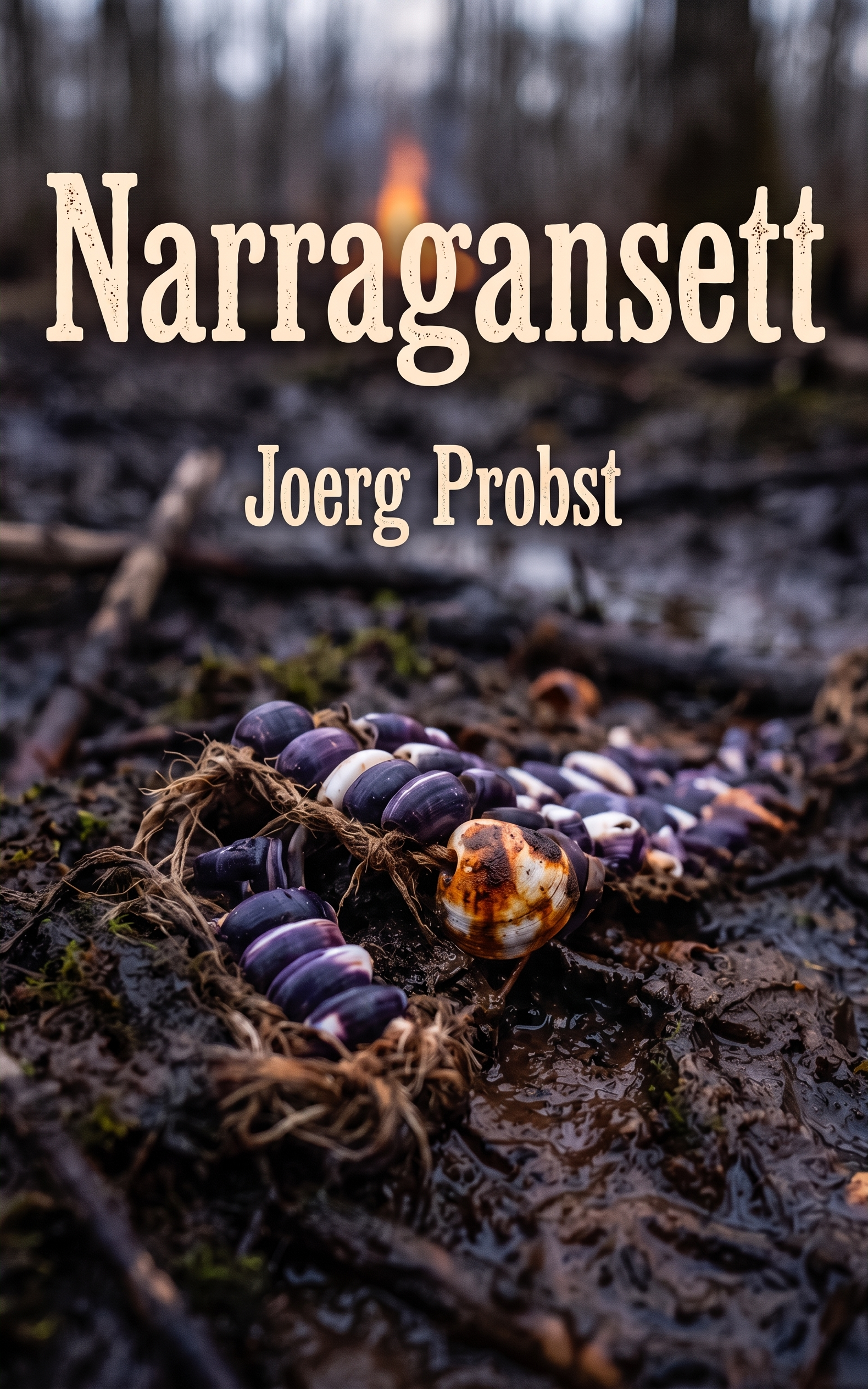
Narragansett
by Joerg Probst
New England, 1675: A fragile peace goes up in flames. While the settlers of the Plymouth Colony satisfy their hunger for land by fraudulent means, resistance grows among the Indigenous tribes. In the midst of this highly explosive powder keg stand two friends on different sides of history: Thomas Eldridge, a young settler, and Kachon, a warrior of the Narragansett. When corrupt governors destroy the Wampanoag's livelihood through deceitful contracts and the betrayal of the 'Praying Indian' John Sassamon shakes the colonies, the violence escalates into King Philip's War. Thomas is forced into the merciless militia, while Kachon is torn between loyalty to his people and the hope for peace. In the dark forests and bloody swamps of Rhode Island a vast historical panorama unfolds. Joerg Probst tells with impressive depth of the greed of the powerful and the struggle for survival of a culture. When the boundaries between right and wrong blur, only one question remains: Can a friendship outlast the downfall of an entire world? A gripping epic about the loss of innocence in a time when neutrality becomes a deadly verdict.
- Historical
- Adventure
- Native Americans
- Plymouth Colony
- Indigenious
- Indian Wars
Prologue - A New World
In the north, beyond the Great Lakes and along the rivers that wound like silver veins through the dark green of the firs, it was the French who were the first to set foot in this realm. They came not as conquerors with sword and plow, but as traders and Jesuits, whose eyes gleamed at the luster of furs and whose hearts were animated by the zeal to win souls for the true faith. In their light canoes, they glided up the St. Lawrence, erecting wooden forts that perched like lonely islands in an ocean of trees, and forging alliances with the Huron and Algonquin that were founded on trade and mutual benefit. The Jesuit fathers, in their black robes and with cross in hand, learned the languages of the natives, shared their fires, and preached of a God who loved the red man too. “We do not covet your soil, our brothers,” Father Marquette whispered in a gentle voice as he handed a chief a gleaming iron knife, clasping his hand with a gesture of paternal affection, “we seek only the salvation of your souls and the fair exchange of the forest’s gifts.” It was a policy of penetration, cunning and adaptable, which left the Indians their hunting grounds and, behind the sweet words of humility, ever sought the profit of the merchants and submission to the Cross. The wilderness remained wild, and the red men kept their freedom as long as the beaver pelts flowed and the prayers ascended.
Quite different was the conduct of the English, who landed on the rocky shores of New England. Animated by an insatiable hunger for land and settled order, they looked upon the endless forests not as a trading territory, but as a God-given possession merely waiting to be cleared, surveyed, and tilled. They came with wives and children, with Bibles and muskets, drove stakes into the damp forest floor, stripped the ancient bark from tree trunks for their fences, and cut deep furrows through the virgin earth with iron plowshares, firmly determined to enclose the vast wilderness step by step in the image of their distant homeland. In the Plymouth Colony, where the Pilgrim Fathers were stranded on the shores of Massachusetts Bay in the Year of our Lord 1620, this striving found its first, harsh expression. The men and women who stepped from the ship Mayflower were emaciated from the long crossing and the terrible winter that struck them like an iron fist. The snow covered the dead, and hunger gnawed at the living, while the surrounding forests were filled with the gazes of the native inhabitants, watching and waiting from the shadows of the trees.
It was Massasoit, the great sachem of the Wampanoag, whose campfires burned at the foot of Mount Hope, who extended the hand of friendship to the pale strangers. He was a man of majestic stature, whose face bore the scars of many winters and the wisdom of countless councils. His people, the Wampanoag, the People of the First Light, inhabited the fertile coasts and wooded hills of Pokanoket, and their power extended over numerous smaller tribes that obeyed the great council. Massasoit saw in the hungry newcomers no immediate threat, but desperate souls near death. With the generosity characteristic of the noble leaders of his people, he sent Squanto and other knowledgeable guides, who showed the pale ones how to plant corn, wrap beans around the stalks, and let squash grow in the spaces between. He taught them the deer trails and the places where the fish ascended the rivers in spring. Without this aid, the colony’s seed would have frozen in the harsh frost, and the names of the Pilgrim Fathers would have vanished into the annals of history like dust in the wind.
A pact was forged, an alliance of mutual respect, sealed with words of fidelity and gifts of friendship. The early governors of Plymouth, men like Bradford and Winslow the Elder, swore eternal bonds, and for decades this fragile union held. The Wampanoag and the English lived side by side, trading in furs and corn, and a cautious calm reigned in the council houses of Pokanoket and the meeting houses of Plymouth. Massasoit, who had granted life to the pale ones, saw them as guests on ancestral land, to be tolerated so long as they honored the old ways. But time passes like the river that never stands still, and with the aging of the great sachem, the foundation began to crumble. A new generation of settlers grew up, who no longer regarded the land as a gift from the indigenous people, but as property assigned to them by the Lord in heaven. Their eyes gleamed with covetousness when they beheld the fertile plains and rich forests, and they took up iron chains to survey the earth, as though it were a piece of cloth to be cut up and sold.
The tide of pale faces pressed relentlessly westward. Where hunters’ trails once ran, the axes of lumberjacks now rang out, and the smoke of settlements rose into the sky like dark pillars. The forests gave way to fields, and the shadows of sacred groves were severed by the straight lines of plows. The English brought with them their laws, written in books, dismissing the words of the red men as a breath of wind. Treaties were struck in which miles were measured not by the strides of ancestors, but by the nautical charts of mariners; and the Wampanoag, who trusted the generosity of their sachem, realized too late that the ground beneath their feet was slipping away. The gratitude of the fathers yielded to the arrogance of the sons, who preached in the meeting houses that the heathens served the Devil and that it was a divine duty to carry the light of civilization into the dark woods, cost what it may.
Amid this creeping alienation grew Massasoit’s son, Metacomet, whom the pale ones called Philip. He was still a youth when the first fractures became visible, and his dark eyes watched with mounting bitterness as the promises of fidelity crumbled to dust. He saw how the colony’s traders sold liquor to the young warriors to weaken them, and how the settlers enclosed the hunting grounds of his ancestors with fences. The original aid of the Wampanoag, which had granted survival to the strangers, proved to be the instrument of their own displacement. What had been granted out of generosity was now claimed as a right, and the surveying chains settled like iron snares around the heart of the land. Metacomet learned the language of the pale ones and their books, yet in his heart burned the fire of his ancestors, and he understood that the frontier had become a powder keg of greed and religious fanaticism.
In stark contrast to the French trading model, which left the red men a measure of autonomy, stood the British settler model as a death sentence for indigenous freedom. The French in the north trade and convert, but they do not displace; the English in the south, however, plant and possess, and where they plant, there is no longer room for the old ways. The Wampanoag, who had once viewed the land as a free gift of the spirits, now found themselves cornered between the encroaching sea of settlements and their own pride, which refused to bow. The councils of the elders still spoke of peace, but in the camps of the young warriors, voices whispered of vengeance, and the wind carried the scent of coming blood across the hills of Mount Hope.
Thus New England stood in the shadow of history, a land where the seed of friendship sprouted into thistles of enmity. The relentless tide of pale faces pressed onward, surveying the earth with iron chains and dispelling the shadows of the woods, while Metacomet, son of the great Massasoit, felt the wrath of his ancestors growing within him in the stillness of the nights. The frontier was no longer a place of peace, but a powder keg ready to erupt into flames at the slightest spark. And in the dark forests, where the owls called and the rivers murmured, the wilderness waited for the storm that was bound to come.
The years passed, and with every spring that melted the snow, new ships crossed the sea, laden with settlers whose eyes hungrily searched for land. The governors of the Plymouth Colony, successors to those who had once sworn the pact with Massasoit, now spoke of rights and possession, and their words were as sharp as the blades of their swords. The traders, once welcomed into the villages of the Wampanoag, now brought deception and injustice, exploiting the natives’ unfamiliarity with European measurements. Nautical miles instead of statute miles—thus did they rob the vast expanses that had been sacred to the ancestors; and the red men, who revered the earth as a living being, understood too late the cunning behind the parchments and seals.
Metacomet, who ascended his father’s seat following the death of the old sachem and the brief rule of his brother Wamsutta, felt the weight of generations upon his shoulders. He had witnessed the generosity of the fathers and the ingratitude of the sons, and in his heart matured the resolve that the time of forbearance had passed. The forests of Pokanoket echoed with the talks of warriors, and the drums of the councils beat more softly, yet with a suppressed power that remained hidden from the pale ones. The French in the north, with their forts and missions, offered a glimpse of how things might have been otherwise: trade instead of robbery, alliance instead of subjugation. But the English knew only one way, and their hunger for land was like the frost in winter—relentless and destructive.
Thus ended the era of mutual respect, and the seed of conflict was sown into the soil that had once been tilled jointly by the hands of the Wampanoag and the Pilgrims. The realization weighed heavily upon the land: the aid that had granted life to the strangers had become the means of their own destruction. And while the settlements grew and the bells of the meeting houses tolled, the wilderness waited for the day when the powder keg would be ignited, and the world that Massasoit had so wisely preserved would sink into blood and ashes.
In the long nights, when the moon stood over Mount Hope and the stars looked down like the eyes of the ancestors, Metacomet walked alone through the woods. He heard the whisper of the leaves and the roar of the sea, and in these sounds lay his father’s voice, exhorting him not to lose his pride. The pale ones measured the land with iron chains, but the heart of the forest could not be captured in miles. The spark had not yet fallen, yet the air was heavy with the approach of the thunderstorm, and the red men and the white stood facing one another like two wolves contending for the same bone. The history that had begun with the generosity of a sachem was about to unleash itself in a tempest of fire and steel, and the new masters of the land had no inkling of the terrible price their greed would demand.
The borders of the colonies expanded like the arms of an insatiable giant, and with every new treaty sealed in the halls of Plymouth, a piece of the Wampanoags’ freedom vanished. The young warriors who grew up under Metacomet learned the craft of the bow and the tomahawk, but also the deceptions of the pale ones. They saw how the Praying Indians—those who had embraced the strangers’ faith—stood between worlds, often serving as instruments of betrayal. The world that had once been a pantheon of nature transformed into a battlefield of souls, where religious fanaticism collided with the desperate struggle for survival of a displaced culture. And in this chasm opening between the peoples lay the seed of the war that would enter the annals as King Philip’s War—a conflagration that would consume the villages of the settlers and the camps of the indigenous alike.
Thus the New World stood on the edge of the abyss, and the shadows of the future fell long and dark across the hills of New England. The French in the north pursued their policy of commerce, while the English drove their plow deeper into the earth, indifferent to the blood sacrifices this plow might demand. Massasoit’s legacy, which had once been a beacon of hope, became a heritage of injustice, and his son Metacomet bore the burden of confronting this wrong. The wilderness held its breath, and the spirits of the ancestors waited for the call of the drums that was to proclaim the beginning of the end.
The Covenant in the Shadows
The mist hung like a heavy, damp sheet over the deep rocky valley, far from the watchful eyes of the Puritan sentries that rose like wooden quills along the border of the Plymouth Colony. It was a sultry morning in the summer of the year 1675, and the air carried the oppressive weight of an approaching storm, already announcing itself in the distan…