

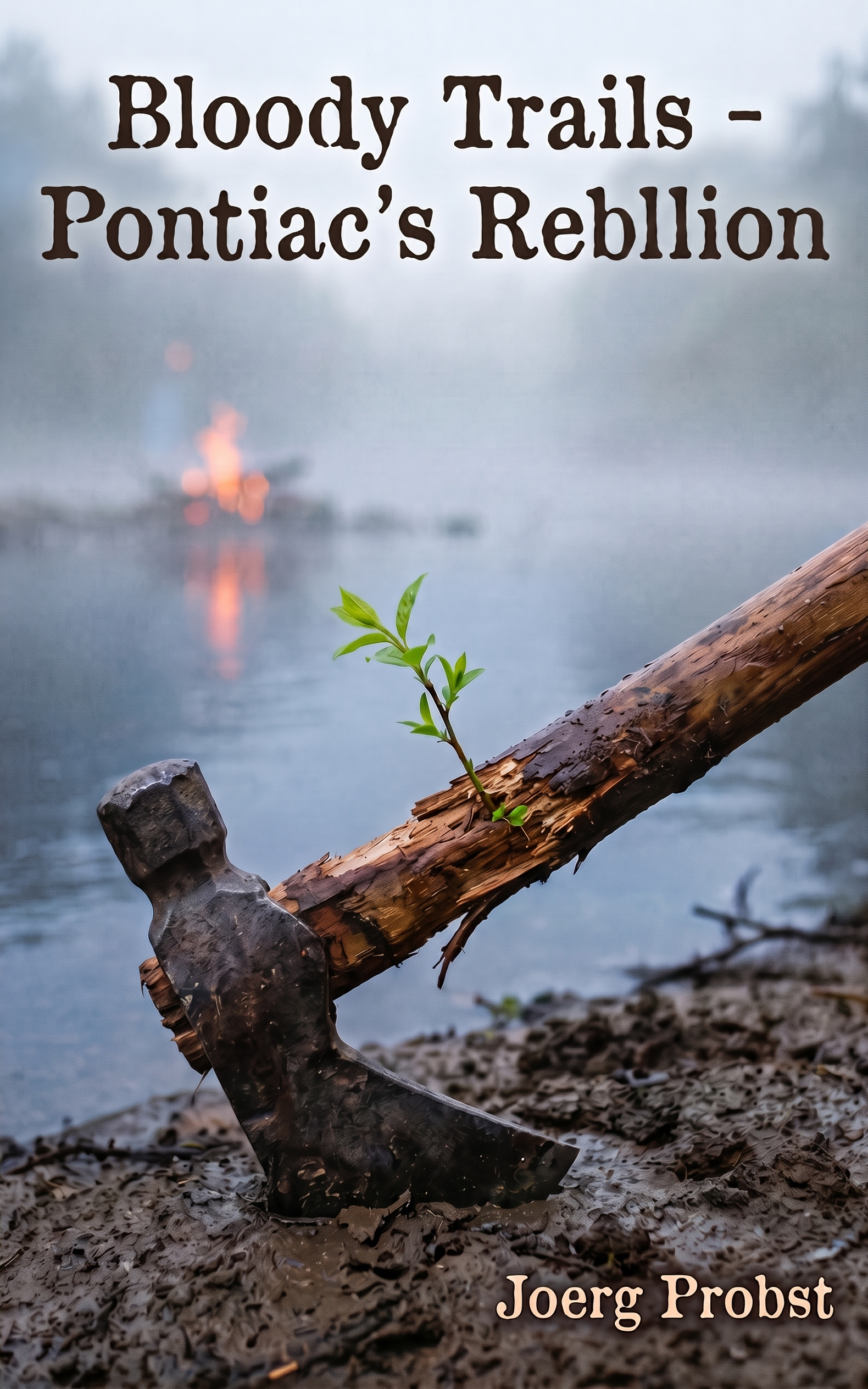
Bloody Trails - Pontiac's Rebellion
by Joerg Probst
North America, 1763: The Seven Years' War is over, yet on the frontier to the untamed West a new, far bloodier conflict smolders. Inspired by the visions of the prophet Neolin, the charismatic Ottawa chief Pontiac unites the tribes into a holy war against British supremacy. In the midst of this storm of violence, the peaceful Tygart Valley is visited by a cruel Seneca war party under the leadership of the merciless Sagonaska. Settlers are killed, houses burn, and the Harrington children Tom and Sarah are dragged deep into the impassable wildernesses on French Creek. The experienced woodsman Sam and his Indian blood brother Awan do not hesitate. Together with a band of loyal Shawnee warriors of the Wolf Clan and the old but experienced Frontiersman Mad Henry Hatfield they take up the dangerous pursuit. A merciless hunt begins through treacherous bogs and dense primeval forests, past the smoking wreckage of British forts. In a world where the boundaries between friend and foe blur, they must risk everything to save the children before the great war finally lays the land in rubble and ashes. Joerg Probst creates a gripping historical panorama of courage, loyalty, and the untamed soul of America.
- Historical Fiction
- Adventure
- Western
- Literary Fiction
- Frontier
- Wilderness
Prologue
It was a land that lived in the deep, undisturbed breath of an almost endless time. Long before the first European axe split the bark of a centuries-old oak or an iron plow broke open the virgin earth, the North American continent stretched out as an immense tapestry of ancient forests, rushing rivers, and unconquered mountain ridges.
Anyone who turned their gaze westward from the eastern cliffs was lost in a sheer endless, undulating sea of treetops. The primeval forests of the Northeast were of such gigantic stature and so dense a canopy that it was said a man could travel from the Atlantic coast to the muddy banks of the Mississippi without ever once leaving the dappled forest floor. It was a twilight, sacred realm beneath a canopy of giant beeches, elms, chestnuts, hemlocks, and monumental white pines whose crowns seemed to touch the sky itself. The ground was soft with centuries of decaying leaves, covered with a thick carpet of moss and ferns, and the air tasted sharp with damp earth and bitter resin.
This land overflowed with untamed life. In the rivers and streams that cut through the valleys like liquid silver, salmon and trout crowded so closely together in the spring that the water seemed to boil. Colonists would later report that one could catch the fish with bare hands or even cross the river on their slippery backs. Further west, where the forest slowly receded to make way for the endless grasslands, the deep rumble of millions of buffalo hooves rolled through the prairie like a constant, dull heartbeat. It was a world of absolute abundance, archaic, mighty, and of an untouched, almost terrifying beauty.
In this vast garden, deeply interwoven with its cycles, lived the people of the First Nations. They were not strangers in the wilderness, no mere element of the landscape, but its most finely tuned component. Over millennia, they had learned to read the secret language of the forest. They knew the whisper of the wind that heralded a change in the weather and understood the tracks of animals like an open book.
In the Northeast and around the Great Lakes, the tribes had formed proud, highly developed communities. The Algonquian peoples—among them the skilled Ottawa, the far-traveled Shawnee, and the wise Delaware, who were respectfully called the "Grandfathers"—moved with complete, silent grace through the dense underbrush. Their canoes of feather-light birchbark cut so cleanly through the dark waters of the lakes that scarcely a ripple betrayed their approach. Their villages typically consisted of dome-shaped wigwams or elongated houses, artfully covered with the bark of elms, which kept out the biting cold in winter and allowed the smoke of the hearth fires to gently escape in summer.
A little further east, in the valleys of what is now the state of New York, reigned the Haudenosaunee Confederacy, the Iroquois Confederacy—also called the Six Nations, as it consisted of six distinct, great tribes that stood loyal to one another. Their social structure was not a primitive tribal alliance, but a highly complex, democratic system founded upon the "Great Law of Peace"—a constitution rooted in respect, equality, and the voice of women, the Clan Mothers, and older than most kingdoms of the Old World.
These people did not see themselves as rulers or conquerors of nature, but as a part of it, equal to Brother Wolf and Sister Ash. Their faith was not walled into stone temples, but lived in every watercourse, every rock, and the nightly shine of the stars. They took from the land only what they needed to survive and asked the spirit of the deer for forgiveness before letting their arrow fly, grateful for the meat that would nourish their children. It was an era of absolute freedom, embedded in the endless, sacred green of a world that still belonged entirely to itself—unaware that soon, upon the eastern horizon, the sails of ships would appear that would forever forge the destiny of this continent and its inhabitants in blood, destruction, and conquest.
Yet the peace of the eternal forest was only borrowed. Ruin did not arrive all at once with the thunder of cannons, but with the distant, rhythmic strike of axes that ate like an insidious poison into the green heart of the continent, with treaties on worthless paper, and with diseases that wiped out entire clans.
With the white sails billowing along the coasts, a completely new world order landed on the shores of America—a world driven by property, borders, and an insatiable hunger for land.
For the First Nations, the familiar paradise turned into a nightmare within a few generations. It began with the invisible spirits of death. Diseases that Europeans brought across the ocean in their clothes and breath—smallpox, measles, influenza—left behind nothing in the villages but paralyzed still lifes of decay. Against these foreign plagues, the medicine men had no herbs, the spirits no counsel. Behind the silent walls of the dwellings, the hearths grew cold, and entire settlements suddenly lay deserted. The weeping in the longhouses often fell silent only because no one was left alive to mourn the dead.
With the survivors came a new, creeping form of slavery: dependency. The strangers brought things that seemingly made life easier, but corrupted the spirit. The earthen pot gave way to the iron kettle, the painstakingly carved bow to the deadly musket. Suddenly, indigenous men no longer hunted solely to feed their families, but to satisfy the insatiable fur hunger of distant European monarchs. Whoever wished to survive in the forest or defend themselves against their neighbors needed the white man's powder and lead balls, as game retreated ever further due to the influx of settlers.
And then there was the firewater. The high-proof alcohol—rum, whiskey, and brandy—that traders rolled into the forests by the barrel acted like poison on the warriors' souls. Where measured words once fell in council, cheap alcohol now sowed discord, violence, and the creeping loss of ancient dignity. The sacred balance of creation tipped as the forest was degraded into a mere commodity. Many a hunter woke in the morning with a headache, only to realize that the previous night's liquor had cost him all of his winter furs.
At the same time, it quickly became apparent to the tribes that the pale faces did not speak with one voice. There were two completely different philosophies seeking to divide the land between them, and they split the loyalties of the indigenous peoples as well.
In the north and along the great lakes and waterways of the west moved the French. Their presence was like a fine net cast over the land without suffocating it. The French came as traders, as fur trappers—the coureurs des bois—and as Jesuit fathers in black robes. They built fortified trading posts and proselytized, but they did not clear forests on a grand scale. They adapted to the Indians' way of life. French men married indigenous women, learned the tribes' languages, and smoked the calumet, the sacred pipe, around council fires. When they proselytized, they often attempted to weave the Christian faith with the traditions of the tribes. For the indigenous peoples of the Northeast, the French were indeed foreigners, but they were partners who respected their living space and traded furs for valuable goods.
The British, however, and the Dutch before them, behaved quite differently. They did not come to trade like the French; they came to stay. From the east pressed an unstoppable avalanche of settlers, Puritan families, and farmers who saw the forest as a dark, devilish place that had to be conquered. Wherever a Briton set foot, the forest fell. They fenced in the land, built stone houses, and declared the soil, which no one had owned for millennia, to be their exclusive property. For the tribes, the British advance meant total displacement.
This irreconcilable conflict finally erupted in southern New England into an initial, apocalyptic purgatory: King Philip's War of 1675 to 1676. Metacomet, called King Philip by the English, the chief of the Wampanoag, saw his people slowly suffocating under the relentless British land grab and legal arbitrariness. In a desperate act of resistance, he forged an alliance of tribes and engulfed the English settlements in a brutal guerrilla war. Villages burned; the soil drank the blood of settlers and warriors alike. Yet the British response was of a brutal, disciplined relentlessness. They used rival tribes as auxiliary troops, starved out the insurgents, and systematically slaughtered Metacomet's people and their suspected allies. In the end, Metacomet was betrayed, shot, and drawn and quartered. His head was displayed on a pole in Plymouth for over twenty years—a macabre monument for any Native who dared stand in the way of British expansion.
The blood of this war burned deep into the memory of the First Nations and fueled only more distrust. It became a sorrowful certainty for the tribes of the Northeast and the Ohio Valley: if the British won, it meant the death of their culture and the loss of their homeland. The French, on the other hand, were the shield holding back the British tide in the east. And so it was no coincidence, but sheer survival calculation, that the warriors of the Ottawa, Huron, Delaware, and many other peoples turned their gaze to the north and stood ready to defend the fleur-de-lis banners of the French king against the British lion. A storm was gathering on the horizon, and the forest held its breath, ready for the great war of the white kings to be fought on the backs of the red peoples.
The rivalry between the two European powers, on the other hand, was like a smoldering fire that crept for decades through the aristocratic undergrowth of the Old World, only to erupt as a devastating inferno in the forests of America. Four times within seventy years, the continent was set ablaze. For every time the royal houses in Madrid, Paris, or London quarreled over successions, alliances, and the colonial balance of power in Europe, the frontier forests across the Atlantic caught fire as well. What began in distant Europe as a cabinet war with powdered wigs and strategic troop movements became, from the valleys of the Ohio across the Great Lakes to the Saint Lawrence River, a cruel, bloody war in rugged terrain.
It began with King William's War at the end of the seventeenth century, the distant echo of the War of the Grand Alliance. For nine years, French-indigenous war parties raided and burned the fortified outposts of New England, while British expeditions hurled themselves in vain against the fortress of Québec. Scarcely had the ashes of this war cooled when Queen Anne's War followed, the American offshoot of the War of the Spanish Succession. It was an era of bloody dawn raids. The Deerfield Massacre burned deep into the English memory when French-Canadian troops and their Indian allies surprised an entire settlement in its sleep in the dead of winter and marched hundreds off into captivity through ice and snow on a long trek back. When the Treaty of Utrecht was signed, the French had to cede Acadia, but the hatred in the borderlands remained unquenched. Half a century later came King George's War, sparked by the War of the Austrian Succession. Once more blood flowed into the rivers, once more New Englanders besieged the massive French sea fortress of Louisbourg and captured it, only to watch the Crown in London casually return the strategic outpost to Paris at the peace settlement in exchange for distant Madras in India—a betrayal that stoked the fury of the colonists and settlers against the British Crown.
Yet all these conflicts were merely the preludes to the fourth and final tempest: the French and Indian War, which broke out in 1754 in the dense forests of the Ohio Valley and would engulf the entire civilized world two years later as the Seven Years' War. Battles were fought from North America across the Caribbean, Europe, Africa, all the way to India. This time, however, the world fire was not ignited in Europe; the spark jumped in the American backcountry, where the territorial power claims of the British clashed with the French line of forts in the Ohio Valley. A young, still inexperienced militia officer named George Washington gave the first fateful order to fire deep in the woods at Jumonville Glen.
There followed a war of epic, murderous brutality. The early years belonged to the French and their faithful indigenous allies, who decimated the lumbering British columns marching in red coats under General Braddock in 1755 at the Monongahela River in a devastating hail of bullets.
The next setbacks were the fall of Fort Oswego in 1756 and the massacre of Fort William Henry the following year. The Indian warriors fought for their homeland, the French for their trading empire. But the tide turned when William Pitt took the helm in London. He poured immense sums of gold into the conflict and threw an overwhelming superiority of regular troops and warships into the scales. Successes came swiftly. In late 1758, Fort Duquesne, the key French position in the Ohio Valley, fell to the Forbes Expedition. The following year, the most important fortresses fell one after another: Frontenac, Niagara, Machault, Le Boeuf, and finally, after a daring nighttime ascent up the cliffs, proud Québec on the Plains of Abraham.
When French forces finally laid down their arms in Montreal in September 1760 and withdrew from North America, they left behind a dangerous vacuum. For the allied indigenous peoples, the departure of their French fathers was a political and existential catastrophe. Suddenly, there were no longer two powers to play off against each other. The British were now the sole masters—and they dropped the mask of friendship immediately.
The new British commander-in-chief, General Jeffrey Amherst, deeply despised the Native people. He viewed them not as sovereign allies, but as conquered subjects. Arrogantly, he eliminated the traditional gifts—powder, lead, blankets, and rum—that had been presented at the annual council gatherings as signs of respect and rent for the land. Without gunpowder, however, the tribes could neither hunt nor feed their families. At the same time, scarcely had the French cannons fallen silent when thousands of illegal British settlers pressed across the Appalachians, cutting swathes through the hunting grounds of the Delaware and Shawnee and building their farms on the sacred ground of the Cherokee. A sense of powerlessness and simmering rage settled over the forests.
In this darkest hour of need, a voice arose from the mists of the spiritual realm in the land of the Delaware. A man named Neolin, known as the Prophet, stepped before the council fires. He recounted a vision in which the Master of Life, Kitchi Manitou, had appeared to him. Neolin's message was radical, a religious awakening amid decay. He proclaimed that the misery of the red people was punishment for having strayed from the paths of their ancestors and embracing the poisons of the white men. Neolin preached asceticism and repentance. He called upon the tribes to refuse European gunpowder, to pour alcohol into the rivers, to burn clothing made of English cloth, and to return to hunting with bow and stone axe. Only if they detached themselves completely from the whites and returned to their pure, ancient traditions would the Master of Life grant them the strength to drive the invaders into the ocean. "Why," Neolin called out with an invoking, trembling voice to the circle of silent elders, "do you tolerate the pale faces upon your earth? They have paralyzed your souls with sweet poison and cut through your hunting grounds with fences. Cast their clothes into the fire, pour their burning drink into the mud, and take up the weapons of your fathers once more!" Neolin's words spread like wildfire, carried by traveling messengers through the endless forests. They gave desperate souls a purpose—yet at their core, they were a call for spiritual purification, not for an organized military campaign.
It took a man of action, a strategist of cool intellect and burning charisma, to forge this religious fervor into a military weapon. Pontiac, a war chief of the Ottawa, heard Neolin's prophecy, but he interpreted it differently. Where the Prophet saw withdrawal, Pontiac saw theological justification for a total, holy war. He understood that the tribes would perish if they fought alone, as Metacomet once had. The only salvation lay in an absolute, unprecedented alliance of all red peoples. With an eloquence that echoed through the longhouses like rolling thunder, Pontiac traveled from tribe to tribe. "The Prophet speaks of turning back, and he speaks the truth!" Pontiac cried, driving a heavy tomahawk into the wooden post so hard that chips flew. "Yet the Master of Life does not only demand that we purify our spirit. He demands that we wash the red path clean with the blood of our enemies! If we do not clench together like the fingers of a single, strong fist, the flood of the English will break us one by one and sweep us away like dry leaves in an autumn gale." He used the deep humiliation inflicted by Amherst and the fear of British settlers to forge an alliance such as history had never seen.
They all followed him: not only his own Ottawa, but the Ojibwe, the Potawatomi, the Wyandot from the north. His messengers, carrying red war belts of wampum, rode deep into the South into the Ohio country, and the battle-hardened Shawnee, the relentless Delaware, the Mingo, and the Miami reached for their tomahawks. Even clans of the distant Illinois and tribes reaching to the borders of Kentucky swore the oath. Warriors who had fought one another for generations now sat around the same fire, painting their faces with the black of war and the red of blood. It was a force coordinating in secret across thousands of miles, while British officers in their isolated forts believed the red savages were definitively subdued.
By early May 1763, the web was woven. Nature was in the full sap of spring when Pontiac struck the first blow. His objective was Fort Detroit, the mightiest British outpost in the West. On May 7, Pontiac appeared before the gates of the fort with sixty chosen warriors. Concealed beneath their blankets, they carried muskets and war clubs, prepared to slaughter the garrison from within during a seemingly peaceful council meeting, while outside hundreds of warriors waited in the tall grass for the signal. Pontiac looked at his men and whispered with grim determination: "Keep the weapons hidden beneath your blankets until I turn the wampum belt with the green side facing up. Let no one hesitate; let no one show mercy. Today we take back what is ours."
The plan was perfect, the ruse devilish—yet when Pontiac passed the palisades and looked into the eyes of the British commander, he found himself facing a line of primed muskets and drawn sabers. A squaw from his own tribe had betrayed him. The commander took a step forward, hand on the hilt of his sword, and said in an icy voice: "We know why you are here, Pontiac. Your blankets do not hide your intentions. Turn back while you are still breathing." But the spark had already been struck. Pontiac withdrew; the element of surprise was lost, yet the hatred was too great to turn back. On May 9, 1763, the first war cry of the Ottawa pierced the forests of Detroit, and the siege began. It was the signal for one of the greatest uprisings in the history of the Indigenous peoples in North America. The storm that was to make the entire continent tremble had definitively broken loose.
The Prophet's Vision
It was in the sweltering summer of the year 1758 when, with the fall of Fort Frontenac, the first decisive blow against Bourbon power was struck in the rugged wilderness of North America. And when, in the late autumn of the same year, the flag of His Britannic Majesty was raised over the smoking ruins of Fort Duquesne as well, that leaden tension l…