

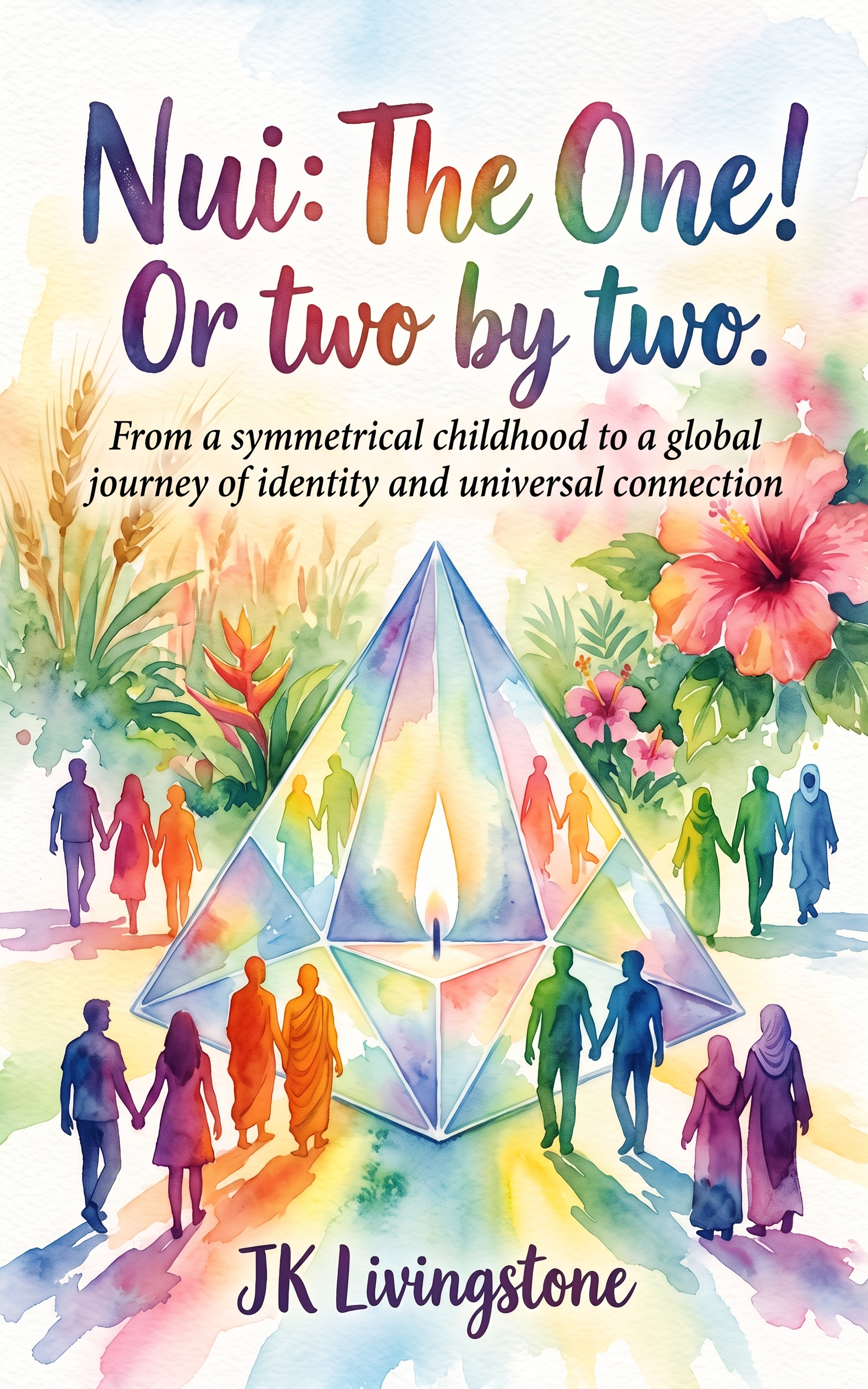
Nui: The One! Or two by two.
From a symmetrical childhood to a global journey of identity and universal connection
by JK Livingstone
Nui Hennessey grew up in a world of perfect balance. In her small Midwestern town, her school was a living mosaic—a 'two by two' harmony of faiths, ethnicities, and cultures that felt as natural as breathing. But as Nui steps out of this curated sanctuary and into the vibrant, chaotic theaters of London, Africa, and Hawaii, the symmetry shatters. Frequently finding herself as 'the one', the lone white woman in spaces rich with diverse heritage. Nui must navigate the complexities of belonging. Her journey takes her from the regal dance studios of London to the healing shores of Hawaii, where she confronts deep-seated tensions and the true meaning of 'Howlie.' However, the greatest shock comes from home; a revelation that her idyllic childhood was actually a government-funded social experiment. Faced with a crumbling past and an uncertain future, Nui must weave together the fragments of her global experiences. Through the loss of a soulmate and the birth of her son, she discovers a new philosophy of 'Rainbow Health 11.' In a quest that spans continents and decades, Nui searches for the key to a lost heritage, ultimately finding that we are all passengers on a modern day Noah’s Ark, sailing toward a future where every 'one' belongs.
- Literary Fiction
- Young Adult
- Romance
- Mystery
- Multicultural
- Generational Saga
The Symmetrical School
She was born and raised in a small Midwestern town where it felt like everyone was pearly white until closer inspection. The streets stretched out under a wide, pale sky, lined with tidy houses and manicured lawns that seemed to whisper of quiet uniformity. Yet, this place was actually part of a very spread out small town where there was a household from diverse countries and many different religions. Christianity was a regular religion being part of "God Bless America," but even that was filled with diverse sects, including Catholics, Methodists, Protestants, Evangelicals, and some others. It was a quiet tapestry, woven so tightly that the edges only became visible when one knew exactly where to look.
Her mother, Merritt Hennessey, loved to explain these delicate divisions while folding laundry or tending to the garden. Merritt, with her soft, rounded features and silver-blonde hair kept in a neat, sensible bob, found comfort in the order of things. She would smooth out a floral sheet and speak of the neighbors with a gentle, domestic reverence. "We all have our places under the sun, Nui," Merritt would say, her voice smelling faintly of lavender and starch. "The Miller family down the road, they go to the Methodist church, and the O'Briens are devout Catholics. It is all part of the same grand design, a big family representing all of the people's desires for a proud, free, and brave future. We simply assist each other's best interests." Nui would listen, her young mind absorbing the idea that their town was a carefully structured sanctuary where every belief had a matching partner, balanced perfectly against the next.
When young Nui walked into her elementary school classroom each morning, that sense of structured harmony became a physical reality. The school did not feel like a chaotic gathering of children; instead, it felt like a carefully curated gallery, or perhaps a modern storybook ark. Inside these brick walls, diversity was not a random occurrence but a rigid law of physics, an orchestrated symmetry that made Nui feel incredibly safe. The children were all excellently schooled and their English was always pure, yet they seemed to exist in precise pairs. There were two Buddhists, two Muslims, two Catholics, and two of every distinct ethnicity. It was a living "two by two" design, a beautiful, quiet balance where no one was ever left to stand completely alone.
Nui would sit at her wooden desk and observe her classmates with quiet, hazel eyes. She watched the subtle differences between the families' eyes, hair, and shades that changed less with the seasons, noticing them only when their young minds were not filled with all of the concept higher thinking of solving the world's problems and developing successful societies by preparing for what lay ahead. She saw how the sunlight from the tall classroom windows caught the rich, dark curls of the two Lebanese siblings, and how it reflected off the straight, glossy black hair of the two Japanese classmates. In the desk next to her sat the two Lutheran children, their fair skin mirroring each other like identical teacups. Everything had a counterpart. The world, it seemed, was designed with a natural, comforting duplicate for every single soul.
Mrs. Gable, who lived just down the road and often kept an eye on the neighborhood children, represented the older, more stubborn roots of the town. She was a tiny, bird-like woman who wore heavy wool sweaters even when the Midwestern humidity began to climb, and she carried an old-fashioned skeleton key on a faded ribbon around her neck. To Mrs. Gable, the town’s heritage was something to be guarded fiercely with fences and strict boundaries, rather than blended. "We had an order here once, real and true," Mrs. Gable would mutter, her sharp eyes scanning the playground as if looking for any deviation from the past. "A garden needs a fence, girl, not just a dream. You have to know who is who, and where everyone belongs." But Nui, with the naive optimism of youth, only saw the beauty in the classroom's perfect symmetry, believing that Mrs. Gable’s rigid views were simply a different kind of balance.
Yet, as the school year progressed, a subtle, quiet realization began to take root in Nui’s mind. She would watch the playground games during recess, observing how the pairs naturally gravitated toward each other, sharing unspoken understandings through similar home lives and shared heritages. The two Buddhist children shared stories of their family temple visits; the two Muslim children sat together during lunch, their families bound by the same dietary traditions. They were beautifully matched, living examples of the yin-yang harmony she was beginning to adore. But when Nui looked at her own reflection in the hallway mirror, or when she joined the circle for reading time, she noticed a quiet, unsettling truth. While the school was a brilliant melting pot of diverse cultures, Nui herself did not seem to have a direct, identical pair in her specific social circle. She was just Nui, a singular observer watching the perfect pairs move in unison around her.
This realization did not bring her sadness, but rather a profound sense of curiosity. She was the one who watched, the one who appreciated the contrast between chocolate and vanilla, the beauty of oppositional tones and beliefs working in absolute coordination. She loved the idea of a world where different cultures joined beautifully, much like the characters in the stories her mother read to her. She would sit on the school steps, watching her classmates interact with a practiced, excellent schooling that successfully masked any underlying friction. Their voices rose in a melodic, collective song, as lovely as babbling streams and rivers, all speaking the same pure English but carrying the rich, silent history of their ancestors in the quiet spaces between their words.
Nui’s teacher, a woman who spoke with the crisp, clear cadence of the Heartland, constantly emphasized the importance of preparing for the future and understanding our role in a global society. "To be a good citizen," the teacher would say, her voice echoing off the chalkboards, "is to understand how we all fit together. We must learn to coordinate our lives so that we can all thrive." Nui took these lessons to heart, aligning them with her favorite childhood song, "Jesus loves the little children," which inspired her to see the sacred value in every single face, regardless of their origin. She imagined the entire planet as a giant version of her classroom, a grand, sweeping ark where every culture, every religion, and every shade of skin was preserved and valued, moving forward two by two into a bright, hopeful future.
As the bell rang to signal the end of the day, Nui gathered her books, her mind spinning with dreams of the vast universe outside her small town. She walked out to the waiting school bus, her heart light and full of wonder. She knew she was different, a singular thread in this highly structured tapestry, but she felt an overwhelming happiness just to be a part of it. The symmetrical school had given her a foundation of peace, a belief that no matter how large or diverse the world might be, there would always be a place of perfect balance waiting to be discovered.
Chocolate and Vanilla
The transition from the symmetrical classrooms of her childhood to the dusty floorboards of the physical theater studio felt like stepping into a larger, more vibrant version of the same great design. Nui was still young when she was accepted into the prestigious group, a place where the air always smelled of ancient beeswax, damp stage curtains, a…