

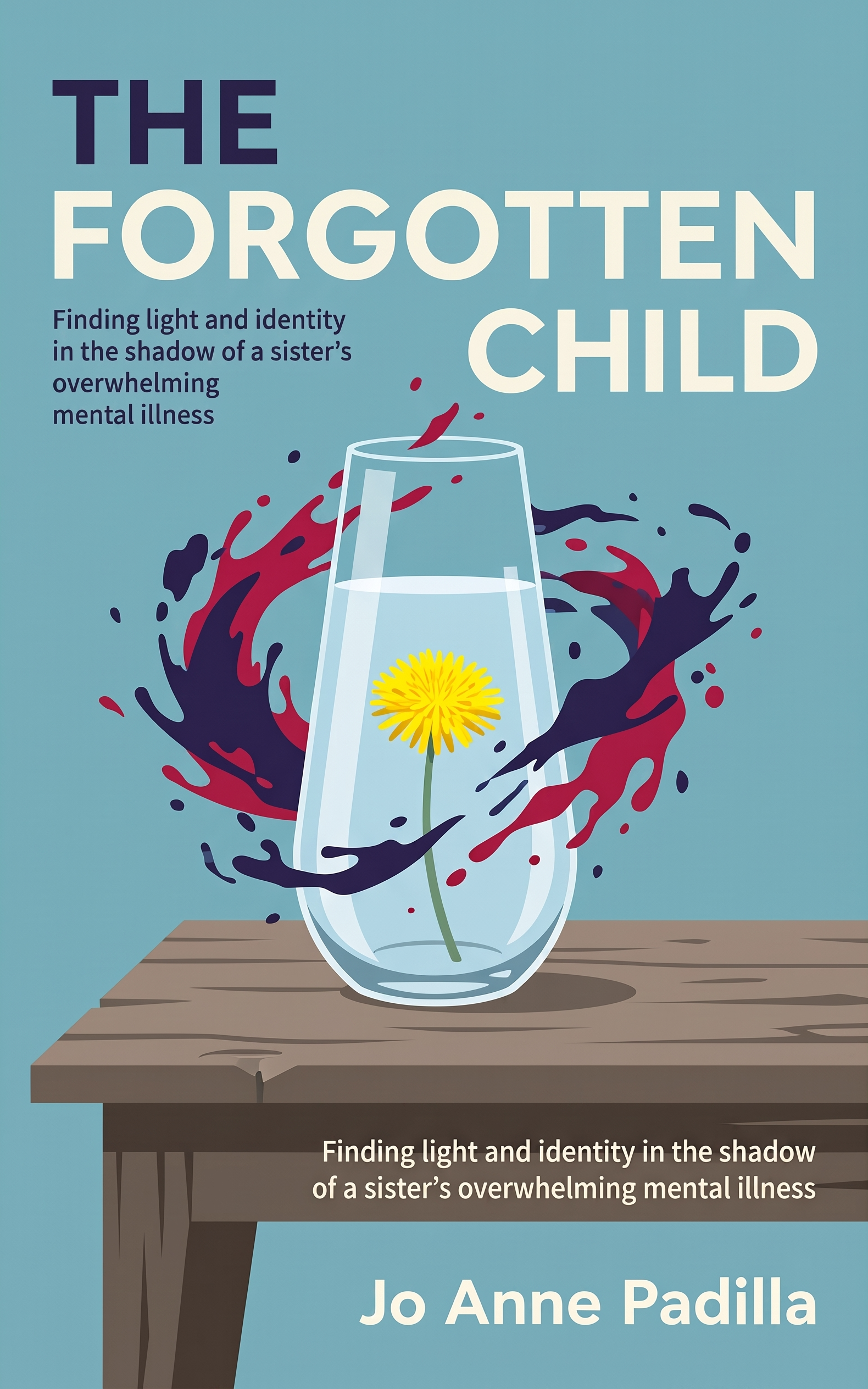
THE FORGOTTEN CHILD
Finding light and identity in the shadow of a sister's overwhelming mental illness
by Jesus Padilla
In a house filled with tension, Nicolette Varga is the invisible daughter. Her entire life is defined by the transparency required to accommodate her older sister Sloane’s violent battles with severe bipolar disorder. Learning to cook her own meals at eight and dialing emergency services in secret, Nicolette quickly becomes a surrogate caregiver in a home ruled by chaos. As the years pass, Nicolette navigates the heavy burden of family duty while fighting to build a life of her own. When she meets Thomas, a steady man who offers her unconditional care, she gets a rare glimpse of what it means to be seen. But breaking free from generational drama is never simple, especially when sudden crises pull her back into the storm. Spanning decades, The Forgotten Child is a deeply moving coming-of-age story about grief, resilience, and the difficult journey of self-discovery. Jo Anne Padilla delivers an unforgettable narrative about breaking free from the past and reclaiming your own identity after years of surviving in the background.
- Young Adult
- Literary Fiction
- Coming of Age
- Family Drama
- Grief & Loss
- Character Study
The Wrong Kind of Hero
The house was always quietest right before it broke apart. I was eight years old, sitting on the cold linoleum of the hallway floor, pushing a small plastic button across the worn pattern to see how far it would slide. My mom and my dad had gone out to run errands, leaving me alone with my sister Sloane again. They called her moods a rough patch, or said she was just being sensitive, but I knew the truth. When the house got this still, it meant the storm had already landed. It smelled like copper and the heavy air that comes right before a thunderclap, thick enough to make your throat hurt if you swallowed too fast.
I listened to her footsteps moving behind her closed door. They were fast and uneven, dragging across the carpet, then stopping dead. Then came the noise from the bathroom. It wasn't a scream or a cry. It was a sharp, wet scraping sound, followed by the heavy thump of something knocking against the porcelain sink. I stood up, my knees stiff, and walked down the short corridor. The air felt cold against my skin. I didn't want to look, but my feet kept moving because in our home, ignoring things never made them disappear.
The bathroom door was cracked open just an inch. I pushed it with the tip of my finger, letting the light spill inside. Sloane was slumped on the tiles next to the tub, her hair hanging in greasy, jagged dark clumps around her face. She was holding a thin piece of metal she must have pried off a razor, dragging it across her left wrist with a strange, methodical pressure. The air in the tiny room was warm and thick with the heavy smell of iron. Red drops were pooling on the pale yellow floor, splashing against the base of the toilet.
I froze in the doorway, my heart hitting my ribs like a trapped bird. "Sloane?" I whispered. My voice sounded tiny, like it belonged to someone else entirely.
She didn't look up at me. She just made another quick, jagged stroke, her breathing coming in short, ragged gasps. Her eyes were bright and dark all at once, staring down at her own skin like she was trying to cut her way out of something inside her. She looked terrifying, but she also looked small, like she was drowning in a deep well and didn't care who saw her sink.
At school, the teachers had handed out little paper pamphlets during safety week. They told us that if someone was hurt, or if there was a real fire, you go straight to the telephone and dial three numbers. They said the people on the other end were helpers who would come right away and save the day. I didn't know what else to do. My mom wasn't there to make a cup of tea or smooth things over, and my dad wasn't there to yell at the walls until everyone went to their rooms. It was just me, the blood on the tile, and the heavy sound of my sister bleeding into the silence.
I ran to the kitchen, my socks slipping on the hallway wood. I grabbed the heavy black receiver off the wall, my hand shaking so hard I dropped it twice before I could punch the numbers in. Nine. One. One.
The lady on the line had a smooth, calm voice that sounded like it came from a completely different world. A world where people didn't bleed on bathroom floors on a Tuesday afternoon. I tried to speak clearly, the way the school pamphlets told us to, but the words came out rushed and scrambled. "My sister is hurt," I told her, clutching the plastic receiver against my ear. "She's cutting herself in the bathroom. There's a lot of blood."
The calm voice told me to stay on the line, said help was already on the way. I stood in the kitchen, watching the clock on the wall tick down the seconds, listening to the soft, rhythmic drips coming from down the hall. I thought I was doing the right thing. I thought this was how you saved someone you were supposed to love.
Within minutes, the quiet of our neighborhood was ripped open by the sound of rising wails. Red and blue lights flashed through the front window, painting the living room walls in violent, shifting colors. I heard heavy boots on the front porch, and then the front door was pushed open. Two paramedics rushed inside carrying heavy black bags. They moved fast, their thick rubber soles loud against the floorboards, asking me where she was. I pointed toward the bathroom, my thumb tucked tight into my fist.
They found her on the floor and immediately went to work, wrapping white gauze tight around her arms, talking to her in firm, low voices. Sloane started to scream then, a high, wild sound like an animal caught in a trap. She kicked out at them, thrashing her legs, shouting terrible things that made my ears burn. The paramedics didn't get angry. They just held her wrists firmly and said they had to take her to the hospital right now. They talked about the psychiatric unit, using big words that sounded sharp and heavy in our small house.
That was when the front door slammed open again, vibrating all the way through the floorboards. My father walked in.
He stood in the entryway, his massive frame blocking the light from the open door. He smelled like sawdust, fresh sweat, and cold coffee. His face was fixed in a hard, stone line, his heavy brow pulled down so low his eyes looked like dark slits. He looked at the flashing lights outside, then at the paramedics holding his eldest daughter on the bathroom floor, and finally at me, standing shrink-wrapped against the hallway wall.
He didn't ask if Sloane was okay. He didn't ask what had happened. He stepped straight into the center of the room, his presence filling up every inch of space until the paramedics seemed to shrink against the walls.
Aris Varga didn't like outsiders. He didn't like people looking into our windows or telling us how to live. He crossed his thick arms over his chest and spoke in a low, gravelly voice that carried a weight no one in that room could argue with. He told the men that it was all just a misunderstanding, a minor household accident with some broken glass. He said my sister was fine, that she was just emotional and dramatic, the way young girls get sometimes. He stood over them, granite-hard and unyielding, until the paramedics began to hesitate, looking between his stern face and Sloane, who was suddenly quiet, cowering under the shadow of his authority.
He talked to them in that steady, immovable tone until they started packing their gear back into their black bags. They looked uneasy, but my father gave them no room to push back. He signed a piece of paper on a clipboard, his handwriting thick and heavy, and escorted them right out the door. Just like that, the men who were supposed to save us were walking back down the walkway, leaving us alone in the dark house again.
The sirens faded down the street, taking the red and blue lights with them. The silence came back, heavier now, thick with a dark, suffocating weight.
Sloane was sent to her room, her arms wrapped in fresh white bandages that my father pulled tight without saying a word. She slammed her door shut, the latch clicking into place like a lock on a cage. Then my father turned around and looked at me.
He didn't say my name. He just jerked his chin toward the front door, stepping out onto the wooden porch. I followed him because you didn't disobey my dad when his jaw was set like that. The evening air was cold, stinging my cheeks as I stood by the railing, wrapping my small arms around my stomach.
He stood at the top of the steps, looking out over the quiet street, his back turned to me. "What did you think you were doing?" he asked. His voice wasn't loud, but it cut through the air like a blade.
I swallowed hard, my knuckles white against my dirty sneakers. "She was hurt, Dad. She was bleeding everywhere. They said at school to call nine-one-one when someone's hurt."
He turned around slowly, his heavy boots echoing on the porch boards. He stared down at me, his eyes cold and dark, devoid of any warmth or comfort. "We take care of our own," he said, leaning down so his face was close to mine. "We don't bring the whole neighborhood into our house. We don't air our laundry for strangers to see. You brought shame on this family tonight, girl. You brought sirens to our door."
I looked up at him, waiting for him to ask if I was scared. I waited for him to hold my hand, or tell me that I had been brave for trying to help my sister when she was bleeding on the floor. But there was nothing like that in his face. There was only anger, a deep, bitter resentment that I had broken the rules of the house.
He pointed a calloused finger straight at my chest. "You betrayed this house," he whispered, each word dropping like a stone. "Don't you ever do something like that again. You go inside, you lock your door, and you keep your mouth shut. We don't need your help."
He walked past me, pulling the front door open and stepping inside, leaving me standing alone on the dark porch. The cold wind blew against my hair, pushing it across my face. I stood there for a long time, listening to the quiet neighborhood, watching the empty street where the rescue lights had been just moments before. I realized then that in our home, doing the right thing was just another way to get punished. I wasn't the daughter who got saved, and I wasn't the daughter who got comforted. I was just the villain who brought the outside world into our private darkness.
The Geometry of Silence
The morning brought a heavy, static calm that hung low in the corners of the house. At eight years old, I had already learned how to read our home like a barometer, watching the way the shadows fell across the linoleum and measuring the pressure in the air before I even took a step out of bed. It was thick and heavy today, smelling faintly of old d…