

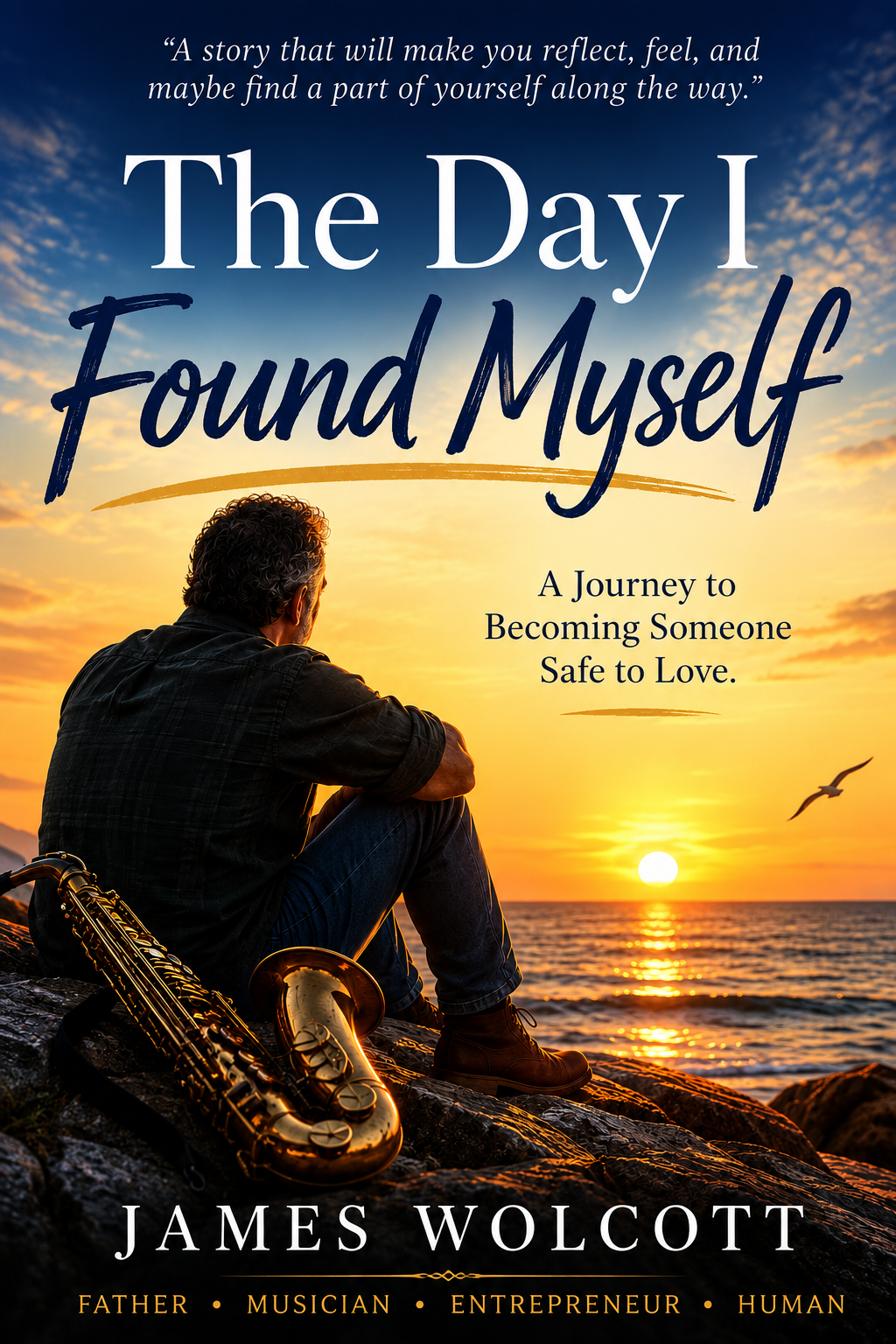
The Day I Found Myself
After losing the love of his life James realizes he is not the man he thought he was. AfWhat is needed to allow him to be safe to love.
by James Wolcott
For sixty years, Jim Wolcott was the 'good guy.' A successful professional, a generous friend, and a steady partner—or so he believed. But when his partner, Heidi, walks out the door, the silence left behind is deafening. Sitting alone in an empty house, Jim is forced to confront a devastating truth: the man in the mirror is a stranger. In this raw and transformative memoir, Wolcott peels back the layers of a life built on emotional avoidance. From the fractured roots of his childhood adoption to the quiet collapse of a thirty-two-year marriage, he explores how passive aggression and perfectionism became his armor against intimacy. This isn't just a story of loss; it's a rigorous guide to emotional intelligence and personal accountability. Through the lens of his own recovery, Wolcott provides readers with the tools to interrupt defensive patterns, understand the nervous system, and practice love without possession. He moves beyond the shame of infidelity and divorce to find something far more lasting: emotional safety. Whether you are navigating a life transition or seeking to break cycles of generational trauma, this book offers a roadmap to recognizing, respecting, and finally liking the person looking back at you.
- Biography
- Self-Help
- Overcoming Adversity
- Emotional Intelligence
- Relationships & Communication
- Life Transitions
The Boy Who Didn't Know His Name
I didn't know I was adopted until I was eight years old, and even then, I didn't really know what it meant. My parents sat me down one afternoon in our kitchen in a small town outside Seattle, and they told me in the gentle, careful way that parents do when they've rehearsed something a hundred times in their heads. They told me I was special, that they had chosen me, that I was wanted more than most children are wanted. I remember nodding. I remember not understanding a single thing about what had just happened to me. I went back outside and kept playing, because that's what five-year-olds do. But something in me shifted that day, even if I couldn't name it. A small crack had opened, and it would take me almost six decades to understand what had fallen through it.
I want to be honest about something right at the start of this book: I had a good childhood. My parents were kind people. They gave me a home, a bike, a dog, birthdays with cake, all the things a kid is supposed to have. This isn't a chapter about neglect or abuse. It's something quieter than that, and in some ways harder to talk about, because there's no villain in it. There's just a boy who grew up with a question mark where other kids had a straight line. Other kids knew where they came from. They looked in the mirror and saw their father's nose or their mother's eyes staring back. I looked in the mirror and saw a stranger. Not a bad stranger. Just someone whose story I didn't have access to.
That's the part people don't talk about enough when it comes to adoption. It's not always about being unwanted. For me, it was about being unmapped. I didn't know what illnesses ran in my blood. I didn't know if I had brothers or sisters somewhere eating breakfast on a Tuesday morning, unaware I existed. I didn't know if I looked like anyone, laughed like anyone, carried some old family joke in my bones without knowing where it came from. Every other kid I knew had a place they belonged to before they were even born. I had a blank page, and blank pages, no matter how much love gets written on them later, still start out blank.
Growing Up With a Question Mark
As I got older, the question mark didn't go away. If anything, it got heavier. In elementary school, when kids traded stories about grandparents and cousins, I'd nod along and make something up in my head just to have an answer ready. Not lies exactly, more like guesses dressed up as facts. I told myself stories about who my birth parents might have been. Sometimes I imagined they were young and scared and had no choice. Sometimes, on harder days, I imagined they just didn't want me, and I'd sit with that feeling until it passed, the way you sit with a stomachache, waiting for it to be over.
I never talked about this much with my adoptive parents. Looking back, I think that was partly because of how our family communicated, which is a subject I'll get into more in the next chapter, and partly because I didn't have the language for what I was feeling. How do you tell the people who raised you and loved you that you feel like you're missing a piece of yourself? It felt disloyal. It felt like admitting that what they gave me wasn't enough, even though it had nothing to do with them and everything to do with a hole that existed before they ever came into the picture.
So I did what a lot of us do with feelings we don't know how to hold. I put it away. I built a life on top of it. I got good grades, made friends, played sports, did all the things a well-adjusted kid does, and for the most part, I was well-adjusted. But underneath all of it, there was this quiet hum, a low frequency of not quite belonging, and it followed me into adulthood without my ever really noticing it was there. I didn't know that hum was shaping how I loved people, how I trusted people, how I decided who was safe and who wasn't. I just thought it was normal to feel like a guest in your own life.
The Search Begins
It took me until my thirties to start looking for my biological mother. I want to say I did it out of some deep emotional need, some crying-in-the-shower moment of realization, but honestly, it started more practically than that. I had kids of my own by then, and every time we filled out a medical form at the pediatrician's office, there'd be that question: family history of heart disease, diabetes, cancer. And every time, I'd have to write "unknown." It bothered me more than I expected. I wasn't just missing my own history anymore. I was missing theirs too.
Back then, before the internet made everything searchable in an afternoon, finding a birth parent was slow and bureaucratic. Washington State, where I was born, had its own rules about sealed records, and I had to go through an intermediary, a woman who worked for an adoption search service, who would contact my birth mother on my behalf to see if she was open to being found. I remember filling out the paperwork and feeling like I was applying for something, like there was a test I might fail. I remember thinking, what if she says no? What if the answer is simply no, I don't want to be found?
Weeks went by. I checked the mail like a teenager waiting on a college acceptance letter. When the call finally came, the woman on the phone told me my birth mother had agreed to make contact. I hung up the phone and sat in my car in my own driveway for probably twenty minutes before I could bring myself to go inside. I didn't cry, exactly. It was more like my whole chest had gone hollow, in a good way and a terrifying way at the same time.
Washington
We agreed to meet in person, in Washington, not far from where I was born. I flew up alone. I remember rehearsing what I would say the entire flight, and then forgetting all of it the second I saw her standing there. She was smaller than I imagined. Older, obviously, but there was something in the shape of her face that hit me immediately, a kind of recognition I hadn't expected because I'd spent thirty-some years assuming I wouldn't recognize anything about her at all.
We hugged, a little stiffly, the way two people hug when they don't yet know if hugging is even the right thing to do. We sat down at a small restaurant, and for the first hour or so, the conversation moved carefully, the way you'd walk across a frozen pond you weren't sure would hold your weight. She told me about her life. She told me the circumstances of my birth, which I won't go into detail on here out of respect for her privacy, but I'll say this: it wasn't the dramatic story I had built up in my head over the years. It was simpler and sadder than that, the kind of story that happens to a lot of young women in a lot of decades, where circumstances and timing and a lack of options collide, and a decision gets made that changes two lives forever.
I watched her face as she talked, looking for myself in it. I found pieces. The way she held her coffee cup. A gesture with her hand when she was searching for a word. It's a strange thing, being an adult and meeting your biological mother for the first time and doing the same thing a five-year-old does when he's told he's adopted: quietly gathering evidence of where you come from, because some part of you has been starving for it your whole life without knowing it.
By the end of that first meeting, I didn't feel like I had found a mother. That's an important distinction I want to make clear, because I think a lot of people assume that's how these reunions work, like something out of a movie where the missing piece finally clicks into place and the music swells. It wasn't like that. What I found was a person. A kind, complicated, real person who happened to be connected to me by biology and by one of the most significant events of both our lives, but who was, in almost every other way, a stranger. We didn't have thirty years of shared history. We didn't have inside jokes or arguments about who left the milk out. We had one afternoon in a restaurant in Washington and a lifetime of distance behind us.
Christmas Cards and Birthday Emails
After that first meeting, our relationship settled into something I've come to think of as the space between rejection and acceptance. It wasn't nothing, but it wasn't everything either. We started sending Christmas cards. Nothing elaborate, just a signature and a short note, "Hope you're doing well, thinking of you this season." Later, when email became the easier way to stay in touch, it turned into birthday messages, a few lines once a year, sometimes a photo attached.
For a long time, I didn't know what to make of this. Some years, I'd get frustrated. I'd think, is this it? Is this all I get? A card in December and an email in July? I wanted more, or at least I told myself I did. I wanted the kind of relationship you see in reunion stories on the news, where the birth parent and the found child become close, where there are family dinners and inside jokes eventually built from scratch. But that's not what we had, and for years I read that as a kind of soft rejection, a polite distance she was keeping because she didn't really want me in her life the way I wanted to be wanted.
It took me a long time, honestly not until I was much older and doing the kind of self-reflection that this whole book is about, to understand that I had it wrong. It wasn't rejection. It also wasn't full acceptance, the kind where you fold someone completely into your daily life. It was something else entirely, something in between, and I think that in-between space is more honest than either extreme. She had a life that had gone on for decades without me in it. She had grieved and moved past a decision made under different circumstances, at a different age, and I had shown up decades later as a grown man asking, in a sense, to be let back in. Of course that wasn't going to look like a mother embracing a returning child. It was always going to look like two adults, cautiously, respectfully, building something small and careful out of the wreckage of something that could have been so much bigger.
I've made peace with the Christmas cards. I look forward to them now. I don't measure them against some imagined version of what we should have. They are what they are: a thread, thin but real, connecting two people who share blood and history but not much else. And I've come to believe that thread matters, even if it's thin. It doesn't have to be thick to be real.
Identity Is Not Just Biology
Here's the lesson that took me the better part of my life to learn, and it's the reason this chapter comes first in this book, before the divorce, before Heidi, before any of the collapse and rebuilding that makes up the rest of these pages. I spent so many years believing that my identity was somehow locked inside a biological connection I didn't have access to. I thought if I could just find my birth mother, find the missing information, find the blood relatives, I would finally know who I was. I thought identity was like a key you either had or didn't have, and I was walking around without one, fumbling at a locked door my whole life.
What I learned, slowly and imperfectly, is that identity doesn't work like that. Meeting my birth mother didn't hand me a fully formed sense of self. It gave me information, some context, a few answers to questions that had nagged at me for years. But the man I had become by that point, the father, the husband, the business owner, the friend, the guy who showed up for people, that man wasn't built from her DNA. He was built from thirty years of choices, of mistakes, of people who showed up for me and people who didn't, of every ordinary Tuesday I lived through long before I ever sat across from her in that restaurant in Washington.
Identity, I've come to believe, is built the way a house is built. Biology gives you the plot of land. It tells you where you're standing. But the house itself, the rooms you live in, the walls you lean against, the roof that keeps the rain off you, that gets built by everything that happens after. My adoptive parents built rooms in that house. My kids built rooms in it. My marriage built rooms in it, some of them, I'd later learn, built on shaky foundations I hadn't examined closely enough. My birth mother gave me the land the house sits on. That matters. It's not nothing. But it's not the whole house either, and for most of my life, I confused the two.
This matters for anyone reading this who has felt like an outsider in their own story, whether through adoption or estrangement or simply growing up in a family where they never quite felt like they fit. The temptation is to believe that somewhere out there is a piece of information, a person, a connection that will finally make you whole. I understand that temptation because I lived inside it for decades. But wholeness doesn't come from a discovery. It comes from a decision, made over and over, to build something real with what you actually have in front of you.
I also learned something about the space between rejection and acceptance that I think applies far beyond adoption stories. So much of life gets lived in that middle ground, and we're terrible at tolerating it. We want clean answers. We want to know if someone loves us or doesn't, if we belong or don't, if the door is open or closed. But most relationships, especially the complicated ones, live in the hallway between those two rooms. My relationship with my birth mother taught me how to stand in that hallway without panicking, without needing to force the situation into a category it didn't fit. That skill, it turns out, would matter a great deal later in my life, in ways I couldn't have predicted back when I was just a kid in Washington reading a Christmas card and trying to decide what it meant.
What I Understand Now
Looking back on all of this from where I sit now, in my sixties, having gone through a divorce and a collapse and a slow, difficult rebuilding of who I actually am, I understand the adoption story differently than I did even ten years ago. Back then, I thought the goal was resolution. I thought if I just gathered enough facts, met enough people, sent enough Christmas cards back and forth, I would eventually arrive at a settled feeling about where I came from. I don't think that's how it works anymore.
What I understand now is that identity was never something waiting to be found in a folder of adoption records or a face across a restaurant table. It was something I was building the entire time, whether I realized it or not, through every choice I made about how to treat people, how to show up, how to love, and eventually, how to fail at loving well and try again. My birth mother gave me a beginning. She didn't give me a self. That, I had to build, and honestly, I'm still building it, which is really the whole point of this book.
I also understand now that the in-between relationship I have with her, not rejection, not full acceptance, is actually a kind of gift, even though it didn't feel like one for a long time. It taught me early, without my knowing it, that not every relationship has to resolve into a clean category to still have value. Some of the most important connections in our lives live in that uncertain middle space, and learning to stay in that space without demanding it become something else is one of the most useful emotional skills I've ever developed. I just didn't know I was developing it at the time.
Questions for the Man in the Mirror
- Is there a part of your identity you've always assumed depended on someone else's approval or presence, whether a parent, a partner, or a family member?
- Have you ever confused "not fully accepted" with "rejected," when the truth was somewhere in between?
- What foundational story from your childhood have you never fully examined, simply because it felt too big or too uncomfortable to look at directly?
- Where in your life are you still waiting for someone else to hand you a sense of who you are, instead of building it yourself?
- If you could sit across the table from the version of yourself who first felt like an outsider, what would you want that person to know?
A Small Step Forward
Here's a simple exercise I wish someone had given me decades ago. Take a blank sheet of paper and draw a rough house on it, nothing fancy, just an outline with a foundation, walls, and a roof. Label the foundation with the things you didn't choose: your biology, your birth circumstances, your family of origin, the parts of your story that were decided before you had any say in them. Then, in the walls and rooms, start writing the things you did choose, or the things you still have the power to choose: the values you live by, the people you've let close, the ways you've grown, the habits you're still working on. Sit with that image for a few minutes. Notice how much of the house is actually yours to build, even if the foundation was poured by someone else a long time ago.
The House That Taught Me Love
People assume that if a house is quiet, it must be peaceful. I grew up believing that too, and it took me the better part of sixty years to understand how wrong that assumption was. My parents' house wasn't loud. There was no yelling, no slammed doors, no dramatic scenes you'd see in a movie about a difficult childhood. What there was, instead, was…