


Whispers in Asunción
An ancestral secret hidden in the beams of a colonial mansion beneath the storm
by Ignacio Bogaz
Asunción, 1778. While a fierce storm punishes the walls of the governor’s mansion, the cracks of destiny begin to open. María Ignacia lives trapped between the walls of her own home and the suffocating expectations of her father, who intends to give her hand to don Rodrigo de Alvarenga, a man twice her age. In the solitude of her chamber, only her secret diary and the silent complicity of the servants offer her a respite from an imposed marriage that she rejects with every fibre of her being. But the true danger does not reside only in the drawing rooms of high society. When lightning cracks a master beam of the main corridor, the repair reveals something that should never have come to light. Among shadowy corridors, the whispers of maids and the roar of thunder, Fernanda, the housekeeper, will unearth a mystery that threatens to shake the foundations of the Álvarez de Toledo family. Will María Ignacia find her freedom before the secrets of the past consume her completely? Ignacio Bogaz immerses us in a vibrant period novel in which passion, betrayal and suspense intertwine in the damp gloom of colonial Paraguay.
- Historical Fiction
- Romance
- Thriller
- Historical Romance
- Forbidden Love
- Domestic Thriller
Chapter I: The Rain Before the Storm
- Asunción del Paraguay, in the year of our Lord 1778
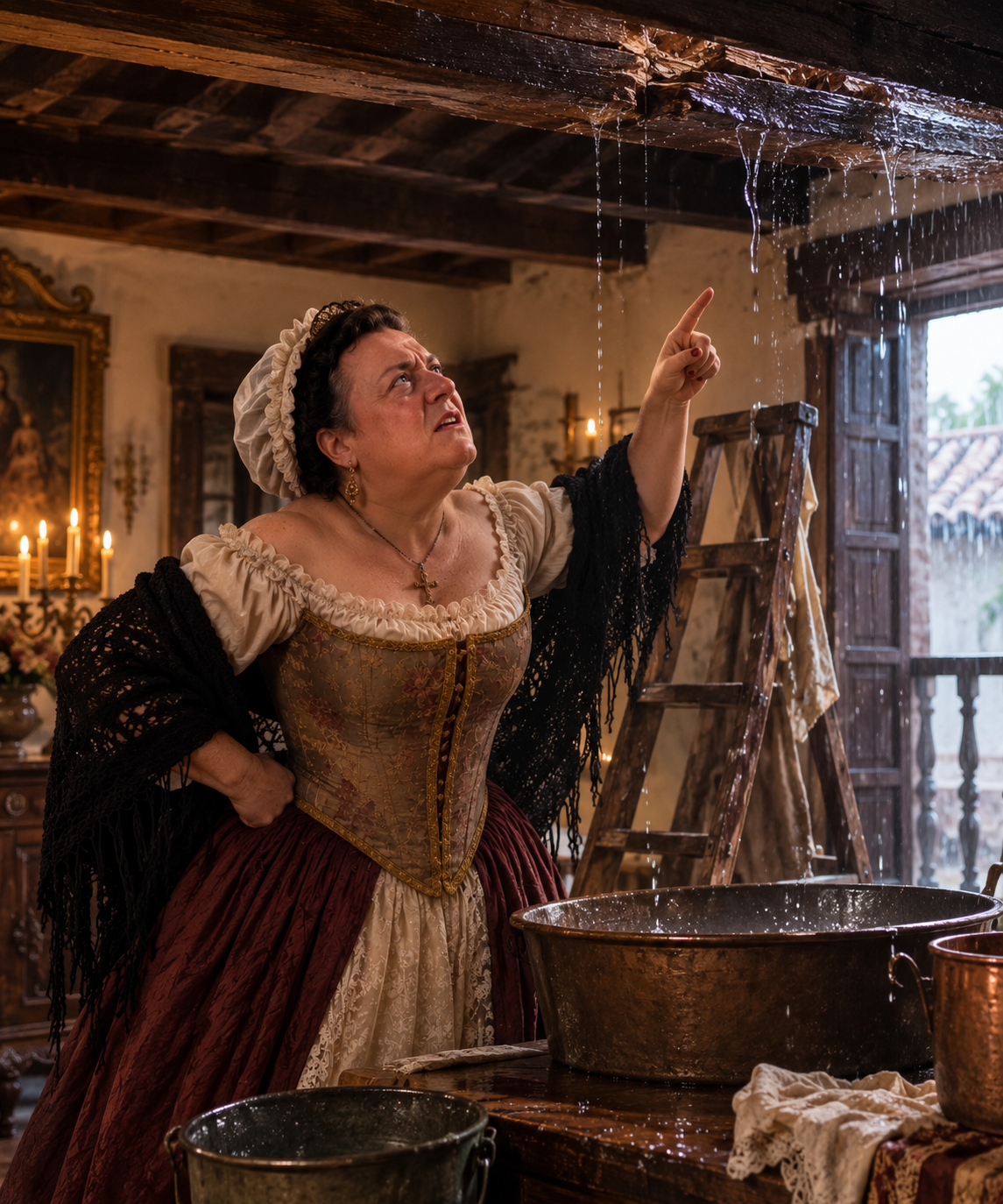
Fernanda gazes upon the split beam whilst the rain invades the gallery.
‘There are storms that merely break roofs.
Others begin by breaking the hearts of those who dwell beneath them.’
The rain had begun before dawn, whilst the city was still a dark mass sprawled beside the river and the cathedral bells had not yet tolled for first mass. It arrived not with an uproar, but with an obstinate patience: first a few scattered drops upon the roof tiles, then a continuous murmur, and finally that grey curtain which seemed to have descended to blot out the roads, the orchards, and even the towers of Asunción.
In the governor's house, the water found every flaw that the sun had spent months concealing.
It seeped through the joints of the tiles, ran beneath the eaves, filled the terracotta gutters, and fell in thick torrents into the inner courtyard. The orange trees, laden with dark and glistening leaves, shuddered under the storm. The wellhead was brimming over. In the galleries, the flagstones gave off an earthy scent that mingled with the smoke from the kitchen, the wax of burnt-down candles, and the sour perfume of moisture-dampened limewash on the walls.
Fernanda knew that house better than anyone.
She had arrived as little more than a girl, before the present governor had taken office, and since then she had seen every soul who had lived under that roof be born, fall ill, marry, and die. She knew which stair-tread creaked when someone tried to slip up unheard. She knew which lock required a sharp tap, and which window blew open on its own when the wind came off the river. She even knew that the third floorboard of the east corridor warped during long rains, though the master carpenter swore it was impossible.
That was why she stopped.
She was carrying a basket of linen against her hip, shielding a candle between her fingers, when she heard the first sound.
It was nothing more than a brief, almost delicate groan, as though the house had sighed in its sleep.
Fernanda raised her head.
‘What fresh misfortune...?’
The second creak was clearer. Sharp. Deep.
The old lapacho beam running across the main corridor split open before her eyes. A black line appeared in the wood, fine at first, advancing slowly until it became a jagged fissure. From the ceiling tumbled a shower of dust, dry chaff, and a tiny spider that vanished beneath the linen chest. Then came the first drop.
It struck the flagstones with a ridiculously tiny sound.
Plink.
Fernanda stood motionless.
Plink.
Another drop ran down the fissure. Then a third. In a matter of seconds, a trickle of water began to slide along the blackened beam, gathered at the tip of a rusted nail, and fell straight onto the pile of clean sheets.
Fernanda stared at the stain spreading across the linen.
‘Holy Mary, Mother of God!’
The basket hit the floor. The sheets spilled across the gallery.
‘Clara!’ she shouted, her voice cutting through doors, bedchambers, and kitchens. ‘Clara Chope! If you don't appear before I count to three, I swear by the Virgin of the Assumption that I shall come and fetch you myself!’
A roll of thunder answered from the river.
In the kitchen, a spoon could be heard clattering down. A young maid poked her head out and snatched it straight back. Two lads carrying firewood froze by the doorway.
Fernanda pointed at the beam as if it were guilty of a personal betrayal.
‘Do you see?’ she said. ‘There you have what happens when men insist a house can wait. “It will hold out for another summer, Fernanda.” “It is merely a damp spot, Fernanda.” “Do not bother his Excellency the Governor with matters of roof tiles, Fernanda.” Well, let his Excellency come now and sleep beneath this!’
The fissure groaned once more.
The lads stepped back.
‘Buckets!’ she barked. ‘Or do you plan to catch the water with your bare hands?’
The house woke with a jolt. There were scuttling footsteps along the corridors, slamming doors, shouted orders, and the clatter of copper vessels being dragged from the pantry. Fernanda strode amongst them all, chin held high, her white cap slightly askew, and a bunch of keys slapping against her skirts. Every new leak was received as an insult. Every puddle provoked a reprimand.
Clara finally emerged from the servants’ passageway. She was nineteen years old, her black hair bound in a plait that fell over one shoulder. Her sleeves were rolled up and she had flour on her right cheek. She had been helping knead the bread when she heard the shouting.
‘Did you call for me, Doña Fernanda?’
‘No, child. I was shouting your name to test the acoustics of the house.’
Clara lowered her gaze, though the ghost of a smile flickered on her lips.
Fernanda saw it and bristled all the more.
‘Look up.’
Clara obeyed. A drop fell onto her forehead.
‘The beam has split.’
‘I can see quite well that the beam has split,’ retorted Fernanda. ‘I can also see that water is pouring in, that the sheets are ruined, and that everyone in this house has chosen the very same day to become entirely useless. What I do not see is Fulgencio.’
‘Fulgencio does not live here.’
‘Which is why you are going to fetch him.’
Fernanda stepped up until she was practically nose-to-nose with her.
‘Go to his workshop. If he is not there, inquire at the Veras’ house. If he is not there either, seek him out at the port tavern, where by this hour he will have found an excuse to drink. And tell him to bring tools, ropes, and two men who know the difference between a hammer and a spoon.’
Clara looked towards the courtyard, where the rain was falling so heavily that the entrance arch was scarcely visible.
‘Now?’
‘No, when the sun comes out and a new generation is born. Of course now!’
‘Doña Fernanda, in this weather...’
‘In this weather the house is dissolving. Put on your cloak.’
There was a harshness in the housekeeper’s voice that made Clara straighten her back. Yet Fernanda, before turning away, took a woollen cloak from the peg—far thicker than those worn by the maids—and thrust it into her hands without looking at her.
‘And do not cross by the boat-wharf street,’ she added. ‘The mud is up to your knees. Go by way of the plaza and do not dally to chatter with anyone.’
It was her way of caring.
Clara knew it.
‘Yes, Doña Fernanda.’
‘And Clara.’
The girl turned back.
‘If Fulgencio tries to charge double on account of the rain, tell him I shall personally remind him how much he paid for that crooked table he tried to sell us as French.’
Clara left with a smile.
The storm snatched the smile from her the moment she stepped through the gatehouse.
Asunción lay disfigured beneath the water. The red-clay streets had turned into thick rivers; cartwheels carved deep ruts, and draught beasts plodded along with lowered heads, twitching their ears. The whitewashed houses seemed starker under the dark sky, and cascades poured from their eaves, forcing passers-by to hug the walls.
Clara gathered her skirts with one hand and held her cloak fast with the other.
Despite Fernanda’s orders, she could not help pausing for a moment under the arcades of the plaza. Half the town had taken refuge there. Indigenous women covered their baskets of manioc, oranges, and medicinal herbs with woven mats. A merchant was arguing with a soldier over some sodden sacks of yerba mate. Two Dominican friars hurried across the square, hitching up their habits, and a barefoot lad chased after a hen that had broken loose from the market.
The air smelled of mud, wet leather, woodsmoke, and the river.
Clara knew every corner of this city. She had been born in a humble dwelling near the northern orchards, the daughter of a Guaraní woman who cured fevers with bark and of a man she scarcely remembered. As a child, she had hauled water, peddled fruit, and swept strangers’ courtyards. The governor’s residence, with its soaring ceilings, mirrors brought from Europe, and tableware bearing heraldic crests, had at first seemed a world entirely apart from her own.
Until she met María Ignacia.
The memory brought a warmth that not even the rain could extinguish.
María Ignacia had taught her to recognise the letters hidden within prayer books. First her name. Then simple words. Later, in secret, lines of verse that they read together beside a window whilst Fernanda pretended not to see them. In return, Clara had taught her the Guaraní names of the trees, how to read the clouds that heralded a storm, and how to listen to the whisperings of the town from the kitchens, where news was always known long before it reached the governor’s study.
That friendship ought not to have existed.
Which was why it was so precious.
Clara went on her way. As she passed the side stables, she heard a sharp whinny, followed by a voice protesting in delicate indignation.
‘Do not shove me, you ungrateful creature! I have spoken to you with more sweetness than to any Christian in this house!’
Nelson Cuy appeared in the stable doorway, holding the reins of a bay mare. He was tall and slender, his dark hair plastered to his brow by the rain. He wore a linen shirt far too clean for a stable lad, a kerchief knotted at his throat, and an affronted expression that made Clara laugh despite her hurry.
‘A mare is getting the better of you,’ she said.
‘She is not getting the better of me. She is staging a drama because she heard the thunder.’
The mare tugged at him once more.
Nelson skipped aside to dodge a puddle.
‘And because she has a dreadful temper. Just like another lady we both know.’
From inside the house came Fernanda’s voice.
‘Nelson!’
His eyes went wide.
‘See? She has the hearing of the devil.’
‘She heard you because you are shouting.’
‘I am not shouting; I am projecting my voice.’
Clara shook her head.
‘I am off to fetch Fulgencio. A beam has split.’
Nelson looked towards the gallery and whistled.
‘That explains the commotion. I thought Doña Fernanda had discovered who ate the honey cakes.’
Clara eyed him with suspicion.
‘It was you.’
‘You cannot prove it.’
The mare tugged again, and Nelson, with an unexpectedly firm motion, guided her back inside. His airy manner was deceiving: he understood beasts better than anyone and could master a skittish horse with scarcely a whisper.
‘Take care,’ he called to Clara. ‘The stream is swelling. And if you see Fulgencio, tell him not to let himself be cowed by Fernanda. Her bark is sometimes worse than her bite.’
‘You tell him that.’
Nelson blanched.
‘I am not a complete fool.’
Clara continued on her way whilst he returned to the stalls, humming a love song he had heard from some Portuguese musicians. His appearance had lasted only a few minutes, but it left behind a lightness of heart that kept her company all the way to the corner.
On the upper floor of the manor house, María Ignacia had not heard half of the uproar.
The rain lashed the shutters of her bedchamber, walling off the outside world beneath a steady drone. She remained seated before a dark wood writing desk, a woollen blanket draped over her shoulders, and a small lamp lit despite it being already mid-morning.
Her room was the only chamber in the house that Fernanda permitted to remain in a state of gentle disarray. There were open books beside the bed, dried flowers pressed between the leaves of a missal, and silk ribbons arranged on a silver tray. Atop the chest of drawers rested a portrait of her mother: a woman of serene countenance, with large eyes and pale hands folded upon her lap.
María Ignacia looked upon the portrait before opening her journal.
She did so every time.
The notebook had green leather covers and a brass clasp. Her mother had given it to her when she turned twelve, with the promise that a woman must always keep a corner of her soul that belonged neither to her father, nor to her husband, nor to her confessor.
Back then, she had not understood those words.
Now she understood them all too well.
She dipped her quill into the inkpot and waited. The ink gathered at the nib, glistening and dark. Outside, thunder sounded. She began to write.
‘Mother:
Today it rains again just as it did the day we bade you farewell. I know not whether the heavens keep memory of our losses, but there are mornings when everything seems bent on returning them to me. The smell of the damp walls, the bell for first mass, even the scent of the jasmine Clara leaves beside your portrait... everything leads me back to you.’
She paused.
Her fingers tightened around the quill.
Ever since her father had spoken to her of Don Rodrigo de Alvarenga, the words had been piling up in her chest without finding an outlet. The man's name surfaced in every conversation. At table. During visits. In the letters arriving from the interior. He owned land, cattle, yerba storehouses, and riverboats trading downstream. Twice widowed. Respected by the Town Council. Fifty-eight years of age.
María Ignacia was twenty-one.
She resumed writing.
‘Father says Don Rodrigo is an honourable man. He repeats it as though honour were enough to share a bed, a table, and every day that God sees fit to grant me. He says he will be able to protect me when Father is gone. He says the town is cruel to women on their own. He says so many things, Mother, and none of them answers the only question I dare ask myself: how can a daughter obey without ceasing to exist?’
The tip of the quill trembled.
A drop fell onto the page. María Ignacia hastened to blot it with her sleeve, but the ink had already spread. It looked like a tiny wound.
‘I do not wish to marry him,’ she whispered.
Speaking it aloud frightened her.
She rose and walked to the window. She pushed the shutter open just a crack. A damp gust swept into the room and snuffed out the lamp. From there, one could see part of the courtyard, the orange trees thrashing in the rain, and the servants scurrying about with buckets. In the gallery, Fernanda was gesticulating beneath a split beam.
María Ignacia almost smiled.
Her mother used to say that so long as Fernanda had the strength to be cross, the house would remain standing.
There was a soft knock at the door.
‘Come in.’
Clara entered, out of breath. She had exchanged her drenched cloak for a lighter one, though mud still clung to the hem of her skirt.
‘I thought you had gone out,’ said María Ignacia.
‘Fernanda is sending me to fetch Fulgencio.’
‘Then you must go before she orders my execution for distracting you.’
Clara closed the door behind her.
‘I only came to see you for a moment.’
From beneath her cloak she produced three wet jasmine blossoms. She had shielded them with her hand on the way from the courtyard. She set them beside the portrait.
María Ignacia looked down.
‘You always find flowers, even when there is no sun.’
‘Flowers do not need the sun's permission.’
The phrase was simple, yet María Ignacia felt it carried something intended for her alone.
Clara saw the open journal.
‘Were you writing to your mother?’
‘Yes.’
‘About Don Rodrigo?’
María Ignacia nodded.
With Clara, she had no need for pretence. She was not the governor's daughter, nor the future bride of a powerful man. She was simply Ignacia, a girl who missed her mother and dreaded what lay ahead.
‘Father wishes to announce the betrothal before the Feast of the Virgin,’ she said. ‘He thinks I do not know, but last night I overheard him speaking with the secretary.’
Clara drew closer.
‘Perhaps he will change his mind.’
‘My father changes his horse more readily than his mind.’
‘Then you must speak to him.’
‘I already have.’
‘And what did he say?’
María Ignacia mimicked the governor’s deep voice.
‘“Affection comes with companionship. Security is worth far more than fanciful notions. Your mother would have understood.”’
Upon uttering those last words, her smile faded.
Clara took her hand.
‘Your mother loved you.’
‘Precisely why it hurts that he uses her memory to persuade me.’
For a few seconds, only the rain could be heard. María Ignacia rested her forehead against her friend’s, a gesture they had shared since girlhood whenever either of them stood in need of courage.
‘I shall not let them send me to that house without a fight,’ she said at last.
Clara looked at her with concern.
‘What do you mean to do?’
María Ignacia opened her mouth, but before she could answer, a voice thundered from the corridor.
‘Clara Chope! Fulgencio will not fly here no matter how hard you pray!’
Clara closed her eyes.
‘I must go.’
‘Go. And return as soon as you are able.’
‘I shall.’
At the door, she turned back.
‘Ignacia.’
‘Yes?’
‘Flowers do not ask permission to grow, either.’
María Ignacia remained still after she had gone.
Then she returned to the writing desk and penned those words at the bottom of the page.
Clara found Fulgencio precisely where Fernanda had predicted: the tavern down by the port.
He was not drunk, though he held a cup of aguardiente in his hands and was haggling with a man over the price of some cedar planks. He was broad-shouldered, with a grizzled beard and huge hands criss-crossed with old scars. When he saw Clara standing soaked in the doorway, he fell silent.
‘What has happened at the big house?’
‘A beam has split.’
Fulgencio sighed like a man receiving news of a long-expected death.
‘The one in the main corridor?’
‘Yes.’
‘I told the governor it needed replacing.’
‘Fernanda says you are to come at once.’
The carpenter drained the rest of his aguardiente.
‘Is she very angry?’
Clara thought of the wet linen, the buckets, and the crooked cap.
‘Very.’
Fulgencio dropped a coin on the table.
‘Then we shall go in through the back door.’
They made their way back beneath a slightly gentler rain. Fulgencio carried a toolbox and was accompanied by two assistants. Upon their arrival, Fernanda was waiting in the gallery with her arms crossed.
‘What promptness,’ she said. ‘Had you delayed a moment longer, you might have come to rebuild the house from the foundations up.’
Fulgencio doffed his hat.
‘Good day, Doña Fernanda.’
‘It is not.’
The carpenter inspected the beam. He tapped the wood with his knuckles, slid a narrow blade into the crack, and called for a ladder. For several minutes no one spoke. Even Fernanda held her peace.
‘The rain has finished opening it up,’ he said, ‘but the damage was already there.’
‘That is what I have been saying for months.’
‘The timber is rotted from within. We shall have to prop it up today and replace part of the span once the roof dries out.’
‘Will it come down?’
Fulgencio looked upwards.
‘Not if we do as I say.’
‘And if we do not?’
‘Then I would take care not to sleep beneath it.’
Fernanda glared daggers at him.
The assistants began setting up props. The hammering echoed throughout the entire house, mingling with the water still dripping from the eaves. Servants cleared away furniture, laid out cloths, and lit braziers to dry the corridor.
The governor appeared around noon.
Don Alonso Álvarez de Toledo was a man of fifty years, tall, grey-haired at the temples, possessing an authority that never required him to raise his voice. He still wore the blue frock coat he donned to receive members of the Town Council. He looked at the beam, the buckets, and Fernanda’s expression.
‘Is it grave?’
‘No,’ she replied. ‘Only that the ceiling of the house where your daughter sleeps has cracked in two.’
‘Ignacia’s bedchamber is on the other side.’
‘The ceiling does not consult the architectural plans before it falls.’
The governor suppressed a smile.
‘Fulgencio, see to it. Spare no expense.’
‘That will cost money,’ the carpenter cautioned.
‘Everything costs money.’
Fernanda muttered something about some things costing more for having been neglected. Don Alonso pretended not to hear her and climbed the stairs.
María Ignacia heard his footsteps before he knocked.
She closed the journal and turned the key in the small clasp. Her father entered without waiting for an answer. For an instant, seeing him framed against the grey light of the corridor, she felt that old affection he always stirred in her: she remembered his hands steadying her when she learned to ride, the stories he told her as a girl, the way he had sat beside her bed through the fevers.
He was not a cruel man.
Which made it all the harder.
‘Fernanda claims the house threatens to bury us all,’ he said.
‘Fernanda believes every hardship is a personal conspiracy.’
‘And yet, she is almost always right.’
Don Alonso approached the window.
‘I wished to speak with you.’
María Ignacia felt her heart sink.
‘About Don Rodrigo?’
Her father looked at her in surprise.
‘The walls of this house are thin.’
‘And Fernanda says I read too much.’
‘This is no matter for jest.’
‘Nor is it for me.’
Don Alonso remained silent. Outside, a hammer struck the beam with regular thuds.
‘Don Rodrigo will come to dine in three days’ time,’ he said at last. ‘I expect you to receive him with courtesy.’
‘I am always courteous.’
‘I expect you to look upon him without prejudice.’
María Ignacia drew a deep breath.
‘He is thirty-seven years older than I am.’
‘He has estates, influence, and a respected name.’
‘I did not inquire about his estates.’
‘Not every marriage is born of a romantic whim.’
‘Was yours?’
The question hung between them.
Don Alonso looked away, towards his wife’s portrait.
‘I loved your mother,’ he said in a low voice. ‘More than you can possibly understand.’
‘Then understand why I do not wish to surrender my life to a man I do not love.’
‘I understand that you are young and believe the world will be lenient with you.’
‘I do not believe that.’
‘When I am gone, you will need protection.’
‘I shall need freedom.’
Don Alonso turned. In his eyes was sorrow, but also that hardness María Ignacia knew only too well.
‘Freedom is a fine word for one who has never had to pay its price.’
‘Perhaps you should allow me to discover how much it costs.’
The hammering ceased.
For a moment, the entire house seemed to hold its breath.
Don Alonso took hold of the back of a chair, as though needing support.
‘Your mother would have wished to see you safe.’
María Ignacia went pale.
‘Do not use her memory to compel me.’
‘Ignacia...’
‘Please.’
The governor gazed at her for a long while. Then he gave a single nod.
‘We shall speak when you have calmed yourself.’
‘I am calm.’
‘That is precisely what troubles me.’
He departed without taking his leave.
María Ignacia waited until his footsteps faded away. Only then did she open the journal and add a final line.
‘Mother, today I spoke as I should have wished to speak to you. I know not whether I was brave or ungrateful.’
The afternoon waned slowly away. The rain grew lighter and finally ceased. Over Asunción there lingered a yellowish light that made the puddles and the orange leaves gleam. From the river came the distant sound of a ship’s horn, followed by the bells of vespers.
Fulgencio finished securing the props. Before leaving, he examined the fissure once more.
‘It will hold tonight,’ he said.
Fernanda did not seem satisfied.
‘And tomorrow?’
‘Tomorrow as well, God willing.’
‘God has weightier matters to attend to. That is what I am paying you for.’
Fulgencio smiled and gathered his tools.
Nelson appeared with a lantern, inspected the buckets, and observed that the gallery resembled the deck of a man-of-war. Fernanda ordered him to hold his tongue and bring more firewood. Clara returned to María Ignacia’s room with a cup of hot herbal tea. Neither of them spoke of the governor. There was no need.
When night fell, Fernanda went about the house locking doors and shuttering windows. She checked the bolts twice over, snuffed the dining-room candles, and left a lamp beside the props. She paused beneath the beam.
The fissure appeared darker in the flame's glow.
Fernanda rested a hand upon the timber.
‘Don’t you dare,’ she murmured. ‘This house has endured far too much to come crashing down over a drop of water.’
A faint sound came from inside the beam.
It was not a creak.
It was something akin to a rustle.
Fernanda brought the lamp closer. Between the parted wood she made out a fragment of dark cloth, wedged in the gap. She slipped two fingers inside and pulled gently.
Out came a small leather pouch, stiffened by the years.
Fernanda glanced towards both ends of the gallery. There was no one.
She tucked it beneath her apron.
Then she extinguished the lamp.
That night, all believed the storm had merely split a beam.
None imagined that it had also opened the past.
Chapter II: "Je suis prêt"
Night had settled a heavy silence over the Álvarez de Toledo household, interrupted only by the dying drip falling from the eaves onto the waterlogged earth of the courtyard. Inside her small bedchamber—a narrow room situated at the end of the service corridor, where the scent of fresh whitewash never managed to dislodge the ancient damp of the wal…