

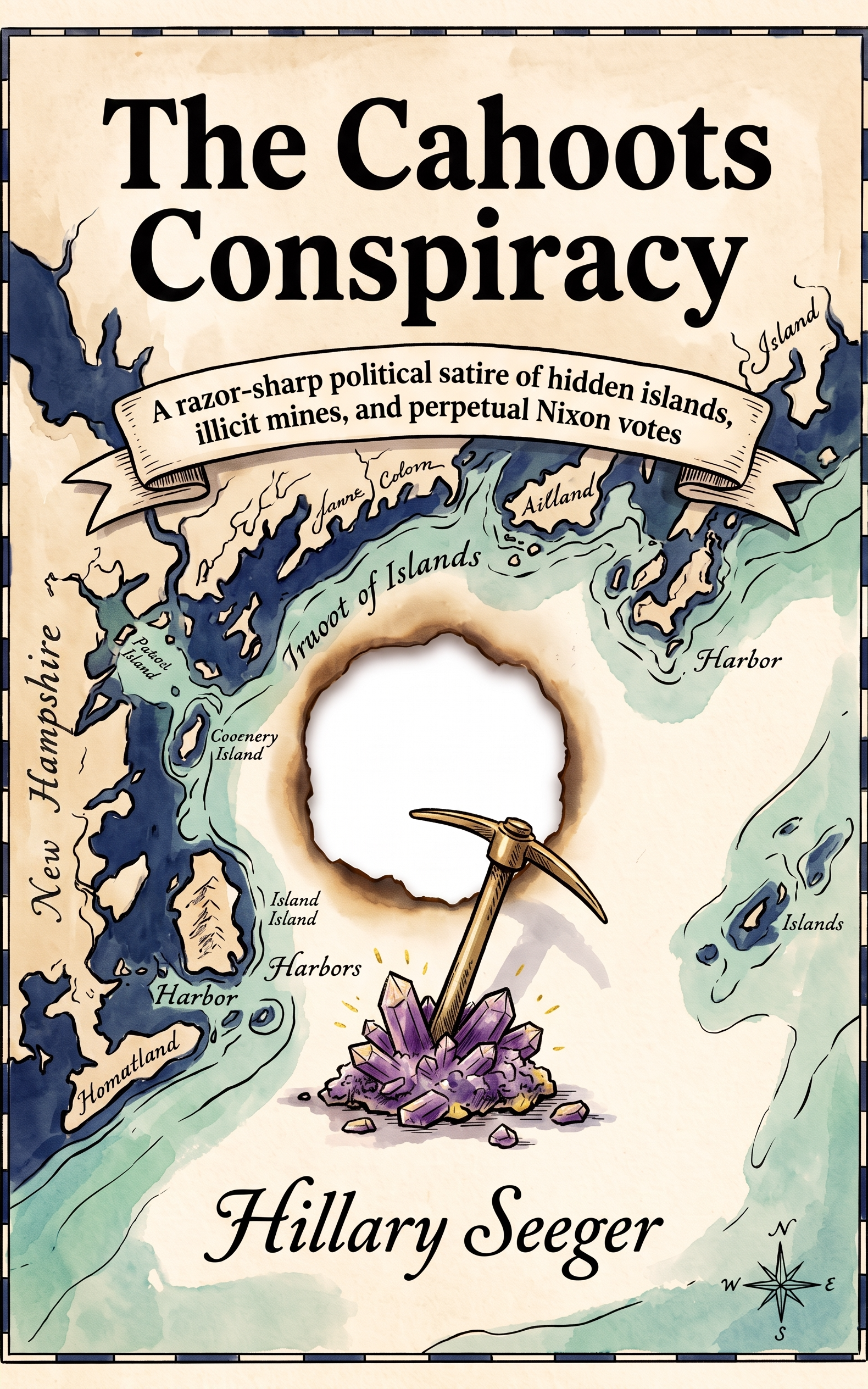
The Cahoots Conspiracy
A razor-sharp political satire of hidden islands, illicit mines, and perpetual Nixon votes
by Hillary Seeger
New Hampshire Attorney General Arthur Pendleton is running for governor, but his polling data has an impossible leak: a town called Cahoots is predicting a landslide for his rival, Blaine Worthington. The catch? Cahoots doesn't exist on any official map. Following a trail of bizarre tide charts behind a nuclear power plant, Arthur boards a rusted ferry and enters a forgotten island governed by 18th-century maritime laws, tide-scheduled traffic lights, and an unwavering tradition of giving Richard Nixon eight percent of every vote. But Arthur quickly uncovers more than eccentric charm. His own grandfather helped erase Cahoots in 1974, and Worthington Mining Corporation is now exploiting that legal void to drill beneath the unmapped soil. Teaming up with sharp-tongued local reporter Tabs Miller, Arthur navigates sabotaged brakes, pedantic town moderators, and secret underground tunnels. To win the governorship and save the town, he must decide whether the law's greatest duty is to expose the truth—or keep the island safely off the map forever.
- Mystery
- Humor
- Political Satire
- Absurd Humor
- Small Town Mystery
- Absurd Comedy
Eight Percent for a Dead Man
I was sitting at my scarred oak desk in the Attorney General's office in Concord, going through the internal tracking polls for the third time that morning, when Dennis Marchetti burst through the door waving a tablet like it was on fire. Coffee sloshed out of my mug and onto a brief I had already annotated twice. The numbers on my own screen had been bad enough. His face said they were about to get worse.
"Arthur. Stop. Look at this. Look at it right now."
He slapped the tablet onto the blotter hard enough to rattle the stapler. I adjusted my glasses and read. One precinct, labeled only with the unofficial ZIP code 00500 and the name Cahoots, showed Celtics Party nominee Blaine Worthington at eighty-nine percent. Undecided was sitting at three percent. And in second place, claiming precisely eight percent for every office from Governor on down, was Richard Nixon.
"Nixon is dead," I said.
"I know Nixon is dead. Everyone knows Nixon is dead," Dennis said. "The dead man is still pulling eight percent in a precinct that does not exist on any map in our war room."
I pulled up the Secretary of State's gazetteer on my desktop. Then the tax rolls. Then every GIS layer the state maintained. No Cahoots. No precinct 00500. Nothing. I could recite the boundary of every New Hampshire municipality from memory. What was Cahoots, and why was it in my polling data?
"It is a data error," I said. "Someone fat-fingered a code."
Dennis paced in a tight circle, tie already crooked, two phones buzzing in his jacket. "I checked the code three times. I called the vendor. I yelled at the vendor. The vendor hung up on me. The file is clean. And my mother, God rest her precise little soul, used to file coastal land abstracts for your grandfather Harold back when he was Land Commissioner. She had photo albums with old clippings about an island called Cahoots thirty miles east of Seabrook. She said the only way out there was a ferry landing near where the nuclear plant was built later. I thought she was telling bedtime stories. Now I think she was filing real papers."
I sat back. The permanent throb behind my left temple gave a friendly little pulse. Running for governor as the Bruins Party nominee while still serving as Attorney General already felt like changing a tire at highway speed. Two weeks after our primary victory, with the November general election fast approaching, adding an unknown precinct was a detail that turned ordinary stress into something with its own ZIP code.
The ZIP code bothered me almost as much as the numbers. 00501 belonged to Holtsville, New York, an IRS facility, and was the lowest ZIP code issued in the United States. I knew that because I knew things no reasonable person needed to know. There was no 00500.
"We are not canceling the Portsmouth campaign stop for a statistical ghost," Dennis said. "Portsmouth expects the Bruins nominee at noon. The general election campaign is in full swing. Blaine Worthington is up three points statewide on his Celtics Party line, and you want to chase a rounding error that votes for a dead president."
"The integrity of the electoral map outweighs any polling bounce," I said. "If a precinct is reporting numbers and does not appear on any official map, I am going to find out why. That is the job."
"The job is winning. The job is not climbing fences behind a nuclear plant because of some vague family rumor."
"If my grandfather was involved in the land records back then, I want to see them. Right now, someone appears to have deleted an island."
Dennis stopped pacing. "You are serious."
"I am packing a subpoena."
We abandoned the schedule. Dennis muttered percentages the entire way down the stairs and into my twelve-year-old Volvo, which he hated because he claimed it gave off the impression of a man who lost on purpose. I brought the tablet, the paper printouts, and the stubborn certainty that a candidate for governor could not simply ignore a town that delivered cartoon landslides for the other side while keeping a dead man's name alive at a perfect eight percent.
Dennis drove down the gray, flat coastal highway toward Seabrook with both hands locked on the wheel and one eye on the signal bars. He talked the whole way.
"You cannot serve a subpoena on a place that legally does not exist. Judges frown on that. Voters frown on that. My blood pressure is already filing a formal complaint."
"Then the town will have to explain how it manages to exist enough to print ballots," I said. "Eight percent for Nixon is not a typo. That is a policy."
"It is a joke. Or a cult. Or both. Either way, we should be in Manchester shaking hands with people who appear on maps."
"People who appear on maps can wait. People who do not appear on maps are currently handing my opponent a manufactured mandate."
He downshifted hard enough to make the engine complain. "My mother handled paperwork linked to Harold R. Pendleton. She said the ferry ran on tides and stubbornness. She said the landing was tucked behind the plant where the public was not supposed to look. I was twelve. I thought she was inventing pirates."
"Your mother filed abstracts. She did not invent pirates."
"She invented enough stories that I still check under the bed for residual jurisdiction."
We argued about opportunity cost, about media cycles, about whether prosecutorial stubbornness translated into electoral suicide. I told him the map had to be clean before I asked anyone to vote on it. He told me clean maps did not win general elections. I told him dirty maps lost lawsuits. He went quiet for almost a full mile, which for Dennis was a personal record, then started listing the press hits we were missing in real time.
The Seabrook access road appeared as a cracked spur off the main route, half hidden by scrub and a chain-link fence that had seen better decades. We parked beside a weathered padlock and a faded tidal chart stapled to the gate post. Someone had written across the bottom in black marker: Passengers by intent only.
Dennis killed the engine and stared at his phones. One bar flickered and died. "I am not leaving the cell signal. If you get arrested for trespassing on utility property, I need to be able to call a lawyer who exists on paper."
"I am the Attorney General," I said. "I brought my own paperwork, and I am bringing my car. I might need transportation on the other side."
"That will play beautifully on the evening news. Candidate in suit pants caught mid-climb while trying to figure out how to drive a twelve-year-old Volvo through a chain-link fence."
I got out. The air smelled of salt and something faintly industrial. The tidal chart showed high water at times that did not match any clock I trusted. The handwritten note flapped once in the breeze and settled. Passengers by intent only. I had intent. I slipped through a rusted gap in the chain link where the bottom wire had come loose, pushed my heavy leather briefcase through after me, and walked back around to unhook the gate latch from the inside so I could drive the Volvo through, locking it behind me while Dennis watched from his rental car.
Dennis rolled down his window. "Last chance. We turn around, I spin the missed luncheon as a 'strategy session,' and we pretend Cahoots is a software glitch."
"It is not a glitch," I said. "It is a mystery place missing from every state database, delivering eighty-nine percent to Blaine Worthington and eight percent to a dead man. I am driving down to the water."
I got back into the Volvo. Dennis made a noise that might have been a prayer or a curse and stayed behind in his rental car with his precious signal. I drove carefully along the overgrown access lane. I checked that the folded subpoena was still in my inside pocket alongside the old 1972 Nixon campaign pin Dennis had dug out of his mother's keepsake box and pressed into my hand before I got out. Dennis said his mother insisted the ferry captain accepted only historical artifacts as fare. Somewhere beyond the scrub, according to Dennis's memories and a chart that cared more about the moon than the Secretary of State, there was a ferry landing.
I drove slowly toward the water. Behind me, Dennis's rental car disappeared behind the tall brush. Ahead, the gravel track narrowed between dunes and overgrown weeds. Locating the landing was a test of patience. The marsh trails looped back on themselves, leading to dead-end mudflats and collapsed wooden footbridges. I spent forty minutes maneuvering around tidal puddles, my tires spinning in marsh mud, searching for any sign of a pier in the coastal fog. I had spent two decades enforcing lines on maps, but today the maps provided zero guidance.
Finally, near a bend in the inlet, I spotted a weather-beaten wooden dock sticking into the grey water. Tied to a thick pile was a small reconstructed work barge. It was barely wide enough for one car, with a tiny wheelhouse bolted to the deck. A weathered man in a faded canvas jacket sat on an overturned crate, whittling a piece of driftwood. This had to be Floyd.
I rolled down my window and leaned out. "Are you the ferry to Cahoots?"
He looked up slowly, eyeing my suit jacket and the dusty fender of the Volvo. "Depends on who is asking, and what intent they carry."
"Arthur Pendleton. I am running for Governor, and I have official business on the island. What is your schedule? When is the next departure?"
"It runs with the tide," Floyd said, going back to his whittling.
"I understand the tide is a factor," I said, pulling out my pocket notebook. "However, tides follow predictable lunar tables. What time in hours and minutes does the vessel depart today?"
"It runs with the tide," Floyd said again. He turned the piece of wood over in his hands. "Clock numbers do not move the water."
"So if I need to reach the island by two o'clock, what time must we leave?"
"Before two."
"That does not give me an arrival window," I said. "Do we leave in five minutes, or five hours?"
Floyd carved a thin curl of pine from his wood block. He looked at the water, then at my front bumper, then back at his wood. "Depends on the wood."
"The wood?"
"And I do not take cash. The fare is a piece of history."
I reached into my pocket and produced the blue and red 1972 Nixon campaign button Dennis had provided. Floyd held it up to the light, tested the pin back with his thumb, and nodded once. He dropped it into a brass tin on his belt.
"Drive the car onto the deck," Floyd said. "Maximum capacity is one car and four people total. No exceptions."
I aligned the Volvo with the creaking wooden ramps and drove it up onto the flat barge deck. Floyd untied the thick hawser, engaged a rattling motor, and pushed us away from the New Hampshire mainland. As the fog cleared over the open water, the skyline of Cahoots came into view. It was a dense cluster of Victorian steep-roofed houses, three distinct church steeples, a high wooden water tower, a grain silo painted like a barber pole, and several metal tide gauges sticking out of the coastal rocks. Everything looked solid, weathered, and built entirely out of nineteenth-century lumber and brick.
The distance between the barge and the shore widened quickly. The integrity of the electoral map was waiting on the other side of the bay, and I intended to collect.
Payment in Legislative Trivia
The fog closed in before we had cleared the inlet. One moment the Seabrook cooling towers stood gray against the sky, and the next they vanished behind a bank of wet white air that smelled of salt and diesel. My phone displayed NO SERVICE and Dennis's seventeenth unanswered text message froze on the screen. I pressed the power button, but the signa…