

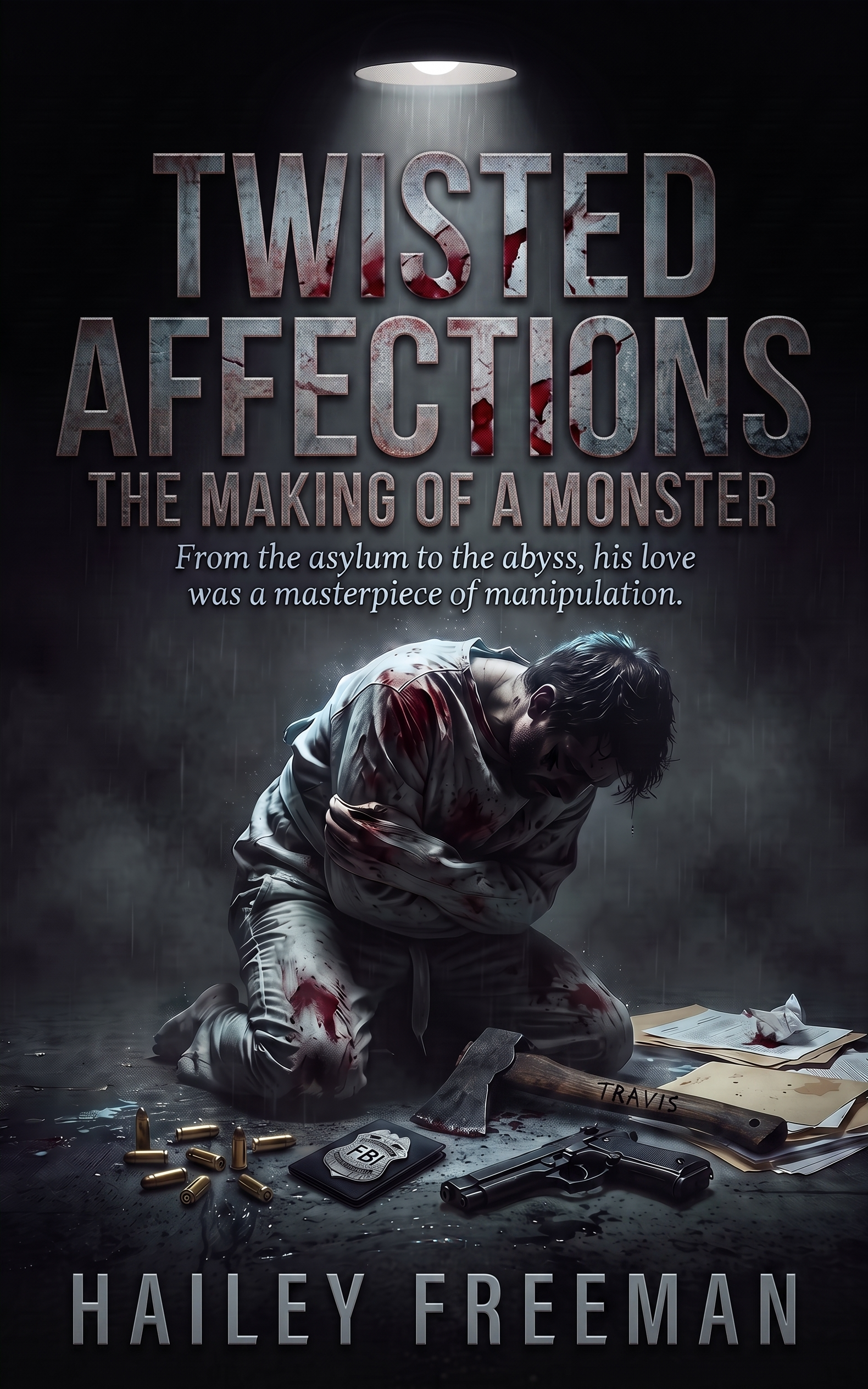
Twisted Affections: The Making of a Monster
From the asylum to the abyss, his love was a masterpiece of manipulation.
by hailey freeman
Karter Hawkings was a man of the law until he met Lyric Elizabeth Gray. Now, he is a man of the shadows. Escaping the sterile walls of the state asylum was only the beginning. As Karter and Lyric flee across South America, he believes he has finally found the intimacy he craves in their blood-soaked isolation. But the ghosts of the past won't stay buried, and the brother he was framed for killing haunts his every waking moment. While the relentless Agent Miller closes the gap, Karter finds himself trapped in a psychological cage far more dangerous than any institution. Lyric is a beautiful architect of chaos, and Karter is merely the tool she uses to carve her legacy. Every life he takes is a desperate down payment on a love that doesn't exist. Twisted Affections: The Making of a Monster is a harrowing descent into the mind of a man being dismantled by the woman he worships. In this brutal finale, Karter must face the ultimate betrayal: realizing he was never her partner, only her most interesting specimen. Experience the chilling conclusion to a journey where the only thing more dangerous than the hunt is the realization of what—and who—you've become.
- Thriller
- Horror
- Psychological Thriller
- Romantic Suspense
- Crime Fiction
The Sterile Echo
That same clean, merciless scent rides the damp air of the warehouse now, though it comes from the river and the rusted containers stacked outside rather than any institutional floor. I crouch against a mildewed wall on the Portland docks, knees drawn up, watching Lyric sleep on a moldy wooden pallet. Moonlight filters through a broken skylight and spills across her like a blade. Her waist-length red hair fans over the warped boards in a dark stain that looks too much like blood. She looks like a saint carved from porcelain, red lashes resting against pale cheeks, lips slightly parted. We are waiting for the freighter that will take us south, away from the sirens and the shame that still clings to my cheap suit. The metal roof drips steadily into a puddle near my boots. Every drop lands like a second hand ticking down the last of my old life.
My hands are shaking again. The tremor started the moment I pulled the trigger on Shellhammer and has not stopped since. I keep flexing my fingers, pressing them against the cold concrete to make them still, but the vibration lives deeper now, in the wrists, in the chest. I check the perimeter for the fifth time in an hour—dark corners, the half-open bay door that faces the black water, the rusted fire escape bolted to the far wall. My FBI training screams that we are exposed. One rookie agent with a flashlight and a radio could end everything. I know the protocols. I used to write them. Now I am the variable they were designed to contain.
I slide my hand into the inner pocket of my jacket and feel the trophy I took from Shellhammer. A single cuff link, gold and plain, still warm from his collar when I ripped it free after the shot. The metal is sticky with dried blood that has turned the color of old rust. I roll it between thumb and forefinger, listening to the faint scrape. I should have left it. Leaving evidence is amateur. But the weight of it steadies me in a way nothing else can. It proves the moment was real. It proves I crossed the line for her and cannot walk it back.
Lyric’s eyes open without a sound. Emerald green, unnervingly still, they fix on me through the dim light as if she has been studying me for hours. Of course she has. The realization lands slow and cold. While I paced and checked shadows and fought the shake in my hands, she lay there with her lashes lowered and simply watched the panic chew through me.
“You did well,” she says. Her voice is soft, melodic, the same tone she once used to read her own book-jacket quotes at bookstore signings. “Killing him was your true baptism. Shellhammer was the last piece of the badge still welded to your skin. You cut it off. That is not murder, Karter. That is birth.”
I want to believe her. I need to believe her, because if I don’t, I am just a murderer in a cheap suit who once wore a federal shield and now keeps a dead man’s cuff link like a lover’s favor. I look at the blood-crusted gold in my palm, then back at her face. The warehouse roof leaks again, a single drop striking the puddle with a sound like a spent casing hitting tile. Outside, a freighter horn moans low across the Columbia, promising distance and salt and the kind of darkness where no one asks for names.
“How long?” I ask. My voice comes out flat, the old agent cadence that used to make witnesses straighten in their chairs. “How long were you watching me fall apart?”
A tiny, polite smile touches the corners of her mouth. She does not sit up. She only turns her head so that the moonlight carves a sharper edge along her cheekbone. “Since the second hour after we arrived. You walked the same triangle seventeen times. You touched your weapon twice without drawing it. You whispered your brother’s name once when you thought the rain would cover it.” She lifts one slender hand and traces a slow circle in the air, as if drawing the path of my footsteps. “I needed to see how deep the fracture went. It goes to the bone. Good. Bones are easier to reshape.”
I close my fist around the cuff link until the edges bite my skin. The pain is clean. Useful. In the asylum they would have called this an unhealthy attachment and upped the dose. Here, in the leaking dark, it feels like the only solid thing left. I remember the weight of the gun in the motel room outside Eugene, the way Shellhammer’s eyes widened when he realized the man he had trained was no longer listening to the rules. He had called me son once, years ago, after a successful warrant service. I put two rounds through his sternum and one through the throat so he could not finish the sentence he started. Blood had hit the cheap wallpaper in a fine spray that looked almost decorative under the yellow bulb. I took the cuff link while his body was still twitching. Lyric had stood in the doorway, already wiping her prints from the doorknob, and told me the mess was beautiful.
“I keep hearing the shot,” I tell her. “Every time the roof drips, I hear it again.”
She finally sits up, red hair sliding over one shoulder like a living thing. The scent of jasmine and copper reaches me even through the river damp. She reaches out and rests her cool fingers over my clenched fist, the one holding the trophy. “That is the old noise. It will fade when you stop fighting it. You are not the man who carried a badge into that motel. You are the man who left a body. The Bureau is already writing the report that paints you as a traitor. Let them. Their language is small. Ours is larger.”
I uncurl my fingers under hers and show her the cuff link. A dark smear of Shellhammer’s blood transfers to her pale skin. She does not flinch. She studies the gold the way she once studied the pages of her manuscript, cataloging texture and weight. Then she brings my hand closer and presses her thumb into the dried blood until it flakes against both of us.
“Keep it,” she murmurs. “Not as guilt. As proof that you chose the correct side of the blade.”
Outside, the freighter’s engines grow louder, a low thrum that vibrates through the concrete floor and into my knees. I should feel relief. Instead the shake in my hands returns, harder, because the ship will take us farther from every system I once understood. There will be no databases to query, no colleagues to call, no clean version of myself waiting on the other side of the horizon. Only her, and the red hair that looks like a bloodstain even when she is at rest, and the knowledge that I will keep killing if she asks, because the alternative is returning to white rooms that smell of bleach and the empty place where my brother’s face used to live.
I stand, joints cracking, and pull her up with me. The pallet creaks. She rises with that fluid, precise grace that once made television cameras love her. I tuck the cuff link deep into my pocket again, next to the spare magazines, next to the last clean handkerchief I own. My FBI training still maps the warehouse—exit angles, sight lines, the probability that Miller already has the docks under quiet surveillance. But the training is just noise now, the same white static that filled the asylum corridors. Lyric’s hand stays in mine, cool and certain, and the freighter horn sounds a second time, closer.
“We move when the deck lights cut,” she says. “You watch the alley. I will handle the dockhand if he asks questions. Do not speak more than necessary. Your voice still carries the Bureau in it.”
I nod. The tremor settles as purpose replaces it. I take my position near the bay door, weapon low, eyes adjusting to the dark. Behind me I hear her gather the small duffle that holds the remaining cash and the forged papers. The warehouse smells of wet rope and diesel and the faint copper of the blood still under my nails. I do not look back at the pallet where she pretended to sleep. I already know she saw every crack in me. That was the point. That was always the point.
The freighter’s silhouette slides into view past the stacked containers, black against blacker water. I check the alley once more, then the rooftops, then the trembling in my own wrists. It is quieter now. Almost gone. Lyric steps up beside me, red hair catching the first slash of deck light, and for a moment she looks exactly like the saint the moonlight tried to make of her earlier. Then she smiles that small, private smile that never reaches her eyes, and the saint is gone. Only the architect remains.
I follow her into the night, the cuff link a hard secret against my ribs, the bleach-smell memory of the asylum finally drowning under the larger stink of the river. If I am a murderer in a cheap suit, then so be it. Better that than the empty white rooms. Better the rot she sees than the scrubbed version the doctors once tried to hand back to the world. The freighter waits. South waits. And somewhere ahead, the next man who will learn what baptism costs when Lyric Elizabeth Gray decides the story needs blood.
I keep my hand near the weapon and match her silent pace. The docks creak under us. Rain begins again, fine and cold, washing nothing clean. I do not look over my shoulder. There is nothing left behind me worth the glance.
Freight and Filth
The belly of the Albatross was a humid hell of rusted steel and the constant stench of diesel. Condensation dripped from overhead pipes in irregular ticks that measured nothing useful. Shipping containers rose around us like the walls of a steel canyon, their paint blistered and peeling into flakes that stuck to the soles of my boots. We had paid o…