

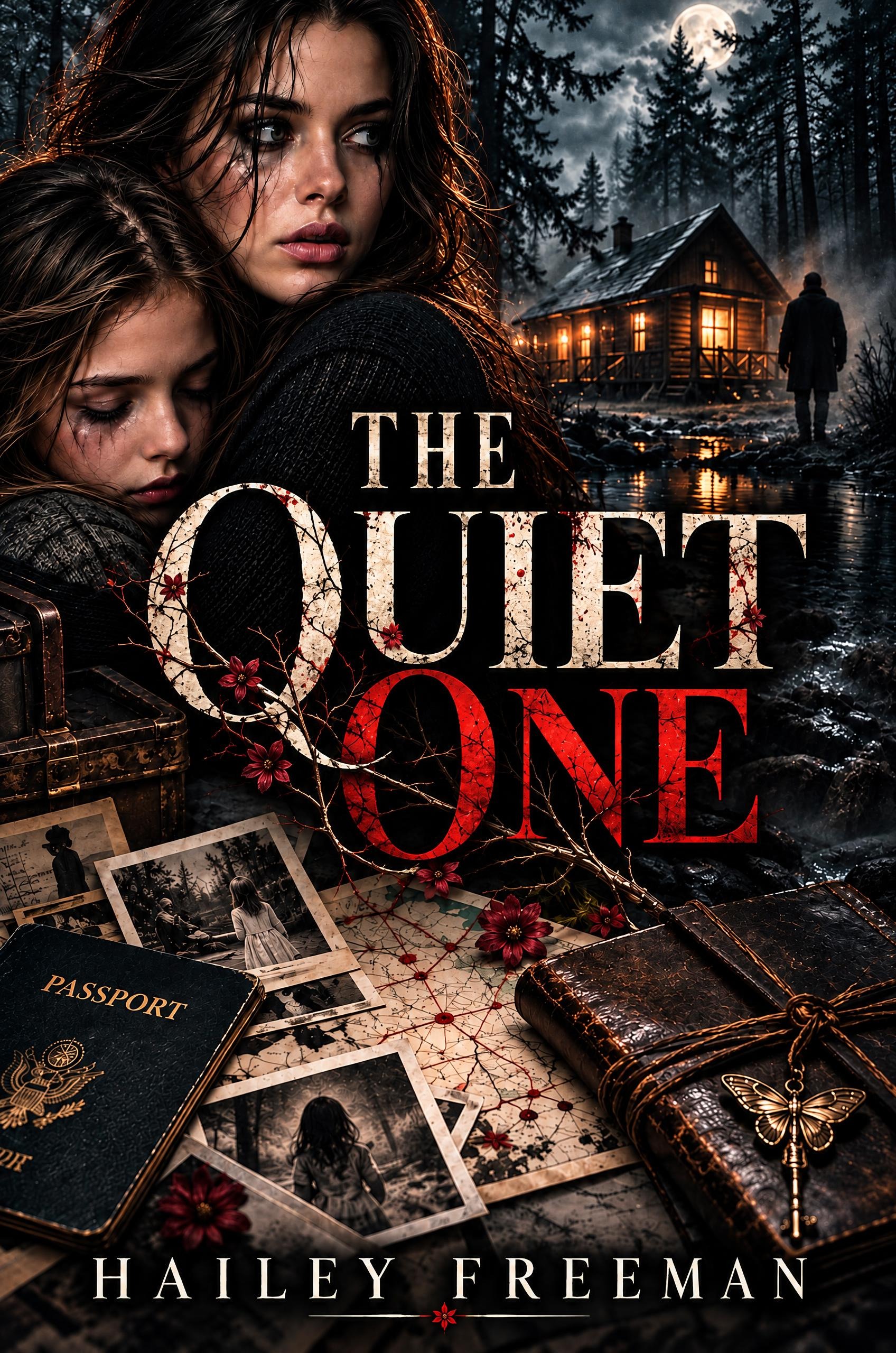
The Quiet One
She kept her sister silent. Silence was never protection.
Twelve years after the abduction, Mara Vale still triple-locks the doors. She works from home. She tracks every itinerary. She cares for Wren, her younger sister, who has not spoken since the night they were taken. Mara believes the man they called The Traveler escaped that forest cabin and is still hunting them. Then Detective Gregory Snyder and Agent Julia Kincaid reopen the cold case. Child disappearances across two continents line up with Mara's research trips. Federal analysts trace predator busts to the sisters' home network. The sanctuary Mara built starts to look like a map. In an unlisted crawlspace she finds passports, travel logs, and the personal effects of children who never came home. The Traveler did not vanish into the world. Six-year-old Wren found him first. Silence was never damage. It was cover. Now Snyder's name is in Wren's newest journal, and Mara has hours to stop the sister she swore to protect before the hunt reaches the people closing in. The Quiet One is a psychological thriller about love, camouflage, and the predator you invited inside.
- Thriller
- Crime Fiction
- Mystery
- Psychological Thriller
- Serial Killer
- Vigilante
The Unlocked Latch
ANNOUNCER: Tonight on Chronicle In-Depth, we revisit twelve years of silence. Across three continents, the trail has gone cold, but the questions remain. Who is the phantom predator known to international law enforcement simply as The Traveler?
The speaker hummed with low-frequency static. A blue glow spilled from the television screen, washing over the hardwood floor and catching the edges of the room. The audio was level and professional, recorded inside an insulated sound booth in Atlanta or New York, but to Mara Vale, it sounded like someone whispering into an empty drainpipe.
CORRESPONDENT: Between 2012 and the present day, twenty-one unexplained disappearances of children between the ages of eight and thirteen have been tentatively linked to a single operational signature. London. Tokyo. Toronto. Paris. Prague. In each case, local authorities found no biological traces, no signs of forced entry, and no ransom demands. The victims simply ceased to exist within their own routines.
Mara did not look away from the television, but her hand found the pocket of her oversized gray sweater. Her thumb traced the small brass notch of a spare deadbolt key. The metal was cold against her skin. She had checked the deadbolts twenty minutes ago, when the broadcast began, but the pressure in her temples demanded another round.
CORRESPONDENT: Former behavioral analysts from the Federal Bureau of Investigation have described the suspect as highly mobile, possessing specialized tradecraft and extensive geographic flexibility. He does not take trophies that can be traced through pawn networks. He does not communicate with the press. Yet in 2014, a breakthrough occurred in the deep woods of the Adirondacks that should have ended the nightmare forever. A sixteen-year-old girl escaped a secluded compound. She was found wandering a rural access road, clutching her six-year-old sister.
On the television, a black-and-white satellite map of upstate New York resolved into grainy video footage. It was archival material from a regional affiliate in Plattsburgh. The camera bounced across yellow police tape strung between frozen hemlocks. State police cruisers sat with their emergency lights flashing, staining the dirty roadside slush with revolving pulses of magenta and red.
Mara stood up from the sofa. She moved without making the floorboards creak, keeping her weight balanced on the balls of her feet. It was a habit born from twelve years of living in houses designed to be defensible perimeters rather than homes.
She crossed the living room to the front entrance. The entry door was solid core oak, reinforced with a steel strike plate that extended sixteen inches into the framed studs. Four deadbolts were set into the jamb at nine-inch intervals, each keyed to a different cylinder. Mara placed her palm against the wood first, feeling for the faint vibration of footsteps on the porch steps outside. There was only the low whistle of autumn wind pushing through the screen of the outer storm door.
She tested the top lock. Engaged. The brass cylinder did not budge under her thumb. She moved down to the second, an older Medeco lock with a hardened steel insert. Engaged. The third was a high-security rim lock with interlocking bolts. Engaged. The fourth, set low near the baseboard, was a sliding horizontal bolt made of heavy cast iron. She ran her fingers over the smooth surface of the latch to confirm the bar was fully seated in its keeper.
Only then did she exhale, a short, shallow puff of air that barely parted her lips.
Behind her, the low rustle of dry paper broke the rhythm of the television broadcast.
Mara turned back toward the glow of the room. In the corner by the low cedar table, sitting on a round braided rug, Wren Vale did not look up. Her younger sister was eighteen now, but she still wore clothes that made her appear barely fourteen: a washed-out navy cardigan with pushed-up sleeves, a charcoal pleated skirt that fell past her knees, and thick wool socks. Her jet-black hair was cut in a straight, blunt line along her jaw, framing a pale, smooth face that looked as though it had never been exposed to direct sunlight.
Wren was folding paper cranes from a stack of unlined white parchment. Her fingers were long, thin, and remarkably steady. She took a square sheet, folded it corner to corner with a quiet crease, opened it, and reversed the fold with mechanical precision. There was no tremor in her knuckles. There was no hesitation in the way her thumbnail scored the edge of the paper, creating a razor-sharp spine.
On the table beside her, twelve completed cranes sat in a perfect diagonal line, each beak pointing directly toward the darkened hallway that led to the bedrooms.
CORRESPONDENT: That surviving teenager was Mara Vale. Her younger sister, Wren, was diagnosed with severe elective mutism in the months following their recovery. To this day, neither sister has spoken publicly about the identity of their captor, nor has law enforcement ever located the man who abducted them. He vanished into the timberland, leaving behind only the cold ashes of an incinerated cabin and a legend that has haunted global task forces for over a decade.
"They don't know what they're talking about," Mara said softly, her voice barely louder than the ambient hiss of the radiator beneath the window.
Wren did not turn her head. She laid another folded triangle flat on the cedar table, smoothed the flap with the pad of her index finger, and reached for the next sheet of white paper.
Mara walked slowly toward the table, keeping her movements deliberate. Over the years, sudden gestures could trigger defensive postures, though Wren never flinched. Wren simply became still, a marble statue holding its breath until the room returned to equilibrium. Mara sank down onto the sofa opposite the rug, pulling her knees up against her chest so her oversized knit sleeves covered her feet.
The scar on her left collarbone pulled tight against her skin. It was an old, ragged line of pale tissue where an iron collar had rubbed through the epidermis during her seventy-two hours of captivity. Whenever the weather turned damp, the scar ached with a dull, throbbing heat, as if the metal were still clamped around her throat.
"We should turn it off, Wren," Mara said, reaching for the remote control on the armrest. "It's late. You have your evaluation notes with Christina on Thursday, and you know how you get when you don't sleep."
Wren's hand hovered over the paper crane she was shaping. She did not grab the paper, nor did she nod. Slowly, her head tilted slightly toward the television screen. Her large gray eyes, unblinking and dark at the centers, reflected the fluctuating blue phosphor of the broadcast. There was no fear in her expression. There was no grief. Her face possessed the eerie, placid neutrality of a pond beneath a sheet of winter ice.
On the screen, a photograph appeared. It was an archival black-and-white still taken from a police evidence folder: a weathered, snow-crusted clearing surrounded by dense lodgepole pines. In the center of the frame lay the blackened foundation stones of a small timber dwelling, surrounded by the charred ribbing of fallen roof beams.
CORRESPONDENT: Though the fire destroyed any direct forensic evidence that could identify the owner, investigators recovered fragments of restraints, padlocks, and personal artifacts belonging to children who had vanished from as far away as Montreal and Chicago. The predator, dubbed The Traveler by Canadian and American authorities, had created an operational hub hidden three miles off the nearest fire road. Twelve years later, the central question persists: did he die in the surrounding wilderness, or does he walk among us, waiting for the right moment to strike again?
Mara's heart hitched in her chest. A cold, sour taste rose in the back of her throat, sharp and metallic like copper shavings. The room seemed to contract, the ceiling pressing down until the air felt thin and dry.
She looked down at Wren. Wren had not stopped folding. She had completed the wings of the thirteenth crane and was now gently bending the narrow neck forward to form the head. Her fingers moved with the rhythm of a clock mechanism, completely unaffected by the television's solemn narration.
"Wren," Mara whispered.
Wren paused. She raised her chin and met Mara's gaze. Her gray eyes were wide, clear, and fathomless. They were the eyes of a child who had seen the bottom of the world and decided there was nothing there worth crying over. She reached to the side of her braided rug, picked up the small yellow legal pad and the black ballpoint pen she kept within reach at all times, and wrote three words in her small, disciplined script:
Locks are good.
She showed the pad to Mara, holding it up with both hands like an obedient student presenting an assignment. Then she set it down and returned to her folding.
"Yes," Mara said, her voice shaking slightly despite her best efforts to steady it. "The locks are good. I checked the bolts. I checked the perimeter sensors on the driveway. Nobody is out there, Wren. Nobody knows where we are."
Mara repeated the phrase like a litany, though every syllable tasted like ashes. She knew where she had logged her research itineraries over the last eighteen months: municipal archives in Cleveland, digitized land registries in Toronto, historical society microfilms in Albany. She had spent the last five years working as an independent archival researcher, taking remote transcription contracts, building index records for libraries that did not have the staff to scan their own basements. It was clean work. It was quiet work. It allowed her to remain inside this house, within five feet of Wren, behind four deadbolts and a monitored security loop.
Yet for three weeks, there had been anomalies. A sedan idling at the corner of their suburban cul-de-sac with its headlights off. An empty mail delivery slip tucked into their box with a routing code that didn't match the county annex. And yesterday, while walking Wren home from the community library down the street, Mara had noticed a tall, rumpled man in a faded trench coat standing across the intersection, drinking coffee from a paper cup and watching them with an intensity that had made the hair on the back of her neck stand up.
She had not told Wren about the man. She never told Wren about the threats. It was her duty to bear the weight so Wren could remain whole, even if that wholeness was encased in twelve years of silence.
CORRESPONDENT: For Special Agent Julia Kincaid, who originally coordinated the multi-agency task force in Plattsburgh, the case remains an open wound.
The screen cut to an office interior. Julia Kincaid sat behind a clean metal desk, her blonde hair cut into a sharp, severe pixie, her jaw set with bureaucratic weariness. Behind her hung a framed organizational chart with blurred photographs connected by red transit lines.
KINCAID: Predators of this psychological profile do not simply retire. They do not age out of compulsion. If The Traveler survived the fire in the Adirondacks, he adapted. He would change his hunting grounds, alter his disposal methodology, and eliminate the mistakes that allowed Mara Vale to walk out of those woods alive. If he is out there, he is watching the survivor. He would view her survival as an insult to his craft.
Mara lunged forward, grabbed the remote control from the table, and pressed the power button. The screen snapped black. The hum of the television died instantly, leaving the living room in total darkness except for the thin slats of streetlamp light slipping between the heavy wooden blinds.
Mara sat with her chest heaving, the remote clutched in her fist so tightly that the plastic casing creaked under her knuckles.
"Enough," Mara said into the dark. "We don't need to hear that filth. It's sensationalism. They make money off our terror. That's all the media does."
In the gloom, Wren did not move. She remained seated on the braided rug, her hands resting quietly in her lap over the white paper crane. Even in the dim light, Mara could see the pale oval of her sister's face, turned toward her with infinite patience.
A sudden, dull knock sounded against the exterior siding near the kitchen window.
Mara froze. Her breath caught in her throat. The sound had been sharp, like a knuckle rapping against cedar shingles, or the dry branch of an overgrown lilac bush scraping against the gutter. Every muscle in her body locked into rigid attention.
She stood up, setting the remote down without making a sound. She slipped her feet into the soft canvas shoes she kept beside the sofa. She walked to the hallway that connected the living room to the kitchen, her dark hazel eyes wide, scanning the shadows. She paused at the kitchen threshold. The security console on the wall beside the refrigerator displayed a tiny green LED: ALL ZONES SECURE.
The perimeter beam had not tripped. The motion sensors in the rear yard were silent.
Mara stepped to the kitchen sink, reached out with one finger, and parted the metal blinds a fraction of an inch. Outside, the narrow suburban backyard was bathed in the pale yellow glare of the neighbor's floodlight. The grass was wet with autumn dew. The wooden fence stood eight feet high, topped with anti-climb brackets she had installed herself three summers ago. Nothing moved. A stray cat sat atop the fence rail, its ears turned back, watching the alleyway behind the property before leaping down into the brush.
It was only the wind. It was always the wind, or an animal, or the expansion of an old house settling into its foundation.
Mara let the blind drop back into place. She rested her forehead against the cool porcelain of the backsplash, closing her eyes. Her pulse drummed against the base of her skull, a hard, rhythmic thud that sounded like boots crunching on frozen pine needles.
The smell hit her then, rising unbidden from the dark vault of her memory. It was not the scent of lemon furniture polish or the chamomile tea she had brewed two hours earlier. It was the smell of damp earth, rotten cedar, and the sour grease of an kerosene lantern that had burned low in a windowless room.
Mara gripped the edge of the kitchen counter. Her fingers dug into the laminated edge until her nails turned white. She tried to force the air into her lungs, but her diaphragm seized, locking her in that familiar, suffocating loop of panic.
Look at the latch, she told herself, whispering the words through clenched teeth. Look at the latch, then look at me. If the chain holds, we breathe. If it doesn't, we run.
The words were the mantra she had used to keep herself from screaming in the back of the ambulance twelve years ago, but tonight they offered no comfort. Because tonight, the memory did not stay behind the wall she had built. The television broadcast had cracked the mortar, and the darkness rushed through the opening with the force of black water.
The living room faded. The hum of the refrigerator died. The suburban quiet was replaced by the low, continuous roar of an October gale tearing through the canopy of the Adirondack timberland.
She was sixteen again, lying on her side on an uneven floor made of rough-hewn pine planks. The wood was so cold that the chill seeped through her denim jeans and into her hip bones, numbing her flesh until her legs felt like dead weight. Her wrists were tied behind her back with coarse nylon cord that had bitten through the skin, leaving her hands swollen and tingling with pins and needles.
Around her neck, the iron collar was heavy and unyielding. It was connected to a three-foot length of logging chain, and the terminal link was bolted directly into a vertical support timber that smelled of creosote. Every time she tried to lift her head, the iron ring dug into the soft hollow behind her collarbone, grinding against the bone.
The cabin was small, perhaps twelve feet by fifteen, lit only by the smoky yellow flame of an oil lamp hanging from a rusted ceiling hook. On the walls, rough pine shelves were packed with rows of small objects: plastic hair clips with cartoon characters, worn sneakers tied together by their laces, faded cloth backpacks, a small porcelain doll with a shattered cheek. They were arranged in chronological order, neatly spaced, like exhibits in a museum of stolen lives.
Across the room, the man stood by a workbench. He was broad-shouldered, wearing an oilcloth hunting jacket and heavy wool trousers tucked into rubber-bottomed boots. In the dim light, she could not see his face clearly—only the heavy, square jaw covered in gray-tipped stubble, and the cold, methodical focus of his movements as he cleaned a skinning blade with an oiled rag.
He had not spoken to her since he dragged her from the back of his truck three nights earlier. He had not given her his name. He only entered the cabin at dusk, checked the tension on the logging chain, placed a plastic cup of water on the floor just out of reach of her swollen lips, and sat at his bench, working on his leather straps and knives.
Mara had sobbed until her vocal cords tore. She had begged him. She had offered him her mother's jewelry, her college savings account, everything her family owned. She had promised she would never tell a living soul if he just let her walk back to the state route.
The man had never once answered. He had looked at her with the flat, indifferent eyes of a butcher assessing a side of beef, then returned to his sharpening stone. The rhythmic shhk-shhk-shhk of steel on whetstone had become the soundtrack to her ending.
On that third night, the gale had knocked a dead hemlock against the cabin roof, shaking the timber rafters with a hollow boom. The man had paused, the skinning blade resting flat on the workbench. He had stood up, adjusted his coat, and walked to the heavy timber door, sliding back the exterior deadbolt to inspect the roofline. He had stepped outside into the black, rain-swept woods, leaving the door unlatched behind him.
Mara had pulled against the logging chain with everything she had left. She had kicked her heels against the rough pine floor, arching her back, screaming through her cracked lips as the iron collar gouged a trench through her skin. Blood had welled beneath the collar, hot and sticky, dripping down onto her shirt, but the bolt in the post did not move. It was anchored deep in the ancient heartwood.
Then, the cabin door had creaked inward.
Mara had closed her eyes, bracing for the blow, waiting for the heavy boots to cross the threshold and finish what had begun on the roadside seventy-two hours earlier.
The footsteps were not heavy.
There was no sound of rubber boots on the sill. There was only the faint, wet scuff of small sneakers on cedar wood.
Mara had opened her eyes, blinking through the tears and the greasy film of smoke from the kerosene lamp.
Standing in the doorway, framed by the thrashing pines and the driving black rain, was her six-year-old sister.
Wren was wearing her yellow rain slicker, the hood pushed back to reveal her wet, plastered hair. Her white knee socks were soaked with black swamp mud, and her small knees were scraped raw from crawling through brambles. She was tiny, barely coming up to the latch of the heavy door.
Mara had tried to scream at her to run. She had tried to shout that the monster was outside, that he was in the trees, that Wren had to get back to the road and find help. But her voice had failed her, breaking into a wet, choking gasp that barely carried across the cabin floor.
"Wren," Mara had croaked, her chin pressed against the blood-slicked timber. "Run. Please. Run."
Wren had not run.
She had not cried. She had not trembled. She had not called out for their mother or father. She stood in the center of the doorway, perfectly balanced, her enormous gray eyes taking in the shelves of stolen backpacks, the iron chain bolted to the post, the blood pooling beneath Mara's collarbone.
Her face had been completely empty of horror. It was an absence so absolute that, even in the middle of her own terror, Mara had felt a cold jolt of confusion.
In her right hand, Wren held a long, curved skinning knife. It was the twin to the blade on the workbench, with a heavy rosewood handle and a brass finger guard. The wide blade was dark, slick with a thick, viscous coating of fresh crimson that dripped steadily onto the clean cedar floorboards.
Drip. Drip. Drip.
Young Wren stepped forward into the room. She did not look behind her into the dark woods. She walked with a steady, unhurried gait toward the vertical post where Mara was chained. The smell followed her—the smell of the rain, the sharp resin of bruised pine needles, and the hot, iron reek of freshly spilled blood.
"Wren," Mara had whispered, her vision tunneling as the darkness crept in from the corners of the room. "Where is he? Where did he go?"
Wren did not answer. She knelt beside Mara on the cold floorboards. Her yellow slicker rustled softly. She laid the heavy, blood-streaked knife down on the timber within reach of Mara's face, its polished edge catching the yellow light of the lamp. Then she reached into the deep pocket of her slicker, pulled out a heavy steel padlock key coated in the same dark grease, and inserted it into the lock binding the logging chain.
With a clean, mechanical click, the cylinder turned.
The iron collar fell away from Mara's raw neck. The relief was so sudden, so dizzying, that the room spun in wild circles. Mara collapsed forward, her forehead striking the floor beside the skinning blade.
Through the haze of shock and blood loss, Mara had watched her six-year-old sister stand back up. Wren picked up the knife. She wiped the blade carefully across the hem of her yellow rain slicker, removing the excess gore with two practiced, deliberate strokes. Then she looked down at Mara, her gray eyes clear and tranquil, as if she had just finished tidying her toy box.
Before Mara had blacked out, before the memory fragmented into sirens, state troopers, and the white sheets of the emergency room, Wren had bent down close to her ear. Her breath had smelled of wintergreen mints and cold rain.
He can't hurt you anymore.
A soft hand touched Mara's elbow.
Mara gasped, violently pulling away, her back slamming against the kitchen cabinets. Her hand swept across the counter, knocking a ceramic mug into the stainless steel sink with a sharp, ringing clatter.
She stood there, panting, her dark hazel eyes wide and wild, her chest heaving as the kitchen snapped back into focus. The modern white cabinets. The hum of the digital clock on the microwave: 11:42 PM. The clean laminate countertops.
Wren stood before her. She had not backed away when Mara lashed out. She stood two feet away, her head tilted slightly, holding a clean glass of tap water in both hands.
Her gray eyes were steady. She looked at Mara with that same calm, unhurried attention she had displayed twelve years ago in the Adirondack mud. Her navy cardigan hung loosely from her narrow shoulders. Her hands were pale, smooth, and completely clean.
Mara pressed both hands against her face, digging the heels of her palms into her eyes until bright spots danced behind her eyelids. She was shaking from head to foot, her knees threatening to buckle beneath her.
"I'm sorry," Mara choked out, her voice ragged. "I'm sorry, Wren. I thought... I heard something outside."
Wren did not blink. She extended the glass of water forward, holding it until Mara's trembling fingers took it from her. Mara drank, the cold water shocking her throat, washing away the lingering taste of copper and damp pine.
Wren reached into the pocket of her cardigan, pulled out her legal pad, and flipped past the previous page. With swift, silent strokes of her pen, she wrote:
The news was loud. It made your head hurt.
Mara lowered the glass. She looked at the small, immaculate script on the yellow paper. Every letter was upright, uniform, and spaced with mathematical regularity. It was the handwriting of someone who exercised total control over every muscle in her body.
"Yes," Mara said, leaning back against the sink. "It made my head hurt. They keep talking about him like he's everywhere. Like he never stopped."
Wren watched her. Slowly, she took the pen and wrote another sentence beneath the first:
He is not here.
Mara reached out and touched her sister's shoulder. The fabric of the cardigan was soft beneath her fingers. She felt the delicate bone beneath the wool, fragile as a bird's wing. For twelve years, she had built her life around protecting this frail, broken girl who had lost her voice to the horror of that cabin. She had turned down archival jobs that required office presence. She had avoided friendships. She had lived like a ghost so Wren would never have to be alone in the dark.
"I know," Mara lied, pulling Wren into a brief, protective embrace. "I know he isn't here. I won't let anyone near you, Wren. Ever. If the chain holds, we breathe. You remember that?"
Wren rested her forehead against Mara's collarbone for a single second. It was the precise spot where the iron collar had left its mark. Then she pulled away, took Mara's hand, and gently led her out of the dark kitchen, back into the quiet sanctuary of their locked house.
Mara let herself be led, but as they passed the darkened front entryway, her gaze drifted to the four heavy deadbolts set into the oak door.
The top bolt was thrown. The second was thrown. The third was thrown. The bottom iron latch was seated firmly in its keeper.
The locks were secure. The perimeter was sealed. But in the silence of the hallway, behind the steady ticking of the grandfather clock, Mara could still hear the slow, rhythmic cadence that lived in the deepest chamber of her skull—the heavy, wet sound of blood dripping onto cedar floorboards, three miles deep in the black pines, where the predator had never escaped at all.
The Deadbolt Routine
The dawn always started at the front door. Mara Vale stood in the cold hallway while the furnace clicked beneath the floorboards. She reached for the top brass cylinder. She turned it once to the right until the heavy tumbler dropped into the jamb. The metal gave a dull clink that resonated inside the pine frame. She tested the latch with her thumb…