

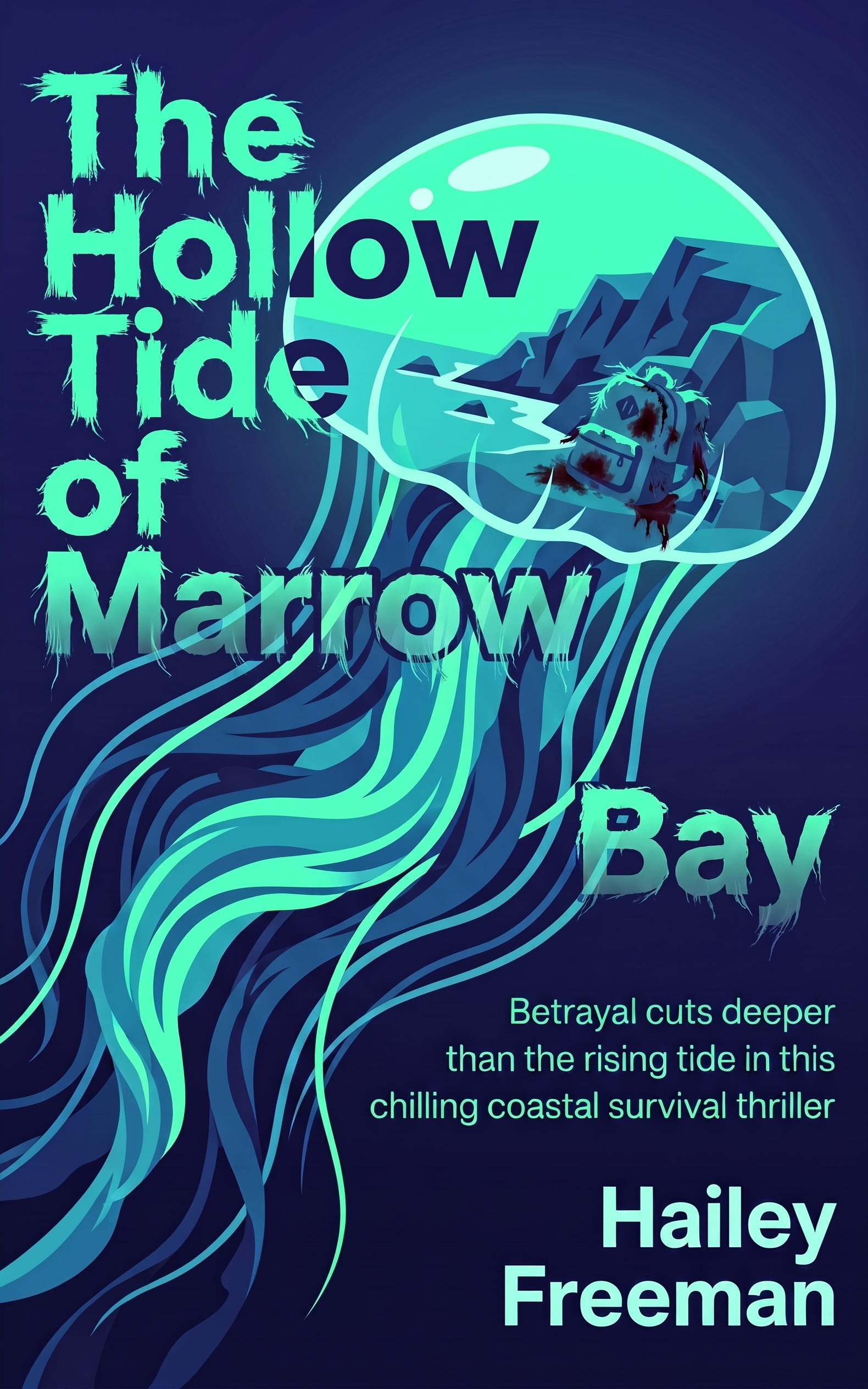
The Hollow Tide of Marrow Bay
Betrayal cuts deeper than the rising tide in this chilling coastal survival thriller
by hailey freeman
Three summers of secret romance were a lie. When Wren Callaway transfers to a coastal high school, she expects a happily-ever-after with her camp boyfriend, Beckett. Instead, she finds him in the arms of the town's golden girl. Heartbreak becomes the least of her worries during a mandatory biology field trip to the jagged, isolated shores of Marrow Bay. When a sudden rockslide destroys the only path home and the tide begins to swallow the beach, the junior class is trapped. But they aren't alone. A masked figure known as 'The Unseen' is hunting them from the shadows, snatching students to create gruesome, public displays of bone and marrow. As secrets are exposed and the body count rises, Wren must use her wilderness survival skills to lead a group of terrified teenagers through the night. In the dark, the truth is more dangerous than the hunter. To survive the hollow tide, Wren must decide who to trust before the ocean—or the killer among them—claims what’s left of her heart. One thing is certain: some secrets are better left buried beneath the waves.
- Paranormal
- Young Adult
- Thriller
- Ghost
- YA Mystery
- Supernatural Romance
The Ghost of Summer Past
The girl in the mirror was a stranger, and that was the entire point.
I leaned closer to the glass, resting my palms against the cold porcelain of the sink. The reflection staring back at me didn't flinch. She had chin-length, blunt-cut auburn hair that stopped exactly at her jawline, framing a face that looked sharper, leaner, and entirely unfamiliar. Gone was the frizzy, shapeless mass that I used to tuck behind my ears whenever I wanted to disappear. In its place was a deliberate edge. I reached up, my thumb brushing against the small silver hoop pierced through my left nostril. It was still slightly tender, a tiny metallic spark that felt like a line drawn in the sand. A boundary made of surgical steel.
For seventeen years, my bedroom had been a sanctuary of invisibility. It was a space defined by what wasn't there. If you looked closely at the pale blue walls, you could still see the faint outlines where my old posters used to hang—mostly generic indie bands I didn't actually listen to, chosen only because they didn't invite questions. But the real evidence of my old life lay piled on the floor of my closet, pushed so far into the dark corners they might as well have been buried in a shallow grave. The oversized hoodies. The gray, fleece-lined sweatshirts that belonged to my older brother, Hudson, or the ones I had secretly kept after Beckett Wilder lent them to me on damp spring nights. They were a security blanket that had slowly turned into a shroud.
I let my hand fall from my nose and gripped the edge of the sink until my knuckles turned the color of raw salt. The bathroom smelled of cheap apple-scented shampoo and the sharp, chemical tang of the dye I’d bought at the pharmacy three nights ago. My mother had cried when she saw the hair on the bathroom floor, thick clumps of honey-blonde curl that had looked so beautiful under the canopy of the Cascade Mountains. She thought I was having some kind of crisis. She thought the stress of my father’s long hours as a park ranger was finally getting to me, or that I was simply buckling under the weight of starting junior year at Cape Mercy High School. She didn’t know that I was just clearing away the dead wood. In the woods, you learn that sometimes you have to burn the undergrowth to keep the entire forest from choking on its own decay.
I turned off the bathroom light and walked back into my bedroom. The floorboards groaned beneath my boots—worn-out leather ones that had actually seen trail miles, not the pristine designer kind the girls in town wore to look rugged. I grabbed my backpack from the desk, its canvas strap stained with old pine sap that had dried into a stiff, dark amber crust. I refused to scrape it off. It was a reminder of who I actually was, even if I was spending the rest of my days trying to look like someone else.
The drive to Cape Mercy High was short, a straight shot down the coastal highway where the fog hung so thick it felt like driving through wet wool. The ocean was somewhere off to the right, hidden behind the jagged cliffs and the dense stands of Sitka spruce, but you could always hear it. It was a low, rhythmic thudding that vibrated in your teeth, a reminder that the water was always waiting, always pulling. When I pulled my beat-up station wagon into the student parking lot, the fog was just beginning to burn off, leaving the asphalt slick and black.
Cape Mercy High School looked exactly like every other building in this town: weathered cedar shingles, green metal roofs, and windows that were permanently filmed with salt spray. It was a school built for the children of fishermen, cannery workers, and the wealthy tourists who bought up the cliffside properties to watch the winter storms from behind triple-paned glass. There was a thick, suffocating sense of nostalgia here, a belief that nothing ever really changed and nothing ever should. Every trophy in the display case by the main entrance was twenty years old, and the teachers still talked about the town’s founding families as if they were royalty.
I stepped through the heavy double doors, the sudden warmth of the hallway hitting me along with the familiar smell of floor wax and floor-mat dampness. I kept my head down, my new haircut swinging against my cheeks like two small shields. I didn’t want to be noticed. I didn’t want to be greeted. I had spent the last two weeks of summer perfecting a blank, unreadable expression that I hoped would act like a mirror, reflecting everyone else’s gaze right back at them.
“Nice hair,” a voice muttered as I passed the row of junior lockers. It was a girl I’d sat next to in geometry last year, her eyes lingering on the sharp auburn line of my jaw before she turned back to her friend. I didn’t answer. I just kept my eyes locked on the scuffed green tile of the floor, counting the paces to my homeroom.
The hallway was a sea of predictable faces. There were the kids from the docks, their hands already calloused and smelling faintly of diesel oil, and there were the kids from the ridge, wearing expensive outdoor gear that had never seen a speck of real dirt. I felt like an interloper among both. I was the ranger’s daughter, the girl who lived in the cabin at the edge of the park boundary, the girl who spent her summers away because she couldn't stand the quiet stagnation of the coast.
And then, the air in the hallway seemed to thin.
I stopped three lockers short of my destination, my fingers tightening on the canvas strap of my bag until the sap-crusted fabric bit into my palm. The noise of the corridor—the slamming of metal doors, the high-pitched laughter of sophomore girls, the squeak of sneakers on wet tile—all of it faded into a dull, distant hum. My chest felt tight, the way it did when the air pressure dropped right before a squall hit the bay.
He was standing by the water fountain, surrounded by a group of varsity athletes who were laughing at something he’d just said. Beckett Wilder.
My mind tried to reject the sight of him. It tried to overlay the boy in front of me with the boy I had known for three summers at Camp Greenbrier. That boy had worn faded flannel shirts with the sleeves rolled up to his elbows, his dark hair wild and smelling of woodsmoke and river water. That boy had spent hours helping me clear brush, his hands rough and dirty, his laughter easy and unforced. He had been the person who sat with me on the high granite ledges above the river, whispering about how he felt like he was suffocating whenever he had to go back to his real life.
The boy standing by the water fountain didn't look like he was suffocating. He looked like he owned the building. He was wearing a pristine grey crewneck sweatshirt that looked like it cost more than my station wagon, his dark, wavy hair perfectly styled and dry. His broad shoulders were relaxed, his posture easy and confident as he leaned against the brick wall. He was the golden boy. The mayor’s son. The varsity soccer captain who had his future mapped out on a silver platter by a family that had run this town for three generations.
I felt a cold, sick sensation pool in my stomach. It wasn't just that he had lied about who he was; it was the sheer scale of the performance. Every word he had spoken under the stars, every promise he had made while the river rushed below us, had been a script written by a boy who was simply playing a part. I had been his summer vacation. I had been the rustic, authentic experience he could indulge in before returning to his real, polished life.
“He looks different out of the woods, doesn't he?”
I didn't have to turn around to know who it was. Kip was standing just behind my left shoulder, his lanky frame leaning slightly to the side as he adjusted his thick, black-rimmed glasses. His neon-purple hair was fading to a dull, stony gray at the tips, and his cargo pants were practically bulging with the weight of small tools and wires. He looked as nervous as he always did, his fingers tapping a fast, rhythmic beat against his thigh.
“I don't know what you're talking about,” I said, my voice flat and dry as dust.
“Right,” Kip murmured, his eyes scanning the crowd. “And I’m the starting quarterback. Come on, Wren. We spent three weeks tracking his digital footprint after you got back. We know exactly who he is. Or, well, who he is here.”
“He’s nobody,” I said. But my eyes wouldn't obey my brain. They stayed locked on Beckett as he turned his head, his deep-set blue eyes scanning the hallway with a casual, practiced ease. He was looking for someone. He was waiting.
The crowd around him parted, and then I saw her.
Sutton Vance walked down the center of the hallway like she was navigating a runway, her long, jet-black hair pulled back into a high ponytail that swung with every step. She was wearing a designer windbreaker that was the color of a wet slate shingle, her icy gray eyes fixed on Beckett with a possessive, absolute certainty. She didn't look like she belonged in a small coastal school; she looked like she belonged in a high-end magazine. Her family owned the Vance Cannery, the largest employer in the county, and her father’s name was on half the buildings in the harbor. She was the town’s undisputed queen, and she knew it.
She reached Beckett and didn't hesitate. She stepped directly into his space, her tall, lean frame moving with a calculated elegance as she wrapped her arms around his neck. She pulled him down and kissed him, right there in the middle of the hallway, a public reclamation that felt as deliberate as a flag planted in wet sand.
Beckett didn't pull away. He held her waist, his fingers sinking into the soft fabric of her designer jacket. He looked comfortable. He looked like he had done this a thousand times before, in this exact spot, under these exact lights.
My breath caught in my throat, a sharp, jagged piece of ice that wouldn't go down. I felt the heat rising in my face, a sudden, violent surge of humiliation that made my ears ring. I had spent three summers believing I was the only girl who knew the real Beckett Wilder. I had believed his stories about how lonely he was, about how no one in his hometown understood him. I had kept his secrets like they were precious stones, hiding them in the quiet corners of my heart while I waited for the school year to start so we could finally be together.
It had all been a lie.
As Sutton pulled back, her laughter ringing out over the noise of the hallway, Beckett’s eyes shifted. He looked over her shoulder, his gaze wandering toward the row of lockers where I was standing. For a split second, the world seemed to stop.
His blue eyes locked onto mine. He froze. The easy, charming smile on his face vanished, replaced by a sudden, stark pallor that made him look ten years older. The color drained from his cheeks, leaving him looking hollow and terrified under the harsh fluorescent lights of the hallway. He didn't look like the mayor’s son anymore; he looked like a boy who had just seen a ghost.
He made a small, instinctive movement forward, his hand twitching as if he wanted to reach out, to say something, to explain the wreckage of the last three months. But Sutton was still there, her fingers brushing the collar of his sweatshirt, her sharp gray eyes beginning to follow his gaze.
I didn't wait for her to see me. I turned on my heel, my auburn bob swinging against my jaw like a whip, and walked away. I didn't run, but every step felt like a sprint against the rising tide. I could feel his eyes on my back, a heavy, burning weight that made me want to claw my own skin off.
“Wren, wait,” Kip called out, his boots squeaking as he tried to keep up with my long, hurried strides. “The library is the other way.”
“I’m going to the library,” I muttered, my voice shaking despite my best efforts to keep it steady. “I just need a place where there aren't any people.”
“That’s basically the definition of the library here,” Kip said, his breath coming in short, nervous puffs as we turned the corner into the older wing of the building. The air here was cooler, smelling of old paper and damp brick. It was the only part of the school that didn't feel like it was constantly performing for the tourists.
We pushed through the heavy wooden doors of the library. It was empty, save for the librarian, Mrs. Gable, who was busy stamping cards at the front desk without looking up. The high, narrow windows let in a grey, filtered light that showed the dust motes dancing in the air. It felt like a tomb, and right then, that was exactly what I wanted.
I dropped my backpack onto a scarred oak table in the back corner, near the local history section, and sank into one of the heavy wooden chairs. My hands were shaking. I pressed them flat against the cold wood of the table, trying to ground myself, trying to remember the survival rules my father had taught me. When you’re lost, you stop. You don't run. You don't panic. You look at your surroundings and you find your bearings.
But my bearings were completely gone.
“You okay?” Kip asked softly, sitting down across from me. He took off his glasses and wiped them on the hem of his oversized flannel shirt, his pale eyes looking small and watery without them. “You look like you’re about to throw up or punch someone. Possibly both.”
“I’m fine,” I said, my teeth clicking together. “I’m just... I’m fine.”
“He’s an idiot,” Kip said, his tone surprisingly fierce for someone who usually avoided conflict at all costs. He put his glasses back on and shoved them up his nose. “We knew he was lying about some things, Wren. But this... I didn't think he’d have a whole other life right here in the open. Sutton Vance? Seriously? They’ve been together since middle school, Wren. They’re like the town royalty. Her dad owns the cannery, his dad is the mayor. It’s like a political alliance, but with teenagers.”
“I don't care about their alliance,” I said, though my chest felt like it was being squeezed by a pair of rusty pliers. “I don't care about him. He’s nothing to me.”
“He didn't look like nothing when he saw you,” Kip observed, leaning forward and resting his elbows on the table. “He looked like he was about to pass out. He knows he’s caught.”
“He’s not caught because there’s nothing to catch,” I said, looking out the narrow window at the grey line of the trees. “He made his choice. He chose the town. He chose her. He spent three summers playing ranger boy in the woods because he was bored, and now he’s back to his real life. I’m not going to be the girl who waits around for him to apologize. I’m not going to be his secret.”
“So what are you going to do?”
“Nothing,” I said. I reached up and touched the silver hoop in my nose, the sharp, clean pain of it helping to clear the fog in my brain. “I’m going to go to class. I’m going to finish my junior year. And I’m never going to speak to him again. If he tries to talk to me, I’ll walk right past him like he’s made of glass.”
Kip watched me for a long moment, his fingers tapping a quiet, irregular rhythm on the oak table. He looked like he wanted to say something else, to warn me about how small this school was, about how impossible it was to avoid someone when you shared half your classes and lived in a town with only one grocery store. But he didn't. He knew me well enough to know that when I made up my mind, I was as stubborn as the old spruce roots that held the cliffs together.
“Okay,” he said quietly. “No talking to the mayor’s son. I can help with that. I’ll be your human shield. If he tries to approach, I’ll just start explaining the technical specifications of my shortwave radio until he dies of boredom.”
A small, dry laugh escaped my throat, the first real sound I’d made since entering the building. “Thanks, Kip.”
“Don't mention it,” he said, pulling a worn notebook from his bag. “But we should probably get to homeroom before the bell rings. I heard Ms. Sterling-Grant is chaperoning the biology trip this year, and she’s already looking for excuses to hand out detention.”
I felt a slight chill at the mention of the history teacher, but I pushed it down. I stood up, grabbing my bag and slinging it over my shoulder. The girl in the mirror this morning had been built for survival. She had a sharp edge and a boundary made of surgical steel. She didn't care about boys who lied or girls who owned the town.
I walked out of the library, ready to face the hallway again, ready to be a ghost in my own life.
The Cannery Queen
The wind off the water always smelled of rot before it smelled of salt. It was the legacy of the Vance Cannery, a sprawling, grey-shingled beast that sat at the far end of the harbor, its corrugated metal pipes constantly breathing steam into the low sky. My father, who had run the place since his own father’s heart gave out on the gutting line, al…