

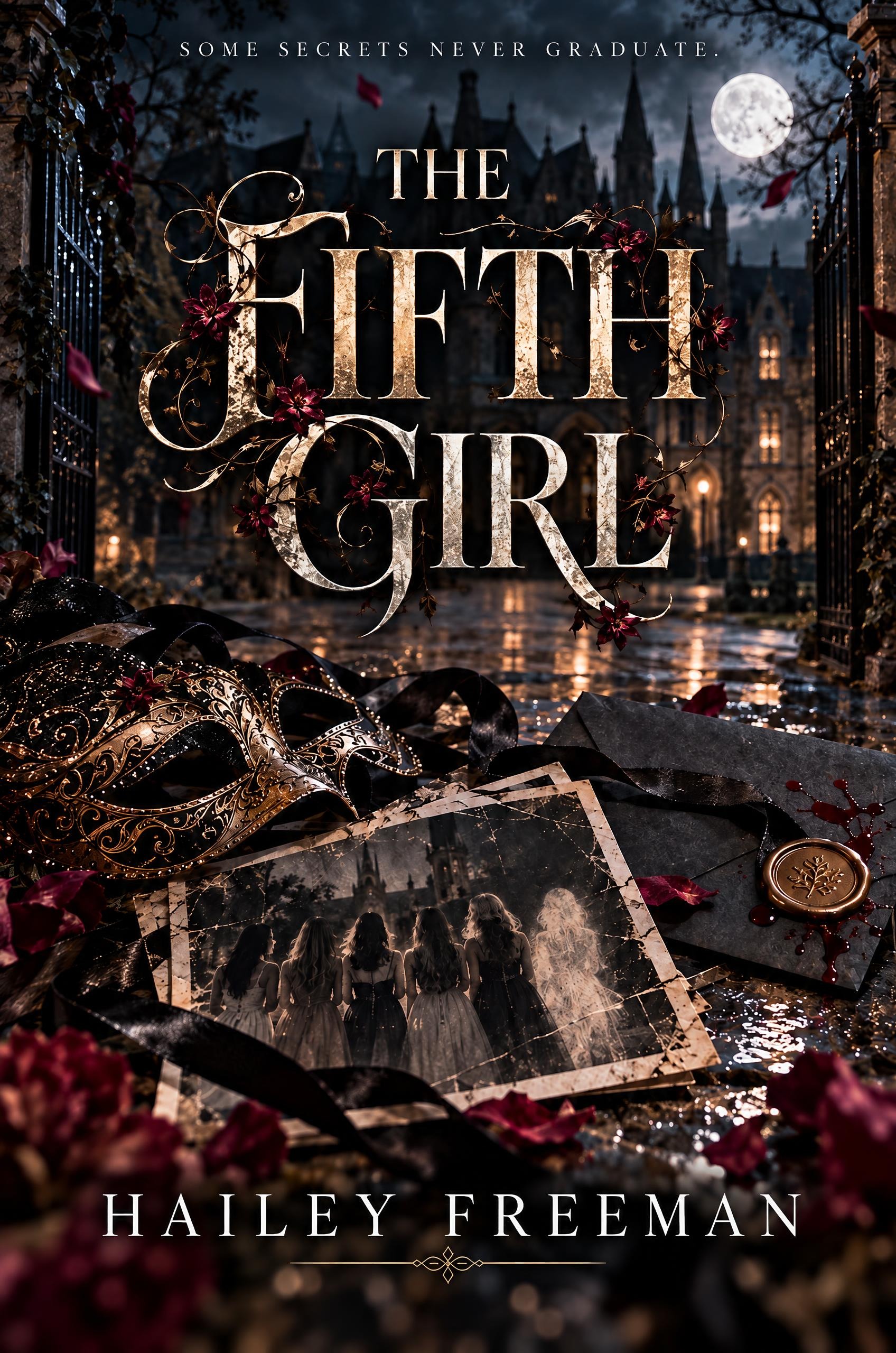
THE FIFTH GIRL
They buried one girl. The woods kept another.
Ten years after Eden Vale vanished from Blackthorne Academy’s masquerade, attorney Sloane Mercer receives a black envelope that should not exist: Eden has already RSVP’d. Sloane, Ivy, Maren, and Delilah return to the campus they swore they would never see again. Detective Roman Vale—Eden’s brother, Sloane’s first love—has spent a decade certain they lied about leaving her in the woods. Then a tormentor calling itself E starts leaking their worst secrets and old photographs. A second watcher stalks them too, but this one keeps them alive. When Eden’s body is found, it proves she lived for months after that night. Their memories of the woods do not match. And in the original photograph, Sloane finally sees a sixth girl they had forgotten: Lennon Pierce. The mystery was never only what happened to Eden. It is what they did to Lennon.
- Thriller
- Mystery
- Romance
- Psychological Thriller
- Stalker Thriller
- Missing Person
THE INVITATION
The mail had arrived while Sloane Mercer was on a conference call with outside counsel, which meant she did not touch the pile until seven in the evening. Her house in the outer borough sat deep back from the curb, tucked behind a pair of overgrown hemlocks that cut off the streetlamps and left the lower windows in gray twilight long before the sun completely gave up. She kicked off her heels by the front mat, carried her briefcase through to the kitchen, and set the bundle of envelopes down between a ceramic fruit bowl she never filled and an empty coffee mug from six that morning.
Most of it was routine paper that kept an attorney’s private household afloat: utility bills, a quarterly statement from her retirement account, two glossy flyers for high-end dry cleaners that claimed to deliver to the neighborhood, and an unsolicited catalog from a furniture store she had visited once three years earlier. She sorted them by rote, sliding thumb under flap, discarding what required no thought, and setting aside what needed an electronic payment.
Then she reached the bottom of the stack.
The envelope was thick, heavy-stock matte black paper that absorbed the harsh white glow of the kitchen recessed lighting. Her name was penned across the front in white ink: Ms. Sloane Mercer, slanted slightly to the right, written with a steady, deliberate hand that did not falter on the ascenders or the loops. There was no stamp, no postal cancellation bar across the top corner, and no return address in the corner. Someone had bypassed the regional distribution center entirely, walked up her winding flagstone path, and dropped it through the brass slot in her front door.
She turned it over. The reverse was sealed with a circle of black wax pressed flat, stamped cleanly with the crest of Blackthorne Academy: the shield split by a quill and an iron key, encircled by the familiar Latin motto that every sophomore was forced to memorize during orientation. It had been ten years since she had worn the blazer with that crest stitched over her left breast pocket. Ten years since she had set foot on the grounds in Upstate New York, and almost as long since she had allowed herself to speak the school’s name aloud in casual conversation.
Her initial impulse was simple and clean. She took two steps toward the stainless steel trash can beneath the sink, her foot hovering over the pedal. High school reunions were an exercise in performative nostalgia for people who had nothing better to do than measure their present against who they used to be behind locked dormitory doors. She had an active caseload, two motions to compel due before the county clerk by noon on Friday, and a life she had carefully pieced together out of long working hours and quiet evenings where nobody asked her questions about the woods behind the chapel.
She slid her thumb under the wax seal anyway.
The seal cracked with a dry, sharp pop. Inside rested a single card of identical black cardstock, edged in foil that caught the halogen glare above her island. The formal script invited the graduating class of ten years prior to gather on the third weekend of October in the Great Hall for an anniversary masquerade gala, followed by a weekend of commemorative alumni events. It was signed by the interim headmaster, printed in standard institutional boilerplate that sounded hollow and grand.
Then her eyes dropped below the printed text to the lower margin.
Directly beneath the RSVP deadline, someone had written a second line in the same white ink that appeared on the exterior envelope. The handwriting was different from the address on the front. It was sharper, smaller, and tilted backward in an unnatural, deliberate slant:
You should come. Eden already RSVP'd.
Sloane remained motionless at the counter. The refrigerator hummed against the quiet of the kitchen, cycled through its compressor rhythm, and shut off with a faint click. Her thumb pressed hard against the cardstock until the heavy corner bit into the soft pad of her skin. The white ink was dry, set deep into the fibers of the paper, completely permanent.
Eden Vale had been legally dead for seven years.
The declaration had taken three years of formal filings, two probate court hearings in Dutchess County, and an endless stream of official notices published in regional newspapers that nobody read. Roman had fought it every step of the way, filing motions of his own, dragging county investigators to the stand to testify that a lack of a body did not constitute definitive proof of demise, but the law did not trade in grief or family stubbornness. When seven years elapsed without a trace, without a single credit card transaction, hospital record, or border crossing, the surrogate court judge signed the decree, and Eden Vale ceased to exist as a missing person. She became an entry in the county archives, an open investigation filed under cold-case homicide, and an empty plot in the family cemetery next to her mother.
Sloane looked down at the words again. Eden already RSVP'd.
It was a cruel joke, she told herself. The alumni association was sloppy with its mailing lists, or some bitter former classmate who had followed the news coverage a decade ago thought it was amusing to scrape open old wounds. Blackthorne had never lacked for cruel people; the place bred them like ivy on damp stone. But whoever had penned the line had known precisely which buttons to push, and they had bypassed the postal service to drop the paper directly onto her hardwood floor.
She reached for her cell phone on the counter, her fingers cold. She unlocked the screen, scrolled through a contact list filled with judges, court reporters, paralegals, and corporate clients, down to an archived contact folder labeled simply Blackthorne that she had not opened in years. There were three numbers inside. She tapped the first without letting herself pause to reconsider.
The line rang four times. She expected voicemail, an automated message announcing that the subscriber was unavailable, or perhaps a changed number after nine years of absolute silence. But on the fifth ring, the call connected with a faint scrape of static.
"Sloane?"
The voice was higher than Sloane remembered, tightened at the edges by a careful, brittle restraint, but unmistakably Ivy Calloway. In the background, a television was playing something low and monotone, perhaps a cooking show or evening news.
"You got it too, didn't you?" Sloane said. She did not offer a greeting, did not ask about Ivy's husband or the life Ivy had built in Connecticut behind limestone gates.
A long silence followed on the other end of the line. The sound of Ivy’s breathing came through the receiver, shallow and controlled. When Ivy spoke again, the polished veneer had dropped entirely.
"A black envelope," Ivy said, her words dropping to a near-whisper. "Delivered to my front gate this morning. The gardener brought it up with the mail. Richard was sitting right across from me having coffee. I had to shove it into my purse before he noticed the school's seal."
"The white ink at the bottom," Sloane said.
"I saw it." Ivy's voice fractured slightly on the last word. "Sloane, it makes no sense. It’s been ten years. Nobody talks about that night anymore. Nobody even comes out to our place unless they're invited. Who could have known where I live now?"
"People who want things found usually know where to look," Sloane replied, her tone level despite the tightness in her chest. "Has anyone else called you?"
"Maren did. An hour ago." A faint rustle of clothing came through the speaker as Ivy shifted positions. "She was at the studio in Manhattan. Somebody left one on her desk in the production office. Not mailed. Slipped in between her research folders while she was in a recording booth. She was hysterical at first, then she got that reporter tone she uses when she’s cornered. She thinks it’s someone trying to set up an expose on her."
"And Delilah?"
"Maren reached her right before she called me," Ivy said. "Delilah didn't say much. You know how she is. She just looked at it, confirmed the sentence at the bottom, and told Maren she wasn't going to lose sleep over high school garbage. But she didn't hang up either. She stayed on the line for ten minutes just listening to Maren breathe."
Sloane stared down at the kitchen counter. The four of them had not been in the same room since the final police interview in the basement of the Dutchess County sheriff's substation ten years ago. They had sat in hard plastic chairs with paper cups of water, their parents and lawyers hovering behind them, repeating the exact same sequence of events until the investigators ran out of questions. Eden walked back toward the dormitory alone. She was upset about an argument. We stayed by the bonfire for another twenty minutes. We never saw her again.
They had said it so many times it had become a chant, a shield that kept the state police from tearing their futures to shreds. But it had not been the truth, and every girl in that room had known it.
"What did Maren want to do?" Sloane asked.
"She wants to go," Ivy said, her voice dropping lower, as if someone in her quiet Connecticut house might be listening from the corridor. "She thinks whoever wrote this has something. Real evidence. She said if someone has letters, or photographs, or whatever was left behind out there, they're going to use the reunion to dump it. Her podcast deals with cold cases now, Sloane. Her whole career is built on being the person who digs up the past. If somebody drops our names into the press with proof that we lied to the state police ten years ago, her sponsors will drop her by morning. And Richard..." Ivy trailed off, her breath hitching. "Richard is looking for an excuse to renegotiate our prenuptial agreement. If my name gets dragged into a homicide investigation, I lose everything."
"There is no homicide investigation," Sloane said firmly. "There is an open missing persons file and an empty grave."
"Then explain the note," Ivy countered, a sharp edge cutting through her fear. "Explain why all four of us got the exact same message on the exact same day in four different locations. That isn't an alumni committee sending mass mailers. That is someone who watched us, found us, and waited for the ten-year mark to remind us that we aren't clear."
Sloane ran a hand through her hair, turning toward the kitchen window that looked out over the driveway. The trees were dark against the street, their needles shifting slightly in an evening breeze. "Delilah agreed to go?"
"Delilah said she'll be there on Friday evening," Ivy said. "She said if somebody wants to throw accusations at her, she’d rather see their face while they do it. Are you coming, Sloane? Because if you stay in the city, and the three of us are there alone, we look guilty before anyone even opens their mouth."
The legal logic was sound, even if it came wrapped in Ivy's perpetual panic. A united front had kept them safe a decade ago; scattering now would only make them vulnerable to whoever was pulling the strings. If an anonymous person was trying to stage a confrontation at Blackthorne, being in the room was the only way to control the damage.
"I'll be there," Sloane said. "Friday afternoon. We meet at the gatehouse before the welcome reception. Nobody talks to anyone outside our group about the notes until we figure out who sent them."
"What about Roman?" Ivy asked, the name dropping between them like an anchor.
Sloane’s hand tightened on the receiver until the plastic creaked. "What about him?"
"He's a detective now. Upstate. He works out of the county bureau that holds Eden's file." Ivy paused, letting the silence sit. "You think he doesn't know about the reunion? You think he isn't going to be there?"
"Roman has spent ten years looking for a ghost," Sloane said, her voice turning flat and cold. "If he had anything new, he would have served me with a subpoena, not a party invitation. We don't worry about Roman Vale. We worry about whoever paid for this cardstock."
She hung up before Ivy could offer another layer of suburban dread. The call disconnected with a sterile chirp, leaving the house completely silent once more.
Sloane stood by the counter for several minutes, the invitation card still resting under the harsh kitchen lights. Her mind worked through the mechanics of the lie they had told. They had spent ten years pretending that Eden had simply drifted away into the dark, a tragic runaway who fell victim to the elements or a stranger along the state route. But Sloane still remembered the smell of the damp pine needles, the sound of branches snapping in the dark, and the absolute certainty that Eden had not left that clearing on her own terms.
She folded the black card back into its envelope and walked through the dining room toward the front of the house. The hardwood floors were cool beneath her bare feet. The house was older, built in the twenties, with deep crown moldings and thick sash windows that rattled whenever the delivery trucks rumbled down the boulevard. She reached the living room, intending to switch on the floor lamp by the armchair, but stopped before her hand found the switch.
The living room windows looked out across the narrow front lawn toward the quiet residential street. Directly opposite her driveway, parked beneath the heavy boughs of an unpruned maple where the municipal streetlight failed to reach, sat a vehicle.
It was a large black SUV, late-model, devoid of chrome trim or identifying decals. The engine was idling; she could see the faint curl of exhaust drifting past the rear bumper into the cool night air. The windows were tinted dark, reflecting only the dull amber glow of a neighbor's porch light across the street. It sat perfectly parallel to the curb, positioned at an angle that gave whoever was behind the wheel an unobstructed view of her front porch and the wide front windows of her ground floor.
Sloane stepped back into the shadow of the velvet drapes, keeping her shoulder pressed against the plaster wall. Her pulse thudded evenly in her throat, steady but fast, the familiar courtroom adrenaline taking over her limbs. In her work, she dealt with corporate fixers, angry litigants, and private investigators who specialized in quiet surveillance, but those men worked with a professional distance. They parked two blocks away and used telephoto lenses from the back of nondescript sedans. They did not idle directly across from a subject's front door with their exhaust smoking in the cold.
She watched the vehicle through the gap between the curtain and the wooden frame. For three long minutes, nothing moved. No headlights flashed, no door opened, and no dome light illuminated the interior. It simply sat there, dark and monolithic against the curb, a silent watcher waiting for her to move.
She reached into her pocket, pulled out her phone, and tapped the camera app, stepping closer to the glass to clear the reflection of her own living room. But before she could bring the lens level with the pane, the SUV’s parking lights clicked on. A low rumble drifted across the street as the driver shifted into gear. Without accelerating aggressively, without the squeal of tires or the sudden glare of high beams, the black vehicle rolled away from the curb, glided past the neighbor’s hedge, and turned down the cross street into the darkness.
Sloane blinked against the gloom. The street was empty now, save for an old station wagon parked two houses down and the leaves blowing across the asphalt. It was as if the car had never been there at all, a momentary shadow conjured by an overworked brain and an old invitation.
Then the phone in her palm vibrated with a sharp, heavy buzz.
The screen lit up, illuminating her fingers with a cold blue square. It was an incoming text from an unlisted number—no area code, no contact entry, just an empty header displaying UNKNOWN.
She tapped the notification.
The message was three words long, set in plain typography against the black background:
Don't go back.
Sloane stared at the screen. The letters seemed to float against the glass, precise and authoritative. It was not the theatrical phrasing of the black envelope; there was no mention of masquerades, no clever references to RSVP lists, and no mocking signature. It was a direct command from someone who knew exactly where she had been looking two seconds ago.
Her thumbs moved across the keyboard, quick and defiant.
Who is this?
She hit send. The blue bubble appeared on the screen, accompanied by the quiet whoosh of outgoing data. She waited, watching the bottom of the thread for the small gray ellipses that would indicate the person on the other end was typing an answer.
One minute passed. The screen dimmed, then went black. She tapped it awake again. The status remained set on Delivered. Nothing else followed.
Sloane lowered the phone to her side and turned back to the window. Outside, the street was entirely still, the maple leaves rattling against each other in the rising wind. She reached up with one hand, gripped the heavy brass latch of the sash window, and threw the lock home with a loud, final click.
FOUR GIRLS
The wrought-iron gates of Blackthorne Academy were thrown wide, fixed back against the fieldstone pillars by heavy iron hooks that had rusted into place decades ago. Beyond them, the asphalt drive cut straight through two miles of old-growth hemlocks and sugar maples, their crowns meeting overhead to blot out the October sky. Sloane Mercer rested h…