

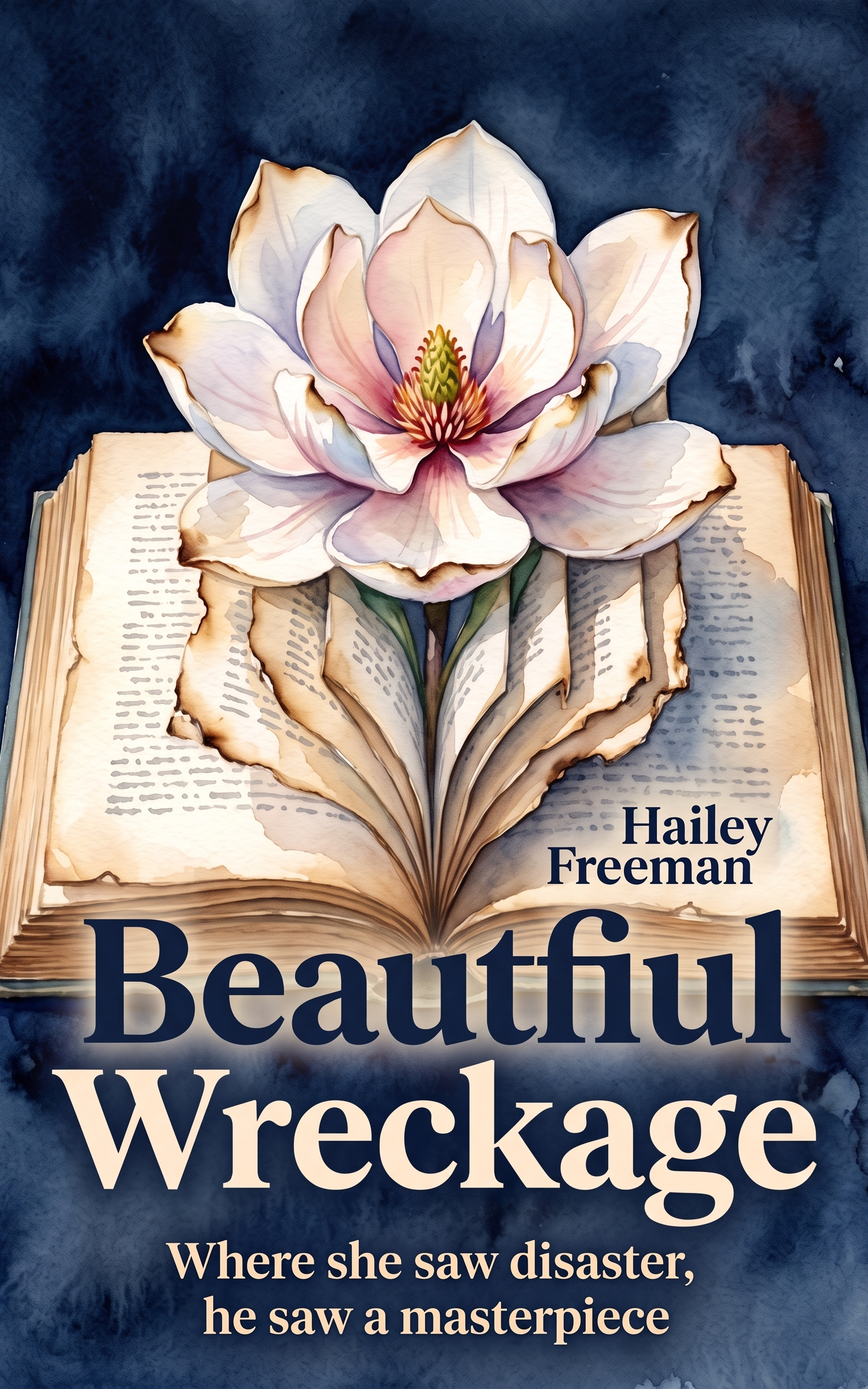
Beautfiul Wreckage
Where she saw disaster, he saw a masterpiece
by hailey freeman
At eighteen, Ava knows one thing for certain: love is a temporary glitch. After years of emotional distance from her mother and being discarded by those she trusted most, she has built a fortress around her heart. She isn’t just broken; she is a self-appointed wrecking ball, determined to destroy any connection before it can destroy her. Then she meets Ethan in a quiet corner of the library. He is sixteen, steady, and impossibly patient. He sees the cracks in her armor and refuses to look away. Ava does everything in her power to drive him off—she picks cruel fights, makes reckless mistakes, and lashes out with calculated coldness. She is waiting for the moment he realizes she isn't worth the trouble. But Ethan doesn't leave. Spanning over twenty years, Beautiful Wreckage is an emotional epic that follows Ava from the depths of self-sabotage to the heights of a life well-lived. Through panic attacks and financial struggles, from a library-aisle proposal to the chaos of raising six children, Ethan remains the anchor she never thought she deserved. This is a story for anyone who ever felt unlovable, proving that healing isn’t about becoming perfect—it’s about finally letting someone stay.
- Young Adult
- Romance
- YA Contemporary
- First Love
- YA Coming of Age
- Slow Burn Romance
Chapter One
I learned early that love is just another word for temporary.
My mother taught me that. Not with words—she was never cruel enough to say it out loud—but with the way she'd look past me when I walked into a room, like I was furniture she'd grown tired of dusting around. With the way her phone was always more interesting than whatever I was trying to tell her. With the way she'd sigh when I needed something, like my existence was an inconvenience she hadn't quite figured out how to return.
I was seven the first time I understood that I was too much. Too loud, too needy, too present. I'd made her a card for her birthday—construction paper and glitter glue, the kind of thing kids make because they don't know yet that love can't be crafted from art supplies. She'd smiled, the kind of smile that doesn't reach anywhere important, and set it on the counter. I found it in the trash three days later, buried under coffee grounds and junk mail.
I stopped making cards after that.
By the time I was ten, I'd learned to make myself smaller. Quieter. I'd slip through the house like a ghost, trying not to need anything, trying not to be noticed. I thought maybe if I took up less space, she'd have room for me. But the smaller I made myself, the easier I became to overlook entirely.
She never hit me. Never screamed. Never did anything that would leave a mark someone else could see. She just... wasn't there. Even when she was standing right in front of me, she wasn't there. And somehow that was worse than if she'd just left completely, because I kept hoping. Kept thinking that maybe tomorrow she'd look at me and actually see me.
She never did.
I'm eighteen now, and I've stopped hoping for a lot of things.
I learned that friends are just people who haven't found a reason to leave yet. Melissa was my best friend for six years—six years of sleepovers and shared secrets and promises that we'd be friends forever. Then her parents got divorced and she needed someone, really needed someone, and I tried. God, I tried. But I didn't know how to be what she needed because no one had ever taught me what that looked like. She started avoiding my calls. Started making excuses. Started hanging out with girls who knew how to comfort people, who hadn't grown up in houses where emotions were something you kept to yourself like a shameful secret.
She didn't even tell me we weren't friends anymore. She just... drifted. Like I was a shore she'd finally found a current away from.
I told myself it didn't matter. That I didn't need her anyway.
I told myself a lot of lies back then.
Then there was Marcus. Seventeen years old and convinced I'd found someone who actually wanted me. He said he loved me—said it after two months, said it like he meant it. And I believed him because I was desperate to believe that someone could look at me and see something worth keeping.
We lasted four months.
Four months of me trying to be perfect, trying to be easy, trying to be the kind of girl someone could love without it feeling like work. Four months of swallowing every need, every fear, every moment of vulnerability because I knew—I knew—that if I asked for too much, he'd realize what everyone else already had.
That I wasn't worth the effort.
He broke up with me in his car, engine still running like he couldn't wait to drive away. Said he needed space. Said it wasn't me, it was him. Said all the things people say when they mean "you're too much and not enough all at once, and I'm tired of pretending otherwise."
I didn't cry. Not in front of him. I just nodded and got out of the car and watched him drive away, and I thought: Of course. Of course this is how it ends. This is how it always ends.
I cried later, alone in my room with my hand pressed over my mouth so my mother wouldn't hear through the walls. Not that she would have come if she had. Not that she would have asked what was wrong.
After Marcus, I stopped trying to be perfect. What was the point? People were going to leave anyway. At least if I stopped pretending, stopped performing, I could tell myself they were leaving because I wanted them to. That I was in control of the inevitable.
I started picking fights over nothing. Started saying the cruelest thing I could think of just to watch people flinch. Started making choices I knew were reckless, stupid, self-destructive—staying out until three in the morning, drinking too much at parties I didn't want to be at, kissing boys whose names I didn't bother learning because what did it matter? They'd be gone by morning anyway.
At least when I pushed people away, I got to pretend it was my choice.
At least when I destroyed things before they could destroy me, I got to feel like I had some kind of power.
I'm good at it now. The destruction. I've turned it into an art form. I can spot the exact moment someone starts to care, and I know exactly what to do to make them stop. A cutting comment. A disappearing act. A fight that comes out of nowhere and lands like a grenade in the middle of whatever fragile thing we were building.
I tell myself I'm protecting them. That they're better off without me. That I'm doing them a favor by showing them who I really am before they waste too much time figuring it out themselves.
But the truth—the truth I don't let myself think about most days—is that I'm protecting me. Because if I push them away first, if I'm the one who ends it, then I don't have to feel the way I felt watching Marcus's taillights disappear. I don't have to feel the way I felt finding my birthday card in the trash. I don't have to feel the way I've felt my entire life: like I'm something people tolerate until they find something better.
I'm eighteen years old, and I've already learned that I'm not the kind of person people fight for.
I'm the kind of person people leave.
My apartment is small, a studio I can barely afford with the money I make waitressing at a diner where the coffee tastes like regret and the regulars know better than to ask me how I'm doing. I keep it sparse—a mattress on the floor, a lamp, a few clothes in a pile that might technically count as organized. I don't decorate. Don't hang pictures or buy throw pillows or do any of the things that would make it feel like a home.
Because home is just another temporary place. Another thing I'll have to leave eventually.
I moved out the day I turned eighteen. My mother didn't try to stop me. Didn't ask where I was going or if I had a plan or if I'd be okay. She just watched me pack my things into garbage bags—because I didn't own suitcases, because we weren't the kind of family that took trips—and said, "You'll need to leave your key."
Not "I'll miss you." Not "Please stay." Not "Let me help you."
Just: "You'll need to leave your key."
I left it on the kitchen counter and walked out, and I haven't been back since.
Sometimes I wonder if she's noticed I'm gone. If she's walked past my empty room and felt anything at all. But mostly I don't let myself wonder, because I already know the answer, and knowing hurts worse than not knowing ever could.
I work nights mostly, come home when the sun is starting to think about rising, and sleep through the parts of the day when people are out living their lives. It's easier this way. Easier to avoid the world when the world has made it clear it doesn't have space for me in it.
I don't have friends anymore. Don't date. Don't let anyone close enough to matter.
I've built walls so high I can't see over them anymore, and I tell myself that's safety. That's smart. That's survival.
But late at night, when I can't sleep and the silence in my apartment feels like it's pressing down on my chest, I wonder what it would feel like to let someone in. To be seen—really seen—and not found lacking. To be loved not despite who I am but because of it.
Then I remember that I already know what that feels like.
It feels like hope.
And hope is the most dangerous thing I've ever touched.
So I stay here, in my small apartment with my sparse belongings and my carefully maintained distance from anything that could hurt me. I go to work, I come home, I sleep, I repeat. I move through my life like I'm underwater, everything muffled and distant and safe.
I'm eighteen years old, and I'm so tired of being this person.
But I don't know how to be anyone else.
I don't know how to stop bracing for the inevitable moment when whoever I'm with realizes what my mother realized, what Melissa realized, what Marcus realized: that I'm not worth the effort of staying.
So I don't try.
I just wait.
Wait for the next person to leave, the next rejection, the next confirmation that I was right all along.
That love is just another word for temporary.
And I'm the kind of temporary that people can't wait to be done with.
Chapter Two
I meet him on a Tuesday.There's nothing special about Tuesdays. They're the forgotten middle child of the week—not the fresh start of Monday, not the relief of Friday. Just another day that bleeds into the next, unremarkable and gray.I'm at the library because it's warm and free and I have three hours to kill before my shift at the diner. I've been…