
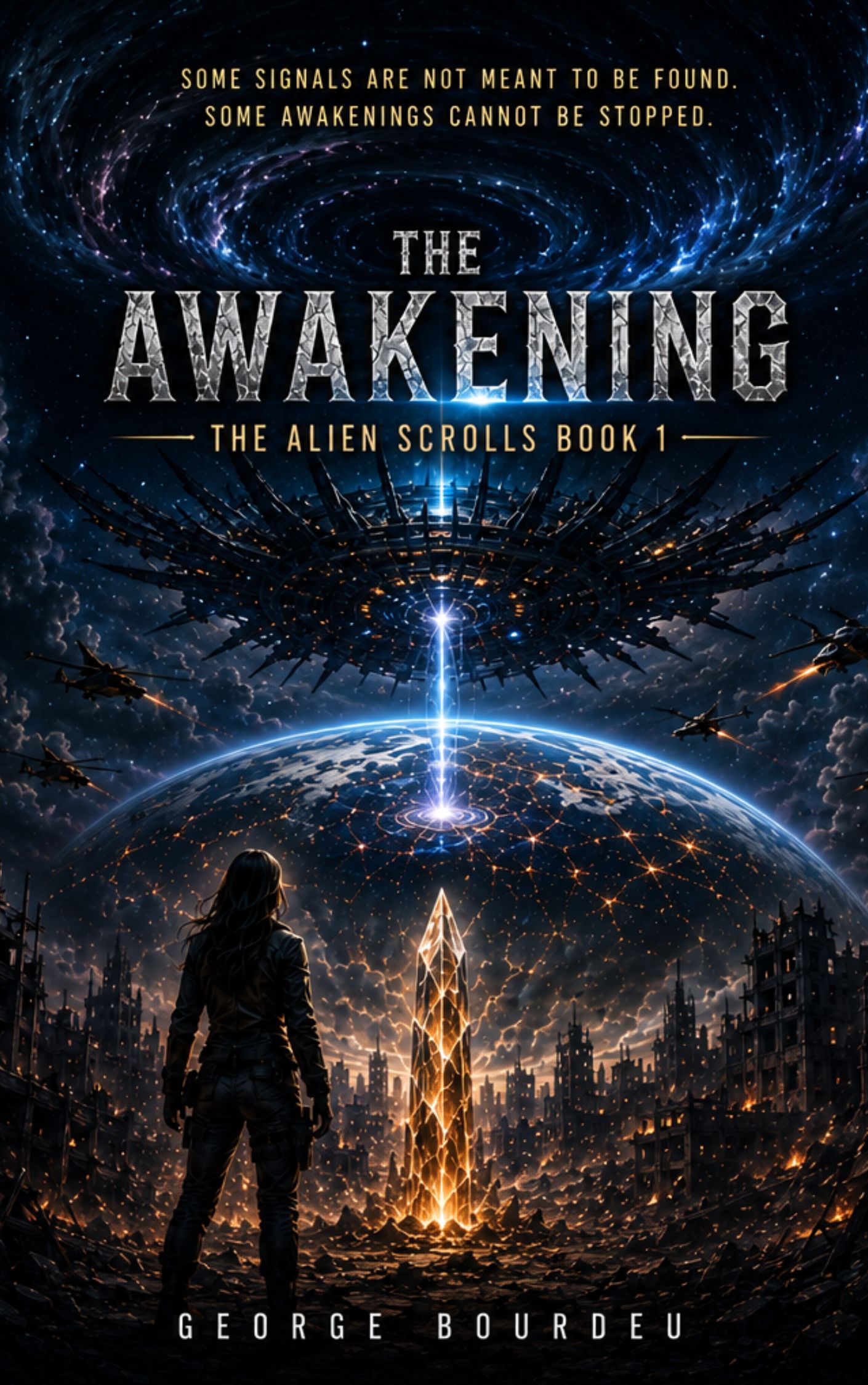
The Awakening The Alien Scrolls Book 1
When the stars align, the children turn and the pyramids rise to harvest humanity.
by George Bourdeu
The world didn't end with a bang or a whimper; it ended with a blackout and the pale, haunting stare of our own children. When a rare cosmic alignment and a blood moon trigger a global catastrophe, modern civilization collapses in an instant. But the darkness is only the beginning. Every child under the age of thirteen has had their hair bleached bone-white, their eyes turned into bottomless pits of ink. They are no longer individual souls; they are a hive-mind enforcer for an ancient, alien power, wielding a lethal 'suicide-curse' over any adult who dares to resist. Dr. Elena Vance, a linguist who was cataloging impossible scrolls when the lights went out, now watches in horror as her nine-year-old son, Leo, helps oversee the construction of massive, life-draining pyramids. These are not monuments, but cosmic siphons designed to power a biomechanical nightmare overseen by entities known as the Wardens. Teaming up with Brian Bell, a tracker who has spent years mapping the glyphs in secret, Elena must navigate a world where a single rebellious thought can be a death sentence. To save her son and the remnants of the human race, she must steal the very scrolls that started it all. The Awakening of the Alien Scrolls, Book 1 is a chilling descent into cosmic horror where the faces we love most become our greatest hunters.
- Science Fiction
- Horror
- Thriller
- Post-Apocalyptic
- Cosmic Horror
- Dystopian
The Glass Horizon
The vault had its own kind of silence. It was not the silence of an empty room. It was something older. The air sat at a constant fifty-five degrees to slow decay. Every sound Elena made was absorbed before it could travel very far. She had always found comfort in that stillness. Tonight it felt different.
She leaned closer to the examination table, adjusting the angle of her magnifying lamp until the light fell across the surface of the scroll in a thin, even wash. The artifact was roughly eighteen inches across, rolled and then unrolled so many times over its unknown lifetime that the edges had developed a faint, persistent curl. The material itself was the first problem. It wasn't papyrus, and it wasn't vellum. The lab analysis had come back three weeks ago with results that her colleague Dr. Marsh had described, with characteristic understatement, as inconclusive. The molecular structure didn't match any organic compound in the database. It sat somewhere between mineral and biological tissue, and it had not aged in any measurable sense. The carbon dating had returned numbers that the machine simply refused to process, cycling through error codes until the technician restarted the whole system.
Elena wrote that down in her notes. She wrote everything down.
The glyphs were the second problem. She had spent eleven years studying ancient languages, and she could recognize the visual grammar of almost any script that had existed between five thousand BCE and the medieval period. These glyphs shared the geometry of several systems simultaneously. There were echoes of proto-Sinaitic, faint suggestions of Linear A, structural patterns that reminded her of the Indus Valley script, and then, woven between all of that, something else entirely. Something with no precedent. The symbols didn't arrange themselves in any direction she could fix. They moved around the page in spiraling clusters, doubling back, overlapping, as though the writing was less a sequence and more a kind of architecture.
She had been calling them the Alien Scrolls in her private notes for two months. She had not told anyone.
She straightened and pulled off her glasses, pressing two fingers against the bridge of her nose. Through the small, high window set into the vault's far wall, she could see a strip of the night sky. She'd checked the astronomy calendar that morning out of habit, the kind of professional curiosity that came with cataloging artifacts tied to celestial events. Tonight was the alignment. A rare convergence of three outer planets that had last occurred in the late Bronze Age, paired with a blood moon that had been building in the news cycle for weeks. The meteorology department had been fielding calls all day from reporters, and the observation decks at the university were booked solid.
Elena had stayed in the vault. The scrolls were more interesting than the sky.
She picked up her pen and turned back to her notes, trying to reconstruct the logic of the third cluster of glyphs from the upper left quadrant of the largest scroll. There were seven scrolls in total, acquired through a private sale that the museum's acquisitions director had handled with unusual secrecy. Elena knew better than to push on that particular thread. The work was what mattered. The origin story of the collection was someone else's problem.
She was halfway through a sentence when the light changed.
It was subtle at first. The scroll's surface, which had always appeared a dull, clay-colored brown under the examination lamp, seemed to take on a faint warmth. She blinked, thinking it was fatigue — she'd been down here since seven in the morning and it was well past ten at night. She set down her pen and looked directly at the scroll, and this time there was no question. A glow was rising from inside the material itself. It was violet, the specific, bruised purple of a fresh contusion, and it moved in slow, rhythmic pulses.
Elena wanted to reach for her camera. Then she hesitated and stepped back.
She stepped back.
The glow deepened. The pulses were slow and lazy. As she watched them, the hair on her arms rose under her lab coat. The rhythm was familiar. It matched her heartbeat exactly. The violet light pulsed in perfect synchronization with her own body.
She pressed her fingers to her wrist. Checked. Sixty-two beats per minute. The scroll pulsed sixty-two times per minute. She counted twice to be sure.
"What are you?" she said aloud, which was something she rarely did in the vault. The words sounded thin and strange in the pressurized air.
The scroll did not answer, but all seven of them were glowing now. She hadn't noticed the others starting. They had simply arrived at their current state, all pulsing together, filling the vault with a light that threw unfamiliar shadows across the shelving units and turned the white walls the color of a bruise. The temperature hadn't changed. The humidity sensors on the wall showed normal readings. Whatever was happening, it wasn't registering on any instrument she trusted.
She moved to the vault's interior phone and picked up the receiver to call the night security desk. The line was dead. Not the flat, electronic dead of a disconnected call, but genuinely silent, the way a phone is silent before anyone has invented electricity. She set it down slowly.
The backup generators, which ran on a separate circuit and were tested every quarter, made a sound she had never heard them make before. It was a long, declining hum, like a voice running out of breath. Then they stopped.
The examination lamp went dark. The overhead fluorescent followed. The only light left in the vault was the light coming from the scrolls, and in that violet glow Elena stood very still for a moment, aware that something had just crossed a threshold she couldn't name.
She went to the window.
The vault's high window was narrow, barely eight inches tall, set just above street level on the building's east side. Standing on her toes, she could see the museum courtyard and, beyond its iron fence, a section of the city's main boulevard. What she saw made her press her hand flat against the cold glass.
The city was going dark. It did not happen like a normal power outage. The darkness moved in a cascading wave from the horizon inward. The streetlamps on the boulevard cut out in sequence. Behind them, the lit windows of office buildings and apartments extinguished. It happened quickly. The darkness fell with a physical weight.
Within thirty seconds, the city was gone.
What replaced it was not ordinary dark. There was no residual light. The darkness was total and the sky was wrong. The blood moon hung enormous and red at the zenith. The sky around it was no longer black. It was the same bruised purple as the light from the scrolls. The color shifted like slow smoke trapped behind glass.
She stared at it for a long moment, her breath fogging the window.
Below, in the museum courtyard, there were children.
She had forgotten about them. There had been a school group in the building that afternoon. She remembered hearing them from the vault air duct earlier. There had been laughter and the squeak of sneakers on marble. Eventually the noise had faded. She assumed they had gone home. But they were still in the courtyard.
They were standing in a loose cluster near the central fountain, and they were absolutely still.
They were not still in the way children are when they are frightened. They did not huddle or look around for adults. They were still like stones. Their arms hung at their sides. Their faces were turned upward toward the purple sky and the red moon.
Then the sound began.
It was low, sub-bass, the kind of frequency that registers in the chest before the ear processes it. A hum, collective and unified, coming from the children in the courtyard. It built slowly, not in volume but in density, thickening the air the way humidity thickens before a storm. Elena felt it through the vault's stone floor, through the soles of her shoes, up through her legs. It was not an unpleasant sensation, which somehow made it worse. There was something almost lulling about it, a frequency that pressed gently at the edges of conscious thought.
She stepped back from the window.
The scrolls were pulsing faster now. They still matched her heartbeat as it rose. She turned to look at them in the violet light. She felt a precise and unmistakable sensation. She was being read. Something was passing through her and extracting information. The scrolls were the instrument.
The feeling hit the back of her skull like a needle. It was sharp and localized. It was a point of entry. Something had touched the back of her mind and withdrawn. It left a faint residue behind.
Elena pressed the back of her hand against her mouth and stood in the middle of the vault, surrounded by pulsing violet light, and made herself think clearly.
The alignment. She had known about it for weeks and filed it as context, relevant background for understanding why certain ancient cultures had associated the scrolls' glyphs with specific astronomical events. She had written in her notes that the connection between the script and celestial cycles was likely symbolic, culturally meaningful rather than literally functional. She had been very confident about that.
She thought about those notes now with something that was not quite embarrassment and not quite dread. It sat somewhere between the two.
The scrolls were the receiver. She understood that with absolute clarity. The alignment had sent a signal. The scrolls had been waiting in this vault to receive it. She thought about the unusual secrecy of the acquisition. She thought about the lab results that returned error codes. The glyphs refused to organize into any linear grammar.
She thought about the needle-point sensation at the back of her skull.
Outside, the children's hum continued, steady and dense. It didn't waver. It didn't change pitch. It pressed against the vault walls with the patience of something that had no concept of hurry.
Elena picked up her notebook from the examination table, the physical, analog one she kept for observations she didn't want to trust to the building's networked computers. She had written in it every day for the past four months. She held it against her chest now, not because it would protect her, but because it was something solid to hold, something that belonged entirely to the world she had understood an hour ago.
She forced herself back to the window.
The children in the courtyard had not moved, but something about them had changed. In the violet light coming through the vault's small window, and the deep red cast of the blood moon overhead, she could see their faces more clearly than she wanted to. The girl closest to the fountain — small, wearing a yellow rain jacket that seemed absurd in the windless, painless night — had her face tilted toward the sky, and even from this distance Elena could see that her eyes were wrong. The whites were gone. The pupils were gone. The irises were gone. What remained was a solid, uniform black that caught no light at all, that absorbed the violet glow and the red moonlight without reflecting any of it back.
Ink-black. Like the color had been poured in and left to set.
And the girl's hair, which had been dark brown in the normal fluorescent light of the museum that afternoon, was white. Not gray, not silver, not the faded white of age. White the way a blank page is white, total and immediate, as though the color had been removed rather than replaced.
Elena looked at the others. Same eyes. Same hair. Every child in the courtyard, all of them standing with that terrible, stone-still patience, had been altered in exactly the same way.
She became aware that she was gripping the window ledge hard enough that her knuckles ached. She released it and stepped back, and as she did the low hum from the courtyard seemed to shift slightly, to acquire a faint directionality, as though the frequency were turning its attention toward the vault's east wall.
Toward her.
The needle sensation returned. This time it lingered for three full seconds, pressing gently at the base of her skull, and within that pressure she felt something that she could only describe, afterward, as the shape of an intention. Not a thought. Not a word. A direction. A vector. Something vast and patient and entirely indifferent to her as a person, interested only in her as a biological system with certain properties it required.
She moved away from the wall. She moved to the center of the vault, placing herself as far as possible from all four walls, and she stood in the violet light of the scrolls, and she thought, with extreme deliberateness, about nothing at all. It was a skill she had never practiced and was not good at. She focused on her breathing. She focused on the temperature of the air against her forearms. She focused on the physical weight of the notebook in her hands.
The pressure at the back of her skull receded.
She didn't know if that meant anything. But it receded, and she filed that observation carefully in the part of her mind that was still functioning as a researcher, the part that refused to stop noting things down even when every other part of her was pulling in the direction of the vault's heavy door and the corridor beyond it and the stairs that led up and out into a city that was now entirely dark.
The scrolls pulsed. Sixty-eight times per minute, now. Her heart rate was climbing.
She made herself look at them. Really look, the way she looked at artifacts she didn't yet understand: without expectation, without the filter of what she wanted to find. The violet light was uniform across all seven scrolls, and the glyph clusters on each one seemed to have intensified, the markings standing out from the surface with a three-dimensional quality they had never shown under the examination lamp. The spiral clusters she had been studying for months seemed to be moving, not literally, not in the way that objects physically move, but in the way that a figure in an optical illusion seems to move when you've stopped trying to hold it still.
She thought about what she had written in the notes she would never publish. The script does not describe events. It organizes them. She had written that three weeks ago, at two in the morning, after a long session with the fourth scroll, and then she had stared at the sentence for a long time before closing the notebook without explaining what she meant. She hadn't been sure she could explain it. She wasn't sure she could explain it now. But standing here in the vault with the sky turned purple and the children humming in the courtyard and the needle-point presence pressing periodically at her skull, she understood that the sentence was correct in a way she hadn't been ready to accept when she wrote it.
The scrolls weren't a record. There were instructions.
And the alignment wasn't a backdrop. It was a switch.
She thought about how long these scrolls had been waiting. She thought about the acquisitions director's secrecy and the lab technician's error codes and the way the carbon dating machine had simply refused to process the results. She thought about the molecular structure that sat between mineral and biological tissue, preserved without aging, as though preservation had been the point all along — as though whatever had made these scrolls had designed them specifically to outlast every system that might be used to date them.
Something had made them to wait. Something had made them to receive. The signal had arrived tonight with the alignment and the blood moon. The scrolls received it and were now broadcasting it back into the world.
The hum in the courtyard deepened.
Elena closed her eyes. In the darkness she saw the image of the small girl in the yellow rain jacket. The girl stood at the fountain with her face turned up to the wrong sky. Her eyes were filled with solid black. Her hair was bleached to nothing. Thirty children did the same thing in perfect stillness. They were not frightened. They were arranged.
She opened her eyes.
Through the high window, the purple sky shifted above the dark city. The blood moon sat at its peak. Below the window, the hum continued. In the vault, the scrolls pulsed their violet rhythm. Elena stood in the center of it with her notebook pressed against her chest. She finally understood that she had not been studying the scrolls.
The scrolls had been waiting for her to stop.
She thought about Leo. Her son, nine years old, at home across the city with her neighbor Mrs. Park, because Elena had told herself she'd only be a few hours in the vault and had not brought her phone to charge. She thought about the cascading darkness she had watched swallow the boulevard. She thought about the school group, here all afternoon, here still, standing in the courtyard with their altered eyes and their unified voice.
Leo was nine years old.
The thought arrived with a cold weight that had nothing to do with the vault's controlled temperature. It pressed into her chest and sat there, and she let it sit, because pushing it away would require spending energy on denial she didn't have. The city was dark. The children in the courtyard had been changed. Whatever the alignment had sent through the scrolls and out into the world, it had been specific in its targeting. It had found children, and it had altered them, and it had organized them into something that hummed with a single voice.
Leo was nine years old, and he was across the city, and the city was dark.
Elena moved to the vault door. Her access card wouldn't work without power, but the vault had a manual emergency release, a steel lever set into the wall beside the frame that was tested every six months for exactly this scenario. She found it in the violet glow without needing to look, her hands going to it with the automatic familiarity of routine. She pulled it. The locking mechanism disengaged with a sound like a held breath finally released, and the heavy door swung inward.
The corridor beyond was completely dark. The emergency lighting strips that ran along the baseboard hadn't activated, which meant the outage had taken out the emergency systems as well, not just the main grid. Elena held the vault door open with her shoulder and looked into the dark corridor for a moment, listening.
The museum was silent. Not the cultivated, comfortable silence of the vault, but the silence of a building that has lost something essential. The kind of silence that comes after systems fail.
From somewhere above her, faint through the building's stone floors, she could still hear the hum.
She took one step back into the vault. She picked up the battery-powered examination lamp and clicked it on. A narrow beam cut through the dark. She tucked her notebook under her arm. She looked at the scrolls one last time as they pulsed in their violet rhythm. She thought about locking the vault again.
She left the vault door open and walked out into the dark corridor.
The examination lamp threw a narrow path ahead of her, illuminating the familiar details of the museum's service corridor in a different way than she was used to seeing them. The scuff marks on the painted walls. The emergency exit sign overhead was dark for the first time in her memory. The door to the stairwell at the far end, propped open as the cleaning staff always left it, a thin vertical slice of slightly lighter dark visible through the gap.
She walked toward the door. The hum from the courtyard followed her through the walls. It was low and patient. It was the sound of thirty children who had become something else entirely.
She pushed through the stairwell door and paused at the bottom of the stairs, one hand on the railing. Above her, the building rose four floors to the rooftop. Below the main floor, the street, the dark city, the purple sky. Her son across that darkness in a house she could not call and could not reach except by walking toward it through whatever the world had become in the last thirty minutes.
She started up the stairs.
The notebook was still pressed against her chest, and in the vault below her the scrolls continued their violet pulse, sixty-eight times per minute, steady as a heartbeat, waiting for whatever came next.
Above the museum, the blood moon hung at its peak. The sky around it moved like something alive, purple and swirling and enormous, and the darkness below it was total and absolute and new. The world the city had been an hour ago was already a different country, already sealed off behind the moment the lights went out, already past the point of return. Elena Vance climbed toward it with her lamp and her notebook and her fear, and the hum rose around her like water rising in a sealed room, and she understood, with a precision that left no room for argument, that the alignment had not been an event.
It had been a beginning.
The Ink-Black Stare
The streets were wrong in a way that went beyond the darkness. Elena had walked this route a hundred times, in rain and in winter cold and in the ordinary distraction of a long workday. She knew the angle of the curbs, the places where the sidewalk buckled slightly from tree roots, the corner where the bakery left its exhaust vent running until mid…