
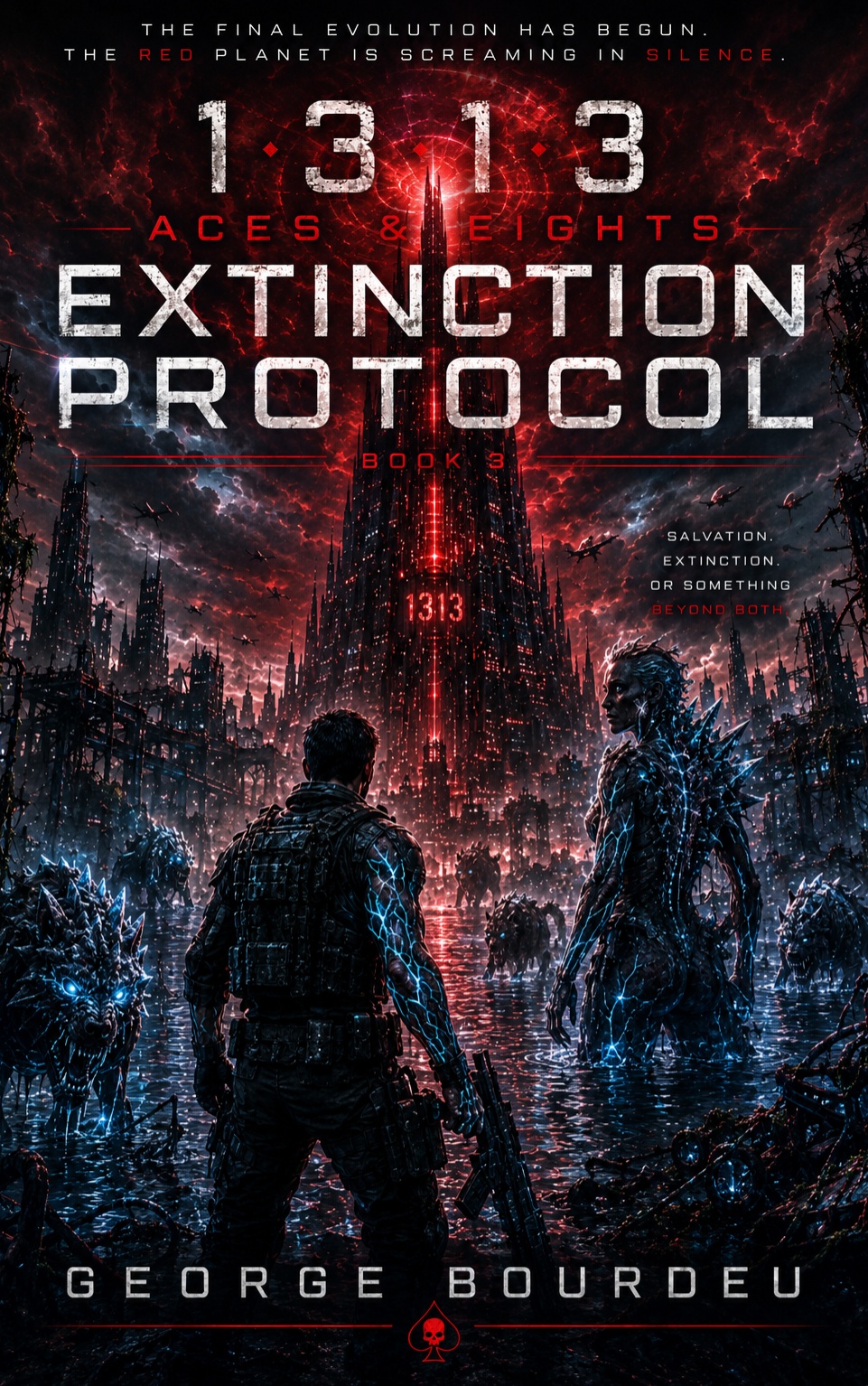
1313 Aces & Eights Extinction Protocol Book 3
The final evolution has begun and the Red Planet is screaming in silence.
by George Bourdeu
The Red Planet is dying, and humanity’s last hope is no longer human. Captain Maverick Jones and the shattered remains of the 1313th Squad are running out of time. As the silicate infection rewrites their DNA, they must descend into the crushing depths of Mars to find the last working launch platform. But they aren't just fighting the clock; they are fighting a planet that is literally being consumed from the inside out. A cosmic entity has burrowed into the Martian core, causing gravity to buckle and ancient tunnels to collapse. Even worse, a radical faction of hybrids has embraced their monstrous new forms, seeking to sabotage the mission and trigger a planetary self-destruct. From the crimson skies to the shifting magnetic storms of the subterranean abyss, Maverick must lead his team through a gauntlet of mechanical guardians and betrayal. As the Red Silence signal prepares to bridge the gap to Earth, the line between savior and monster vanishes. The evolution is non-negotiable, and the price of survival may be the extinction of the human soul. In the pulse-pounding conclusion to the Extinction Protocol trilogy, George Davies delivers a terrifying vision of a future where silence is the only thing left to hear.
- Science Fiction
- Horror
- Space Opera
- Space Exploration
- Military Sci-Fi
- Parallel Worlds
Red Inheritance
Six months after the silicate upload at Meridian Station rewrote the biological contract of the human species, Maverick Jones was still bleeding.
Not from a wound. From the inside out, in the slow, patient way of something that had decided it owned the territory and was taking its time remodeling. The infection had been threading through his vascular system since the Martian campaign, and in the last three weeks it had reached his lymph nodes — he could feel them, a low-grade pressure beneath his jaw and along his collarbones, like fingers pressing from the inside. His neural-link's Puppet AI, a piece of Spire-issue hardware he had never gotten around to having removed, kept filing the readings in a low-priority buffer. He had stopped checking the buffer. He knew what it said.
The Harbinger smelled of recycled oxygen and old hydraulic fluid, the way every decommissioned troop transport smelled — like a building that had learned to move and resented it. The hull plating on the port side was scorched black from the atmospheric exit burn, a souvenir of forty-eight hours ago and the particular violence of getting off Earth's surface when Earth's surface was no longer interested in letting things leave. The corridors were tight and the lighting was the color of a bruise, emergency-spectrum phosphorescent strips that had been designed for triage conditions and cast everything in a yellow-purple wash that made healthy skin look like old wax. The Harbinger had not been designed for deep-space transit. It had been designed to drop soldiers into hot zones and then fly low until the shooting stopped. Jack had it running on three functional engine blocks, the fourth having shed a turbine housing during the exit burn, and the fuel margin that Simon had calculated to four decimal places was a number Simon refused to discuss out loud. The math was not in their favor. The math had not been in their favor for a long time, and they had stopped letting that be a reason to stop.
Twenty-three people in the troop bay. The number sat in Maverick's chest the way numbers like that always sat — like a stone that had been there long enough to become part of the architecture. The 1313th had been larger. It had been larger several times, and each time the number had come down, the weight of the difference had distributed itself somewhere inside him without asking permission. Twenty-three people in the specific silence of survivors, distributed across the fold-down berths and the floor plating in the configurations that exhausted soldiers had always arranged themselves — backs against solid surfaces, sightlines toward exits, weapons within reach even in sleep. They had already survived one thing that should have killed them. The jury was still out on the next.
Maverick stood at the observation port at the bow of the Harbinger and watched Mars resolve from a rust-colored smear into a world.
It was smaller than he remembered. He had thought about that on the transit out, in the hours when there was nothing to do but think, and he had decided it was him rather than the planet. The silicate infection had done something to his depth perception — recalibrated it, the way it seemed to recalibrate everything it touched, pushing his biology toward a precision that was no longer entirely human. He perceived distances differently now. He perceived a lot of things differently. The man in the scratched transparent aluminum of the observation port was someone he recognized only in outline: the jaw, the set of the shoulders, the posture of someone who had spent twenty years holding a line when everything on the other side of it pushed back. Everything beneath the surface was something he was still mapping.
Mars turned in the dark ahead of him, and the Portal's red pulse was visible even from here, a deep crimson heartbeat in the planet's northern hemisphere, patient and absolute, the way the worst things always were.
The door behind him opened. He did not turn.
Michael moved into the space beside him and stopped, and for a long moment neither of them said anything. That was Michael's particular gift — the ability to occupy silence without filling it, to stand next to a person in the specific way that communicated everything without requiring language. He had done it on the Spire, in the dark corridors of the Rust Districts where they had first met, and he did it now in the bruise-colored light of the Harbinger's bow corridor with Mars growing slowly in the port ahead of them. Maverick had never had to tell Michael when he needed company and when he needed to be left alone. Michael simply knew.
They watched Mars grow larger together, and the red light of the Portal pulsed across the transparent aluminum like something breathing.
"Simon's going to pull the sensor array in about ten minutes," Michael said finally. Not a question. Just the shape of the situation, offered quietly.
"I know," Maverick said.
Michael nodded and said nothing else. He stayed at the port, and Maverick let him stay, and the planet kept getting larger in the glass.
The debris field hit the sensors seven minutes later.
Simon's voice came through the ship-wide channel in the specific register that the squad had learned to read the way you read weather — clipped, fast, each word carrying more information in its velocity than in its content. "Debris field, low Martian orbit, bearing mark seven-two. It's the relay station. What's left of it." A pause that lasted exactly as long as it took him to read a secondary display. "Maverick. You should see this."
Maverick was already moving toward the bridge.
The former Spire relay station that had maintained the Martian signal network had come apart in low orbit, its structural frame shattered into a slow-moving constellation of alloy fragments and frozen atmosphere. The Harbinger's navigation system was already plotting a course through it, threading the debris on a route that accounted for mass and trajectory and the gravitational drag of the planet below. Simon had both portable screens running and was cross-referencing something against the ship's sensor array with the focused intensity of a man who had found something he did not want to have found.
Jack was at the helm with his feet on the console and his hands nowhere near the controls, which meant he was either very confident or performing confidence for an audience of himself. He had the look he got when the math was bad and the options were limited — a specific kind of easy stillness that was the opposite of how he actually felt.
"Relay station's been dark for about four months," Jack said without turning. "Structural failure from the seismic activity, best guess. Or something pushed it." He paused. "Fuel margin's holding, by the way. Barely. But holding."
"How barely?" Maverick asked.
"The kind of barely that I am choosing not to put a number on, for the good of unit morale." Jack did turn then, and the easy expression was in place, but his eyes were doing the calculation that his mouth was refusing to perform. "We get one pass at insertion. If we overshoot the approach window, we don't have the fuel to correct."
"Noted." Maverick moved to Simon's station. "What did you find?"
Simon pulled up the visual feed on the main display and said nothing, which was itself a kind of answer. On the screen, the debris field rotated slowly in the light of the Martian sun, and the fragments were not gray or silver or the dull brown of oxidized metal. They were threaded through with crimson. A deep, pulsing red that caught the light and held it the way living tissue holds warmth — veins of it running through the shattered alloy like something had grown through the station from the inside and then expanded until the structure gave way.
The silicate had already been here. It had already changed things.
"Active material," Simon said. His voice was stripped down to its functional components. "The relay station's been colonized. Whatever went through Mars went through the orbital infrastructure first." He pulled up a secondary display showing spectral analysis. "It's still cycling. The material in the debris field is still metabolically active. It's not dormant."
Maverick looked at the red light moving through the broken alloy and felt the pressure behind his sternum shift — a low, resonant ache, like a tuning fork responding to a frequency it had been built to recognize. He kept his expression level. He kept everything level.
"Plot the course through it," he said. "Stay on the insertion window."
"There's more," Simon said.
He said it in the way that meant the more was the part he had been deciding whether to report. Maverick waited.
Simon pulled up a third screen. It was a diagnostic readout, and it took Maverick three seconds to recognize the format — neural-link hardware monitoring, Spire-issue, the kind of display that the Puppet AI generated automatically when it was logging biological telemetry. The kind of display he had stopped pulling up six weeks ago because the numbers had a way of making the next hour feel very short.
"I was running a passive diagnostic on the ship's network nodes," Simon said, and his voice had gone careful in the way it got when he was managing someone's reaction rather than just delivering information. "Your neural-link's been broadcasting to the ship's system log. Low-band, automated. I pulled it by accident." He looked at Maverick directly. "The Puppet AI has been filing medical telemetry in a low-priority buffer. I accessed it before I realized what it was."
The bridge was very quiet. Jack had taken his feet off the console.
"Seal it," Maverick said.
"Maverick —"
"Seal the buffer, Simon. Encrypt it to my neural-link access only. Don't delete it."
Simon's jaw worked slightly. He was running the calculation of whether this was the moment to push back, and arriving at the same answer he always arrived at when Maverick's voice took that particular flatness. "Done," he said. He entered the commands. "It's sealed."
"Thank you." Maverick looked at the display with the crimson-threaded debris field one more time, then looked at Jack. "Get us through."
"Already working on it," Jack said. His voice was missing its usual register of dry amusement. He put his hands on the controls and held them there, and the Harbinger began its threading approach into the debris field, and the red light of the colonized relay station filled the forward ports like a planet-scale warning that had long since passed the point of being a warning and become simply a fact.
Maverick left the bridge. He walked the corridor toward the troop bay with his hands at his sides, and he did not check the buffer, and he did not think about what Simon had read before he sealed it. There would be time for that. There was either going to be time for it or there was not going to be time for anything, and the distinction was no longer one he spent energy on.
Zoraid found him in the corridor outside the troop bay, which meant she had been waiting for him there, which meant whatever she needed to say was not something she wanted said on the bridge or in the bay itself. She had the look she got when the information was operational and the timing was bad — a focused, contained expression that had the same quality as a door held closed against pressure.
"We have a problem," she said.
"Which one?"
"New one." She kept her voice low, below the threshold of the troop bay's ambient noise. "Forty minutes ago, one of the hybrid soldiers was found in the engine compartment. Hands inside the secondary relay housing." She let that sit for a moment. "Not repairing it."
Maverick looked at her. "Dismantling."
"Three relays pulled and a fourth partially disconnected. If the fourth had gone, we'd have lost lateral stabilization on the insertion approach." She held his gaze. "This wasn't confusion or a bad call. This was deliberate."
The number in his chest shifted — twenty-three, and now one of the twenty-three was a different kind of weight. "Which soldier?"
"Davan Reyes. Third-wave hybrid integration, six months out from the Meridian upload." Zoraid's voice was even and precise in the way it was when she had already run through her anger and come out the other side into something colder. "He's been pulling at the hardware on his own neural-link interface for the last two weeks. Scratching at the integration points. I thought it was anxiety response. I was wrong."
Maverick thought about the debris field outside the port, the crimson threading through shattered alloy, the silicate metabolizing what it had already claimed. He thought about the forty-seven seconds on the bridge when Simon had been very careful and Jack had taken his feet off the console.
"Where is he now?"
"Secured in the aft storage compartment. Michael's with him." She paused. "He's not violent. He's calm. That's what concerns me more."
The calm of someone who had already decided, rather than the agitation of someone still deciding. Maverick had seen both, and she was right about which one was harder to manage. "I'll talk to him."
"Maverick." She put her hand on his forearm — not restraining, just marking the moment. "He's not the only one. I've been watching the bay. There are two others showing the same hardware interference patterns. Scratching at their integration points. Keeping to themselves." Her eyes held the specific weight of a person delivering a count that has strategic implications. "This isn't one soldier with a breakdown. This is the beginning of a faction."
Maverick stood in the corridor with the bruise-colored light on his face and the red glow of Mars filtering through the hull seams at the far end, and he let that information settle into the architecture of the situation. A Harbinger running on three engine blocks and a fuel margin no one would name out loud. A debris field of colonized alloy between them and orbit. A planet whose core was being consumed by something older than the civilization that had tried to reach it. Twenty-three people, and at least one of them working against the mission, and at least two more who might follow.
"Keep watching the others," he said. "Don't approach them yet. I want to know if the behavior escalates before we're in the insertion window." He paused. "And thank you for not bringing this to the bay."
Zoraid nodded once and moved back down the corridor, and Maverick turned toward the aft compartment.
Michael was outside the storage compartment door when Maverick arrived, standing with his back against the corridor wall and his arms at his sides — not guarding so much as simply being present, the way Michael occupied space when he was holding a situation steady by the weight of himself. He looked at Maverick when he came around the corridor junction and said nothing, which meant the situation inside was contained and the details were Maverick's to handle.
"He talk to you?" Maverick asked.
"A little," Michael said. "He said he could hear it. The signal. Said it's been getting louder since we left Earth's atmosphere." He looked at the compartment door. "He said it feels like someone else's hands."
Maverick pushed the door open.
Davan Reyes was sitting on a sealed equipment crate with his back against the compartment wall and his hands in his lap, palms up, in the position of someone who had chosen stillness as a form of argument. He was a compact man, dark-skinned, with the particular stillness of someone who had arrived at a decision and was now simply waiting for the world to catch up to it. The neural-link integration points at his temple were raw and reddened — the skin around them abraded, the hardware housing scratched, the kind of damage that took sustained effort to produce.
He looked at Maverick when the door opened and his expression did not change.
"I know what you're going to say," Reyes said.
"Tell me what I'm going to say," Maverick said. He kept his voice level. He stepped inside and let the door close behind him.
"That we need the relay housing intact. That what I did was a threat to the mission. That twenty-three people depend on the Harbinger holding together until we reach the surface." A pause. "That I'll be confined until we land."
"All of that is true," Maverick said. "I'm more interested in why."
Reyes looked at his own hands. "You can feel it, can't you," he said. It was not a question. "The signal. The thing running through the silicate. You can feel it the way I can."
The pressure behind Maverick's sternum registered its presence the way it always did now — patient, constant, a low-frequency hum his body had stopped treating as foreign. "What I feel doesn't change what you did to the relay housing."
"I know." Reyes closed his hands. "I know that. But I did it anyway, because if we reach the surface, if we go deeper into whatever is down there, it gets louder. The signal. It has been getting louder for six months, and I can feel it wanting things. I can feel it rewriting things." He looked up. "I don't want to be rewritten."
Maverick looked at the man on the crate — this soldier who had survived Mars and the Meridian upload and six months of transit with a signal growing in his cells, who had made a decision with his hands in the dark of the engine compartment out of a fear that was not irrational and not cowardice. It was a specific kind of fear, the kind that came from understanding exactly what you were afraid of.
"What you did today nearly killed twenty-three people," Maverick said. "Including you."
"I know."
"If you do it again, or if you compromise this mission in any way before we reach the surface, I will confine you for the duration and you will not see the inside of that facility." He kept his voice even. Not cold. Just clear. "But I need you to hear me on something, Reyes. Whatever the signal wants — whether it wants to rewrite you or finish you or something else entirely — you don't stop it by pulling relays on a fuel-critical ship in low Martian orbit. You stop it by getting to the source."
Reyes said nothing for a long moment. Then: "Is that actually true? Or is that what you tell yourself?"
Maverick held the question where it landed, which was somewhere close to the center of things. "Both," he said. "Stay here until we're through the debris field. Michael will bring you food." He turned for the door.
"The others can feel it too," Reyes said behind him. "I'm not the only one."
"I know," Maverick said, and he stepped back into the corridor and closed the door.
Michael looked at him from the wall. Maverick gave him a short nod, which covered the situation and the instruction simultaneously, and Michael settled back against the wall with the calm patience of someone who could hold a post indefinitely and never once make it feel like a punishment.
Maverick walked back toward the bow.
The debris field took forty minutes to thread. Jack ran it on manual override for the final approach, talking to himself in a low, steady stream that the open channel caught and distributed across the ship in fragments — not commentary for an audience, just the way Jack Harper processed the relationship between his hands and the controls, narrating the geometry of it the way some people count under their breath when the arithmetic gets tight. The Harbinger groaned through three course corrections and lost a panel of hull insulation on the starboard quarter that spun away into the debris cloud and vanished. The red-threaded alloy fragments passed close enough on the port side that their crimson light pulsed through the observation ports in slow, rhythmic waves.
Maverick stood in the bow corridor and watched them pass and felt his chest respond to the frequency of that light the way it had been responding to everything Martian since they crossed the orbital threshold — a deep, resonant recognition that had nothing to do with memory and everything to do with biology.
He thought about what Reyes had said. It has been getting louder for six months, and I can feel it wanting things.
He thought about the buffer Simon had sealed, and the numbers in it that he had not read but already knew, and the way the infection had moved from his bloodstream into his lymph nodes with the methodical patience of a system executing a long-cycle program. He thought about the twenty-two people in the troop bay who were not Reyes, and the two among them who Zoraid was watching, and the mission that was waiting three hundred meters beneath the Martian surface in a facility that had never appeared in any briefing he had received and whose existence he knew about only because the silicate upload had given him access to data that had been filed under administrative suppression for thirty years.
He had not told the squad that. He had told them the sensors flagged it as structurally intact, which was also true, and he had not examined the distance between those two explanations very closely, because there were distances you did not examine until you had to.
The last fragment of the debris field cleared the port side, and Jack's voice came through the channel, stripped of its performing calm and carrying something that was closer to actual relief. "Through clean. Orbital insertion window in eleven minutes. Everyone who is not currently holding something down should find something to hold."
The Harbinger settled into low Martian orbit with a series of structural complaints that the hull absorbed and the crew ignored, and Mars spread itself across every port and screen in the full detail of a world that was no longer what it had been. The ridgelines were wrong — collapsed in sections, as if the planet had exhaled and not fully inhaled again. The basin systems in the northern hemisphere showed the dark shimmer of flood water that had no business being there, seeping through fissures that the original geological surveys would not have been able to predict because the geological surveys had been conducted before something began consuming the core. And everywhere, threading through the terrain in patterns that had no natural origin, the red. Silicate veins running through the exposed rock of the surface, visible even from orbit, like the planet's own circulatory system had been replaced and the replacement was not hiding anymore.
Simon pulled up the surface survey on the main display and was quiet for a moment in the way that meant the data was worse than the model had predicted. Then he started cataloging, his voice finding its working velocity — magnetic anomalies in the eastern grid, seismic bursts registering as irregular biological pulses rather than tectonic activity, three of the original colony's surface infrastructure nodes gone dark and one showing active power draw from a source that did not match any registered system.
That last one was Theta-9. Maverick watched Simon's screen pull up the anomaly and mark it, and he felt the infection behind his sternum register the coordinates the way a compass needle registers north.
He said nothing. He watched the planet turn below them, and the red light of it filled the Harbinger's ports like a verdict that had been waiting six months to be read, and somewhere in the troop bay twenty-three people who had already survived one end of the world were preparing themselves for the approach to the next one.
He turned from the display and found Michael in the corridor doorway, watching him with the quiet, evaluating patience of a man who had known him long enough to read the things he did not say.
"We're going down," Maverick said.
Michael nodded. He asked nothing about the facility or how Maverick knew about it or what was waiting at the bottom of the shaft. He simply said, "When?"
"Insertion window opens in nine minutes," Maverick said. "Get the bay ready."
Michael turned back toward the troop bay, and Maverick turned back toward the port, and Mars filled the glass ahead of him — smaller than he remembered, red-threaded and broken and breathing in a rhythm that was no longer geological, its Portal pulse visible in the north like a slow heartbeat, patient and absolute.
He put his hand flat against the transparent aluminum and felt the cold of the deep against his palm, and the infection in his chest burned low and steady, recognizing something in the planet below the way a thing recognizes the place it came from.
He took his hand off the glass.
He went to find his kit.
Seeds of the Sentinel
The Harbinger's drop-pod hit the surface two hundred meters off target and punched through the collapsed roof of an access tunnel like a fist through old paper. The impact was a full-body event — not the controlled deceleration of a planned insertion but the blunt, negotiation-free physics of a magnetic fluctuation catching the guidance fins at the…
Want to read the rest?
Get the full book here: