

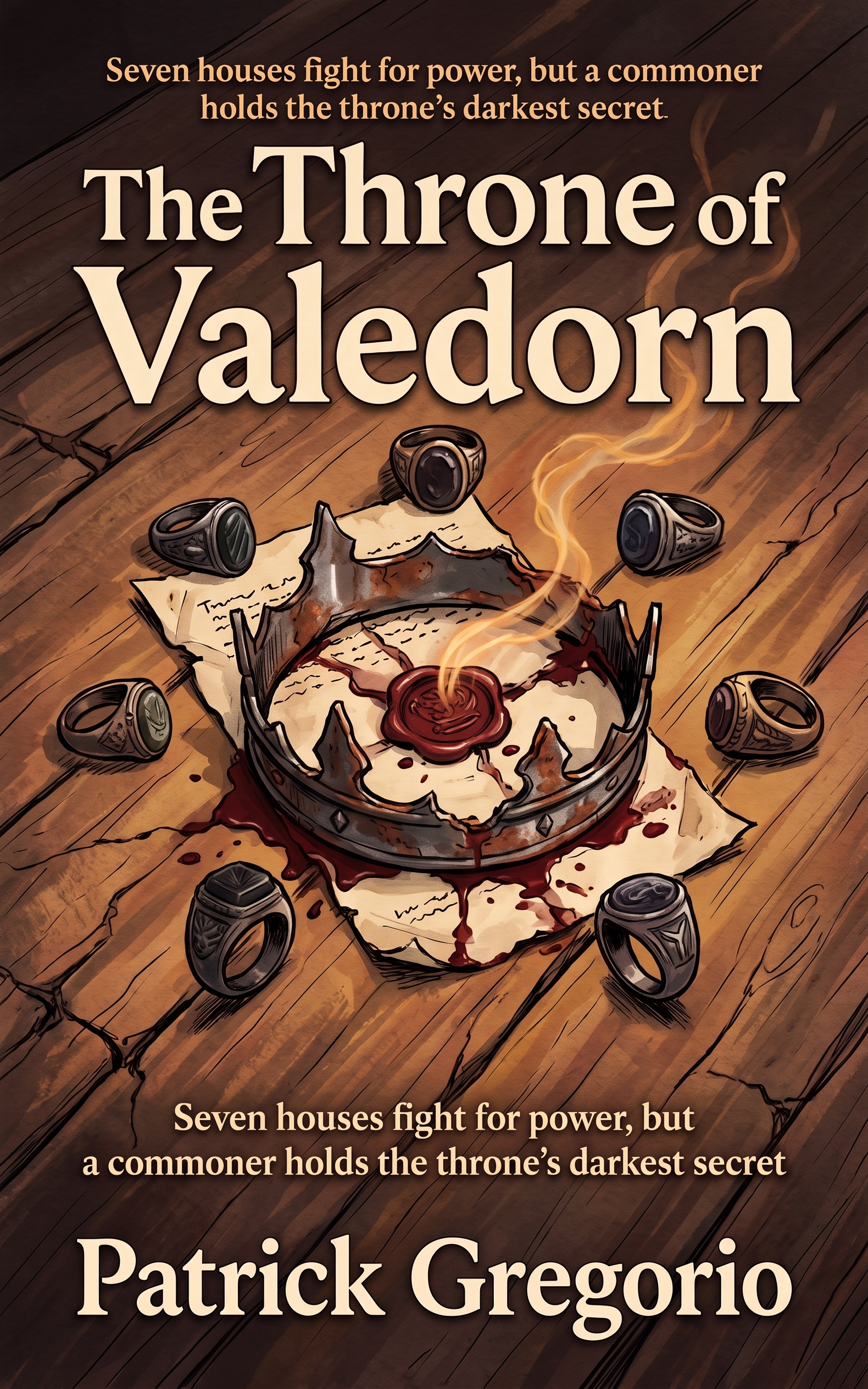
The Throne of Valedorn
Seven houses fight for power, but a commoner holds the throne's darkest secret
by Patrick Gregorio
The King of Valedorn is dead, leaving no heir and a kingdom fractured by greed. Seven noble houses vie for absolute control, wielding assassination, bribery, and dark, forgotten magic in a desperate bid to claim the crown. Noah Vance is no lord—just a dockworker struggling to survive in the river district. But when he stumbles upon a sealed royal document detailing a secret line of succession, his quiet life vanishes. What begins as a desperate attempt to sell the truth for coin quickly turns into a lethal game of survival as noble houses send assassins to wipe out every witness. Forced into an uneasy alliance with a disgraced archivist, a ruthless spymaster, and a cynical mercenary, Noah is dragged into the heart of a deadly conspiracy. As civil war looms and ancient borderland rituals threaten to consume the realm, Noah must decide how much he is willing to sacrifice. In a game where loyalty is blood and trust is fatal, a commoner must learn to play the noble's game—or burn with the kingdom.
- Fantasy
- Thriller
- Mystery
- Political
- Epic Fantasy
- Dark Fantasy
The Sealed Letter
The rain had been falling for six hours straight, and Noah Vance's hands had gone numb somewhere around hour four. He kept working anyway. A man didn't get paid for standing still, and the foreman, a squat bastard named Dobbs, had a habit of docking wages for anyone who slowed the line.
The barge from the capital had come in late, riding low with cargo that smelled of tallow and salt fish, and somewhere beneath the ordinary crates sat one that shouldn't have been there. Noah noticed it because the wood was too fine for dock work, oak instead of pine, with brass corners that had already started to green from the damp. Someone had packed it wrong. One corner had split along a knot in the grain, and when Noah dragged it off the stack, the crack widened, and a leather satchel slid halfway out onto the planks.
He should have called Dobbs over. He should have logged it, tagged it, let the manifest sort out whose problem it was. Instead he crouched behind a stack of grain sacks, out of the lantern light, and pulled the satchel the rest of the way free.
It was heavier than it looked, stiff leather stamped with a crest he didn't recognize, and the buckle had rusted shut from river damp. He worked it open with his belt knife, more curious than careful, telling himself he'd put it back the moment he saw it was nothing.
It wasn't nothing.
Inside lay a single folded letter, the parchment thick and creamy, sealed with a disc of red wax pressed with a design Noah had seen only once before, stamped on a tax notice nailed to the guild hall door the week after the king died. The royal mark. His pulse picked up before his mind caught up to why.
He broke the seal. He knew it was stupid even as his thumb pressed into the wax, and he did it anyway, because a letter sealed like that, hidden in a false-bottomed noble's crate, was either worth nothing or worth more coin than he'd see in ten years of hauling crates. He needed to know which.
The hand was careful, formal, the kind of script clerks trained years to write. Noah's reading was rough, learned from a dockmaster who'd needed someone to check manifests, but he could pick through it word by word. Names. Dates. A phrase that stopped him cold: the child lives, placed under the name, and then a name he didn't know, followed by a town he did.
The king's heir wasn't dead. Everyone in the kingdom, from the capital taverns to the river towns, believed the whole royal line had been wiped out in one terrible winter. This letter said otherwise, in the king's own recorded hand, verified with a second seal below the first.
Noah folded it back along its creases, breathing hard, rain running down the back of his collar. He knew exactly one man in Oakhaven who could tell him if this was real or an elaborate forgery worth burning for warmth. He shoved the satchel under his coat and walked into the dark.
Jonah Nibel's shop sat wedged between a tanner's and a shuttered net-maker's, no sign above the door, just a window crowded with old ledgers nobody wanted. Noah knocked the pattern Jonah had taught him once, two fast, one slow, and waited under the dripping eave until the bolt scraped back.
"It's late," Jonah said, spectacles pushed up on his forehead, ink still fresh on two fingers. "Which means you either owe someone money or you're bringing me trouble. I'd prefer the money."
"Trouble," Noah admitted. "Paying trouble, maybe."
Jonah's mouth flattened, but he stepped back and let him in. The shop smelled of tallow smoke and old paper, shelves crammed floor to ceiling with account books nobody would ever read again. Noah laid the letter on the workbench under the lamp, and Jonah's whole posture changed the second he saw the broken wax.
"Where did this come from?"
"A crate. Don't matter whose."
"It matters a great deal whose." Jonah lifted the parchment by its edges, tilting it toward the light, running a thumbnail lightly along the grain. He held it close enough to smell the ink, then set it down and studied the remaining half of the seal like a man reading a death sentence. "This paper is treasury stock. I know the weight of it in my hands, I spent eleven years handling nothing else. The seal is genuine, pressed while the wax was still warm from a proper signet, not a forged die. And this hand," he tapped the script, "belongs to a royal clerk trained in the old chancery style. Nobody forges that anymore. The men who taught it are dead or exiled."
"So it's real."
"It's real, and it says the crown's only heir did not die in that fever with the rest of them." Jonah's voice had dropped to something close to a whisper, and his hands, usually so steady over a ledger, trembled faintly against the desk. "Do you understand what you are holding, Noah? Every noble house that fought over succession this month has been arguing over a throne that isn't empty. If this is true, it makes every claim they've staked a lie."
"Then it's worth something."
Jonah looked at him the way a man looks at a fool standing too close to a cliff edge. "It's worth a war. Do you know the difference between coin and a death sentence? Nothing, if the coin comes from a secret like this one. Whoever wants that heir found, or wants that heir silenced, will kill everyone who's touched this paper and everyone who's touched them."
The front window shattered before Noah could answer.
Glass sprayed across the ledgers, and a man in dark oilcloth was already through the frame, blade drawn, moving with the flat, practiced calm of someone who'd done this before. Behind him, boots hit the alley stones, more than one set, and a voice outside called for the satchel by name, as though they'd known exactly what it was and exactly where it had gone.
Jonah didn't argue or ask questions. He grabbed the letter, shoved it back into the satchel, and hauled Noah toward the rear window by his sleeve with a strength that surprised them both. "Move, boy, unless you'd like to discuss terms with House Plifer's blades."
They dropped into the alley as the front door burst inward, and Noah heard the crash of a lamp overturning, then the low catch of flame finding dry paper. By the time they reached the second corner, the sky behind them had gone orange, Jonah's whole life's work burning with a fury that would keep anyone from chasing too fast through the smoke.
They ran through rain-slicked streets until their lungs burned, ducking under the sagging sign of The Rusty Anchor, down through a trapdoor behind the ale casks into a cellar that smelled of mildew and spilled wine. Jonah sat hard on an overturned barrel, chest heaving, and finally looked at Noah with something like grim clarity.
"You can't sell this," he said. "Not to anyone. The moment coin changes hands, they'll know exactly who sold it and exactly where to find you afterward. You didn't find treasure tonight, Noah. You found the reason half the capital is about to burn."
Shadows in the Lower City
The palace corridor smelled of beeswax and old stone, and Beatrice Plifer walked it the way she walked everywhere, as though the marble had been laid specifically to carry her weight. Two of her enforcers trailed a respectful distance behind, boots silent on the runner carpet, and neither dared speak until she stopped at the door of her private stu…